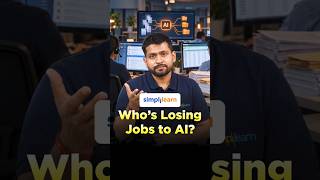

AI Could Leave 1 in 5 Knowledge Workers Jobless
44sThe shocking statistic about 20% unemployment in knowledge jobs sparks immediate curiosity and debate.
▶ Play Clip"Title promises 2027 and skills to stay ahead, but the video only covers 2030 projections and never actually discusses skills."
This video analyzes Anthropic's economic research to identify which jobs are most at risk from AI adoption by 2030. It highlights that nearly one in five knowledge workers could face unemployment in an extreme AI scenario, with programmers, customer service representatives, and data entry workers among the most exposed roles.
Anthropic's economics team predicts that in an extreme AI scenario, nearly one in five knowledge workers could be unemployed by 2030.
Programmers have roughly 75% AI task exposure, customer service representatives around 70%, and data entry workers around 67%.
Market research analysts, financial analysts, software testers, and IT support specialists also have high AI exposure.
Most exposed jobs happen largely on computers and involve questions, data, or working with data.
If AI becomes better than humans at most knowledge work, companies will adopt it quickly, potentially leading to nearly 20% of knowledge workers being unemployed.
The jobs most exposed may not be physical jobs first; they could be white-collar careers once considered safe.
The video concludes that AI's impact will likely hit white-collar knowledge workers first, challenging the assumption that such careers are secure. It urges viewers to consider which skills will remain valuable as AI adoption accelerates.
Stark Unemployment Projection
Provides a concrete, alarming statistic from a leading AI lab that frames the entire discussion.
00:02Quantified Job Exposure
Offers specific percentages for job roles, making the risk tangible and actionable for viewers.
00:16Identifying the Common Thread
Reveals a clear pattern that helps viewers understand why certain jobs are more vulnerable.
00:57Challenging Safety Assumptions
Directly contradicts the common belief that white-collar jobs are safe from automation.
01:24[00:02] Anthropic's [music] economics team and one stat really caught my attention. In their extreme AI scenario, nearly one in five knowledge scenario, nearly one in five knowledge workers could be unemployed by 2030.
[00:16] [music] So naturally, I started to dig a little bit deeper. So which jobs are most exposed? Now the interesting part is that Anthropic has a data on that too. Programmers with roughly 75% had [music] AI task exposure. Then comes the
[00:31] customer service representatives. They have around 70%. [music] Then data entry workers who have around 67%. >> [music] >> market research analyst, financial
[00:44] analyst, software testers, and IT support specialist. Now did you notice a pattern? Most of these jobs happen largely on computer [music] and involve questions, >> [music]
[00:57] >> or working with data. Now this role does not mean 75% of programmers are going to measuring how much of the work AI can extreme scenario, if AI becomes better than humans at [music] most knowledge
[01:11] work, then companies are going to adopt it quickly and nearly 20% of the knowledge workers [music] could be unemployed. So the jobs most exposed may not be physical jobs first. They could be [music] some of the jobs we once
[01:24] considered the safest white-collar careers. Let me know what you think >> [music] >> in the comment section below.




⚡ Saved you 0h 01m reading this? Transcribe any YouTube video for free — no signup needed.