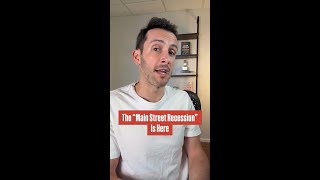

Why the Recession Definition is Broken
45sChallenges the official definition of a recession, sparking debate and curiosity.
▶ Play Clip"Delivers on the promise of critiquing recession definitions, but the title overstates the 'who decides' angle; it's more about proposing an alternative."
The video challenges the traditional definition of a recession, arguing that GDP-based measurements fail to reflect the economic reality of ordinary Americans. The creator proposes a new 'Main Street Recession' indicator based on real wage growth and the Sahm rule, and assesses the current economic situation using this framework.
The creator introduces a new concept called 'Main Street Recession' as an alternative to the traditional definition, which they argue is flawed.
The National Bureau of Economic Research (NBER) has a subjective and convoluted explanation for recessions, leading to ambiguity in determining start and end dates.
Many use two consecutive negative quarters of real GDP growth as a recession indicator, but GDP doesn't reflect the average American's economic situation.
Current GDP growth is largely due to tech companies investing heavily in data centers, while other indicators show ordinary Americans struggling.
The creator spent six months developing a simpler recession measurement based on two rules: real wage growth and the Sahm rule.
Real wage growth (inflation-adjusted income) is a key indicator: positive growth is good, negative growth means declining spending power.
The Sahm rule measures if unemployment is rising quickly, serving as a second condition for recession.
As of last week, real wage growth turned negative, triggering one condition. Unemployment hasn't risen yet, so it's a 'yellow alert' rather than a full recession.
The creator predicts inflation will continue rising, wages won't keep pace, and a mild Main Street recession is likely for the foreseeable future.
The creator asks viewers whether they prefer this new indicator, GDP, or another method for measuring recessions.
The video argues that traditional recession indicators like GDP are inadequate and proposes a more people-centric measure. It suggests that the US may be heading into a mild 'Main Street recession' despite GDP growth, highlighting the disconnect between macro statistics and everyday economic experience.
What is the traditional benchmark for a recession?
Two consecutive negative quarters of real GDP growth.
00:31
What are the two rules of the 'Main Street Recession' indicator?
1) Real wage growth must be negative. 2) The Sahm rule (unemployment rising quickly) must be triggered.
01:25
What does real wage growth measure?
Inflation-adjusted income, indicating whether spending power is increasing or decreasing.
01:25
According to the video, what is the current status of the US economy?
A 'yellow alert' – real wage growth is negative, but unemployment hasn't risen yet.
01:53
What does the creator predict for the near future?
Inflation will keep rising, wages won't keep pace, leading to a mild Main Street recession.
02:21
Introduction of Main Street Recession
Introduces a novel concept that challenges the traditional recession definition.
00:02GDP Growth Driven by Tech Investments
Highlights the disconnect between GDP growth and ordinary Americans' economic struggles.
00:46Two Simple Rules for Recession
Provides a clear, actionable framework for assessing recession conditions.
01:25Prediction of Mild Recession
Offers a concrete forecast based on the proposed indicator.
02:21[00:02] invented a better one. It's called a Main Street Recession. And as of last indicator that started going off in just a minute. But first, let me just explain why the traditional definition makes no sense. First and foremost, fun fact,
[00:17] of recession. The National Bureau of Economic Research, who is responsible for declaring official recessions, has this convoluted explanation of what a recession is. It basically says it's entirely subjective and they just decide
[00:31] when recessions start and end. And second, because of this subjectivity, a lot of people use the benchmark of two negative quarters of real GDP growth as fine. GDP is a fine measurement. But my problem with it is that it doesn't
[00:46] really represent what is going on with the average American. Right now, GDP is growing basically because all of these tech companies are investing billions and billions of dollars into building data centers. Meanwhile, almost every
[00:59] other economic indicator shows that ordinary Americans are struggling. So, shouldn't a recession measure whether or not the economic lives of ordinary people are getting better or worse, rather than measuring economic output at
[01:12] the highest possible macro level? So, about six months ago, I spent a ton of time coming up with a new measurement of a recession. I thought about like 50 make it really simple. And I came up with two basic rules of whether in a
[01:25] recession or not. Number one, is real wage growth positive or negative? Real wage growth is a measurement of inflation-adjusted income. If real wage increasing. That's good. When real wage growth is down, people's spending power
[01:39] is declining, which is bad. To me, this one simple measurement explains so much about what is happening in the economy for ordinary people. Rule number two is basically the Somrull, which measures if unemployment is going up quickly above
[01:53] definition back in November. And back then, we were not in a recession by these measurements. But just last week, that changed as real wage growth turned negative. Inflation has shot up over the last couple of months, wages haven't
[02:06] kept pace, and so the average American is now experiencing declining spending power. Right now, by my definition, we're sort of in a yellow alert kind of conditions have been met. Fortunately, the unemployment rate hasn't gone up,
[02:21] wage growth. So, I don't think we're in a full-blown Main Street recession, but the warning signs are there. Personally, unfortunately, I don't think this is inflation's probably going to keep going up. I don't think wages are going to
[02:34] keep pace, and I think we're going to be in a mild Main Street recession for the foreseeable future. This is a problem. This sucks, right? I don't care if GDP is going up if the average economic life of an American person is getting worse.
[02:48] indicator make sense to you? Do you prefer GDP? Is there a better way to measure a recession? Let me know in the comments.




⚡ Saved you 0h 02m reading this? Transcribe any YouTube video for free — no signup needed.