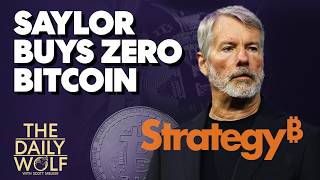

Saylor Stopped Buying Bitcoin?!
53sSaylor is a legendary BTC maxi, so the news that Strategy added $525M in cash and zero Bitcoin sparks debate about his conviction.
▶ Play Clip"Title is accurate — the Saylor analysis delivers real insight, even though the episode also covers several unrelated market stories."
This episode of Daily Wolf breaks down why Michael Saylor's Strategy is no longer buying Bitcoin, instead engineering a complex balance sheet with massive cash reserves. It also covers a wave of crypto exchange shutdowns, Circle's acquisition of IBM's blockchain patents, and the race to dominate prediction markets.
Between July 20-26, Strategy sold 5.43 million MSTR shares, raising $544.5M. It spent $25M repurchasing STRC and added $525M to cash reserves, boosting them to $3.75B. It bought no Bitcoin, still owning 843,775 BTC bought for roughly $63.7B.
Strategy has accepted the need to financially engineer a complex balance sheet around Bitcoin. The market can no longer price Saylor as a consistent Bitcoin buyer. STRC jumped on the buyback but still trades far from $100 par.
The biggest risk to Strategy is duration risk, not Bitcoin's price. Even lower Bitcoin prices would not hurt much as long as they don't stay there. Fears of forced liquidations have quieted.
The exchange that pioneered 100x leverage perpetual swaps will cease operations on September 23rd. Users have two months to withdraw assets, marking the end of an era in crypto derivatives.
BitMart is the third crypto exchange to close this month. It had roughly 9-10 million customers and was a preferred venue for launching and trading new tokens during the last cycle.
Unlike last cycle's collapses (Voyager, Celsius, FTX, BlockFi), these are orderly wind-downs with no fraud. Mid-tier exchanges are being squeezed out by hyper-liquid incumbents and larger exchanges, a classic bottom signal.
The first generation of crypto built the casino; the next generation is being forced to build actual businesses. Marginal companies are disappearing while those with capital, customers, and useful infrastructure take control.
Circle acquired nearly 1,000 blockchain patents from IBM, covering more than 680 patent families in blockchain, banking, insurance, and cloud security. Financial terms were not disclosed.
KB Kookmin Bank plans to launch cross-border payments on JP Morgan's Connect. POSCO International and LG CNS are testing tokenized trade receivables on Injective. This is adoption of the technology, not of tokens.
Robinhood and Crypto.com are in talks to list prediction markets. Robinhood already has contracts with Forecast X and Kalshi, showing a race among platforms to offer prediction products and capture flow.
The video concludes that crypto is maturing: Saylor is now a rational balance-sheet manager, exchange shutdowns are likely bottom signals, and institutions are adopting blockchain plumbing without necessarily embracing tokens.
Michael Saylor
person
Scott Melker
person
John D'Agostino
person
Sandy Call
person
Amy Oldenburg
person
Yahoo Finance
service
BitMEX
service
BitMart
service
Circle
service
IBM
service
JP Morgan's Connect
service
KB Kookmin Bank
service
Injective
service
Robinhood
service
Crypto.com
service
Forecast X
service
Kalshi
service
How much cash did Strategy raise from selling MSTR shares between July 20 and July 26?
$544.5 million.
00:02
How many Bitcoin does Strategy currently own?
843,775 Bitcoin, purchased for approximately $63.7 billion.
02:55
What is the biggest risk to Strategy, according to Scott Melker?
Duration risk, not Bitcoin's price.
04:31
Which exchange pioneered 100x leverage perpetual swaps?
BitMEX.
05:38
When will BitMEX cease all operations?
September 23rd.
05:38
How many customers did BitMart have at its peak?
Roughly 9-10 million.
06:59
What did Circle buy from IBM?
Nearly 1,000 blockchain patents, covering more than 680 patent families.
09:25
Which South Korean bank is launching cross-border payments on JP Morgan's Connect?
KB Kookmin Bank.
11:13
Which two companies tested tokenized trade receivables on Injective?
POSCO International and LG CNS.
11:38
Which prediction market providers already have contracts with Robinhood?
Forecast X and Kalshi.
13:54
Saylor is no longer a consistent Bitcoin buyer
This marks a fundamental shift in how the market must value Strategy and its impact on Bitcoin demand.
03:08Duration risk is the real threat
Reframes the Saylor risk narrative: sustained low prices matter more than temporary dips, a principle investors can apply broadly.
04:31Perpetual swaps will survive BitMEX
Highlights that BitMEX's innovation (24/7 perpetual futures) is becoming standard across all markets, regardless of the exchange's fate.
05:50Orderly wind-downs are bottom signals
Contrasts this cycle's shutdowns with fraud-driven collapses, suggesting consolidation may indicate a market bottom.
07:11Circle's patent buy shows blockchain's institutionalization
A major payments company building a patent moat signals that blockchain is becoming core financial infrastructure, even if tokens aren't adopted.
09:25[00:02] half a billion dollars this week and bought no Bitcoin. What they did was increase their cash reserves and buy back some SCRC. We're going to talk about that and everything happening in the news that's driving markets. Let's
[00:16] the news that's driving markets. Let's go. Daily Wolf on Yahoo Finance. I'm your host Scott Melker, also known as The
[00:29] Wolf of All Streets. Now, last week was an interesting one. As you know, I was out at the Out East Summit in the beautiful North Fork of Long Island. We beautiful North Fork of Long Island. We experienced some hurricane-like wind
[00:42] got through it and had some incredible conversations. On this show, of course, you saw conversations with the likes of John D'Agostino from Coinbase and Sandy Call from Franklin Templeton. And of course, Amy Oldenburg from Morgan
[00:56] Stanley. And you can tell exactly the direction that crypto was going by the guests that we had on at a conference. These are large institutions who are all making huge bets in the crypto space and the future of the industry. And right
[01:10] now, there's clearly a battle for the soul of crypto, whether it will be the asset class that we've always anticipated and believed it will be or whether it will be entirely co-opted by governments and the largest institutions
[01:24] on the planet. But it's very clear that right now, crypto is consolidating. I'll tell you about some weak businesses in crypto that are disappearing entirely while the companies with capital, customers, and useful infrastructure are
[01:36] taking control. Now, we're going to keep doing this every Monday. Sorry in advance. But we got the first story. Michael Saylor's strategy boosted cash reserves to 3.75 billion dollars. Must be nice.
[01:50] billion dollars. Must be nice. Repurchased 25 million dollars of SCRC. They They more than a half a billion dollars here and bought no Bitcoin, which has become the recent trend after selling Bitcoin before it would be
[02:02] back. But it used the money to strengthen the increasingly complex financial machine here that surrounds Bitcoin, which is the story that we've here. So here are the facts. Between July 20th
[02:15] So here are the facts. Between July 20th and July 26, Strategy sold 5.43 million MSTR shares, obviously dilutive by most metrics to MicroStrategy shareholders. They raised 544.5 million, spent 25 million repurchasing
[02:28] STRC, which is a rounding error. This reminds me of when they sold 32 Bitcoin to inoculate the market, buying back a small amount of STRC here to show that they are willing to do it. They added 525 million more to their dollar
[02:43] reserves, which increased it to 3.75 billion dollars. We can call that roughly 2 years or 2 years and a month of coverage for their obligations. And once again, bought no Bitcoin after selling Bitcoin a few weeks ago, but
[02:55] selling Bitcoin a few weeks ago, but they still own 843,775 Bitcoin, which they have bought for approximately 63.7 billion dollars. So the real story here now
[03:08] now is that Strategy has accepted that they are a company that has to financially engineer a complex balance sheet around Bitcoin. And that means that the market can no longer
[03:22] price in the fact that Saylor and Strategy will be a consistent buyer of Bitcoin. Right? STRC jumped on the news, obviously, that he was buying some back, but it's still trading far from a $100 par. So they're willing to do little
[03:34] things to try to spark the market and get STRC back to par, which will likely still have to happen through manipulating the dividends, the way that they've intended to do so. But also, they heard the market when it
[03:48] said that buying back their convertible note for over a billion dollars was a bad idea and they needed to raise those cash reserves and they've done that now. So, there are no longer any question marks about Saylor being an irrational
[04:01] the biggest fear. The bears who were screaming about forced liquidations are very quiet now. Nobody seemingly believes that there's a scenario where MicroStrategy or Strategy is forced to sell Bitcoin when they don't want to
[04:17] unless of course there's a massive massive dip in Bitcoin and it stays there for a very, very, very long time. As I continue to say the biggest risk to Strategy is duration risk, not actually price. Even lower Bitcoin prices would
[04:31] not be that bad for Strategy as long as they don't stay there. So, the question now that will be debated endlessly is whether he's going to come back into the market as a buyer. Seemingly right now you cannot expect that and it's
[04:43] interesting that Bitcoin has traded up since the market expected that because many believe that Saylor and Strategy were the only buyers of Bitcoin that were in the market. But, the real kicker right now is Strategy really is no
[04:56] longer just a company that raises cash to buy Bitcoin. Now, they raise cash for a lot of other reasons and they're managing an entire financial ecosystem built around that core asset. I think that Strategy will continue to disappear
[05:09] slowly from the narrative. Things will be just fine and the one thing that that if Bitcoin simply goes up everything will be forgotten. Now, not everybody is doing as well as Saylor and Strategy
[05:24] right now. We've got four shutdowns in just a week one which, you know, we talked about on my morning show quite a few times last interviews we didn't get to this piece of news. BitMEX to shut down after
[05:38] 11-year run that reshaped crypto derivatives trading. The exchange that pioneered 100x leverage perpetual swaps will cease all operations on September 23rd, giving users 2 months to withdraw assets. So, listen, everybody knows the
[05:50] assets. So, listen, everybody knows the sorted past of BitMEX, but BitMEX was the only player in the perpetual swap market. They invented it, and that near you. So, regardless of what happens with BitMEX, 24/7 365
[06:05] options or futures trading on a perpetual swap where longs pay shorts and shorts pay longs is coming to every single market. It will be one of the most compelling and important innovations that ever happens in
[06:18] That said, they had some bad times over at BitMEX. There's some wildly incriminating information there. Their founders pardon, but gotten some legal trouble, and it's no surprise that the exchange
[06:32] itself is winding down, but it is the end of an era and potentially a signal of a impending bottom. We'll talk about it in a second cuz here's another one. BitMart shuts down after 8 years. Third crypto exchange to close this month. Of
[06:45] course, there was a Sendex, which I told you about as well. Now, interestingly, I mean, BitMart wasn't one of the biggest names, but they did get quite large during the peak of the last cycle. I believe that they had nine
[06:59] 10 millionish customers, maybe slightly less or slightly more. They were doing insane volumes, and they were one of the preferred venues for launching and trading new tokens that had just hit the market. So,
[07:11] get the death with something like BitMart. Now, you'll remember last cycle, the bottom, while it did not look exactly the same, was when Voyager and Celsius and FTX and BlockFi all collapsed. Now, there's no fraud here.
[07:25] There's not necessarily over leveraged. These two are orderly winding down. There's no evidence that that there's going to be any danger to people on insolvent, nothing like that, but clearly there's no business anymore for
[07:38] squeezed by the hyper liquids on one side and the larger exchanges on the other, but the bigger story is that we're just seeing a shift in the market not it. We have projects going down, too. We have two Chapter 11
[07:50] Cloud data firm storage, one of the darlings of a previous altcoin cycle, files for Chapter 11, extending a week of crypto failures. Token Token slides 16%. So, they're going to keep operating, but this So, they're not
[08:03] of the more compelling narratives. And of course, Movement Labs files for Chapter 11 bankruptcy. This is not uh the actual token. It's the the labs that are behind it. There's a differentiation there. But, regardless, they had a
[08:16] market making issue. Four shutdowns of different colors all in the same week. To me, these are bottom signals, right? This isn't the technology failing necessarily. This is just the old
[08:31] incumbents and the sort of marginal companies that were in the middle getting squeezed out by a lack of interest from retail, uh by time-based capitulation. These are the kind of things that you see when a market is
[08:44] going to, you know, cry in their Cheerios about any of these particular projects dying. I'm sure there are still some depressed and expected it to come back massively. Probably not. I think that
[08:58] everybody that participated in these has long since capitulated. The reason cuz nobody's there anyways. I mean, these are like tumbleweed old Western ghost towns. Right? So, it's just a sign of the times
[09:10] and a sign of things likely to come, which is that uh the more successful when the market rises again and they crypto's first generation here built the casino. It's next generation is being
[09:25] forced to build actual businesses. And one of the companies that's doing that, of course, is Circle. It's an interesting story. Circle buys nearly interesting story. Circle buys nearly 1,000 blockchain patents from IBM.
[09:37] Portfolio covers blockchain technology, banking, insurance, and cloud security, though the financial terms of the deal were not disclosed. They basically called this more than 680 patent families. I mean, this is crazy.
[09:50] blockchain patents from IBM, who was very early in the space and trying to that somewhere a lawyer just minted a brand new beach house in Malibu cuz that was a massive effort by IBM that they just capitulated. I would love
[10:07] how much money they spent for these thousand uh patents. But, clearly, they're building a moat here for Circle, for Arc, for their payments network, and everything they're doing, and allowing
[10:20] an expansion in the future into other verticals. But, you've got to imagine that having a thousand patents really is about that moat and the protection. We stablecoin issuers coming into the market. We know that every institution's
[10:33] assets, that's RWA, all of the narratives that we've been screaming And now, Circle has a whole new business protecting all of the patents that IBM and themselves, I'm sure, had around these assets that will allow them to
[10:49] protect and build without fear of as much competition. So, I mean, you know, blockchain technology. They're clearly capitulating, but Circle bought all of
[11:01] property believing that blockchain is becoming core financial infrastructure. And maybe that's really the story here, story as well. But, the story here is that, you know, maybe crypto
[11:13] is maturing and becoming institutionalized, but maybe it's really falls into the background that it becomes successful. We're no longer talking about blockchain or any of those things
[11:25] like this. South Korea's KB Kookmin Bank to launch I'm sure I butchered that. To launch cross-border payment service on JP Morgan's connect this report. I thought JP Morgan hated crypto. Weird. Weird. That's one story coming out of
[11:38] South Korea. Another South Korea trading giant puts receivables on chain in giant puts receivables on chain in tokenization test with LG CNS. So let's say we can name all these institutions that you've never heard of
[11:52] major developments coming from South Korea, which has been ahead of the curve Korea, which has been ahead of the curve in adoption of our technology. But KB and they plan to launch blockchain-based
[12:05] corporate dollar payments using JP Morgan's connect this network. Once again, this is a story of building plumbing that will probably not benefit us or our decentralized networks. This is using JP Morgan's connect this, which
[12:17] is highly centralized, closed ecosystem. So it's an adoption of the technology, but not, of course, of our tokens. The second one is POSCO International and LG CNS testing tokenized trade receivables on Injective. So Injective was also a
[12:33] darling of previous previous altcoin cycles. Nice to see their name here. But here requires customers to own crypto at all or manage a wallet or understand blockchain, right? It's just becoming the underlying
[12:48] technology that's superior to what's currently being used that will be adopted slowly with time. But this, once again, comes back to a fight for the soul of crypto, right? This isn't decentralized systems like
[13:01] Bitcoin or building on Ethereum or even Solana or any of the others. This is taking what companies learned from what was built in a more decentralized manner that people could capitalize from and creating their own
[13:13] internal systems using the technology. It's plumbing. You've heard me have this conversation about the DTCC that settles 4.5 quadrillion in volume a year, but them adopting the technology means almost nothing for any of us
[13:27] because they're just replacing the pipes of their own systems to make them faster and cheaper. But that is within their own internal system. So we got one more story here before we go. Prediction markets race heats up as
[13:40] Robinhood and crypto.com hold talks. Look at them there holding talks. holding talks. To be honest. But right, I mean, a dating app approach right now to prediction markets. They're just like
[13:54] keep swiping until you prove liquidity. But this is a really interesting way for companies are building prediction markets themselves and they've done that also have deals for contracts with Forecast X and Kalshi and now talking
[14:09] about listing crypto.com. So clearly there's a race right now for everybody to use everything that everyone else is building and to be a venue for all of they don't care, right? They'll take anyone's prediction markets, offer them
[14:24] on their own platform, make the money, and move on. And that looks like the future for prediction markets. So listen, I think strategy is being priced out as a buyer or seller. Clearly is a rational actor right now who is doing
[14:38] sheet and make sure that strategy remains solvent while we have a lot of bottom signals. That's it for today. We'll see you back on the next Daily
[14:50] We'll see you back on the next Daily Wolf tomorrow. Peace.


⚡ Saved you 0h 14m reading this? Transcribe any YouTube video for free — no signup needed.