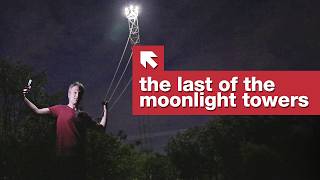

One Tower Lights a Whole City?!
45sThe shocking contrast between modern streetlights and historic moonlight towers sparks curiosity and awe.
▶ Play Clip"The title perfectly captures the video's core question about the moonlight towers' design philosophy."
This video explores the history and legacy of Austin's moonlight towers, a unique municipal lighting system from the 1890s that used tall towers with bright lamps to illuminate large areas, earning the nickname 'artificial moonlight.' It explains their operation, cultural significance, and why Austin preserved them while other cities dismantled similar structures.
The video begins with a mention of proper training and safety equipment for maintaining the towers, highlighting the risks involved.
Austin's moonlight towers are among the last surviving municipal lighting towers, designed to provide light equivalent to natural moonlight within 1500 feet of the base.
When installed in 1894, the towers used carbon arc lamps, which produced light via a constant spark between two carbon electrodes. The electrodes wore down quickly, requiring frequent replacement.
A utility employee would ascend the tower nightly via an elevator pulley system to replace the lamps. Safety equipment was minimal by modern standards.
In 1936, the towers were upgraded to mercury vapor lamps, which were easier to maintain.
While other cities dismantled their towers, Austin kept theirs. In 1993, the city took them apart for restoration, and today only about a dozen remain standing.
Before the towers, Austin was dark after sunset. The towers allowed businesses to stay open late and people to socialize after dark.
Originally 31 towers were spread around Austin, before skyscrapers dominated the skyline. They lit up most of the town, enough for safe navigation.
The towers became an icon of Austin, referred to simply as 'the towers' in local newspapers. The phrase 'As Austin As' was used in the 1960s to describe them.
Modern lighting is generally more efficient, but the towers remain as historic artifacts, cherished by Austin residents.
Austin's moonlight towers are a unique piece of history, preserved as cultural icons despite the advent of modern lighting. They symbolize a bygone era when a few bright lights could transform a city's nightlife.
What type of lamps did the moonlight towers originally use in 1894?
Carbon arc lamps.
00:53
How far from the base did each tower provide light equivalent to natural moonlight?
1500 feet.
00:27
In what year were the towers upgraded to mercury vapor lamps?
1936.
02:08
How many moonlight towers were originally installed in Austin?
31.
03:19
What phrase did a newspaper use in the 1960s to describe the towers as iconic?
'As Austin As'.
04:13
Artificial Moonlight
Explains the core concept: each tower provided light equal to moonlight within 1500 feet, enabling reading a watch.
00:27Carbon Arc Lamps
Describes the first practical electric lights used in the towers, with a constant spark between electrodes.
00:53Austin's Unique Preservation
Highlights that Austin is the only U.S. city to keep its moonlight towers, making them a rare historic artifact.
02:22Iconic Symbol
Shows how the towers became a symbol of Austin, referenced in local culture and newspapers.
03:46[00:00] need proper training and safety equipment, The folks in charge are understandably a bit cautious. the camera and you can.
[00:15] and it's one of the last surviving municipal lighting towers anywhere, why have thousands of small lamps down every street
[00:27] when you could have just a few, very bright and very high? - Each tower was intended to provide light equal to that of natural moonlight in an area 1500 feet from the base of the tower,
[00:41] and that is light by which somebody could read the face of their watch. These lighting systems were all throughout the Midwest - When these towers were installed in 1894,
[00:53] they used carbon arc lamps, the first practical electric lights. a constant spark shooting through the air between two carbon electrodes. it's usually because there's a fault with something big and electrical
[01:10] This was the same effect, just deliberate. are steadily vaporized, wearing down as they're worn away by the spark, so they burn out quickly. And the city had to pay someone
[01:24] - The City of Austin Electric Utility, and as we know it today, Austin Energy, Every night, a utility employee would go up
[01:36] through this elevator pulley system through the middle of the tower This pulley system, there's this little thing and then you have workers on the ground who are hoisting him up.
[01:51] I don't know when hard hats came into play, our safety equipment is not as it is today. and in 1936 it was the mercury vapor lamps,
[02:08] and it's a little bit easier to get up there to get up to make those changes. designed for vertical video, it's this one.
[02:22] as electric street lighting became possible. For some unknown reason, Austin never got round to it, There's only about a dozen towers still standing.
[02:34] And in 1993, the city took them all apart, As for what they look like when they're switched on, - Austin is the only city in the United States
[02:49] Before the moonlight towers were put up around town, I think it allowed them to keep businesses open after dark, People could enjoy themselves with friends and family,
[03:04] Moonlight towers were the only game in town in parallel with the moon itself, of course. although admittedly I am standing right next to it.
[03:19] 31 of these towers were spread around before skyscrapers came along. most of the town would be lit up
[03:33] but enough that you could see your way around. Hence moonlight tower. It's artificial moonlight. for that name being used until the mid-20th century
[03:46] and these towers became an icon of Austin. The Austin newspapers just called these "the towers".
[03:58] First reference that I found in a newspaper In the early 1960s, had the phrase, "As Austin As".
[04:13] where the newspaper was comparing itself And in July, 1962, the masthead said, They have become a symbol of Austin.
[04:29] one of those moonlight towers in Zilker Park that look like a holiday tree. and you get dizzy, and you feel like Austin
[04:43] - There are modern versions of these towers Sometimes it is just better to stick a big light on a pole. In most cases, though, modern lighting is a much better choice,
[04:58] Although that does mean in the 21st century, it's difficult to imagine what a city lit just by moonlight towers would feel like. from every house, every building.
[05:11] can be brighter than the old towers would be. These aren't street lighting anymore. They're historic artifacts, kept running because, well,
[05:23] because the people of Austin like them.



⚡ Saved you 0h 05m reading this? Transcribe any YouTube video for free — no signup needed.