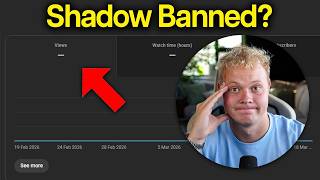

Why Your Videos Get ZERO Impressions
44sDirectly addresses a common frustration with a clear explanation of the impression system.
▶ Play Clip"Delivers on the promise with actionable advice, but includes a lengthy promo and some repetition."
This video explains why YouTube may not be showing your videos to viewers, focusing on the concept of impressions and the tiered nature of the YouTube algorithm. The creator outlines practical steps to improve impressions, including warming up new accounts, testing titles and thumbnails, and being patient with the algorithm's testing phase.
Many creators complain their videos get no impressions, making it impossible to improve click-through rate or average view duration. The video promises to explain how to move from zero impressions to getting views and making money.
An impression is counted each time a viewer sees your thumbnail on YouTube (e.g., on the homepage). Impressions are broken down into title and thumbnail, which together determine click-through rate.
YouTube pushes new videos to a small test group (e.g., 2,000 people). Based on performance (click-through rate and average view duration), it may push the video to larger tiers (50,000, 100,000 impressions). Poor performance means the video stays in a small tier or dies off.
YouTube often tests videos to find the right audience, which is why impressions may fluctuate early on. If a video dies off after reaching a larger tier, it's because it didn't perform well enough to be pushed further. Testing new thumbnails and titles can help revive it.
A trust score reflects how much YouTube trusts your account. New and aged accounts may need 'warming up' to appear human and avoid being flagged as spam. This involves watching 1-2 hours of content daily, subscribing, commenting, and liking videos for at least a week.
The creator states that 99.9% of viewers do not need anti-detect browsers or proxies. These are only necessary if you're constantly violating YouTube guidelines. The real issue is usually a lack of fundamental YouTube knowledge.
Two students had only 4 subscribers and 600 views after four videos. Instead of using anti-detect, they changed their video angle (still in the warning niche, but focusing on transformation). This led to over 1,000 subscribers and 4,000 hours of watch time within a few days.
As of March 2026, YouTube takes longer to push new channels, often leaving them at zero impressions initially. The creator recommends giving YouTube at least 15 videos before expecting significant traction.
Restricted mode limits content shown to viewers. If your videos contain drugs/alcohol, sexual situations, violence, mature subjects, or profane language, they may be hidden from users with this setting enabled. You can check your own channel by enabling restricted mode and seeing if your videos disappear.
1) Your video ideas are unoriginal or overdone. 2) Your thumbnail and title are copied from others. 3) Poor retention (viewers click off quickly) signals low quality. 4) You're in a saturated niche (e.g., motivation) with too much competition.
To get impressions, focus on creating original content, testing titles and thumbnails, warming up your account, and being patient. Avoid unnecessary tools like anti-detect browsers and instead invest time in learning YouTube fundamentals.
What is an impression on YouTube?
An impression is counted each time a viewer sees your thumbnail on YouTube, such as on the homepage.
00:41
How does YouTube's tiered algorithm work?
YouTube pushes a new video to a small test group (e.g., 2,000 people). Based on performance (CTR and average view duration), it may push the video to larger tiers (50,000, 100,000 impressions). Poor performance means it stays in a small tier.
01:20
What is a trust score?
A trust score reflects how much the platform trusts your account. Low trust scores can result from spammy behavior or being a new account.
04:50
How long should you warm up a new YouTube account?
At least one week, watching 1-2 hours of content daily, subscribing, commenting, and liking videos like a normal user.
06:12
When are anti-detect browsers and proxies necessary?
Only if you are constantly going extremely against YouTube guidelines. For most creators, they are not needed.
07:23
What did Tom and Petra change to get more views?
They changed their video angle (still in the warning niche, but focusing on transformation) instead of using anti-detect tools.
08:18
How many videos should you give YouTube before expecting traction?
At least 15 videos.
10:52
What types of content are hidden in Restricted Mode?
Content about drugs and alcohol, sexual situations, violence, mature subjects, and profane or mature language.
11:38
What are four reasons for low impressions?
1) Unoriginal video ideas, 2) copied thumbnail/title, 3) poor retention, 4) being in a saturated niche.
12:34
Tiered Algorithm Explained
Provides a clear, actionable model of how YouTube distributes impressions, which is often misunderstood.
01:20Account Warming Technique
Offers a concrete, practical method to build trust with YouTube, especially for new channels.
05:32Anti-Detect Myth Debunked
Saves creators time and money by clarifying that anti-detect tools are rarely necessary.
07:23Case Study: Small Changes Work
Demonstrates that testing new angles can dramatically improve performance without complex tools.
08:18Restricted Mode Check
Reveals a little-known setting that can silently hide videos from a segment of viewers.
11:09[00:01] under my videos that they don't get any impressions and that it is a huge that you need a pretty decent click-through rate and a pretty decent average view duration for your video to actually gain traction. Now, the problem
[00:16] is if you don't even get any impressions, there's no way that you can improve your click-through rate or even your average view duration. So, in this video we're going to cover everything about impressions that you need to know
[00:28] to be able to kind of get impressions. So, after this video you will fully understand how to take your channel from literally this, not getting any impressions right here, to actually getting impressions, getting views, and
[00:41] actually making some money, all right? Now, before we kind of get into the whole video, it's very important to first understand understand what is an impression, right? Now, an impression is how many times your thumbnails were
[00:55] shown to viewers on YouTube. So, if you go for example on your YouTube homepage and you scroll scroll on your YouTube homepage, every single thumbnail you see basically giving that video one impression. Now, impressions are always
[01:08] broken down into two parts, um title and thumbnail. This then makes up the click-through rate, right? How often viewers watch the video after seeing the
[01:20] thumbnail. Now, how does YouTube actually share your content? This is extremely important to know, all right? Because there are some people but like under you guys that do actually get some impressions, but don't get millions of
[01:34] YouTube or the YouTube algorithm actually works in tiers, like most people don't know this yet, but the YouTube algorithm works in tiers and it's very basic. So, once you post a video, your video goes into tier one, so
[01:49] into a very small tier, right? Let's say for example of 2,000 people or something that get your video on their YouTube homepage. Now, out of that like it then depends how your video performs for YouTube to then
[02:03] decide like hey, let me push that video down to a larger tier, to a larger group of people. This is then where you get like 50,000 impressions, maybe 100,000 impressions, and then depending on how your video performs, so either it
[02:17] performs really good, then it goes to a even larger tier, or it doesn't perform that well, then you know, YouTube doesn't push it to the next tier, all right? This is very important. Now, YouTube tracks the the click-through
[02:31] rate, and then obviously the average view duration, all right? So, if you for example post a video and that video gets a few hundred impressions, like even a a few hundred impressions, like even a few hundred impressions, make a huge um
[02:43] make a huge How do I say it? Or are a huge factor on how YouTube is going to push your video. So, let's say for example, first video you post, you put like YouTube pushes it to 100 people, nobody really clicks on it, YouTube is
[02:56] not going to push off the video to a larger tier. Now, sometimes, and this is very important to understand as well, is sometimes YouTube or in most cases YouTube is actually testing your your videos, right? Your video topics. It's
[03:10] looking for audience. So, that's why you will very often see your impressions in the beginning you will see them going like this because YouTube is testing, once you reach the larger tier of impressions because many people will ask
[03:25] me why do videos even die off? A bit off topic off topic now, but people ask me why do videos even die off? Now, if it was for example here in this larger tier of of impressions, let's say for example here you got like now, let's say 50,000
[03:39] completely dies off. The reason for this here or for this kind of straight bar is very simple because it does not perform good enough to actually get pushed out to a even larger tier. So, a very good thing that
[03:55] larger tier. So, a very good thing that you can do once this is happening, test and change up the thumbnail and the title. And have a look. Now,
[04:09] yes, the video is not going to get thousands of impressions anymore once you you start testing. But, as I've said here in the beginning, YouTube can make very, very, very good decisions when to push a video and how much to push your
[04:22] video. All right? So, even if your video only gets like 100 impressions, these 100 impressions might be enough for your video to actually get pushed again. All right? So, this is just some uh other info that some of you guys might find
[04:35] interesting to understand that, as I've said, YouTube is pushing your content in tiers. All right? And then, it obviously all depends on how your video is performing. Now, the first reason for, you know, not
[04:50] really getting impressions is because of low trust score channels. Now, this is something that we in 2026, it's something that happens. It's something we It's kind of a challenge that we all have, right? But,
[05:03] Now, for the people who don't know what a trust score is, a trust score is basically just how much does the platform actually trust your account, all right? Now, since there are so many spam channels and so many view farming
[05:17] the it's a little bit diff- like not difficult, but harder to to actually get trust from the platform, all right? We'll get to that a bit later as well. what we like to do is we actually like to warm up our YouTube accounts, right?
[05:32] Just to show YouTube like, "Hey, there is actually like there's a human behind that account." Now, we have pre-monetized accounts, we have new accounts, we have aged accounts, we have personal accounts. From all of these
[05:44] different accounts, we only need to warm up new accounts, so brand new accounts, like accounts that you can just brand newly create, or even aged accounts, accounts that are very, very old, all right? So, these are the two accounts we
[05:56] actually need to warm up. And then we have, yeah, how to actually warm up your account. Use it as a normal user for like, yeah, just use it as a normal user. Watch 1 to 2 hours of content per day like a normal user, all
[06:12] right? Then subscribe, comment, and like to videos. Don't act like a bot because otherwise or like AI, because otherwise YouTube is again going to put you into a lower trust score. If you overdo this, right, or un- or act like not human,
[06:28] it's actually going to hurt your trust score more than it's actually going to help you, all right? Very important. Then you do this for 1 week um to lower the low to to lower the risk of a low trust score.
[06:41] Now, many people ask me, is it necessary for 1 week? The longer you do it, the Because some of you guys might know personal accounts, right? Personal. Whoops. Personal accounts are
[06:54] that's kind of what we're trying to recreate with this warming up. Now, personal accounts are accounts that you, for example, use every single day to, you know, watch YouTube, all right? That's a personal account, an account
[07:08] watch videos on YouTube, and these accounts are usually the most powerful accounts, all right? And that's what we're trying to replicate here, okay? right. So, then the next thing is anti-detect
[07:23] and proxies. Now, let me be very honest here. 99.9% of you do not need a anti-detect or proxies. Most of you lack the fundamental knowledge about YouTube, and that is why you are not getting any
[07:39] views. So, if you are not constantly going extremely against the YouTube guidelines, you do not need anti-detect and you also do not need proxies. Don't
[07:51] right? Especially if you've never blown up a faceless YouTube channel. Now, you hundreds of people and we have never ever used a like like literally any
[08:03] ever used a like like literally any anti-detect or proxy softwares. Never. Never. All right? Now, just an example of um longer and we'll get to that in a second on how small changes make a very huge
[08:18] difference. So, we have here Tom and Petra, um two of my students, right? They started their channel. They You you guys can read through this, but they had four subscribers after the first four videos. They didn't even have Here they
[08:32] have 600 views across all of these videos. Now, instead of just going ahead and trying to figure out like, "Hey, what is the best anti-detect? How can I get anti-detect anti-detect or proxies installed?" No, that's not what you want
[08:46] to do. Go ahead and go to YouTube exactly like like we read here. Thursday night we uploaded our new format video. So, we're trying to do the same thing over and over and over and over again, it's obviously not going
[09:02] it's always going to have the same end, all right? Still in the warning niche, but a different angle, all right? Focusing on the transformation and exactly the key success drivers, Luke and Stefan explained during our call and
[09:16] yes, it works. So, sometimes you just need some little changes, all right? So, here they were constantly getting 1,000 views per hour. All right? And then from here, this Thursday call, it took us until Monday
[09:29] and they had over 1,000 subscribers and over 4,000 hours of watch time, which is pretty crazy, but it's you know, not the most difficult thing. You just have to test. All right? Now, if you want to skip all of the trail and trial and
[09:42] skip all of the trail and trial and error, um, too, then literally go ahead description, book a completely free call with me. We'll literally just have a look if it makes sense to work together and if I can actually help you to get to
[09:55] your goal. And if yes, if it makes sense to work together, then we can go ahead and we can scale up your channel as well. Right? Then we need patience. Patience is a big thing and I know most of you guys probably do not want to hear
[10:09] this. Most of you Most of you guys just want to hear like, "Hey, this is how you get 20 20,000 or 100,000 impressions in the first 24 hours." No. All right? Currently, we are on March 2026 and patience is key on YouTube. All right?
[10:24] YouTube takes way longer to push push out new channels and often leaves them at zero impressions before giving them an initial push. This is very very very important to understand. Now, let me
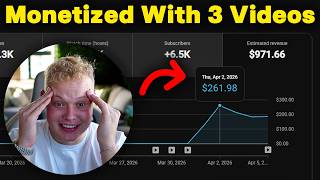
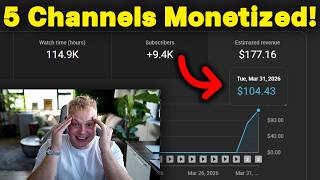
[10:39] quickly give you an example of exactly this. If we look at just as an example this video here, which we literally monetized 1 day ago, we can see that it took extremely long for YouTube to push out the videos. As we can see here, it
[10:52] out the videos. As we can see here, it took us 1 2 3 4 5 6 7 videos, 8 9 videos for YouTube to to actually start pushing out the videos. So, I would highly recommend you guys to give YouTube at least 15 videos. Then we have
[11:09] the restricted mode. This is massive. Um, most people don't even know about this. If we go here to YouTube or to this link, you guys can check this link out as well. But if you go to this link, you guys can see here YouTube your
[11:22] YouTube content and restricted mode. All right? Restricted restricted mode was was created to give viewers better control over the content they can see. This This mode initially limits your YouTube experience. All right? Now,
[11:38] YouTube will not show your videos to people if it has some of this content right here, right? If they have this setting turned on. So, content about drugs and alcohol, then sexual situations, violence, mature subjects,
[11:54] profane and mature language, and then I don't know what this word here is, but make sure that you check that. Let me just open YouTube so I can show you. And Let me show you like this, all right? I always like to show you guys. So, we can
[12:08] literally go to this channel, to my own YouTube channel right here. And we can click here, all right? And then here, restricted mode on or off. Then you just go ahead and you turn it on. Then it's going to reload.
[12:21] And if you see a bunch of your videos disappearing right here, then you know, like, "Hey, okay, I have a problem. I need to change something in my content." Very important. Most people don't even know about this. This is now not the
[12:34] biggest thing, but this can be a reason why you're not getting any views. All right? Now, here are four other reasons why you might not be getting impressions. So, firstly, your video ideas suck. All
[12:47] firstly, your video ideas suck. All right? If you go ahead and you recreate a video that has been done a thousand times, there's literally no reason why YouTube should push out should push out your video. All right? Then you have a
[13:00] thumbnail and title are one-on-one copied from someone else, YouTube is video. And if I was YouTube, I would also not push it out, right? If it's the exact same as someone else's. Then the video length or even bad retention. So,
[13:15] impressions and some people click on your videos, and they click off very quickly, this usually signals to YouTube that the video is not good and good, and that the the the viewer is not really happy after watching the video, so
[13:29] YouTube will not push out that video anymore. Or you might just be in a bad niche where, you know, like for example in the motivation niche where thousand channels every single day get created. There's no space. YouTube is not going
[13:41] to push out your content, all right? Now, I have said um as I've said, most people lack the funda- fundamental YouTube knowledge, and this is why they keep failing. So, if we look at here for example your
[13:54] people don't even know how to pick video topics. Most people think you just randomly pick video topics. And that is exactly why I created a completely free course as you can see here, and you can just click here on the screen right now.
[14:08] It will take you immediately to that video, and I'll see you on that video. valuable, and after that you'll know every single little small thing about every single little small thing about YouTube, and I'll see you there.
⚡ Saved you 0h 14m reading this? Transcribe any YouTube video for free — no signup needed.