
Word Search is Just Pathfinding with One Rule
45sExplains a complex algorithm with a simple analogy and clear visual example, making it educational and shareable.
▶ Play Clip"Delivers a clear, concise explanation of backtracking via Word Search, though the 'two lines of code' promise is not literally fulfilled."
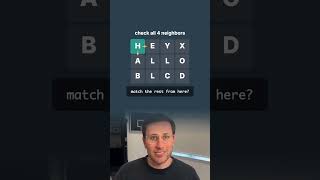
This video explains the Word Search problem, a classic coding interview question, by framing it as a pathfinding challenge with a single extra rule. The core technique is backtracking, which is presented as a simple, recursive approach: match a letter, explore four directions, and undo if it fails. The video demonstrates the algorithm with a step-by-step trace through a grid.
The problem is described as pathfinding with one extra rule: build a word by moving through neighboring cells (up, down, left, right) without reusing the same cell.
A brute-force approach that tries all paths is exponential and too slow. Instead, find the first matching letter, then check all four neighbors for the next letter.
Example trace: start at 'H', find 'E' to the right, then 'L' below, then another 'L' (trying the one below first), but no 'O' is found, so backtrack and try the other 'L'.
Every step is: match the letter, explore four directions, and undo if it fails. Backtracking is simply reversing when you hit a dead end.
The video succinctly demystifies backtracking by applying it to the Word Search problem, showing that it is a straightforward recursive strategy of try, explore, and undo. It effectively conveys the core idea in under two minutes.
What is the core idea of backtracking as described in the video?
Match the letter, explore four directions, and undo if it fails. Reverse when you hit a dead end.
00:56
What is the time complexity of a brute-force approach to Word Search?
Exponential, which is too slow.
00:16
In the Word Search problem, what are the allowed moves?
Move up, down, left, or right, without reusing the same cell.
00:01
Word Search as Pathfinding
Reframes a common problem in a simple, intuitive way.
00:01Backtracking Definition
Provides a concise, memorable definition of backtracking.
00:56[00:01] looks intimidating, but it's really just pathfinding with one extra rule. You're goal is to build that word by moving through neighboring cells. You can move up, down, left, or right, but you can never reuse the same cell.
[00:16] path through the grid, but it's exponential, which is way too slow. Instead, you can find the first matching letter in the grid. Then from that cell, check all four neighbors for the next letter. Let's trace through this. Start
[00:29] at H. We need E next. Check each direction, and on the right side, there's E. So we move there. Now from E, we need L. So we look around and we find L down. Go ahead and take it. From this L, we need another L. We have two
[00:42] there's one to the right. So let's try the one below first. But now we need an O. And checking its neighbors, we don't find any Os. There isn't one there. So we just backtrack. Unmark that L and go back so we can try the other L
[00:56] instead. Now when we look for O again, it's right there on the right. We found it. Every step is just match the letter, explore four directions, and undo if it fails. That's backtracking. Just reverse when you hit a dead end. Learn more with
[01:08] interactive visualizations at hellointerview.com.




⚡ Saved you 0h 01m reading this? Transcribe any YouTube video for free — no signup needed.