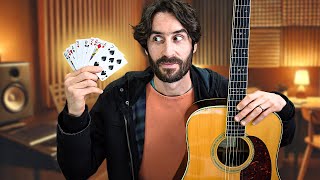

If I Had Six Hearts, You'd Break Them All
57sThis instantly relatable, quirky lyric hook shows how a random card can spark a memorable song idea, making viewers want to try it themselves.
▶ Play Clip"Delivers a solid creative technique with useful examples, but the 'never run out' claim is marketing hype and the video stretches one idea across 18 minutes."
This video presents a creative songwriting technique using a standard deck of 52 playing cards to generate and develop new song ideas. The host demonstrates how each card's suit and number can be interpreted instinctively to spark unique, personal concepts, and then shows a deeper method for interrogating a single card to explore story, form, rhythm, harmony, and melody. The technique helps overcome writer's block and provides a pool of ideas to draw from.
A simple technique using a deck of playing cards to generate song ideas, preventing repetitive songwriting.
Only a standard pack of 52 playing cards is required.
Each card has a number and a suit; the combination becomes a prompt for interpretation.
Hearts lean toward love/romance songs; other suits suggest different themes.
Numbers can be interpreted in many ways, e.g., 'six hearts' becomes 'if I had six hearts you'd break them all.'
A Queen of Clubs brought up the host's grandmother and golf, showing how personal memories can spark ideas.
Spades remind the host of his builder father; seven as a lucky number leads to a song about work ethic.
The technique works best when choosing at random and not giving in to the urge to swap; staying with discomfort strengthens creativity.
Having a pool of diverse ideas avoids writing the same kind of song and keeps songwriting fresh.
A more advanced method: interrogate a single card through story, form, rhythm, chords, melody, and visuals.
Diamonds suggest wealth, status, marriage, purity, hardness; two implies couple, giving concepts like marriage breakdown or 'too much wealth.'
The number two can dictate two song sections (e.g., verse/bridge) or a short, sharp form of about 2.5 minutes.
The number two can suggest 2/4 time, iambic pentameter (five sets of two), and two-note melodic motifs.
Two can be a chord extension (sus2 or 9th) or a two-chord vamp, e.g., C to D minor 9.
The diamond shape can be physically traced on a keyboard to create a unique bassline or melody.
Even numbers create stable structures (4/4, 8-bar phrases); odd numbers (3,5,7) create instability, influencing themes and form.
Picture cards inspire via their visuals; look for themes in the deck's artwork.
The host encourages viewers to try the technique and share their results in the comments.
The card trick offers a flexible, low-cost framework for generating endless song ideas by forcing creative constraints. Whether you need a quick spark or a detailed structural blueprint, this technique helps you turn randomness into personal, original songs.
What does the heart suit traditionally represent in this songwriting technique?
Love songs or themes of romance.
01:37
What is the recommended way to choose a card from the deck?
Shuffle and pick at random, without scanning or choosing deliberately.
06:19
Why should you stick with the first card you pick?
To strengthen creativity muscles by not avoiding discomfort and forcing yourself to find ideas in challenging prompts.
06:46
What are some associations the host lists for diamonds?
Wealth, status, class, wedding rings, purity, industrial cutting, hardness.
09:01
How can the number two be used in song form?
It can limit the song to two sections or suggest a short, sharp form of about 2.5 minutes.
10:51
What is the relation between even numbers and musical structure?
Even numbers represent stable structures, such as 4/4 time or 8-bar phrases.
15:31
Give an example of using the number two as a chord extension.
Adding a 2 to create sus2 chords or using the 9th (which includes the 2) like D minor 9.
12:44
What does the host suggest for using the diamond shape visually?
Physically trace a diamond shape on the keyboard using notes of the C major scale to create a melody or bassline.
14:21
What practice does the host recommend weekly for songwriters?
Spend time collecting and generating new song ideas, then review and develop them later.
07:52
How can odd numbers be used in time signature?
Use them as unstable time signatures, e.g., 5/4, to match an unstable theme.
16:13
Suit as Thematic Shortcut
Offers a quick, intuitive way to aim the tone of a song, making the creative prompt feel less daunting.
01:37Discomfort Builds Creativity
Encourages sticking with random cards even when uninspired, which strengthens ideation muscles and prevents self-editing.
06:34Even vs. Odd Numbers as Structural Guide
Provides a simple numerical rule for choosing stable or unstable musical forms and themes.
15:31Multi-Faceted Card Interrogation
Demonstrates a rich sequence for converting a single card into concrete decisions about story, form, rhythm, chords, and melody.
08:46[00:02] or Melody writing techniques we know if we can't find something interesting to write about an idea or thought or a feeling that we want to express then the grinding Halt and if you're someone who
[00:14] you find yourself stuck in a loop writing about the same things over and to show you today might be the answer to this little technique is every time I do it it never fails to produce results I
[00:28] always end up with a whole heap of new and interesting ideas to work with so in this video I'm going to show you a fun and exciting way to write songs a way to generate and develop new and interesting song ideas and all you'll need is a pack
[00:42] of cards so we're going to use this standard pack of 52 playing cards to essentially generate a whole range of different song prompts that we can then use to start writing different kinds of songs so let's Dive Right In by opening
[00:56] songs so let's Dive Right In by opening the deck giving it a little Shuffle and I'm simply going to pick a card from the
[01:10] to do this game is to try and respond instinctively to the card as soon as I turn it over so every playing card has two elements we have the number and we have the suit in this case we have the number six and we have the suit of
[01:23] which one we move towards first what matters is that we move quickly through this process and instinctive ly and creatively through this process and then note down all the different ideas that come from this prompt so whenever we
[01:37] have a heart suit it leans us towards a love song or a song about Romance the because our relationship with numbers is such that we can interpret them in so many different ways and depending on how much you like playing with numbers will
[01:52] determine your appetite for this this method but for me I look at the hearts I look at the six and one concept might uh a love song where you're saying something like if I had six hearts you'd break them all you know this idea of the
[02:07] break them all you know this idea of the broken heart is so common in love songs different angle such as you know if I had multiple Hearts you'd still break them all that becomes interesting so I'm going to write that one down uh that
[02:20] also for me feels like it could be A Chorus Line just the nature of the phrasing so one of the ways to really quickly generate lots of different ideas is to turn turn a card over and write down the first thought you have the
[02:34] first idea that comes to mind in response to that card if we do it again let's just see what happens Queen of Clubs Queen of Clubs Queen of Clubs instantly makes me
[02:50] Clubs Queen of Clubs instantly makes me think of golf and my grandmother loved golf in fact I think my grandfather loved golf she played so she could hang about the Queen of Clubs has got me thinking about my grandmother and this
[03:06] is what's so powerful about this idea that it doesn't have to be and it that it doesn't have to be and it shouldn't be the most obvious or literal response to the prompt when you turn over a queen um one of the obvious
[03:20] thoughts you might have is royal family something around the mon and that could and we could certainly take it in that direction but where find this far more useful and and more personal is when I use the prompt to take it in a
[03:36] unexpected direction or a Direction that's less predictable and in this case the clubs relating to golf is fairly predictable in some ways but the Queen of Clubs relating to my grandmother and her life and maybe her life at the end
[03:50] story that I would be interested in writing so we're always looking to respond to the prompt in in a personal emotional way or in a way that feels
[04:02] emotionally relevant to us because if it feels emotionally relevant then we've to write the story you know that story about my grandmother is a story I would like to write I could write about the royal family but it doesn't feel as
[04:16] personal it it feels detached it feels like something that's more of a research write down Queen of Clubs and make a note about my grandmother and the latter note about my grandmother and the latter part of her life let's try one more
[04:38] Spades my dad was a builder um for most of his life and so whenever I see Spades I always think about him on the tools on the building sites where I used to go and visit sometimes as a kid and I'm thinking about the number seven as as a
[04:53] very lucky number it's a number that's revered um around the world in a lot of different cultures putting those two numbers together the Spades representing numbers together the Spades representing my father in construction and instilling
[05:05] a very powerful work ethic I guess in me and my sisters um coupled with seven being a lucky number in lots of different cultures a magical number now gets me thinking that this could be a song about um my appreciation of or how
[05:21] lucky I am to have had a parent who instilled a work ethic in me around hard work and labor and and you know being on the tools and using your hands to make the tools and using your hands to make things again this is just a thought in
[05:36] response to the card it doesn't feel very well formed and it's not meant to it's meant to be just an initial idea a spark of an idea but if I write it down and I come back to it later I'm going to check in and see how much energy I have
[05:49] around that idea and and how much desire I have to develop it but again it feels personally relevant it feels like something that is part of my life and a story that I might want to tell and it's also an idea that I wouldn't have
[06:02] have presented itself so seven of stress here is I'm not selecting a card as in I'm not holding the cards this way
[06:19] and scanning through them and picking one that I like the look of it's really this technique works best when we we hold the deck this way and then we pick a card at random and it's also really important that the
[06:34] first card we get is the card we stick with even if it's uncomfortable and it will be uncomfortable the first response is often one of discomfort because we look at it and we've got nothing that comes to mind that feeling makes us want
[06:46] to then put the card back and find another one where it is easier to talk about or we do have a more obvious idea that comes to mind but I'm going to challenge you to actually stay with the card that you pick and just sit with it
[06:58] for a moment because because we're trying to strengthen these creativity muscles we're trying to strengthen these idea generation muscles and we can only do that if we don't let ourselves off the hook if we don't just move on to the
[07:10] easier option so sitting with the card and really interpreting what the numbers memories playing around with some sensory language whatever it is you need
[07:22] to find a way to sit with it and see what emerges so that's an example of how I would try and wrap rapidly generate a few different ideas three very different song ideas there and the real benefit of collecting lots of different song ideas
[07:36] is firstly we don't get stuck writing the same kind of song we don't get bored with our songwriting if we've got lots of different ideas on lots of different it's great to have a pool of different song ideas to dip into is because on any
[07:52] given day you can review the list of song ideas you have and see what day and so a really great practice is to spend a little bit of time every week spend a little bit of time every week collecting and generating new song ideas
[08:06] documenting those ideas and then finding other times throughout the week or the month to review those ideas and develop some of them the ones that feel like they are ready to be developed because if we only collect and generate ideas
[08:19] and do nothing with them this leads to another problem which is we have books filled with potential songs but we have very few songs that actually get developed and finished and this leads to a lot of frustration so now I want to
[08:32] show you another way of playing this game and really going deeper on each card interrogating each card to extract more ideas and more potential directions that a song idea could take and to do this effectively I've created a little
[08:46] through and the first step in this sequence is to create a story so let's sequence is to create a story so let's start by picking a new the two of diamonds and interpret this is prompt just thinking about
[09:01] storytelling creating different narratives so diamonds can mean wealth they can mean status they are a symbol of class are found in wedding rings they can mean Purity they also
[09:17] have industrial applications in terms of cutting they're hard I think on the most scale of hardness they're right up there around 9 diamonds are associated with if we then think about the number two well the
[09:32] number two lends itself obviously to a couple so then we get to lean into marriage but we could also take the idea of cutting and apply it to this idea of a marriage breakdown so we could go marriage
[09:46] breakdown or relationship breakdown we can also interpret the number two uh lyrically too much if I'm playing around with hardness or Purity or any of these
[09:58] things or wealth and then I'm taking the number two and I'm going to convert it number two and I'm going to convert it into the word two as in two much T now into the word two as in two much T now I'm thinking of too much wealth the idea
[10:11] that there is too much wealth held by too few in the world it could be too too few in the world it could be too hard too hard it could be a commentary hard too hard it could be a commentary or a story about struggle
[10:23] challenge again I'm not judging any of these yet I'm just free flowing in my idea generation and trying to interpret the two and the diamond in as many ways as come to mind and I started off with the list of words you know wealth status
[10:38] symbol of class wedding rings Purity those sorts of ideas and now I'm moving more into little statements that flesh out the idea a little more so those might be some ways we can interpret the two of diamonds from a story point of
[10:51] view if we now look at the next step in this sequence I'm going to look at form and this is where the number really comes into play so two as a form consideration might mean that I'm only going to have two sections in this song
[11:06] and only two sections leads me to think of either verse and of either verse and chorus but more likely a a where we have 3 a sections uh which are the verses and the refrain line will be contained
[11:21] within the verses and then I've got a bridge coming in after the second verse so that that might be the form that I choose because I want the song to only have two sections thinking about form through the lens of diamonds I mean
[11:34] diamonds are sharp so maybe I'm thinking of a short sharp form something that isn't too long maybe I'm deliberately thinking about how to contain this song idea something like 2 and a half minutes
[11:46] where the sections move quickly and and it doesn't feel like it drags in any way it doesn't feel like it drags in any way so short sharp form might be a parameter rhythm two is a nice way to think about the
[12:03] subdivisions so if I'm in 44 for example instead I might think about being in two4 which is cut common time I might also want to lean on structures of two also want to lean on structures of two rhythmically and melodically so I am big
[12:17] pentameter for example is five sets of two the I am is the two Dum so that may be a way that I structure the melody and perhaps the lyrics in this I Amic pentameter kind of approach or at least leaning on the couplets that idea of
[12:32] couplets then leads us to rhyme scheme and we may want to play with couplets in rhyme schemes what if we think about the two of diamonds in terms of chords well
[12:44] to take the number two and think of it as an extension for the chord so instead of Triads we might be adding the two to create sus two chords or we might be
[12:56] thinking in terms of the nine so to demonstrate demonstrate that if I was thinking about the key of
[13:10] with a two chord Vamp so this song might be a two chord Vamp to start with going from the one chord to the two chord in
[13:24] chord in C C to D minor n might be that or we might go to the D Minor 9 so
[13:40] that might be nice so to going from the c major to the D Minor 9 the nine is the same as the [Music]
[13:55] Melody through the lens of the card and if we think about that Melody and take terms of two note motifs in the key of C we might be doing
[14:07] motifs in the key of C we might be doing [Music] this just toggling between two two notes or two pairs of notes we can also take the diamond and actually play with it visually so if I literally look for a
[14:21] diamond shape on the C chord a diamond shape that I can create using the notes of the c major scale it might be
[14:40] little Baseline that I create for this song so I'm being very literal here in in taking the shape of the diamond and literally looking for a diamond shape in different way into the songwriting process it's a different way to
[14:53] interpret this set of information that we've been given with the two of diamonds card what one of the other major challenges of songwriting is knowing we can essentially write about anything and this sometimes cripples us
[15:05] and stops US writing about anything because if the whole world is available if we have all the choice then it's really hard to make that choice it's really hard to know where to start and often we just don't start we just leave
[15:19] often we just don't start we just leave the piece of paper blank and so having a technique like this can help start to Define some of the parameters and as you look through a deck of cards and interpret at these numbers you see that
[15:31] of course we have odd numbers and even numbers and this is significant for songwriters because our even numbers represent stable structures 44 is the most stable time signature we have but generally any structures that are using
[15:46] generally any structures that are using even numbers 2 4 6 8 they're stable then we have the odd numbers we have the thre the fives the sevens the 11s which is the Ace and so as you're going through this you're either going to turn over a
[16:00] stable or an unstable number and this takes the thought process in a takes the thought process in a particular direction if we take a five we might say okay great I'm going to make that the time signature I'm going
[16:13] make that the time signature I'm going to write in 54 and 54 is an unstable time signature and so that now dictates the theme or the type of song I want to create if I'm going to set it in 54 it means I need to find a subject matter or
[16:27] a theme that is a little unstable a little uncomfortable perhaps it also might mean that we put five lines in the verses again destabilizing the structure the number can be interpreted very literally and used very practically in
[16:42] the structure of your song Because songs and music are based on numbers we have numbers everywhere in our structures it's a very easy and often creative way to define the parameters and then of course we have the Royals and so turning
[16:57] picture cards that gets the brain working in a whole different way as well and depending on what kind of cards you have the picture itself May inspire a about collecting and using different sets of play cards is you see all the
[17:12] variations in the imagery so look at the picture cards in your deck and see how being portrayed in that deck so there you have the songwriting card trick that for me is one of the most creative and fun ways to generate song ideas and I
[17:28] would love to know in the comments if any of you try this technique out what kind of ideas did it help you generate where did it take your thought process and did it result in songs that otherwise wouldn't have been written and
[17:41] this is the kind of thing we love to discuss with our growing community of songwriters so if you're interested in joining that Community with songwriters from around the world check out the links below and hopefully we'll see you
[17:53] links below and hopefully we'll see you there thanks bye

⚡ Saved you 0h 17m reading this? Transcribe any YouTube video for free — no signup needed.