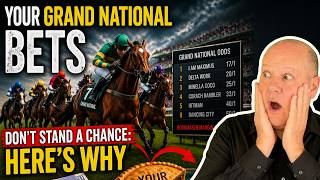

The Grand National Bet Trap (No One Talks About)
45sReveals a common mistake casual bettors make, sparking realization and shares.
▶ Play Clip"Title accurately warns that bets are disadvantaged; video delivers clear explanation of bookmaker margins without exaggeration."
This video explains why most Grand National bets are stacked against the average punter, focusing on the bookmaker's built-in margin (overround) that guarantees profit regardless of the outcome. Through a simple analogy using an apple pie, the presenter illustrates how bookmakers take a slice for themselves before any bets are settled, and advises punters to shop for the best odds or use betting exchanges to reduce the house edge. The video also touches on corporate vs independent bookmakers and briefly mentions a strategy called 'trading' used by professional bettors.
The presenter, Peter Webb, is on BBC Radio discussing sports betting, with a focus on the Grand National, a unique event that attracts casual bettors.
Odds should sum to 100% if they reflected true probabilities, but they add up to 120-150% or more due to the bookmaker's built-in margin (overround).
The race is a whole pie (100% outcomes). The bookmaker cuts a slice for themselves before the bettor gets a share; that slice is their guaranteed profit.
Overround percentages translate directly into expected losses. A 25-30% overround means the punter loses that much on average over time.
Corporate bookmakers control risk by limiting stakes and accounts, while independents stand their bets but can lose big (e.g., Frankie Dettori's 1996 Magnificent Seven).
Exchanges allow betting against other people with a small commission (e.g., 1-2%), offering better odds and no restrictions. Professional traders can lock in profits before the race.
The Grand National is a fun event, but casual bettors lose significant value due to bookmaker margins. To reduce the edge, shop for the best odds or use betting exchanges for lower commission.
What is the overround in betting?
The sum of all implied probabilities (from odds) exceeding 100%, representing the bookmaker's built-in margin.
02:28
How does the bookmaker guarantee profit regardless of outcome?
By setting odds so that the total implied probability exceeds 100%; they effectively take a percentage of every bet.
03:13
What typical range does the overround reach for big races like the Grand National?
120-130% or sometimes over 150%.
04:38
What is the main difference between corporate and independent bookmakers?
Corporate bookmakers limit stakes and restrict accounts to manage risk; independent bookmakers stand their bets but can suffer large losses.
06:22
What advantage do betting exchanges offer over traditional bookmakers?
Exchanges charge a small commission (1-2%) and allow betting against other people, often providing better odds and no restrictions.
08:33
Odds don't reflect true chance
Reveals the fundamental mechanism behind bookmaker profit that most casual bettors ignore.
02:28Apple pie analogy
Simple visual explanation of overround makes a complex concept accessible.
03:13Best price advice from Peter Webb
Concise, direct advice from a professional: always seek the best odds to reduce the bookmaker's edge.
07:37Betting exchanges as solution
Introduces an alternative with lower commissions that can significantly improve bettor's expected value.
08:33[00:00] Have you been listening to Peter? But Peter, it's Grand National Day. Mums and dads, the husbands, the nannies, and the wives and the children.
[00:13] They pick out their four or five horses and they out their 50 pence each way. Every, why have you got the. Have him on the following week.
[00:28] It's Grand National Day. We like what we.
[00:44] So this is me and I was invited into b BBC Radio bhi to talk about sports betting I've been betting for a very large number of years, and horse racing is one of the key sports on which I bet, and Henry Kelly was a keen horse racing fan, but he.
[01:01] Gary is, uh, living, breathing proof that sometimes bookmakers do not win. But today we were here to talk about the Grand National.
[01:15] It's not just a horse race, it's an event. Office sweepstakes get passed around, names are pulled from a hat. Suddenly, people who haven't placed a bet all year are talking
[01:29] Phones come out, apps, open bets, go on. And in those final minutes, millions of people all do the same thing. They pick a horse, and that's exactly why it works, because while
[01:45] everyone is focused on the horse, nobody is thinking about the price. And that is where the real story begins. Let's start with how a bet actually gets placed, whether you're on course.
[02:00] You walk up to a bookmaker or you scroll through the odds on your screen. it, those odds aren't random.
[02:14] So you pick one, you place your bet, and you accept the price that's being offered. But here's where it gets interesting.
[02:28] If those odds truly reflected the real chances, then when you add them all together, they should equal 100%. They add up to more, which means something extra has been baked in.
[02:45] And to show you exactly what that looks like, I'm going to do some cooking.
[03:13] Imagine this whole apple pie is the race, 100% all the possible outcomes. Now, in a fair market, every slice of that pie would be shared between the
[03:27] horses, and if you picked correctly, you'd get paid fairly for your slice. But that's not what happens before you even place a bet, the bookmaker
[03:39] They remove it, set it aside, that's theirs. Less than 100%.
[03:53] You are competing for what remains while they've already secured their share. And it doesn't matter which horse wins that missing slice. They keep it every single time.
[04:08] The image on the left shows the bookmakers over round. In a perfectly fair market, all the odds would add up to 100%. That would mean every horse is priced exactly in line with its
[04:22] true chance, no edge, no advantage. Instead, these markets add up to 120, 130, sometimes over 150%.
[04:38] It means the bookmaker has already built in their margin. They've effectively stretched the market beyond 100%. So every price you see is slightly worse than it should be.
[04:54] This second image shows the percentage lost by the punter, Because those inflated percentages translate directly into expected losses.
[05:11] So when you see 20%, 30%, even more, that's telling you for That's how much on average the bookmaker expects to keep.
[05:26] That might mean you are giving away 25, 30% over time. They see the odds.
[05:39] They pick a horse, but they never realize the game was tilted And this is how it works. Nothing hidden, nothing illegal, just odds, quietly adjusted
[05:53] So let's simplify things again. Every time you place a bet, a bookmaker will take a cut. And as we have seen, that cut could be 25% or more.
[06:07] 'cause if you place three bets, losing 25% at a time, you've only And of course, if you place another bet, then it's all gone. But of course, it's not just the pie we're talking about here.
[06:22] That has gone to it's worth saying not all bookmakers operate the same way. Most of what we've talked about applies to the big corporate firms.
[06:36] They don't just set the prices, they control the game. They can limit how much you stake, restrict your account, and if you So even if you find an edge, you often can't use it.
[06:51] The independents, if they lay you a bet, they stand it. Win or lose, and sometimes that goes badly wrong.
[07:03] Back in 1996, he laid every ride of Frankie Ator at Ascot. The magnificent seven, seven winners, one after the other, No limits, no restrictions, no escape.
[07:22] Corporate bookmakers manage risk by controlling you. But either way, that built-in edge, it never disappears.
[07:37] Now I'm joined, uh, by Peter Webb of the Bet, angel at the betting Peter, what's, uh, the best advice that you have for punter? Um, generally to get the best price that you can, and, uh, I think it
[07:51] Um, if you can't get the best price, then you'll ever make money. So try and get a good price whenever you have decided on your pick. So don't let me stop you having fun on the Grand National.
[08:04] But be aware that if you just place the bet blindly, you're gonna be losing 25, 30% or more of that bet in a deduction that the bookmaker has taken from you. Now, you may win, but over subsequent years, um, the amount that you
[08:18] Um, or you may just never win because it's so difficult to pick But the thing you should do is get the best price, go out and look for some That will reduce the amount of pie that you are paying to the bookmaker.
[08:33] There is another way as well, and if we go back to that slide where I compared bookmaker rods and the deductions at the top, you'll see a thing that's called exchange and you'll see that the deduction there is only 1%.
[08:45] betting against other people. But this video is aimed more for people who don't have that level of awareness. other people, not a bookmaker.
[09:00] The deduction is very small. Um, the bet stands and there's no limit on what you can do on an exchange, If you look at the result that I'm gonna put on the screen now.
[09:16] before the race even started. So before the race had started, regardless of who went on to win the race, I actually knew that I'd won 3000 pound or just short of 3000 pound, and I could
[09:30] How's that possible? without knowing who the winner is? They'll take a bit of time to explain, so I'm not gonna explain it in this video.
[09:44] managed to achieve that result. not only are you gonna not lose much. In the long term based upon the maths, if you do win, you're probably
[09:58] And on that note, I do hope that you pick a winner at the Grand National and enjoy the race.
⚡ Saved you 0h 10m reading this? Transcribe any YouTube video for free — no signup needed.