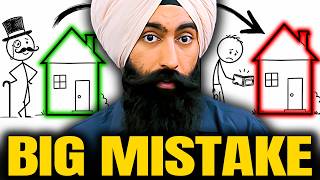

Why Your House is an Expense, Not an Asset
45sChallenges common belief that homeownership is a wealth-building asset, sparking debate.
▶ Play Clip"Title accurately reflects the core argument: houses are often expenses, not assets, due to ongoing costs."
The video challenges the common belief that owning a house is a sure path to wealth, arguing that houses are often expenses rather than assets due to ongoing costs like property taxes, insurance, and maintenance. It highlights the retirement crisis in America, where people relied on jobs, 401(k)s, and home ownership but are now struggling. The speaker advocates for a shift in mindset and introduces a three-phase wealth-building strategy: getting, growing, and protecting money.
A house is an expense because it requires property taxes, insurance, and maintenance. Even if the house appreciates, costs increase, and if you stop working, you still have to pay. This can lead to financial strain, especially for retirees.
America faces the largest retirement crisis because people believed that a good job, 401(k), and house would set them up. But with inflation and rising costs, that formula no longer works.
In the first 15-20 years of a 30-year mortgage, more than half of the payment goes to interest, not principal. Refinancing resets this, making home ownership less profitable than assumed.
Wealth building has three phases: getting money (foundation), growing money (investing), and protecting money (insurance, estate planning).
If you have credit card debt or less than $2,000 saved, you are in the financial danger zone. Avoid restaurants, vacations, and subscriptions like Netflix. Use time to earn more money or develop skills.
Investing $8,000 at 20% return for 40 years yields over $11 million. But the average American with credit card debt pays 20% APR, making credit card companies rich instead.
Spend max 75% of income, invest min 15%, save min 10%. Use three separate bank accounts to enforce this system.
People fear wanting to be rich due to childhood messages like 'money is bad' or 'rich people are evil'. Reframe to 'we can't afford it yet' and see money as a tool for freedom and helping others.
A happy life requires physical, mental, spiritual, and financial fitness. Financial problems cause stress, divorce, and suicide.
Without money, you become desperate and fall for get-rich-quick schemes, lottery tickets, or overpriced courses. True wealth comes from owning assets that pay you even when you stop working.
The video concludes that true wealth is built by owning income-generating assets, not by relying on a job or home appreciation. It emphasizes the need to reframe money mindset and follow disciplined saving and investing habits.
What percentage of a mortgage payment goes to interest in the first 15-20 years?
More than half (over 50%) goes to interest.
02:32
What is the 75-15-10 rule?
Spend max 75% of income, invest min 15%, save min 10%.
09:50
What are the three stages of wealth according to Jaspreet?
Getting money, growing money, and protecting money.
06:34
What is the financial danger zone?
Having credit card debt or less than $2,000 saved.
07:16
How much would $8,000 invested at 20% return for 40 years grow to?
Over $11 million.
08:37
What is the average APR on credit card debt?
20%.
09:21
What are the four pillars of a happy and fulfilled life according to the speaker?
Physical fitness, mental fitness, spiritual fitness, and financial fitness.
14:39
Why does the speaker recommend term life insurance over whole life insurance?
Term life insurance is cheaper and acts as a bridge until you build assets, not to get rich off it.
05:15
What is the key to becoming wealthy according to the video?
Owning the right assets that pay you even when you stop working.
18:11
Retirement Crisis
Highlights the failure of the traditional 'job, 401(k), house' formula for retirement.
01:37Three Stages of Wealth
Provides a clear framework for wealth building: get, grow, protect.
06:3475-15-10 Rule
Simple, actionable budgeting rule to enforce saving and investing.
09:50Four Pillars of Fulfillment
Connects financial health to overall well-being, emphasizing its importance.
14:39Wealth Through Ownership
Core principle: wealth comes from owning assets, not working a job.
18:11[00:01] >> knew that, bro. >> Because it doesn't pay you an income. >> It's an expense. >> Property tax, fixing stuff, expensive. And now they say, "Well, what if I pay
[00:16] the house, but now you still got the property taxes and the insurance. And let's say, Louis, you bought your house in a great area. million dollar house. It you bought it in a great area, now it
[00:29] goes up to a million dollars. You're going to say, "Just look at me. I got a million dollar asset I'm sitting on." Good. I'm happy for you. million dollar house. Cuz if your house goes up in value, so do your property
[00:41] taxes every year. You have to now insure a million dollar >> Yeah. >> And now what happens job to keep paying that, but what if you stop working? Maybe you retire, maybe
[00:55] you can't work, you still have to pay these expenses. Or maybe now you built this house, you paid it off, you were able to support the cost, and now you your kids have to pay to support this million dollar house. And why do now so
[01:08] house and sell it? Because they can't afford the cost of just keeping the house. So, now we think that buying this house is going to make us wealthy, when in reality, that's not always true. Now, I'm not saying it's bad to own a
[01:22] a house. In fact, it's a very good thing to own a house and pay it off. But the mistake that many people make is they think Just believe me. my 401k, and buy a house, and I'm going to be set. When you have that sort of
[01:37] else. And right now, America is facing the largest retirement crisis of history. Because everybody thought if I got a good job, I invested in a 401k, and I owned a house, I'm going to be set.
[01:53] Just do the math. If those are the people now that are facing this retirement crisis. What makes you think that it's going to be easier for you market where inflation is a bigger problem now than it was for the previous
[02:06] generation. What makes you think that all of a sudden it's going to be easier insanity is doing the same thing and expecting a different result. Well, here expecting a different result. Well, here you are.
[02:20] thing about it because then people will say, "Well, Jaspreet, if I have to pay to build equity as opposed to making my landlord richer?" Yes.
[02:32] But that's not always what's happening. Because when you get a 30-year mortgage and you pay $3,000 a month, it's not $1,500 going to your bank and then $1,500 going to principal. Now, 80% is going towards towards interest. In fact,
[02:46] more in the beginning. And so it's not for the first 15 to 20 years of a 30-year mortgage that more than half of your payment is going straight into banker's pocket with interest and then the other small
[03:00] percentage is going towards principal. And now we have to assume that you don't do a refinance because if you refinance on year eight, again. And so again, I'm not against the owning
[03:14] a house. In fact, I would prefer you to own a house than rent it. The mistake that people make is that buying a house thinking that it's going to make me rich. So, how about you buy a little bit bigger, little bit nicer because it's
[03:26] the biggest investment of your life. And when you think it like that and I'm telling you and I and I look at speak from experience cuz I worked as a And in that sales training, what do they teach you? You are selling the best and
[03:39] teach you? You are selling the best and biggest investment of somebody's life. selling you an investment, right? I'm not selling you an expense. Hey Louis, This This biggest money pit hole you're going to have. I'm not going to sell it.
[03:53] for your kids." >> Yeah, your family's going to have memories here for decades. Yeah. >> And and that's But when you start to do the math, you realize
[04:06] that maybe maybe owning the house isn't as good of an investment as you originally thought. And so, this is where now we start to maybe some of the things that I was taught was wrong.
[04:19] hump because sometimes we have that ego, and I had that, too. crap, I need to do something different, what I realized was everything that I was told was a lie, and I need to
[04:33] restart my learning. And it's difficult once you've built a degree, you built a job, you built that foundation, start over. But you're not starting over. What you're doing is now just
[04:49] shifting the direction, and now you can start to accelerate the path towards which will give you that true freedom. One of the things that I've learned in don't pay attention to end up mattering the most. And that's why I want to talk
[05:02] to you about life insurance with our sponsor Policy Genius, because if you don't have the assets to live off of yet, and something tragically happened the last thing you want is now your spouse and your family trying to
[05:15] that's where term life insurance can come into play. Now, I'm talking about term life insurance here, not whole life insurance. The whole idea with term life insurance is it's life insurance for a period of time, 10 years, 20 years, 30
[05:29] years. That way you can work to build your assets. It is a lot cheaper than whole life insurance because the whole idea is you're not here trying to get rich off your life insurance. It's just there as a bridge until you can build
[05:41] your assets. This is one of those things where the earlier you start, the cheaper 30-year-old guy, you could potentially get a half a million dollar term life insurance policy for less than a dollar a day. So, if you have any questions,
[05:54] insurance, or you want to see how much a term life insurance policy would actually cost to you, I'll put a link to PolicyGenius' form down in the to complete, and it'll give you an actual quote on how much term life
[06:07] have that link for you down in the description. listening to this right now thinking their entire life has been lied to about money, finances, uh how to invest, if I do these things,
[06:21] then I'll be safe in the future. What would you say then are the three biggest money rules that wealthy people do that most people aren't following?
[06:34] three steps, because there's three stages of wealth. stages of wealth. And I'm going to break it down into getting the money. >> Yeah.
[06:48] growing the money. Phase three, protecting the money. Phase getting the money, is all about, now, how are you going to just lay the foundation for your finances?
[07:03] And people say, "Well, what business should I start? What job should I get?" Do what you believe is right for you. Sometimes it's >> Mhm. >> But you got to you got to figure out how
[07:16] Figure out how you're going to earn more money. So, here's a few basic rules. Number one, if you have credit card debt, if you don't have $2,000 saved up for an
[07:30] financial danger zone. Now, listeners just right now, Louis, but I'm going to do this because uh I want say this to make friends. >> [laughter]
[07:43] >> If you have credit card debt or if you don't have $2,000 saved up, a restaurant. You should not go on another vacation. subscription. >> Or go to Starbucks or
[07:56] >> All of those all little expenses are destroying your finances. Now, why am I saying no Netflix? It's not because of the $15 a month. It's because the average American is watching more than 2
[08:10] like to say 2 hours. More than 2 hours of TV a day. debt, without $2,000, >> Yeah. >> You need to use that time to earn money
[08:25] >> Develop those skills >> money. Now, the reason why I'm so aggressive about this is because >> let's assume now you're you've got a little bit of cash
[08:37] bank right now. If you took that $8,000 today and you could get a let's just say 20% return on your money for the next 40 years, you're not going to retire with half a
[08:52] assume that you never invest another penny again. Only the $8,000 today. million dollars or a million dollars or two million dollars or five million going to retire a decamillionaire with over a 11 million dollars. Now, you're
[09:08] pretty good. Sign me up. I've got $8,000." Well, here's the reality. You're probably not going to get those returns. >> Visa, Discover, MasterCard, and you're the one
[09:21] Because the average American household with credit card debt has $8,000. >> The average APR on credit card debt is 20%. So, if you, instead of making them rich, took that money
[09:37] and you could get those same returns, you would be incredibly wealthy. private jets with those big buildings. It's because you're working hard to make them rich. So, when it comes to that getting money, you got to first lay that
[09:50] danger zone, and create a system for your money. I like to teach 75 15 10, from here on out, 75 cents is the
[10:02] maximum that you can spend. 15 cents is the minimum that you invest. 10 cents is the minimum that you save. This way, now every time you get paid, you're always putting up money aside to
[10:16] save and invest before you spend all of your money because what? Wealthy people do, we talked about, is their money is making them money. How do assets. How do they get that? Because they take their money and they don't
[10:28] spend all of it. They always have money to save and invest before they spend all of it. So, create three bank accounts. Don't do this all out of one. One for money. >> Yeah, 75 15 10. 75% of every dollar, the
[10:43] maximum you can spend is 75%. Is that what I'm >> Yeah. >> The minimum is 15% you invest, and the minimum is 10% to save. And imagine if you could do the minimum to invest would
[10:56] be 40% of every dollar. That'd be incredible. If you're able to invest more than just 15%. You may not be able to expenses, but imagine if you bump that number up every month. Be powerful.
[11:10] >> And that's now goes into the mindset of of of how do you build your wealth? the the first I'm I'm going to take a step back here money, the common feeling that I think a lot of
[11:25] people feel is right about talking about money and I don't I don't feel right saying I want >> Why do people fear the idea of wanting to be rich or looking at people who have
[11:37] money as bad and wrong or judging them as negative? as negative? >> Well, I think there's a few reasons why. I'm going to start with our own money traumas.
[11:49] you, money for this. That's too much money. Oh, that's only Now, all of a sudden, you grow up believing
[12:04] that I don't have the ability to have these things and the people that do are rich people. Now, maybe you grew up hearing that rich
[12:17] people are great and they have the money to do that, but most people don't. There's a lot of vilification around this idea of they must have done something bad, slimy, sleazy, or not nice to achieve that money.
[12:32] let's reframe this. What if you grew up being told, "We can't afford it yet. We don't have the money yet. It's too much money today, but if we do this, this, and this, we will be able to
[12:48] comfortably afford this." Now, we start to reframe how we think. grow up with these traumas that money is bad, evil, comfort ourselves by saying the people that are affording it are bad
[13:04] because now we have these insecurities around money because why can somebody like me who works hard, got a good degree, checked all the boxes, how come I can't do it?
[13:16] But they can. This guy without a college degree has a lot of money. I am a somebody who got a good degree, good credibility, I got a good job. Why am I struggling with money? I heard this a
[13:29] lot because I hear "Jaspreet, my wife and I are doctors. We make $500,000 a year. We have zero assets. What is going on?" And then I start looking at their numbers and I see okay, you got a Benz,
[13:42] traveling on these nice vacations first staying at the nice hotels. You're always buying the organic blueberries. lot of different things and you realize oh, it's not just how much money you
[13:55] >> Mhm. >> And now when you start to just create that tension, you start to realize oh my god, Money is bad. It's evil. Well, now let's reframe that and
[14:08] your life because the reality is it costs money to eat and it costs money to Money is a part of life. You want to pay your bills? You got to have money. If and say hey, I don't got money. Can I give you a hug this month?
[14:24] much. But once you understand that money is a you can then realize it's not the only part of life. Because I and you know, I've talked about this before that if you really
[14:39] want to live a happy and fulfilled life, you need to be physically fit. You need to be mentally fit. You need to be spiritually fit, but also financially Because if you are not financially fit,
[14:53] what happens next? Well, now your relationship suffers. Because you and your wife are now going to be arguing because you're stressed about bills. Because you want to go on a vacation.
[15:07] purse. Or you want to buy your husband that But you don't have the money. You want to buy college for your kids. It's stressful. Money problems are one of the leading causes of
[15:20] divorce and also suicide. It's a real thing. But yet we're we're scared to thing. But yet we're we're scared to talk about the topic of money. mentally healthy. I need to be spiritually healthy. And I need to be
[15:35] independent parts of my life. Now you can understand, okay, this it's Now you can understand, okay, this it's not bad for me to want to learn money. in a society that uses money, but
[15:49] if I have more money, I can also do more good. I can also help other people. I can also feed other hungry people. feed other hungry people. And when you have that sort of idea,
[16:01] now you don't have to go in and think, oh my god, yeah, maybe it's not a bad thing to be rich. Maybe it's just freedom. And maybe if I become rich, I can be an example of what it means to be a good
[16:14] person who is rich. That's why I always say we need more good people with money. And now we start to reframe that, but it means you have to rewire the way you Cuz most people look at money in a way that does not serve them.
[16:28] They look at it where they cause us stress, anxiety, fear, uncertainty. >> If you don't have money, you're at the mercy of people that have money. You become desperate. Because now I have to go to work.
[16:40] I have to do these things. And desperate people don't make good financial decisions. And it's really unfortunate, but now when you're desperate, what happens? Well, the first thing is if I'm just in
[16:52] a really crappy place, maybe I start to soothe myself by buying a nice car that I can't afford, buying some nice clothes that I can't afford, or or indulging in that. >> Lottery tickets, yeah.
[17:05] I try to soothe myself through another things. Maybe now I say I want to get rich. And this guy on the internet says if I pay him $995, he's going to give me a six-step system to making six figures in six months
[17:20] working only 2 hours a week. That sounds great. Or maybe if I just throw my money into this cryptocurrency, into this hot stock to be able to double my money in 12 months.
[17:32] And now we get caught up in this idea of fast money because I'm desperate. I'm in Well, unfortunately, that's not how building wealth works. And when that's what you want, you get
[17:45] head caught up in all the the crap out there and there's no shortage of people because it is very attractive to sell you this idea of get rich fast. Investments that go up by these crazy percentages.
[17:59] in on the next one. I mean, could you imagine if you could double your money every 6 months? I mean, you would be the richest person in the history of time. >> In our economic system, you can't become
[18:11] wealthy by working a job. Doesn't matter if you were a teacher, a truck driver, a doctor, or an executive. The way you become wealthy is by owning the right assets. That way now you can get paid even if you stop working. Because if you
[18:23] stop working at your job, the money stops coming in, but you've still got stops coming in, but you've still got bills to pay.




⚡ Saved you 0h 18m reading this? Transcribe any YouTube video for free — no signup needed.