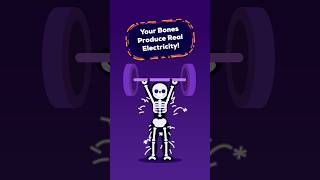

Your Bones Are Tiny Batteries
45sThe shocking idea that your bones generate electricity is a mind-blowing fact that sparks curiosity and shares easily.
▶ Play Clip"Title promises a fascinating fact and delivers exactly that — a clear, engaging explanation with no filler."
The video explains how bones generate electricity through a phenomenon called piezoelectricity, produced by collagen molecules when bones are compressed. It details how this electrical signal plays a vital role in bone remodeling and why exercise is crucial for bone health.
Collagen molecules in bones contain charged groups of atoms. When bones compress, these molecules slide past each other, creating an imbalance of charges — a tiny battery effect.
The charge is too small to shock you. To light an LED for one second, you'd need to walk for 19 years.
The skeleton is constantly rebuilt, directed by 42 billion osteocyte cells. Every step drives fluid through tiny tunnels around these cells, generating another faint electrical signal.
Normally, osteocytes tell bone-building cells to stay away. When bones are stressed, they signal builders to add new soft bone where needed.
Some scientists think the piezoelectric charge attracts minerals that harden bone, though the mechanism is debated. This explains why exercise is good for more than just muscle.
Even in your 60s, weightlifting can stop bone thinning and bulk up your spine.
Bones produce piezoelectricity
Reveals a surprising scientific fact that bones generate measurable electrical charge.
00:13Electrical signals drive bone remodeling
Connects everyday movement to a vital biological process, showing how exercise impacts bone health.
00:26Piezoelectric charge may attract bone-hardening minerals
Offers a plausible mechanism for how bones strengthen, though still debated.
00:54Exercise benefits bones even in old age
Provides a practical, motivating takeaway for older adults to maintain bone health.
01:06[00:00] Your bones produce real electricity. Collagen molecules, your bones' protein-building blocks, contain charged groups of atoms. As you walk, your bones compress and the molecules slip past each other,
[00:13] creating an imbalance of charges like a tiny battery. Scientists call this piezoelectricity. Luckily, this charge can't shock you. To light an LED for one second, you'd need to walk for 19 years.
[00:26] But these tiny jolts are part of a vital process. your skeleton is constantly being rebuilt, directing this process of 42 billion osteocyte cells. Every step drives fluid through tiny tunnels around these cells, generating another faint electrical signal.
[00:42] Normally, osteocytes tell bone-building cells to keep away so your bones don't become huge everywhere. But when your bones are stressed, your cells get the signal to call the builders in, adding new soft bone where it's needed.
[00:54] Some scientists think Cotogen's piezoelectric charge is what attracts the minerals that harden the bone. The precise mechanisms are still debated, but it's why exercise is good for more than just building muscle.
[01:06] So even in your 60s, weightlifting can stop your bones from thinning and bulk up your spine.




⚡ Saved you 0h 01m reading this? Transcribe any YouTube video for free — no signup needed.