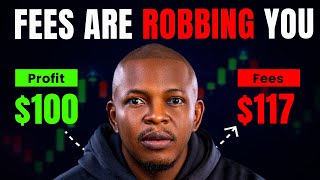

He Paid $117 in Fees on a $100 Trade
60sA shocking real example shows how fees can turn a winning trade into a loss, making viewers immediately question their own trading costs.
▶ Play Clip"Solid fee explainer, but the second half is a Delta Exchange ad — take the solutions with a grain of salt."
This video reveals how trading fees quietly destroy retail crypto profits by being charged on position size rather than the amount risked. Using a real $100 trade that racked up $117 in fees, the presenter shows how exchanges like Binance and Crypto.com wipe out wins and exaggerate losses, then offers two practical ways to cut costs.
A community member risked $100 and paid a total of $117 in fees to open and close the trade. A 1:1 winner would actually lose $17, and a losing trade would cost $217 instead of $100.
Many traders hit wins but end up with little or nothing because transaction fees quietly drain results. The video promises to show how exchanges calculate fees and two ways to pay lower fees.
Exchanges calculate fees based on the full position size, not the amount you risk. In the example, a $10 risk on a BTC trade with a tight stop produced a position size of $10,599.
Binance's taker fee is 0.05% and Crypto.com's taker fee is 0.07%, both publicly available on CoinMarketCap.
On Binance, open and close fees total $10.60 for the example trade. If it loses, the loss is $20.60; if it wins $22, the net gain is only $11.40.
With Crypto.com's 0.07% fee, the same trade costs about $14.84 in total fees (though the transcript says $47.84, the arithmetic confirms $14.84). Losing costs ~$24.84, winning nets only ~$7.16.
Same trade, same setup, but different exchanges can mean keeping $11.40 vs $7.16 from a $22 win — a massive difference caused purely by fees.
Delta Exchange charges 0.01% on BTC and ETH futures, making open/close fees for the same trade just $2.12 — keeping about $20 of the $22 win.
Delta's options fee is 0.03% but capped at 3.5% of the option premium, protecting traders on cheap, deep out-of-the-money options. Daily and weekly expiries are available.
Move contracts pay based on how much price moves in either direction, not which direction. This is useful for events like Fed decisions where direction is uncertain.
Delta Exchange offers a full demo account with real market prices and virtual money, including advanced products, with no expiry.
Scalping on 1-minute charts creates tight stops and large position sizes, multiplying fees. Trading 15-minute or 1-hour charts cuts fees and slippage significantly, though trades take longer to play out.
Fees are a hidden tax on every trade. Once you understand they are charged on position size rather than risk, you can protect your bottom line by choosing a low-fee exchange and trading higher timeframes to shrink position sizes.
What do exchanges charge trading fees on?
Position size of the trade, not the amount you are risking.
01:53
In the example trade, what was the position size for a $10 risk with a tight stop on a BTC scalp?
$10,599.
02:08
What is Binance's taker fee?
0.05%.
01:26
What is Crypto.com's taker fee?
0.07%.
01:26
If a trade risks $10 on Binance with a position size of $10,599, what are the total open/close fees?
$10.60.
02:08
On Binance, how much do you net from a $22 win after fees?
$11.40.
02:38
On Crypto.com, how much does the same trade lose if it hits the stop loss?
About $24.84 (including the $10 risk and ~$14.84 in total fees).
02:38
What is the first solution to reduce trading fees?
Use an exchange that charges lower fees, e.g., Delta Exchange's 0.01% BTC/ETH futures fee.
03:20
What is Delta Exchange's options fee and how is it capped?
0.03%, capped at 3.5% of the option premium.
04:51
What is a move contract on Delta Exchange?
It pays based on how much price moves in either direction, not on direction.
05:22
What is the second solution to lower fees?
Trade higher timeframes like 15-minute or 1-hour charts to shrink position size and reduce fees and slippage.
07:18
Why did the scalp trade have such a large position size?
Because the stop loss was tight on the 1-minute time frame.
07:18
Fees can exceed your risk
A concrete example shows fees turning a fair $100 trade into a guaranteed loss, framing the entire problem.
00:02Exchanges charge on position size, not risk
This is the single most important mental model for understanding why leverage and tight stops inflate fees.
01:53Exchange choice changes net profit dramatically
Same setup, same risk, different exchange — net profit swings from $11.40 to $7.16, showing fees decide outcomes.
03:07Move contracts solve direction-uncertainty events
A novel derivative that lets traders profit from volatility size without predicting direction.
05:22Higher timeframes cut fees by shrinking position size
The counterintuitive fix: trade slower to pay less, since fees scale with position size not risk.
07:18[00:02] Now, a member of my community took a trade with $100 and paid a total of $117 [music] in fees to open and close that trade. Now, think about it. If that trade was a one-to-one winner,
[00:16] instead of making $100, he would have actually lost $17 because it all went [music] to fees. And if that same trade had lost, he wouldn't have lost $100.
[00:29] had lost, he wouldn't have lost $100. He would have actually lost $217. Many people don't know how much transaction fees eat into their wins >> and make their losses even worse. That is why I am making this video. You might
[00:42] be trading, hitting wins, and still ending up with little [music] or nothing because your profits is quietly leaking into fees. But by the end of the video, you'll understand [music] exactly how fees work
[00:55] [music] I'm going to show you how exchanges calculate their fees and two ways you can start paying much lower fees. So, How do exchanges calculate their fees? Now, look at this BTC trade. It is a
[01:12] 2.2-hour trade and it went straight to take profit. Let's say you are risking $10 on this trade. Without fees, if it goes against you, you lose $10. If it goes your way,
[01:26] you'll make $22. Now, let's see what actually happens once you bring in >> transaction fees from two different exchanges, Binance and [music] crypto.com. Binance's taker's fee is 0.05%.
[01:41] Crypto.com's taker's fee is 0.07%. This information is publicly available on CoinMarketCap. Now, this is a key thing most people
[01:53] You are risking $10, [music] but your exchange doesn't charge you on the $10. They charge you on the position size of the $10 on that trade.
[02:08] So, for this trade, the position size is 10599. And you can work that out easily with the FS calculator by entering [music] stop loss.
[02:22] So, on Binance, these fees comes out to be 10.6 dollars to open and close the trade. >> That means if this trade goes against you, you are losing 20.6 dollars, not 10
[02:38] dollars. And if it goes your way, you are making 11.4 dollars, not 22 dollars. And it even gets worse with crypto.com because that fee is 0.07%, which means to open and close this trade, you pay a transaction fee of
[02:54] 47.84 dollars, making you a loss of 24.84 [music] making you a loss of 24.84 [music] dollars, not 10 dollars if you lose, and only 7.16 dollars if you actually win this trade.
[03:07] So, same trade, same setup, just a different in exchange and their fees. And look at how much money is disappearing because of this. So, what are the solutions? Like I said,
[03:20] there are two of them. The first one is to use an exchange that charges much [music] lower fee. Right now on Delta Exchange, BTC and ETH features are charged at [music] 0.01%. This is extremely low.
[03:36] And for the same trade above, the fee to open and close the trade is just [music] 2.12 dollars. That means you keep about 20 dollars of your 22 dollars win against 11 dollars on Binance [music] and 7 dollars on
[03:51] crypto.com for that same exact trade. Now, full disclosure, Delta Exchange is you through [music] the second way to stop paying high fees, Exchange offers and what makes [music]
[04:05] already know, that is the reason they fit into this video. Right now, BTC and fit into this video. Right now, BTC and ETH futures on Delta Exchange is just 0.01% in fee, which on the trade example we gave was
[04:20] the difference between keeping $20 and keeping $11. On futures generally, they sit around the big exchange fees around 0.02% for >> [music] >> And they run perpetuals and futures on
[04:35] BTC, ETH, and a wide range of altcoins with a leverage of up to 100x. Now, where they really stand out is in options. It's the product they are best known for. Their [music] options fees is 0.03%
[04:51] and this is a smart part. It is capped at 3.5% of the option premium. In plain English, on cheap options, where a normal percentage fee [music] would eat into a huge chunk of your
[05:06] trade, Delta caps it so [music] you're never overpaying. That protects you exactly on deep out [music] of money options most platform quietly bleed you on and you get daily and weekly expiries. So, you can trade short dated
[05:22] moves, not just the long ones. They also have a product I haven't seen in many places, move contract. Normally, you have to predict up or down. A move contract pays based on how much price moves in either
[05:38] direction. So, if you know a big move is coming, say Fed decision or major news, but you're not sure which way, you trade the size of the move instead
[05:50] of the direction. That is genuinely [music] a different tool here. And before you risk a single naira or a dollar on Delta Exchange, they have a dollar on Delta Exchange, they have a full demo account. So, real market
[06:05] but virtual money and every product including [music] advanced ones are there and they don't expire. If you are new to any of these, Practice first there before you go live with real money. Now, a few more things
[06:20] >> [music] >> You can trade more than crypto. You can swap futures on gold and US stocks like Amazon, Tesla, Google and Nvidia. [music] So, the same chart trading applies beyond crypto.
[06:34] For options traders, there is a strategy builder for multi-leg setup, basket order to place several trade in one click and also isolated, cross and portfolio margin modes. On their security, they have run since 2018. That
[06:49] is 8 plus years with no confirmed major hack, which in this industry actually Now, if you want to learn how to trade options, if you want to see the full breakdown video, I made a video about that and I will link that
[07:04] If you want to check out Delta Exchange, I will also leave the link in the description of this video. So, this is the first way to stop paying high um transaction [music] fee. The second way to stop paying high fees is this. If you
[07:18] look back at a trade I showed you, that was a scalp trade on the 1-minute time frame. Because of that, the stop loss is tight, Because of that, the stop loss is tight, which is why position size was so big at
[07:31] [music] 10,599. And fees are charged on position size. fees. And that is a trap. To to reduce the And that is a trap. To to reduce the fees by 10 times or even more,
[07:45] day trading >> [music] >> on the 15 minutes or swing trading on the 1 hour. That's where you pay much lower transaction fee. Your trade might take longer time to play out, but you
[07:59] get lower fee and even lower slippage. You can even actually risk much more account and pay lower slippage. And if you want to know exactly how I do swing trading step by step, then watch this
[08:13] trading step by step, then watch this next video.



⚡ Saved you 0h 08m reading this? Transcribe any YouTube video for free — no signup needed.