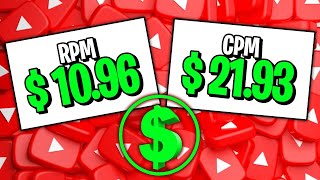

YouTube RPM vs CPM Explained Simply
45sDirectly addresses a common confusion among new creators, offering a clear, actionable explanation that hooks viewers seeking monetization knowledge.
▶ Play Clip"The title accurately reflects the content, which clearly explains the difference between RPM and CPM."
The video explains the key metrics RPM (Revenue per 1000 impressions) and CPM (Cost per 1000 impressions) for YouTube creators. It uses a real example from the creator's own channel to illustrate the difference and clarify what each term means. The core message is that CPM is what advertisers pay, while RPM is the creator's earnings after YouTube's cut.
Once a channel has 4,000 watch hours and 1,000 subscribers, YouTube runs ads and RPM/CPM become relevant.
CPM is the cost per 1000 ad impressions before YouTube takes its share.
RPM is the revenue per 1000 impressions that the creator receives after YouTube's share.
The creator's CPM was $24.08 and RPM was $11.46 for September, earning $706 US in ad revenue.
What does CPM stand for?
Cost per 1000 ad impressions before YouTube's share.
[0:31]
What does RPM stand for?
Revenue per 1000 impressions after YouTube's cut.
[0:14]
What are the requirements for YouTube channel monetization?
4,000 watch hours and 1,000 subscribers.
[0:52]
How do CPM and RPM relate to each other?
Advertisers pay CPM; creators receive RPM (which is lower).
[2:55]
Monetization triggers RPM and CPM
Explains when these metrics become relevant for creators.
[0:00]Youtube monetization requirements
States the specific thresholds needed to monetize a channel.
[0:52]CPM is cost per 1000 impressions before YouTube cut
Defines CPM clearly as the pre-revenue-share amount from advertisers.
[1:36]RPM is what the creator receives
Differentiates RPM as the actual earnings per 1000 views after YouTube's share.
[2:55][00:00] when our youtube channels reach a
[00:02] certain level
[00:03] we get monetized which means
[00:06] youtube then starts running ads in our
[00:08] videos and we start earning money from
[00:11] it
[00:12] so that's when we might start hearing
[00:14] the terms rpm and
[00:17] cpm but what do they actually mean well
[00:20] in this video i'm going to give you a
[00:22] very simple answer to that and it's
[00:24] coming up right now
[00:33] so here we are on my youtube channel
[00:35] mark warner social media selling one two
[00:37] three and this video is all about
[00:40] explaining the difference between rpm
[00:42] versus cpm and these become important
[00:46] terms or metrics for us all to
[00:48] understand once our youtube channel gets
[00:50] monetized that's right once you have
[00:52] over four thousand watch hours on your
[00:55] youtube channel and a thousand
[00:57] subscribers youtube
[00:58] start putting ads in front of your
[01:00] videos or ads within the videos and
[01:02] that's when the term rpm and cpm come
[01:04] into play so i'm recording this video on
[01:06] the first of october the start of a new
[01:08] month here in sydney um and my cpm for
[01:10] the month was 24. and my rpm was
[01:14] 11.46 so for the month of um september
[01:17] i've earned um 706
[01:19] u.s
[01:20] dollars which will convert to about 900
[01:23] australian dollars in advertising
[01:25] revenue so cpm and then rpm is how this
[01:28] final figure is decided
[01:31] so cpm is the cost per 1000 ad
[01:34] impressions
[01:36] before youtube share with me some of the
[01:39] revenue so what does that mean so
[01:40] basically what that means is advertisers
[01:43] are paying from last month what was the
[01:45] figure it was twenty four dollars and
[01:46] eight cents so last month on my channel
[01:49] advertisers were paying twenty four
[01:52] dollars and eight cents per 1000
[01:55] impressions of their ad
[01:57] placed in my video that's right so when
[02:00] the advertisers have to bid and place
[02:02] their um they're at in my video it is
[02:05] worth to them
[02:07] um or the bidding for them is 24.08
[02:10] now from what i understand my channel is
[02:12] pretty high you know the average channel
[02:14] could be you know i'm i'm feeling um
[02:16] people tell me you know around 10 that
[02:18] type of thing so the advertisers are
[02:21] determining my content and the people
[02:23] who are watching my content a little bit
[02:25] more valuable hence why it's a twenty
[02:28] four dollars in eight cents um cpm now
[02:32] that means the rpm is always going to be
[02:36] lower than the cpm because the rpm
[02:39] is what is paid to me the revenue share
[02:42] or the revenue split for the month of
[02:44] september and i'm using this as an
[02:45] example is
[02:47] 11.46 and it includes all the views that
[02:50] were monetized on my channel so it's
[02:53] pretty straightforward so again
[02:55] the cpm is what the advertisers pay the
[02:59] rpm is what i get paid in
[03:03] at the end of each month and and this is
[03:05] a really live example because we've just
[03:07] ticked over the end of september for the
[03:09] month of september the rpm on my channel
[03:12] was 24.8 cents which means the um sorry
[03:15] the cpm was 2408 the rpm 1146 earning me
[03:19] 706 um dollars in ad revenue us dollars
[03:22] which converts to about 900 odd
[03:23] australian dollars probably 930 which is
[03:25] pretty good for me so simple explanation
[03:28] what i want you to do i'd love you to go
[03:29] to um the comment section below um and
[03:32] let me know what your cpm is and your
[03:34] rpm because it will be different on each
[03:36] particular um channel and there is no
[03:38] right or wrong um you know answer to
[03:40] that you know some people are no doubt
[03:42] are going to be way more than mine and
[03:44] i've seen that already
[03:45] other people i know will be
[03:47] significantly less as well so go to the
[03:49] comments let me know your thoughts on
[03:51] that and while you're there don't forget
[03:52] to hit that subscribe button as well
⚡ Saved you 0h 03m reading this? Transcribe any YouTube video for free — no signup needed.