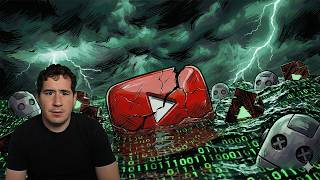

Best time to be a YouTuber?
40sChallenges common belief with surprising stats on creator deficit, sparking debate.
▶ Play Clip"Title accurately reflects the video's core argument about AI threatening YouTube's ecosystem."
Devon Nash argues that AI-generated video content poses an existential threat to YouTube's creator economy. He explains how YouTube's discovery and ad systems rely on a balance between supply (creators) and demand (viewers), and that AI will flood the platform with indistinguishable content, breaking discovery and collapsing ad revenue for human creators.
Devon claims that if the problems discussed aren't solved, it will be the end of content creators on YouTube and possibly all video platforms.
Contrary to popular belief, there are 2.74 billion active users but only 65 million active channels, resulting in a thousand times more watchable hours than content uploaded daily. It's actually the best time to be a creator.
Brands pay via CPM (cost per mille). AdSense matches ads to viewers based on demographics. Creators get 55% of ad revenue on long-form, 45% on shorts. Average ROAS is 2.6x.
The system functions as long as there are more viewers (demand) than creators (supply). Making consistent, high-quality videos is hard, so supply has been limited.
AI can now generate long-form video from a single sentence, enabling millions of videos to be uploaded, breaking the supply-demand balance.
With 1000x more videos, discovery becomes impossible. CPMs drop as brands have more inventory to choose from, making it nearly impossible for creators to earn ad revenue.
Examples like the 'old man' video (3.6M views) and real-time AI generation show that AI video is already convincing and will only improve.
YouTube has updated its policy to flag mass-produced or repetitive content, requiring human input. But as AI improves, detection will become impossible.
AI-generated content is already flooding platforms like X (Twitter). Video will be next, and moderation is impossible at scale.
Devon admits he has no solution. He suggests extreme verification but notes it's not practical. The goal is to get smart people thinking about the problem.
AI-generated video will flood YouTube, breaking discovery and ad revenue systems. Without a solution, the creator economy as we know it may collapse.
How many active users does YouTube have?
2.74 billion active users.
01:08
What percentage of YouTube channels have over 100,000 subscribers?
0.4% (top 0.4%).
01:59
What is the revenue split for long-form YouTube videos?
55% to the creator, 45% to YouTube.
04:49
What is the average ROAS (return on advertising spend) for YouTube ads?
2.6x (for every dollar spent, $2.60 returned).
05:31
What does CPM stand for?
Cost per mille (cost per thousand views).
03:49
What is the key condition for YouTube's discovery and ad system to work?
Supply (creators) must be less than demand (viewers).
07:48
What is the name of YouTube's policy against mass-produced or repetitive content?
The inauthentic content update.
23:44
What example does Devon give of an AI-generated video that got 3.6 million views?
A video of an old man (not real) giving advice about aging.
21:49
What is the revenue split for YouTube Shorts?
45% to the creator, 55% to YouTube.
04:49
What tool did someone use to generate an AI video of Devon speaking Chinese?
HeyGen.
27:50
Existential Threat to Creators
Sets the stakes: AI could end content creation as we know it.
00:02Creator Deficit, Not Surplus
Debunks common myth: there are more viewers than creators, making it a good time to start.
01:08YouTube Ads Have 2.6x ROAS
Key metric showing YouTube's effectiveness for advertisers.
05:31AI Video Generation Breaks Supply-Demand
Core argument: AI will flood the platform, destroying discovery and ad revenue.
10:08AI Video Already Indistinguishable
Demonstrates with real example (3.6M views) that AI content is already convincing.
21:49[00:02] this video is because I truly do not know how to solve this problem. And I'm hoping that people smarter than me will watch this video and forward it to relevant decision makers or smart people will be able to commentate and add to
[00:15] this discussion because this is not clickbait. This is not an exaggeration. I truly believe that if we don't solve the problems discussed in this video, it is quite literally the end of content creators on YouTube as we know it and
[00:28] quite possibly content creators across all video platforms as we know it. So, in two parts. The first one is to understand the discovery system that YouTube uses. The second one is this to explain the ad system and then we're
[00:40] kind of what is going on. Starting with creator discovery. So, there is a opinion on YouTube. You'll hear this all over the place. people that create on people that view YouTube in general, they'll be like, "YouTube is really
[00:54] creating videos on YouTube. There's not enough people to watch them. And so, if there would be no way for me to get discovered and I'd just be screwed before." And that's dead wrong. It's actually not true. As at the time of
[01:08] this upload, there's about 2.74 billion active users on YouTube. But there's only 65 million channels active to actually host videos for those users,
[01:20] accounting for about 1 billion hours of content uploaded per day, which sounds like a lot, but when you consider the amount of humans available to watch that content, what we call watchable hours, there's actually a thousand times more
[01:32] per day watchable hours than there is content uploaded. So for that reason you you search something on YouTube you search a topic and you get a video from like 2 years ago 3 years ago or four years ago that is literally because the
[01:45] there just isn't enough new stuff available to serve you that content that fresh and it just isn't there and and one of the big reasons for this is because if you look at this chart here from YouTube uh once you start getting
[01:59] uh creating consistent channels is quite rare if you just passing a thousand subs pretty unbelievable just to get partnered. And then to get it to 100,000 subs puts you in the 05.4% of YouTube. You're literally in the top
[02:13] 1%, double the top 1%. So, it's quite rare to have a consistent content of time and stay active on the channel compared to the number of people internationally that want to watch videos. So, we actually have a creator
[02:26] be really important to understand for what we're going to talk about later. deficit on YouTube. It's actually currently the best time ever to be a YouTube content creator as of the current moment in time. It's it's it's
[02:39] available that want to watch the stuff that you create. And you could easily be system. And if you go on to your YouTube recommended page, you'll probably find lots of videos being suggested that have 200 to 500 views and are just getting
[02:54] started because YouTube is has enough space available to recommend those uploading. It's actually a huge misconception that um all these people quite hard to do, right? It's even hard to be consistent and be successful.
[03:08] Okay, so that's part one. All right. Now, the second thing we got to understand before we start putting this all together is how YouTube's ad system works. So, as you probably know, as if you're a creator on YouTube, you get
[03:21] paid by YouTube to make videos, which is pretty cool. And the people that actually pay you are brands. Those are people that want to run ads. So, the way to understand the YouTube ad system, I I'm not going to explain like the whole
[03:34] thing because it would take an hour and I'm not your dad and you can Google it I'm going to explain enough of it to kind of understand like the context of this video. Okay, basically ads are the
[03:49] ultimate matchmaker, right? Like it's like Tinder on steroids. Okay, so let's say I'm a company and I'm willing to pay $10 per,000 views. Everything on YouTube is calculated in terms of CPM, which is cost per MLE or a,000 views. All right.
[04:03] So, I'm willing to pay $10 on a,000 views, but I want all of those people to be ages 32 to 38. I want them to be male and I want them to live in Texas. All right. So, what Google is going to do, it's platform called AdSense. AdSense is
[04:18] going to go out and it's going to say, "All right, um, what types of people are 32 to 38 and live in Texas and what kind of videos do they watch?" And then it's going to go look for some videos that those people watch and then it's going
[04:33] to say, "Oop, found one." And it's going to link that brand's ad to that video. the ad. And then Google gets paid by the brand because the brand paid them 10 bucks. And then there's a really simple split. Uh on long form video, it's 55%
[04:49] split. Uh on long form video, it's 55% to the creator and then 45% to YouTube. And then on shorts, that's reversed. And they say that's because uh I think it's music licensing is is why. And I and I believe them. It sounds
[05:03] right. So it's it's 4555. But either way, you get paid a large amount of that money that the brand um offered up to to to get your ad seen. And then uh there's the agency world on the back end that's like return on advertising spend to
[05:18] figure out that you made money because people that watched your ad end up buying your thing. And it turns out that like YouTube is one of the best ways general is one of the best ways to add advertise a product. And you can
[05:31] [clears throat] mostly expect about a 2.6 what we call ROAS, return on advertising spend. Uh so for every dollar you spend on AdSense, you will usually get about $2.6 6 back. It's pretty great. There's It's kind of hard
[05:43] to beat other than influencer marketing and a couple other ways there. There's like some meta ads and stuff like that. It's a great system. So, the AdSense system allows both brands and creators to get paid and YouTube to get paid. It
[05:56] really is a beautiful system. I mean, I'm an ad guy, so of course I'm a little bit biased on this, but man, it's so cool. The just the ability to monetize creators for having a voice. And I also want to just jump in here real quick.
[06:09] The ability for creators to ever have a voice even period is a rarity in human history. Right? We have lived an entire our civilization has lived through I guess four or call it 4,000 yearsish of actual development. During that time it
[06:25] has really been only in the last 100 years at all that we have been able to you'd be locked down you couldn't even read. you you were locked down by some noble that uh that that told you what to think and you couldn't even read a book
[06:39] to verify if he was correct much less could you have your own platform uh then even when technology was more prevalent we had news networks we had individuals that would dominate the airwaves and you could never have a voice so the thing I
[06:51] want to like echo is like right now is a precarious time it's an opportunity where like as an individual I can make this video on YouTube and nobody tells this video on YouTube and nobody tells me that I can or can't within reason. Um
[07:06] it's it's a really really cool thing and I want that cool thing to keep going. So I want that cool thing to keep going. So um we're going to talk about what is is and and now that you understand these two things. So I want you to understand
[07:22] the YouTube creator discovery and I want you to understand like the ad system and keep both of these things in mind as we talk about what's next. Okay. So the system that this is like this this is the system these two things this makes
[07:35] the system these two things this makes the system right and the system is fine it's great actually okay um and it remains great as long as
[07:48] the rule of supply is in effect what does that means
[08:02] demand, we're good. Basically, what does that mean? Supply meaning the number of people that want to watch videos. Demand meaning the Sorry, demand is the number of people that want to make videos. Try
[08:14] again. Demand is the number of people that want to watch videos. We did it. All right. The number of people that want to watch videos is demand. The number of people that want to create videos is supply. As long as we have a
[08:27] and fewer people that want to create them, there will be ads available and there will be u discovery to be had because there will be more viewers waiting for content to be uploaded like there is today which is great, right? Um
[08:43] YouTube was made with this system in mind because in in in in theory, right, there uh it it's hard to make videos. I I know a lot of people don't think that like They think that that that that uh it's the easy job. But but actually, if
[08:59] you want to make consistent videos and you want to upload interesting things and get people to watch it and you want to talk about interesting subjects and to do that and you want to get paid full-time, which means you you really
[09:13] have to have around like 40,000 to f 50,000 views per video and upload about three times per week if you want to make full-time income on YouTube. and uh assuming you don't have any other channels to do it. Um that's pretty hard
[09:26] videos and you've got to keep doing it and it requires a lot of creativity. So, um, that system in theory when YouTube kind of decided to make the system that kind of decided to make the system that way, it was built with all this in mind
[09:40] and they're like, "Yeah, there's never really going to be a time where we have really going to be a time where we have way more pe videos than we have suppliers like like like demand demanders for it. So, we're good and we
[09:53] And I can end that video. I could I can end this whole thing now, right? I could just close down this video and we can go watch something else. I I mean unless of watch something else. I I mean unless of course and this is just a of course
[10:08] right unless someone were to invent something that seamlessly generates video that seamlessly generates video actually long form video
[10:21] when prompted with a single sentence right and you could automate that and then create thousands of videos actually hundreds of thousands actually millions
[10:36] actually millions and upload them. Uhoh. What happens if and upload them. Uhoh. What happens if that happens? That's right. You have that happens? That's right. You have been snuck. You've been sneaked. This is
[10:48] a video complaining about AI [laughter] and you didn't even know it. But this is not a normal AI complaint video. Um, this is uh really the structure of >> [laughter] >> So, uh, it's a specific thing that's
[11:02] haven't heard anybody talk about at all. And, um, that is that that we're going to break down the problem here and kind of go over it, um, and discuss what's and and I don't know how to address it. So, so here here we go. I I guess before
[11:19] we do that, uh, I'll I'll do a couple of things. So, it's it's the this is going realm of a shorter video. So, it's 11:30. If you're still watching, u post in the comments the secret call at 11:30
[11:33] comments that you're still here. Also, um I have a couple of things that I do. I have a Patreon where I have like 300 videos now, usually like 30 to 40 minutes long that are discussing business and all the stuff that I do.
[11:47] patreon.com/devash, link in the description down below. It's $5. You get like 200 videos. I I teach business. I teach all the stuff I learned building two multi-million dollar companies and what I and uh pretty much put everything
[11:59] on there. Uh there's also a consulting link. I I I do do consulting, but be I haven't uploaded here for a while, my consulting queue is like four months backlog and I don't know how to fix that. So, I'm just trying to get back to
[12:11] I spend so much time on every individual project, I I can't do many of them. So, me in that email, please expect a wait and I'm sorry. Okay, that's that's I everybody um for like continuing to support this channel when I do upload
[12:27] videos and I I I do appreciate it. It's awesome. Let's get into uh what this problem is. All right, so you understand the creator discovery, you understand the ad system, you get like where we're at, and now you have AI coming in that
[12:42] is going to generate tons of long form video and it's going to upload like a lot of content, like a lot a lot, like way more than the YouTube system was designed to deal with. and way more than the YouTube system can deal with. So a
[12:55] couple of things are going to happen. The first thing to understand is we are going to have consumer grade video capability that is indistinguishable. That's a big word indisinguishable
[13:14] nonAI video. Let's put it that way. So there is like the what I'm saying is there is go we're going to consumers the ability to upload videos to YouTube a and create videos in general that you
[13:29] you cannot distinguish from real videos. All right. So, AI video is going to be some of the stuff in a minute that is going to absolutely blow your mind. Which means that if you've been following what this uh what what all
[13:43] this is leading to, we are going to have a supply problem. Now why that is a a supply problem. Now why that is a particular issue on YouTube is because particular issue on YouTube is because the discovery system is built similar to
[13:57] the ad system where the ad system assigns the appropriate creator to the appropriate brand. The discovery system assigns the appropriate viewer to the appropriate video. You you you go watch a video that you want to watch. And
[14:11] way and they've been up and down. They're pretty good at doing this. why they have the number one viewing video platform. Generally, when you go on YouTube, you'll have find some stuff you want to watch. So, the but but the
[14:24] only reason that's possible is because there is YouTube is able to individually and and algorithmically categorize these videos. And let's say that there's a
[14:37] if you want to learn about marketing and business stuff, like there's not that there's only one that talks about this kind of stuff specifically. And so, you watch the Devon Nash stuff. If you're crazy enough to watch a 30 minute video
[14:53] on how YouTube works, you come here, right? And and there's other people that talk about YouTube with 30 minute videos. Um, and they're maybe as good as me or not as good as me. I don't know. But either way, um, there's not that
[15:07] many. So, so, so what happens when there's 100 Devon Nash types of content or a thousand or or or 10,000? Well, the system breaks and all of a sudden, if
[15:19] system breaks and all of a sudden, if you have a,000x more videos, you just you have a,000x more videos, you just can't recommend all of them and there's can't recommend all of them and there's not enough people to view them. So, the
[15:32] Imagine a line that gets thinner and thinner and thinner and what ends up many videos to assign to too many viewers and kind of everything gets like
[15:44] instead of a video that would have got a thousand views, it gets like a 100 views get paid less, right? But it also means that there's less discovery which means there's less like momentum. The entirety of the YouTube system and algorithm is
[15:59] based on momentum. It's like viewers coming in watching content and then that content ramping up and and and boosting to other content like like to other ends up saying, "Oh, this is a great video." But that's not possible when you
[16:12] have like a thousand more videos in that subject matter or or or a million more. of supply discovery breaks down. But the problem with payment is even worse
[16:24] problem with payment is even worse because um if if if brands right now there's there's way more limited of fill for brands than there is for for people that want to watch videos that want to than people that want to pay to
[16:37] put their ads on them. And so if the I if there's it's even worse if you think category. Let's say in the all of the business categories on YouTube there's currently a hundred um videos total. Okay, obviously there's millions. But
[16:51] let's just imagine there's a hundred videos total in all of the business category that is YouTube. Okay. Well, if brands want to advertise on business related things, they have a choice of 100 videos they can access. And so the
[17:04] supply and demand econ economics of that dictates that the uh amount of available money will be the money they have distributed out to those 100 videos weighted for the videos that are good, right? Uh like the top videos get the
[17:17] But if there's a thousand videos, it's by definition 10 times less. And if there's a million videos, it's thousand times less. Right? So what ends up happening when there are too many videos in a particular category, uh, is that
[17:30] the CPMs and the amount of money goes down for the that the brands can pay and basically nobody makes any ad revenue. So not only is anything is anything is discoverable, all right, but also there
[17:44] situation where you get paid for it. And currently those are sort of those two The the topunnel, what we call Topfunnel, meaning that like YouTube is a legitimate discovery platform. If you've never heard of Devon Nash,
[17:57] watching this video right now that have never heard of me and they they have no interested in this topic or they they found or YouTube decided they'd be interested in this topic and so they they got they got uh they got served it.
[18:09] The people that are here that are those people should subscribe to this channel. of brands here that have never advertised on this video before and are advertising and showing ads on it. Uh because I the content I'm making
[18:22] in in all these circumstances, this is good for me. But if I if I if there's a hundred more videos about this or about uh business, then um that's not
[18:34] possible. And so essentially the entire system breaks down. And so, um, all creators effectively become, uh, unmonetizable because you your total
[18:46] views go down and you get out competed, but also because YouTube has to match a 100 advertisers previously to a thousand times more competition. And what do we do when we have a hundred 100 more channels that do Mr. Beast content? What
[19:00] channels that do talking head uh, business content? Right? It's just not untenable. Now, I know what you're thinking, [laughter] and we're going to get into the real scary stuff next. Like, like warning,
[19:13] get spooky, okay? It's going to get we're going to get real spooky. Real we're going to get real spooky. Real spooky time. All right. Um because you have a couple of thoughts maybe that uh you're you're thinking right now that
[19:28] are like but Devin um let's discuss some stuff you might have got wrong. some stuff you might have got wrong. number one reason that uh the number one
[19:43] thing you might have got wrong, right? Um just going to just going to list some objections here. Okay, AI video isn't ever going to be as good or as compelling as human video.
[20:00] compelling as human video. And for that, um I want to discuss something that has confused me for a long time. There there there's a weird problem that doesn't let some subset of hum significant subset of humans like
[20:14] you imagine AI as it exists today and you see that it's progressing and you know that it's progressing like these people when when put in a room and people when when put in a room and confronted will uh admit that that that
[20:27] AI is progressing and getting better but they like don't see a world where it can like possibly be as good as humans. Like take a look at the classic like Will take a look at the classic like Will Smith spaghetti test, right? We've got
[20:40] Will Smith eating spaghetti and here's like 2023. like 2023. It's like completely ridiculous. And like 2025, you can see he's enjoying his spaghetti a lot more believably. But
[20:55] his spaghetti a lot more believably. But still, I hear you say I I I I hear in my I I hear your comment physically, but Devon, I can still tell that's AI, okay?
[21:07] You can't fool me. I'm a master of this place. I have passed through shadow and fire and I grew up on the internet and there is no way that AI is ever going to there is no way that AI is ever going to fool me. I submit to you the following
[21:22] fool me. I submit to you the following video. Let's watch this for a minute. I'm 73 years old and I'm about to tell you something that might [music] upset you. Everything you think you know about getting older is completely wrong.
[21:35] [music] And the worst part, the people who should be telling you this, your parents, your teachers, >> uh, society, they're either lying to you or they don't know themselves. >> Now, if you have not been terrified by
[21:49] what I just played for you, you need to think again. Okay, this video has 3.6 6 million views on YouTube uploaded a month ago. 3.6 million 11,393 comments
[22:02] and it's this guy is not real. Just like the lady in the plane, it's not real. He's not real. Okay. So, and you might still be saying and I would believe you, but Devon, [laughter] I I I can I can see the the pixels, the
[22:18] old man. He's not real. I can see that. AI will never be as good as this, right? But like I just showed you Will Smith eating spaghetti two years ago and now I'm showing you this old man. Okay. And and like would your parents fall for
[22:32] your would would some of your friends fall for this? Okay. Like we are going to reach a point no matter what anybody thinks where AI is indistinguishable.
[22:44] Indistinguishable. There is no way to tell. So So like all the people that are platform and then we'll move over there." anti-A platform how there will be nothing that can aggregate there will be no way like sure like Google and Meta
[22:59] will have tags for their AI videos and like what is AI and what isn't but the on like DeepSeek some like some Chinese knockoff or something like you will be YouTube that has no tags on it that it's AI or not and it will be up to YouTube
[23:12] and Gemini it'll be a battle of the AIs it'll be Gemini versus whatever crazy thing that that the the other people come up with uh that that that decides es if the video is going to be um flagged as AI or not and to YouTube's
[23:28] credit and and like really to their credit. They have in uh July very recently just kind of started being worried about this and um this has been kind of the talk of the town on YouTube. There's been a big update called the um
[23:44] inauthentic content update, which you can kind of see here where it says uh mass-produced or repetitive content. This includes a template or little to no variation across video and content uh replicable
[23:58] at scale. Uh this policy applies to your channel as a whole. And it goes on to channel as a whole. And it goes on to say that um you must prove that a human This means adding commentary, personal opinions, unique editing, or
[24:10] transformative humor. Prompting the AI to make a video is high risk for like they didn't have to do this. It's actually super cool for creators that they're like taking a stance and they're saying, "Hey, like inauthentic like what
[24:23] we call AI slop content. You might have seen on YouTube. It's like monkeys pushing things into cars, stories about like obvious AI cats." Uh, now they're But YouTube has decided like, "No, this is like a threat to creators. We're
[24:35] there's like a lot of anti-youtube people and like there's a plenty of stuff that YouTube could be do better, but uh even those people should admit that YouTube making this decision to not propel AI content into immediate
[24:47] monetization is not to their immediate benefit and obviously like is them thinking about the creator in mind for the long term. So this is good. This is really good that they're doing that. A and I'm I'm a big fan. Um, but the the
[25:00] fact of the matter is that we're going to reach a point in time very soon where to reach a point in time very soon where AI video just simply is something that YouTube probably can't tell is AI or not. And and again, I I just don't like
[25:15] if you disagree with this point, I just think that you you there there may just not an ability to kind of project into the future. This technology as it exists to be today. And tomorrow it's going to
[25:30] better, a little bit better. As we've seen in the Will Smith exit spaghetti example affformentioned, it's going to get bad. But it's not just going to get bad. It's going to get crazy. So let's look at this. All right, I'm just going
[25:43] to show you this. This is the real guy in the corner here. And this is what he's generating in real time. All right, that's not real. This is real. This is that's not real. This is real. This is the real guy.
[25:57] cling. I I I mean again [laughter] I I I mean again [laughter] this is this is today. So So what I if if you don't [laughter] you don't see how how incredibly scary
[26:11] this is. I don't know what to do. Let me give you another one. Okay. Like like like it is it is going to get insane there. And these are all things that can don't have to have any knowledge of like video creation. These guys aren't coding
[26:26] anything. Like they aren't uh they aren't making anything. Here's another one. Watch this. >> Let's play some
[26:39] >> Hey Christopher, this is Juliano Maserelli. I was reaching out about the >> Like this is crazy. >> Did you end up getting that in place? asked I don't know how many times if you take it off drop.
[26:51] >> I'm good. >> What do we do? I I I mean so there are going to be thousands of Joe Rogan's thousands of of of Deon Nashes if they if I ever get to
[27:04] that point. There's just going to be no way. I mean like like all of society is YouTube, [laughter] right? It it's we are so woefully behind right? It it's we are so woefully behind as a as a as a as a species to be able
[27:18] to deal with this. Okay. And look like like like just for fun. All right. like like just for fun. All right. Here's an AI video of me.
[27:37] know, I I I don't I don't I don't speak Chinese. [laughter] Chinese. [laughter] So, um, like that was super easy to generate. And this was generated by, uh, someone in our in our Patreon community,
[27:50] this dude's super cool, using Hey Genen in like 10 seconds. Like, it was it was generated a year ago. So, imagine what you can do now. I mean, this is this is you can do now. I mean, this is this is me. It's it's it's
[28:08] do you do? Like, like, it's just it's just gonna be crazy. So um just gonna be crazy. So um there is no way right like you can't there is no way right like you can't really uh moderate it out. You can't
[28:22] really uh moderate it out. You can't create a different platform and there is no way to tell this apart and this will come to YouTube in the
[28:35] and this will come to YouTube in the form of millions of videos. And a great place to kind of see this in action right now is like the X platform, formerly Twitter, where you can see like there is so much like GPT and and and
[28:52] related like LLM. They they they currently write in a way that if you've kind of tell what what their what what their writing is. And uh they'll use things like it's not exceptional. It's a total mind game
[29:08] and it'll like shock you if you people that use X on here will post their in comments and they'll they'll they'll confirm like what I'm talking about. platform and they're trying to moderate it and they're they're trying to stop
[29:23] it. They're trying to like deal with raw AI slop like Grock putting bikinis on okay. Like they're they're trying but it's just an onslaught. It's impossible. So imagine that problem at scale with video. And so normally, like if you've
[29:38] watched some Devon Nash videos, you'll you'll be used to like at this point, I'm going to be like, well, here's the conclusion and here's the problems that I'd suggest uh we think about and here's some of the solutions that we could
[29:54] maybe think about to address these problems. That's not going to be in this video. I have no solution to this problem. I I like the the nearest thing that I could maybe think about is like extreme draconian verification where but
[30:09] like all people will have to be retrained that like if you see a video that is not on the official Devon Nash channel, the official Joe Rogan channel, the official white house.gov, the official I don't know, right? Like it's
[30:23] not real or could maybe not be real. And and with it and this is so soon I mean publicly available. You can go to Cling AI and you can do the thing that those guys in the webcam were doing wi with um Leonard DiCaprio and and this old guy.
[30:38] you could do that with like fairly minimal effort. And the consumer grade to get more extreme as the year goes on. By the end of the year, this stuff will be everywhere. Like we're not like this is not a distant like 10-year thing.
[30:51] Like who the hell knows we're going to be in 10 years floating balls of energy or we destroy ourselves. I don't know. But this is where we're at now. So these problems need to be addressed like right now. And like in partic like what's
[31:03] vulnerable populations like older people that are that could be scammed. You could just set up as somebody's son give them a call on Zoom or something and be like, "Hey, I'm I'm in a car accident or whatever. I need $100,000 for a surgery
[31:17] or something. Um generate a couple AI images of you in the hospital." And it's a huge problem. So uh the objective of this video is not to solve it. I don't know how to solve it. is to get more smart people thinking about it.
[31:30] [laughter] And so I'm sorry if for that reason it kind of comes off as a little bit doomer. It's it's it's it's not it's not trying to be. It's just that I I I truly think that the current system we have on on um this this content creator
[31:45] hundreds of videos about this. I'm fascinated by the topic, right? I I I'm so excited about the uh the the ability to be a content creator. I I I love space and I don't want it to go away. I I I think we're at a very important
[32:01] I I think we're at a very important point in history where we have for uh again only in recent memory has content creation as it exists now been even available to humanity, the the majority of humanity and to keep it. I think we
[32:15] are going to have to start thinking about problems like this and what to do about them. And as a community, we're going to have to respond. So, that's the thought lead in that direction hopefully. Uh, let me know what you
[32:28] think. It's heavy stuff. Yeah, I'll be back. Thanks everybody.

⚡ Saved you 0h 32m reading this? Transcribe any YouTube video for free — no signup needed.