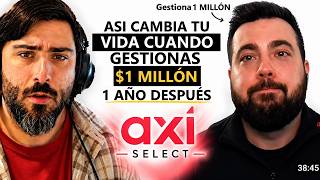

The Dark Side of Hitting $1M in Trading
60sReveals the psychological struggles and risk-taking mistakes after reaching a major milestone, offering a cautionary tale that resonates with traders and aspiring investors.
▶ Play Clip"Delivers on the promise of revealing untold truths about managing a million, with genuine insights and specific examples."
In this interview, Fran, a trader managing a million dollars through Axi Select, shares his journey over the past year, including quitting his job, moving to Bulgaria, and the psychological challenges of managing a large account. He emphasizes the importance of consistency, risk management, and having a financial cushion, while debunking myths about algorithmic trading and the need for constant adaptation.
Fran reached a million dollars in February of last year, after a year of consistent withdrawals and building a financial cushion. He emphasizes that it didn't happen overnight and required careful, gradual steps.
After reaching the million, Fran experienced a psychologically complicated stage, where small profitability (0.5%) translated to significant dollar amounts, leading to overthinking and mistakes. He had a drop of almost 6% in April but recovered it the same month.
Fran added more systems (Bitcoin, DAX) and increased risk by almost 2%, which led to bad months. He then reconfigured back to a more conservative approach, reducing risk to 0.75% and aiming for 1%.
Fran quit his job only after reaching a million and having a financial cushion. He had been withdrawing for about six months and calculated that trading could generate more income than a conventional job. He emphasizes it wasn't impulsive.
Fran shifted from trend-following to breakout systems because markets changed, especially with gold. He constantly develops and tests new strategies in demo mode for three months before implementing them, emphasizing trial and error.
Algorithmic trading involves constant development, monitoring, and testing. Fran spends time creating strategies, analyzing metrics, and adjusting portfolios, which is grueling but necessary for survival.
Fran shares his Axi Select account, showing a track record with a 1.14% monthly return, 43% total return over 2.5 years, and a 47% win rate. He highlights consistency, with only one negative month.
The key to managing a million is survival, not trying to make a killing. Fran advises against increasing risk after reaching milestones, as that leads to account blow-ups. He emphasizes consistency and psychological control.
Fran describes a terrible period after becoming self-employed, where he had to combine accounts and faced Murphy's Law. He stresses the importance of having a financial cushion and humility during tough times.
Fran advises being prudent, having savings to withstand bad months, and not changing strategies even during 6-month drawdowns. He emphasizes risk management and psychological stability.
Fran's journey highlights that managing a million in trading is about consistency, risk management, and psychological resilience, not quick wins. His advice: build a cushion, stay prudent, and focus on survival over making a killing.
What was Fran's monthly return on his Axi Select account?
Approximately 1.14%.
20:53
What was Fran's win rate on his account?
47% positive trade rate.
21:46
What risk level did Fran initially increase to after reaching a million?
Almost 2%.
04:46
What is the key to managing a million according to Fran?
Survival, not making a killing.
25:10
How long does Fran test strategies in demo mode before implementing?
Three months.
10:46
What was Fran's maximum drawdown in April?
Almost 6%.
04:31
What advice does Fran give about financial cushion?
Have savings to withstand many bad months.
36:27
Psychological Impact of Large Account
Highlights how small percentages translate to large sums, causing overthinking and mistakes.
03:17Quitting Job After Cushion
Shows the importance of financial planning before making major life changes.
06:18Constant Strategy Development
Debunks the myth that algorithmic trading is set-and-forget; it requires ongoing work.
12:13Survival Over Making a Killing
Key principle for long-term success in trading.
24:02Prudence and Cushion
Advice to have savings to avoid impulsive decisions.
35:56[00:02] think, is ultimately maintaining it; I'm going to keep working until I practically reach a million. I passed the month to February, I collected the January payment, which was 5000, and then the million passed and I collected another 11. I had already been withdrawing $0000
[00:16] each month. Once I had a financial cushion, I realized that this would generate a significant income, because in two or three months you can earn what you would earn in a year of conventional work. Well, yes, but of course, it didn't happen
[00:29] overnight. Things have to be done with your head, carefully and little by little, right? Look, I'm creating every day. It is true that this year I have made more types of breakouts and I test them after three months in demo mode,
[00:42] work well and I consider that it is correct, then I change it. In other words, not everything works out the first time, it's all trial and error, right? A lot of trial and error, and then you take them out, look at them, Then you put it on and it doesn't work. The point is that survival is always important
[00:57] , even when you have a bad period of minus 5, minus 6, keep doing the same thing and it's about consistency. Hi Fran, how are you? Hello . One year, one year later. One year later, dude. One year later. We were just
[01:10] time seems to fly by, and it's true that it sounds like a cliché, but it's the truth. And we held at Axi there in Madrid, which we were talking about, and it was spectacular. the way, which is good to know, that [laughs] you were enjoying yourself there. Those were
[01:25] very intense days, it was really cool and we also have to thank Axi for all of this because the truth is that both the Rich thing and everything we experienced there, the interviews and all, but well, more than
[01:38] totally, man, and being able to share a little because otherwise this 100% 100%. Ultimately, for me, that's the key , isn't it? We can go out to eat, chat for a while, and not just about trading, but in general. I talked to
[01:53] nothing to do with trading, and that's also appreciated, isn't it? You're there a little bit and know, man, I really liked it. Yes, yes. Well, in the end I spoke more in 4 days Yes, yes, yes. 100% 100% true, eh, it's a great truth. And there we met.
[02:07] a little update on how your trading situation is going. As the video we made a year ago where we chatted, and you were raising some very interesting points, right? Because you were in a situation where you did
[02:21] n't know whether to leave your job or not, you were already starting to see a year now managing a million dollars, which I understand is the watching us, saying, "Hey, look, so what happens in that first year, right? Or is it the
[02:33] first year and a bit since you reach such a big milestone as a company like Axis Select? So, I'd like to catch up with you a bit . Would you like to? [clears throat] Yes, yes, of course.
[02:46] Tell us a little about how this year has been. This year, well, a thousand things have happened, really. I don't remember exactly if I had already gone to the movies when we spoke, I do Um, the previous event was another Axi event, so during that
[03:01] , it was done . Yes, yes, of course. Right. Well, then I went to Australia, which was also awesome, and then I became self-employed and dedicated myself
[03:17] What Well, that's great. Um, during that year, well, a lot happened when I reached the million, to be honest. A lot happened. It's moments where I increased the risk, changed my trading strategy, and added more
[03:33] do, okay? What you should never do. And well, psychologically, complicated stage, the complicated stage because you start to
[03:46] see that with very little profitability, like 0.5%, you already have 0.5%, you already have 3,500 or 4,000. Then you see the numbers and you think, "Wow, if I make two good trades of 60, I've
[04:04] Yes, that's right. Then you start overthinking it and you start making mistakes, right? It's very common. absolutely. It's very difficult to get there.
[04:16] really. But even more important is to persevere and try to do things right. So, well, in April I did have April I did have a drop of almost 6%,
[04:31] if I remember correctly. I recovered it the same month; it was a historic save. How great. And after that, I added more systems, I added Bitcoin, I added DAX systems, so I increased the risk by almost 2%, and what
[04:46] had to happen, happened: a bad month, and then another one, at least. After that, I reconfigured it a bit, went back to how it was, and I stayed like that from what would be
[04:58] July, June, July, August, September, back to break-even. And from then on, I left the portfolio well configured and let it run , let it do what it has to do,
[05:11] , let it do what it has to do, increasing the risk, I think it's now at 0.75%, if I very good, and to try to achieve a 1%. And a
[05:27] and to try to achieve a 1%. And a very conservative approach, very little, and that it very conservative approach, very little, and that it goes on, or totally the key, what you say in the end is that it's not the same to operate when you're
[05:39] reach that stage where you're more consolidated. What matters is right? That with a very small return the results are very what it achieves and therefore you have to take it easy, think very carefully about what
[05:53] otherwise... Totally, totally. Hey, and I'm very trajectory because of everything you've mentioned, just briefly, because, well, of from the inside and perhaps you've normalized it, but just the fact of leaving your
[06:06] job, that seems like a very big leap for a person, doesn't it? In the many doubts, if it was easier for you... Because you were more settled. Can you explain a little in case many people reach that point and are having doubts?
[06:18] How did you deal with it? No, look, I dealt with things okay? I mean, I kept working until I practically reached a million. Suddenly I received a payment of, I think it was 5,000,
[06:33] okay? No, sorry. The month passed, February arrived, then I reached a million and received another 11,000. And I thought, let's see, is it really worth it? I had been with Axi for a year, a year and two months, and I had been
[06:49] withdrawing [clears throat] practically every month since July, August, September December. I mean, I had been withdrawing for about six months, even in October and November, another $4,000 each month, January too. In other words, it took me
[07:06] month, January too. In other words, it took me almost a year from when I started to quit . No, it wasn't that I quit tomorrow for the first pot. No, it wasn't like that. Once I had a cushion, I saw that this was
[07:20] generating a strong income and that it was worth it because maybe in two or three months you can earn what you'd make in a year from a conventional job. Well, then year from a conventional job. Well, then yes, but of course, it wasn't
[07:34] overnight. So, it was a whole process. I became self-employed, then I left the country, now I'm in Bulgaria trying to start a business here and see if I can do things as well as possible. So, well, it
[07:47] was a year of quitting my job and another year of leaving Spain, and you have to do things with your head, carefully, and little by little, right? No, this idea of jumping in the deep end after the first pot, well, it's your decision, but it's not
[08:02] Absolutely, because above all you don't know how long it's going to last, that in the what you've done makes perfect sense: see a bit of You do it, which wasn't a matter of chance, but rather the result of hard work, and that's when you start to think about it
[08:16] , but it seems incredible to me. Of course, so job, but I already had, I mean, I calculated roughly what I would spend in a Right. I mean, it
[08:30] wasn't an impulsive decision or anything like that, you know? That's it. Totally, man, totally. And once that process happens, which you said was about more or less. Yeah, I reached the million in February of last year
[08:45] . In mine, a little longer. the portfolio strategy or strategies you used at the beginning until now, when you say you've made changes, there's been a change or is it pretty similar? Let's
[09:00] see, when I added more systems, when I made adding it, risk, that's
[09:12] all. And now it's true that this year it was about looking very closely, trying to move away from trend-following systems with very large ratios, and trying to replace them with systems that have the same risk and are very similar in terms of operations,
[09:26] symmetrical and so on, but more like breakouts because, since it moves so much up and down well, trying to get smaller ratios and a bit more breakout-oriented, not so trend-following, because
[09:40] gold until January of this year. So, of course, if you got in and caught the rise, wow, it was spectacular, it was a smile every day. Yes, yes,
[09:52] but of course, now it hasn't changed. We've had a few months, I think, that have been very especially for manual 3D trading. Wow, it's complicated, really, Wow, it's complicated, really, having four or so months that are so strange.
[10:07] Mm. Yes, it's about adapting to survive. Well, you can't really do that. Look at it differently that myth to debunk—that many people think you just hit the right note, right? Saying, " strategy, and all that, so I just relax and let everything work." And
[10:20] depends on the market, the current conditions, you have to tweak certain things, not many, not make big changes, perhaps driven by the say, "Damn," as you say, right? Maybe if a market isn't showing me trends, then I
[10:33] ratios, on other types of systems that might survive better in these kinds of situations. I think that's brilliant. How do you do that a kind of fleet of strategies that more or less cover those kinds of
[10:46] inefficiencies, and you activate them, you create new ones? How does that work? Well, I'm creating this news every day. Then I have, yes, it's true that this year I've done More types of breakouts, not so much trend-following. That's what
[11:01] worked really well for me last year, in demo mode. After those three months, if they work well and I think it's Okay. And I have a little bit of everything,
[11:15] really. I have reversals, trend-following, and breakouts. So, well, it's about evaluating For example, January is very good, then February, March, and April are bad. Okay, so we
[11:28] have to reduce the weight of some. We put more weight on others, more or less, so they're similar put more weight on others, more or less, so they're similar in terms of the number of trades and the level of
[11:42] risk I can assign, okay? The same risk management, and gradually giving more weight to one thing or another, so that in three months it changes, and I in three months it changes, and I choose those. I already have portfolios
[11:57] set up; that is, they 're running all the time. Sure, sure. That's if the other system changes, well, I'll modify it, either partially or completely, since I already have it prepared.
[12:13] Of course, that involves work, a lot of work. Of course, work behind the scenes that is Absolutely, absolutely. Yes, because many people with algorithmic trading think it's system, a portfolio, and then letting it run. But it's what
[12:25] day. I understand that your main workflow, your outside of trading, more about creating, updating, preparing for future environments, I understand, right? Yes, of course. That's about
[12:39] constantly developing strategies, and then you implement them. Then you see the metrics it gives you in real time, so to speak, the ones the program gives you, plus you keep track of everything to make sure it's
[12:52] working, and then you keep developing out completely new things methodologies. So, then you take it, I don't know, I don't know how, maybe
[13:08] if you don't know much about the program, but you try different types of but you try different types of exits: trailing, moving, simply leaving the Stop Loss or Take Profit, leaving it open if you want it to last through the
[13:21] leaving it open if you want it to last through the weekend or not, if it's worth it, if you want you want to use a slightly more pitch-like methodology with shorter periods or leave it with more ATR based on market data, depending on how you
[13:35] want it, how you see it. So, it's about building and racking your brain to see what you can get out of it, okay? And then also for different services, gathering the data and
[13:48] configuring the instruments to extract data for different types of things or services. So, it's about setting things up, monitoring, and a lot of testing and data. It's a bit
[14:01] grueling sometimes, to be honest, you don't have very good weeks, well, I'm Here I am with the computer creating and I don't have that much work to do, and I don't know , well imagine the week of the 15th to the 21st to the 22nd, well, you spend that week
[14:15] , but well, at the beginning of the month you do have to analyze everything see if you make any modifications, you put other new instances in place, that algorithmic process is very clearly reflected , you know?, of saying, "No, it's that in the
[14:30] that have to do with research, with development, with, you know? It's like different stages, I understand, within trading that are distinct and involve different functions, right?, that the trader has to have. And that
[14:42] that, I mean, I don't know if many people think of trading as more, uh, all the time, but I also think that part of trading has something home, or even in another country like you, researching strategies, creating, I do
[14:56] n't know, that seems to me to have something magical about it, right? Yes, look, that's the cool thing about it, when someone tells you an idea or you say something and you say, "Ah, okay, well, maybe I can stick this machine gun in here and see if it works and I
[15:10] can get it out this way, I don't know, from the mooring or you Yes, I'll also tell you one thing, I mean, not everything works out the first time and it's all
[15:22] trial and error, you know? A lot of trial and error, and then you take them out, look at them, and say, "Wow, that's cool." Then you put it on and it does n't work. It does not work well. No matter how many B tests you run on MT5, no matter
[15:34] how much you put it in demo mode, it doesn't give you the metrics, while others that are more consistent later on stand out or shine when it comes to doing things. So yes, look, that's the beauty of it, like I said, for me the beauty is that it
[15:48] gives me a lot of freedom because, like I said, I can work, I can do things on a Saturday, a Sunday, or I can go to Madrid for four or five days to do the event and not have problems of, well, I'll
[16:01] leave doing this here in the background and when I get back I'll have it ready, I'll get to it. So, of course, it gives you the freedom to manage your time in a very, very different way.
[16:14] could you share that now? I'd like to ask you a little about that how you experienced it, because I find it really interesting. Um, can you in Axi so we can see what the situation is like and ask you a bit, do
[16:29] see it. Okay, I have two identical screens and no, no. Perfect. So, well, now that I've noticed something, this does you're in the middle of the game, you can see the whole track record, right? In other words, they don't
[16:44] update it for you, right? That's great, that's great, that's great. great, that's great, that's great. Well, here it is, as I said, in February of last year I reached one million.
[16:56] Uh, this month was really weird because it had like 20 days, okay? I'll tell you a little bit about how the whole story went. I was 20 days old and had almost story went. I was 20 days old and had almost 2% or something like that. I already had $0,000 there
[17:12] in projected profit, and because I was stubborn and wanted to see the 20 at the end, look how the month ends instead of taking it and deciding, it's cut and totally out,
[17:27] but well, things happen, then what I told you in March, very well, here in April was the big fall, little more risk in. But he was very heavy on gold and he recovered me. Just as it
[17:42] fell, it rose less in May. Very well, almost 2%, that is, it's outrageous, it's 2% here so people get an idea. Well, 1% is Okay, more or less. Yes, yes.
[17:57] Yes, yes. And then came -4, which ended at minus 2. Well, no, sorry, here came minus 6 in this season. Yes, yes. -2.56, -2 with 1. Here I added more
[18:13] weight to the Dax, I added Bitcoin because I had just that, what I'm telling you, portfolios that had gone well for me, January, February, March, April and May had gone positive every month. Already.
[18:25] sure, sure, sure, they're for me ." Yes of course. If I build portfolios of both Bitcoin and the DAX and they last 5 months, I do n't apply it, apart from the fact that I was heavily invested in gold, right? Although I had one
[18:40] remember correctly. M. Then I said, "Well, I'll put it in." Well, look, I figured I'd include it , that's fine, although in August I recovered and ended up a little bit in the black. Like I said, then came the recovery and
[18:54] here, I think it was in October when I put the portfolio that had to be there. Okay, so October, November, that part recovered. Everything has recovered well. It is
[19:08] the year's figures weren't very spectacular, but well, like I said, here we have to end, and so that, well, this was also
[19:20] because they went very well, especially the gold, okay? And then this year, well, look, I have a risk, as I was saying before, of 0.75 to try to reach 1.5.
[19:32] Yes, it's true that I started changing the trend thing here, changing the trend thing here, okay? More breakout-type games with the same content. So, well, February is just that . For me, a -020 and a -030 is
[19:46] more or less like bricking the break-even point because they are two operations. 's not much. And then, well, that's it, March, April, May. Okay, I have one month with April, May. Okay, I have one month with 1%, another with 0.22%, one with 1% and 0.28%, and
[20:00] this one is 31. Let's see how these three days end because I've also been noticing that in recent months, things usually happen in the last few days of the month, okay? There is a lot of volatility. So, since there are
[20:13] we finish the month. Yes, it's true that I was at the month. Yes, it's true that I was at a 05. I fell on Friday and today I had a couple of DSLs. Well, 031, like I said, with 031 it's 2,500.
[20:27] Dollars. In other words, if I make a couple of good trades or three, Yes, yes, absolutely. No, that's all. Um, what else? I have it
[20:40] in the one I put it in, right? So that it can be viewed, for example, in Myic book. Yes, if you can see the whole account, okay? So that the metric can be seen
[20:53] clearer. So, on a monthly basis it 's roughly 1.14. The maximum return has been 6.8%, which the account has had in total over these two and a half years, and it has therefore reached 43% with
[21:08] only modified it those months last year, which was when I shouldn't have done it, and well, in the end, a total of and well, in the end, a total of
[21:22] of everything withdrawn. This is so that the metrics are a little more visible. Okay, 1700 in total, if you notice, I
[21:34] also have short positions, I also implemented that this year and well, you can see that I do n't win absolutely all the
[21:46] trades, I mean, I have a 47% positive trade rate compared to 53%, that is, it 's not always winning. The average win. I see that the ratio must be roughly one to five, more
[22:02] or less, right? 1 cu a un. Yes. Very good. That's great, man. over 41. Yes, I already told you, but well, that's by a lot because of the , but it's very good. Yes, they are very good metrics
[22:16] and I'm telling you that the risk is, for example, the uh here that counts it, it doesn't count it as an axi, uh as you can see, well, more
[22:28] or less it's always a lot of consistency there, a lot of consistency of the 24 well it's a wild thing, I mean, except for one month absolutely everything positive. Sure, a year like that changes things for you, huh? That's why
[22:42] , I mean, imagine, I started in January of '24 because on December 23, well, maybe I started it in December or I don't know. started it in January. Well, look, I think I started it in December and I had
[22:57] the first bad month, men05, but well, after that, as you can see, it's all good now . Yes, yes, yes, yes. This bump in the road that was the change, it's that no, you don't have to
[23:10] make changes, you have a methodology and that's it . And this year looks like it will be very similar, a lot of consistency and many positive months. That's most important thing for me, and what I think people want to take away from this—and I
[23:23] hope they do—is that in programs like Dark Select, with in programs like Dark Select, with 1%, as you say, that's $1,000,000. That's what needs to change your mindset, because nowadays people still think a lot about
[23:36] a lot, and that's fine, it's one option, but there's another one like this where, with, as you say, 4% annually, you're already going to earn a salary that here in Spain, for example, is top on average, I mean, 32,000, you know?
[23:50] That is, with 4% annually. So, those kinds of things need to be considered knowing when to take risks, and what kind of strategies to use. Well, that's something we need to Completely. Excellent.
[24:02] Of course, having a management style that aligns with what you're doing on the program, which is truly one what you're doing on the program, which is truly one And in terms of cost,
[24:16] it's hard to reach a million, but hey , it's the best there is. we were at that event because all 10 of you were there, right? There were 10 of you who had reached a million, huh?
[24:28] . Twenty people have already reached the million mark, and currently there are about twelve. In other words, they've fallen, they've fallen, they've hardest part is staying in the game. It's about staying put. It's about staying put. Yes. I
[24:42] with Greg, who's the CEO, right? He was from Ax Select, and asked if he was responsible. The person responsible, right? Perfect. And I was asking him traders who reach a million, for example, from doing what you did. In other words, in the
[24:57] of wanting to survive in the long term, managing the risk well, but I understand and want to make a killing, then that's where the accounts break down. So, what avoid that? When you get to Mellón, the important thing is
[25:10] survival, not so much trying to make a killing, right? The point is that survival is always important, even when you have a bad period of minus 5, minus 6,
[25:22] keep doing the same thing and that's consistency. In the end, you want to, you have a consistency. In the end, you want to, you have a drawdown, you're in a hurry or something, and you say, large trade and cash it out or something." No, not those kinds of decisions, or when you reach a million
[25:37] and you say, "It's happened to me too." Yes, that's why , that's why I say it. You say, damn, I see this, let's increase the risk. Well, there it goes Completely. Completely. So you have to, in the end it's
[25:51] So you have to, in the end it's psychological to look at what kind of account you have, how you're managing it, how you're doing, and adapt to that. I mean, it's not much more than that. If you want to carry out
[26:06] the operation and you want to add more substance to it, then get another account and that's too bad. Ultimately, it's a learning process; I think you have to experience it because
[26:21] told that many times. Yes, yes. And until it happens to you 're not aware of it anymore. And for example, it's happened to me too, just And for example, it's happened to me too, just now talking to the people at Axi, I might
[26:36] make a copy. I already tried to do it, but of course, I tried to do it one way, I also make mistakes, eh, out of 10 things I do, only one turns out right. Well, and if I'm lucky, two. I
[26:48] mean, it's incredible. Then I set up a very high risk that would be 10%, 12% all gold. That's enough. And well, a loss of 5000 out of
[27:02] 5000 that I increased, 4000 out in 6 months. So, of course, I've already put it another way of saying, wow, well, maybe if what I have to do is something similar to what I do with the million,
[27:17] more relaxed, okay, that's a very low risk, an account of the same, 0,000 that anyone can join, and if you want to put in 10,000 and you want to put the risk at 20, well,
[27:30] that's up to you. Yes, that's right, yes, yes. I don't mean to say that in the end I think what needs to be done is something that is very stable over time with a very controlled risk and that you can ride out
[27:45] controlled risk and that you can ride out bad 6-month periods and then if people want to invest and add the multiplier they consider appropriate, well, multiplier they consider appropriate, well, that's at their own risk. What I
[27:58] ultimately wanted was to give it a really spectacular climb. Hm. and in the end they didn't. Yes. Uh, it's what you were saying before, this is a long-term world and what counts is surviving another year,
[28:14] and the bombshell might work out once for every ten times it goes wrong. not worth it. I agree. It's not worth it. 100%. And the Drown process, for example, which I asked you about earlier,
[28:28] obviously, you have spectacular results, you've managed to reach 're settled, you're comfortable, you're relaxed, but in that process, if you look back you started doing strange things, you started changing things there after, I understand
[28:42] that if you already made the leap of leaving your job, how do you you make a significant leap of faith in terms of, hey, I'm going to leave my job, I have two or three years of leeway to make this work out, and then
[28:54] your head? What was happening there? It was terrible, that lid was terrible, wasn't mean, I haven't been in bed for three days already , man. Well, look, I was a freelance magician, I quit my job as a freelance magician,
[29:09] okay? And right there in May, which was the last month, well, that's when I became self-employed, July, July and August. Terrible. the moment Murphy's Law, Murphy's Law, uh, is
[29:22] incredible. And I had to say that it was the change in conditions of Axi, which was that before with 5000 you could already operate a millan. To be honest, that change didn't work out well for me at the time. I was self-employed and
[29:36] had three other accounts with the portfolios I mentioned—DAX, Bitcoin, and other things—already working, and NQ was also generating returns. Suddenly, I have to take
[29:50] four accounts of 5,000 each and combine them all into a million. I mean, suddenly I have to before with 5,000. Yes. So , I'm cutting off ways to make money. I'm falling one step further and becoming self-employed.
[30:04] That day I said, well, look, let it be what it has to be. What I told you before also plays a role there. I didn't quit my job without having a fund, right? I mean, well, whatever happens, and
[30:17] even though I have a lot of expenses, well, at least I have... well, since I expenses, I had to pay my quarterly taxes and I had to And the tax return and everything else was reduced, but even so, I think I had
[30:32] more. I had a year and a half, a year and four months to say, "Well, whatever happens year and four months to say, "Well, whatever happens , I have , I have a cushion.
[30:46] beginning and take it easy, you've been too clever humility in the moment is humility. It's humility. Yes, yes, yes. You 're stupid, you've gotten too clever, unplug the cable, go back to the
[31:00] beginning, put everything back the way you had it before or something similar with an acceptable risk had it before or something similar with an acceptable risk
[31:12] you say, it's a very sweet moment that I'm already leaving the strategies behind, I'm letting the whole month pass. I'm not closing down anymore, even if I have, I don't know, 1%, I'll just leave it. The month ends when it
[31:27] ends, because another thing I said wrong was in January of this year when I said I'm not going to cut it anymore, I mean, I have to have a very large amount, I have to have 000 there for me to say this month I'm going to cut it, it has to be
[31:41] month I'm going to cut it, it has to be very profitable for me. Uh, so in January I had that here, well it was 150 more or less what I have now in profit, although it's not reflecting it correctly this month , I might have to talk to them
[31:53] because it's not reflecting the percentage correctly. So I had that, well, I earned about $150 and I had the 0.640, I moment and I said, well, I'll collect it, I'll set up
[32:07] the gold copy, let's see if I can give it the boost we were used to in previous months, I make very good numbers and Yes of course. I have this on a demo account
[32:21] course. I have this on a demo account why, but the systems always work better. I don't know if it's a liquidity issue, I don't know why. In demo they always work a little better, they always come in
[32:34] a little earlier, they always work, I don't know why. So, what I have is a demo account and I make a copy of it to my real account. Okay. So, even though there's that tiny
[32:46] microsecond delay, it's still worth it to me because they work better. Yes, yes, in demo mode, I think that's one reason , because since there's infinite liquidity in demo mode, the systems
[32:59] do the calculations differently and have that small advantage. When the live stream cuts off, I still see what's happening in the demo. Yes of course. And you saw that you earned more than
[33:13] Yeah, yeah, yeah, yeah, yeah. I had made between 150 and 800 a month all Sure, sure, sure. And I'm stuck with a cut-off account. Then I said, "No, look, the bad month when I arrive, when I'm 19, I do
[33:27] cut it, I do." Exact. Exactly, exactly. Yes, yes. So that's what I was saying , you have to live, you have to take all the hits blows you say, "Okay, now I understand that I shouldn't have done
[33:42] this, done that, get out." Yes. And what you're saying is super platforms like Axi, Darwin, etc., because of course, on those types of platforms or even funding, you have fees, right? You operate on a pay-as-you-go basis,
[33:55] trades short because of the payout; that is, you don't let your infinite flow of trades happen, right? In an ideal scenario, you don't get carried away by the payments, and that, as has happened to you, there's a month when you get paid and you say,
[34:09] would have happened if you hadn't done it and you realize that the same covered future losses, which you're really going to have to deal with, you Then that's very good advice. That's just how it is , that's just how it is. In the end
[34:22] you're cutting off operations, you're modifying the data, and that's why you're ? So it's better yes, no, it's not great. Or if not, or if he hasn't scaled it like
[34:37] I had in training, which by the way got me banned, but I had one account, I had three accounts, I was 2% away from getting the last one of 100,000 and what I did was I had the same operation, okay? When one reached
[34:51] 1000 it would stop, leaving the other two; when it reached 2000 it would stop; when it reached 3000 it would stop. Then you'll be sure. But anyway, that's another way, another type of strategy you can follow. So , you have to consider
[35:04] how this is also a strategy. Yes, yes, yes. It's a management process. You have to approach everything with an idea and a plan. Whether it's going to be short, long, medium, whether you have to do some kind of thing
[35:19] , like I used to do, staggered or something like that . Totally, totally, dude, totally. Hey, to wrap things up, Fran, since we've seen a bit of the million is already settled, that now it's a sweet process, that you've
[35:31] things that I understand you've already given a lot of advice and that they're much Honestly, you've mentioned two or three things that make a difference to me, but still, is there any advice you could give to people, or even to yourself a year
[35:44] and a half ago, now that you're more mature in this field so we can still learn from each other? Okay, I'll stop sharing with you now. Yes. Let's see, the advice I can give.
[35:56] This is the mythical one they talk about, and let's see if I can give some advice that isn't too if I can give some advice that isn't too
[36:11] okay? Try to be as prudent as possible. What I mean, Ah, I'm going to tie it Try to have some savings or a fund, something that will allow you to withstand many bad months, okay?
[36:27] Always have that cushion so that it doesn't influence what you're doing. influence what you're doing. In other words, that prudence of having something that doesn't change you or make you more impulsive or change your operations or
[36:42] your management, right? First we have to achieve that, it doesn't matter if it's through another type of work, it doesn't matter if it's through non- Roma people. Build up a cushion of a few months or a year so that whatever happens, you're prepared . Mm. Don't
[36:56] change what you're doing, even if it's for 6 months. I've had 6 6 months. I've had 6 bad months. I think that's one of the best pieces of advice I can give, besides being psychologically well, okay?
[37:09] Don't do things haphazardly, as they say in Galicia, and have risk management appropriate to the account you are managing. So, that certainty
[37:24] is very good advice, man. Prudence is always undervalued in people, and it's often a superpower, and I think that's more evident here than ever before, because many people in
[37:36] much more irresponsible, much more irrational decisions. The moment you reach you start projecting into the future, and you start jumping into places you yet, and 20 houses a month—you'll
[37:51] see what a mess you're going to make, you'll lose it all. Absolutely, absolutely, because stressful situation, as you say, which is unnecessary and will try to make trading pure, to execute it without pressure, without
[38:05] noise, to be as clean as possible, and the more things you add, the worse it is away from what you want. So I think it's great advice, no doubt, man, appreciate it, Fran, I really do. Thanks for stopping by again.
[38:18] You know it's always a pleasure. Thank you for inviting me to do it as always, and whenever you want, we can do it again at the end of the year . [laughs] I'm looking forward to it, man. I'm really looking forward to it, and I'm sure other people are too, man.
[38:31] That's it, that's it. Thank you so much, man, really. I hope it goes very well. See you soon. I hope we meet again soon . And an arch. By the way, I'll have tell me you want me to leave down here so people can get to know you or whatever, you'll have it down here
[38:43] , what he's doing, in case you have any way of communicating with people, whatever you want. And about the club too, the club, that I belong to the club, we haven't talked about it yet, but well, about the club so
[38:55] people know where I came from, the algorithm, my social media there too, perfect, dude. Very good, handsome, really, well thank you very much, have a good day and a hug.
[39:07] great day. A hug. See you later. Hello!
⚡ Saved you 0h 39m reading this? Transcribe any YouTube video for free — no signup needed.