
Stop Buying Used Cars at Night
45sThis practical, counterintuitive tip immediately grabs attention and is easy to remember, making it highly shareable.
▶ Play Clip"The title promises 12 things, but the transcript covers about 8 distinct checks, so it's slightly exaggerated but still delivers solid advice."
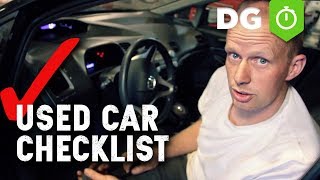
This video provides practical advice for inspecting a used car before purchase, especially for budget-friendly options. The host covers visual checks, fluid inspections, tire condition, and the use of an OBD2 scanner to detect hidden problems. The goal is to help buyers avoid costly mistakes and find a reliable vehicle.
Inspect the car in daylight to compare panel uniformity and spot repainting, which may indicate accidents or rust.
Check tires for even wear; feathered or cupped tread suggests bad alignment or accident damage.
Transmission fluid should be bright red and not burnt; engine oil should be clean and at proper level.
Brake fluid level indicates pad wear; low means worn pads, full could mean good brakes or topped off.
Use an OBD2 scanner to check for diagnostic trouble codes; zero codes is ideal but may be cleared.
Check readiness monitors to see if codes were recently cleared; all complete means car has been driven enough.
During test drive, turn off fan and radio, listen for ticking, knocking, or squeaking noises.
Call a parts store to ask about common parts ordered for that model to identify known issues.
When should you inspect a used car, and why?
In daylight, to see panel uniformity and spot paint or rust issues.
00:15
What does a repainted panel on a used car usually indicate?
It likely means the car has been in an accident or has rust.
00:27
What does feathered or cupped tire tread indicate?
Feathered or cupped tread indicates a bad alignment, possibly from worn suspension parts or accident damage.
00:55
What color and smell should healthy transmission fluid be?
Bright red and not burnt.
01:26
What does the brake fluid level tell you about brake pad wear?
Low fluid means brake pads are worn; full fluid could mean good brakes or that someone topped it off.
01:57
What tool can you use to check for diagnostic trouble codes?
An OBD2 scanner.
02:42
If readiness monitors show 'incomplete', what does that imply about the car's history?
It means the codes were likely cleared recently, and the problem may still exist.
03:44
What should you do during a test drive to check for mechanical issues?
Turn off the fan and radio, and listen for ticking, knocking, squeaking, or squawking noises.
04:37
What is a practical way to research common problems for a specific used car model?
Call a local auto parts store and ask if they've ordered many parts for that model.
05:18
Daylight Inspection
A simple but crucial tip to avoid hidden paint or body issues.
00:15Tire Wear Check
Tire condition can reveal alignment and suspension problems, saving you from costly repairs.
00:39OBD2 Scanner Use
A cheap tool that can uncover hidden engine and emissions problems.
02:42Readiness Monitor Trick
A clever way to detect if trouble codes were recently cleared, revealing potential issues.
03:44Silent Test Drive
Listening for unusual noises is a free and effective diagnostic method.
04:37[00:00] Okay guys, I just want to go over what to look for when you're buying a car, used off of maybe side of the road, you want to cheat vehicle for a couple of grand, a few things
[00:15] you want to keep in mind. First thing you want to do is don't buy it at night, take a look at it in the daylight. You want to see it in good sunlight and you want to be able to compare panels to each other to make sure that they all look uniform.
[00:27] If it's been painted, first warning signs stay away, it's either been in an accident or it's rusty, if one panel's rusty, most likely, another panel's rusty and it's on its way.
[00:39] The tires are very important if you're spending a few grand on a vehicle, even 8 grand, if the tires are warrior looking at it, could possibly another 800,000 for new boots. So you want to look at the tires, you want to turn them all the way out one way and you
[00:55] want to run your feet, your hands over and make sure that it's wearing evenly. It fits feathered at all where it's cupped, it means it's a bad alignment and that could be worn parts and you'd have to replace those suspension parts or again it could be in an accident.
[01:12] So make sure that your boots are in good shape. Underneath the hood, you want to check a few things. You want to check your transmission fluid, usually yellow handle.
[01:26] You want to look for nice red fluid, that's not low and you want to smell it, make sure that it's not burnt. You want to check your engine oil, make sure that it's not low in any means and that it's
[01:41] in good shape, nice and clear and again doesn't smell good. It still isn't as telltale because if there was an issue they would have changed the oil beforehand. You can actually tell how much your brakes are war but how much fluid is left in your reservoir.
[01:57] This is the brake fluid reservoir. If your brakes are war, it means that your pistons are coming out farther and this reservoir will be lower. If it's full, it's a good sign that your brakes are in good shape but somebody could have
[02:12] topped up the fluid as well. So what I'm saying is low oil means that the brakes are war when the reservoir is full. It means it could have really good brakes or somebody's topped it off so you have to
[02:24] take that with a grain of salt. You want to check over belts, a general condition of it. You want to check, make sure there's a little corrosion and rust on exhaust and aluminum parts and check your antifreeze when it's cold, make sure that there's no oil or anything
[02:42] in there and it looks nice and green or paint depending on what's in there. Now a good investment is an OBD2 reader. You can pick these up really cheap now.
[02:55] This one I paid $45 and every single car built after 99 has an OBD2 port. So underneath the dash there's a plug where this plugs in, the Civic Center, right by
[03:15] the console, turn your ignition on and best case you want to look for zero diagnostic codes. You can read the VIN, you can read the codes so just hit Enter.
[03:30] It checks your CAN bus which is your computer for anything logged and hopefully it will come up no diagnostic trouble codes. Now that either means that the car is in good shape, they just replace the battery or they
[03:44] just cleared the code. So another way to see how long it's been since they cleared the codes is to go underneath and wait for a readiness test. Readiness is important for e-tests.
[03:57] Every emissions monitor has to go through so many cycles before it's complete. So by going through there and if all of them are complete, you know that the vehicle has been driven a good amount of time since the last time that the computer has been cleared.
[04:13] So that will also say whether your car is ready for an e-test or not. So you want to look for all of these completes. Anything that's supported needs to be complete.
[04:25] Anything that's not supported is not imported. Like a heated cat is not supported, they don't need that for an e-test. That'll also save you $30 when you go for your e-test knowing that your monitors are ready.
[04:37] So when you're driving it, you want to turn your fans off, turn your radio off, listen for any noises. Anything that ticks or knocks or squeaks or squaks, it's a warning sign that that's probably
[04:49] going to cost you money. Don't let the customer talk to you or whoever's selling it, just tell them to be quiet. You want to listen to it. You can talk when you're outside the vehicle. Keeping these things in mind, hopefully keeps you from buying something that is going to
[05:05] be a problem further on. But check your reviews online and see what is good about the car. But realize that for every one person that says something bad about the car, there's 200
[05:18] that are driving and happy, but just not posting about it. So once you find a car that you like and that you're interested in, call a dealership and or sorry, don't call dealership, call a park store and ask if there's any, there's been
[05:31] a lot of parts ordered for this particular car, whether it's got bad wheel bearings, bad brakes, bad transmission or anything else, and that might save you in the long run. So yeah, there you go.
[05:43] To follow up ready with projects that include conversions and repairs to anything from Ferrari to change us and check out the tape on us by newest invention that's coming to market. And remember if you're hot, healthy, you should have rich.
⚡ Saved you 0h 05m reading this? Transcribe any YouTube video for free — no signup needed.