
AI Summary
This video challenges the limiting money beliefs inherited from Soviet-era culture, arguing that mindsets like 'money is evil' and 'rich people are thieves' drastically lower your chances of a secure life. The speaker shares his personal transformation and presents 13 practical rules for building wealth, along with a four-question lending test, emphasizing that money is a tool for security and freedom.
Chapters
According to a Boston study, holding mindsets like 'money is evil' and 'rich people are thieves' lowers your chances of a normal, secure life by 85% compared with a person with focal attention.
The speaker argues that post-Soviet culture instills the idea that rich people are criminals, honest work can't make you wealthy, and you should be 'like everyone else,' which keeps people trapped in poverty.
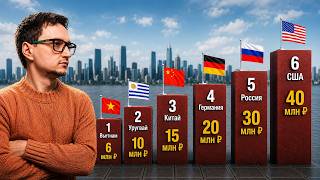
The average after-tax salary in the US is about $4,500. Americans are taught from a young age that time, skills, and selling are valuable, so they proactively seek opportunities.
The speaker's personal example: after calculating, he realized hiring a specialist is faster and better than DIY. Rich people use money to buy time, then use that time to rest or earn more.
Average salary in Qatar is $4,000. Men are taught that money is a responsibility to provide for family; family is seen as a personal financial investment, which fuels reinvestment in the economy.
Canadians earn around $3,000 per month and treat making money as a normal, fundamental skill. Wanting to earn more is encouraged, not criticized.
Successful countries share proverbs like 'First help yourself and your family, and only then others.' The speaker contrasts this with his own upbringing, where he was told to always help his brother even in poverty.
Without savings, any unexpected event—a bad tooth, a broken washing machine, or a child's emergency—can knock you out of ordinary life and take a long time to recover from.
The world doesn't pay for fatigue or hours worked. You can work 12 hours a day and stay poor, or solve a specific problem in a narrow niche and earn astronomical amounts.
Loans, credits, and installment plans for consumption are nonsense. Debt holes are almost impossible to escape, and bankruptcy has long-term consequences.
Borrow only to increase income: for education, a more lucrative profession, a normal business, or a move for development. Never borrow for a robot vacuum cleaner—as one friend did for his 20 m² garage.
Kindness while poor is a one-way ticket to poverty. Help only when it doesn't harm you; if you can't help without hurting yourself, refuse.
Money should work for you. The book 'The Richest Man in Babylon' teaches this. Inflation in Russia hit 900% over 20 years, meaning idle cash under a mattress loses 10x its purchasing power.
If you've gained wealth, there will always be someone who wants to take it. Modesty and living below your means bring peaceful sleep.
Rich people count time, interest, risk, and benefit. The poor only count other people's money. The speaker tracks every penny and still uses cashback in stores.
Money doesn't care how hard you try or how long you work. Your skill is a solution to someone else's problem—that's where the money is. The speaker closes viewers' problem of financial ignorance.
Your skills must have a clear, applied connection. Example: a video editor who knows neural networks earns 75% more than one who works the old-fashioned way (3,500 rubles vs 2,000 rubles per video).
Diversify, don't risk everything at once, don't invest in what you don't understand, and ignore internet hype that says 'buy now or you'll miss out.'
Cut unnecessary expenses like a car you don't need when working from home, a million subscriptions, or a third mistress.
Don't wait for a good politician, better times, or a savior. An Arabic proverb: 'While we were waiting for a good time to come, life passed.' Take responsibility now and act in current conditions.
Before lending money, ask: Is this my last money? Am I ready to give it back and lose it? Will this improve my life? Am I helping out of desire or guilt? If any answer is negative, say no.
Money can't buy happiness, but the speaker says that while poor he never felt happy. Poverty is a disgrace to yourself and to the child you were. Money is an instrument of security and freedom of choice.
The video delivers 13 actionable money rules while stressing that inherited beliefs must be unlearned to achieve financial stability. Money isn't a source of happiness, but without it, the speaker argues, freedom and peace of mind are nearly impossible.
Mentioned in this Video
Study Flashcards (14)
According to the Boston study, how much lower are your chances of a secure life if you believe money is evil?
easy
Click to reveal answer
According to the Boston study, how much lower are your chances of a secure life if you believe money is evil?
85% lower than someone with focal attention.
00:02
What was the speaker's father's saying about money?
easy
Click to reveal answer
What was the speaker's father's saying about money?
"It's better to have a pittance, but a clear conscience."
02:08
What is the average after-tax salary in the United States according to the video?
easy
Click to reveal answer
What is the average after-tax salary in the United States according to the video?
Approximately $4,500 per month.
03:39
What cultural idea about money is instilled in Qatari men from childhood?
medium
Click to reveal answer
What cultural idea about money is instilled in Qatari men from childhood?
Money is responsibility for your family and future; do what you want but provide for your family.
06:02
What is the most important feature that unites all successful countries according to the speaker?
medium
Click to reveal answer
What is the most important feature that unites all successful countries according to the speaker?
Proverbs like "First help yourself and your family, and only then others."
07:56
What is Rule 1 of money according to the video?
easy
Click to reveal answer
What is Rule 1 of money according to the video?
Create a financial cushion (emergency savings).
09:08
What does the world pay for according to the second rule?
easy
Click to reveal answer
What does the world pay for according to the second rule?
It pays for problems solved, not for fatigue or hours worked.
09:53
When is borrowing acceptable according to Rule 4?
medium
Click to reveal answer
When is borrowing acceptable according to Rule 4?
Only to increase income: study for a more lucrative profession, start a normal business, or move for development. Never for consumption.
11:29
What item did the speaker's friend buy on an installment plan while living in a 20 m² garage?
medium
Click to reveal answer
What item did the speaker's friend buy on an installment plan while living in a 20 m² garage?
A robot vacuum cleaner.
11:44
What is the central idea of the book 'The Richest Man in Babylon'?
medium
Click to reveal answer
What is the central idea of the book 'The Richest Man in Babylon'?
Money should work for you; money should bring money.
13:14
By how much did inflation in Russia reduce purchasing power over 20 years?
hard
Click to reveal answer
By how much did inflation in Russia reduce purchasing power over 20 years?
Inflation reached 900%, meaning money lost about 10 times its purchasing power.
13:44
How much more did the speaker pay for video editing by someone who knows neural networks?
hard
Click to reveal answer
How much more did the speaker pay for video editing by someone who knows neural networks?
3,500 rubles vs 2,000 rubles, which is 75% more.
16:53
What are the four questions to ask before lending someone money?
hard
Click to reveal answer
What are the four questions to ask before lending someone money?
Is this my last money? Am I ready to give it back (and lose it)? Will this improve my life? Do I help out of desire or guilt?
19:31
What realization came to the speaker when he looked at his childhood photo?
medium
Click to reveal answer
What realization came to the speaker when he looked at his childhood photo?
That being a poor person in the modern world is a disgrace to himself and to the child he was.
22:36
💡 Key Takeaways
Inherited beliefs dramatically reduce financial security
Cites a Boston study showing an 85% lower chance of a secure life, making a strong data-backed case for changing money mindsets.
00:02Cultural attitudes drive prosperity
Comparing the US, Qatar, and Canada reveals that treating money as a skill and family responsibility correlates with higher average incomes.
06:02Pay is tied to solving problems, not effort
Shifts the focus from working harder to working smarter, a core principle for escaping paycheck-to-paycheck living.
09:53Inflation silently destroys idle cash
The 900% inflation example in Russia is a powerful, concrete warning against hoarding money instead of investing.
13:44Money is security and freedom, not happiness
A personal, emotional conclusion that poverty prevents happiness, framing money as a tool for dignity rather than an end in itself.
21:26Full Transcript
[00:02] that money is evil, that rich people are thieves, and that the most important thing in life is to be a good person, then I have bad news, of course. With these mindsets, your chances of having a normal, secure life, according to a Boston study, are 85% lower
[00:18] than those of a person with so-called focal attention. In this video, I'll tell you where all this garbage in our heads comes from, why other countries live differently, and what
[00:30] rules of money always work in any country and at any time. My hand is itching, it probably means money. In the CIS countries, poverty is our
[00:42] genetic code. Here we are truly brothers. And now I will prove it to you. I am a brothers. And now I will prove it to you. I am a child of the nineties. I think you too, child of the nineties. Just remember your childhood, when the grass was greener and
[00:56] everything was much simpler. Now remember what your mother, grandmother or other adults told you about money. Let me tell you straight down the list what
[01:08] exactly I was told about money. Rich people are always criminals. That is, he stole from somewhere, was shady, dishonest, and deceived someone. Even this phrase, which, in general, is still relevant today. Those who stole little are imprisoned. Or another phrase:
[01:24] "From righteous labors there will be no balat marble." In general, it’s honestly impossible to earn big money. The only option is to either steal, or to attach oneself to power somewhere, for example, or there is another option: to sell out, for example, to
[01:39] some oligarch. The rules of the game have not changed much even now. And I am more than sure that many of you still believe that money is evil, it spoils people, money does not bring happiness, you need to be patient. The main thing is to just be a
[01:54] good, honest person. You can't stick your head out, otherwise they'll notice. You can't write anything in the comments, otherwise you'll go to jail . Be like everyone else, don't be smart, sit in [ __ ], in general, and don't complain. The main thing is stability, stable work, a
[02:08] stable political situation. And, of course, even if you are paid pennies, you are respected at work. My father often said one phrase, like a mantra: "It's better to have a pittance, but a clear conscience." And then my mother finished me off,
[02:23] and it seemed like she said the right words : “I don’t need much,” she said. “ I need a piece of land, about two meters by two. That’s all I need from this world.” The words seem to be correct, but what is the essence? The point is that I give up everything. I do
[02:37] n't need anything. I don’t need money, or well-being, or good social security, or good health. I don't need anything. All I need is a grave. My parents are completely a product of the Soviet era. Fully. I'm more than
[02:53] sure that you have the same thing. People change with the times. It was such an era back then, and parents conveyed it. It was with this set of attitudes that we were allowed into adulthood. And then, of course, we are surprised.
[03:08] Why do we work all our lives, try, try to do something, and still live from paycheck to paycheck? Because, of course, with such attitudes, with such thoughts, it simply cannot be otherwise . It just doesn't happen. If you
[03:23] are convinced that righteous labors will not produce marble chambers, then they will not exist. This is 100%. And now the main thing. Let's look at what results citizens of other countries with different attitudes and different cultures achieve.
[03:39] When I was preparing this video, to be honest , I was even surprised myself. Let's take the decaying West, let's take the United States. The average salary after taxes is approximately
[03:52] $4,500. While you're warming up your fingers to write that the prices there are much higher, although the spoiler is that in reality, no, they're not higher, it's either cheaper there than in Russia, or the same as in Russia. Since childhood, the main attitude of any
[04:07] childhood, the main attitude of any American is that time is money. From a young age, a child understands that your hours, your efforts, your skills are the most important and valuable resource. Selling, negotiating, offering a service is
[04:21] not scary at all. Just remember all those movies from the nineties where a little kid sells lemonade on the street. From childhood they absorb that their time costs money, from childhood they absorb that money is earned. Therefore, the American does not
[04:36] wait for any ideal conditions. He calculates how much his hour is worth and how to sell it for more. Looks for different connections, and, of course, opportunities. It is clear that if this is the son of wealthy parents, for example, like Elon Musk from a wealthy
[04:51] family, he will have more opportunities, and he will hypothetically be able to achieve more. And if he is the son of poor parents, then, of course, he will be able to achieve something, but he will clearly not be the second Elon Musk. Although, who knows.
[05:05] Here I have my personal story. When I was poor, I did everything with my own hands, from repairing my house to fixing my car. That is, I was constantly overhauling the chassis, changing various relays, and so on. And then I sat down and
[05:20] calculated what I could do cheaper. It's cheaper for me to hire someone or continue doing everything myself. And, of course, at some point I realized that hiring a person would be faster and better quality, and at that time I could
[05:35] quality, and at that time I could earn more. And all rich people do exactly the same thing. They understand that with money they buy time, and they use this time either to get rest and pleasure, or to
[05:50] earn more money. Now let's look at other countries. For example, a boat. The average salary on a boat is $4,000 per month.
[06:02] Someone will say: "Of course, $4,000." There is oil in the boat. It's clear why people live so well there. There are 25 billion barrels of oil there alone, while Russia has
[06:14] 25 billion barrels of oil there alone, while Russia has 80 billion barrels. In Katera, from childhood, all men are instilled with the same idea: money is responsibility for your family and your future. Do what
[06:27] you want, but be kind enough to provide for your family. As in any Islamic country, family is more important than the opinions of a neighbor or anyone else , and the money earned is reinvested in the economy and provides a real boost to the country and its people. And here is the
[06:41] most important point. In Qatar, family is perceived as a personal financial investment. And according to the Paris study, it is precisely those who invest in human capital and connections who become rich.
[06:55] Imagine that you are a very rich person. You have hundreds of millions in your accounts . But what good are these hundreds of millions if you don't know or understand who to turn to if, God forbid, you break your car
[07:11] or if you need to transfer this money from one country to another . Human capital and connections are needed to maintain a level of well-being and to become much richer. The next
[07:25] side is Canada. Just like in England, Canadians earn around $3,000 a month. For Canadians, making money is a basic skill, not a modest talent, from childhood. Financial literacy is a fundamental part of
[07:41] adult life for Canadians. Nobody there criticizes you for wanting to earn more. On the contrary, it is only encouraged. And the most important feature that unites all successful countries. In all absolute countries there are different proverbs, but
[07:56] they sound something like this: "First help yourself and your family, and only then others." When I started researching this, I realized that our attitudes were completely opposite. I remember how my mother always told me
[08:11] something like: “Even if you are in extreme poverty, even if you are poor, always help your brother.” But I have an older brother, and I always have to help this brother . And do you know what it looks like? It's as if you're in a rotten
[08:26] boat that's about to sink, and at the same time you're building a boat for a stranger, even if it's your own brother, but a stranger. I understand that from the point of view of society and from the point of view of, you know, these very attitudes that were
[08:40] these very attitudes that were broadcast to us, I am now saying absolutely inhumane things. How can you not help your own brother? I'm not saying not to help. I'm talking about helping when you have the
[08:53] opportunity. If you don't have the opportunity, you're in deep [ __ ] yourself. Spending your life, your resources, to help other people is stupid. Of course, attitudes are difficult to change, but 13 rules that
[09:08] we will now consider will help you do this. So, rule one. Create a financial cushion. If you don't have money saved, it's only a matter of time before you're broke. A bad tooth, a washing machine, anything at all , and you just fall out of
[09:24] ordinary life. I think everyone has encountered this, and I am certainly no exception. Therefore, the airbag is the first thing to take care of. Especially if you have children, God forbid something happens to a child,
[09:39] you will need money, and this can throw you off your financial rut so much that it will be a very throw you off your financial rut so much that it will be a very long time before you get back to your previous state. Rule two. In the era of capitalism, money is not paid for
[09:53] plowing, not for the fact that you work a lot . The world doesn't pay for fatigue, it pays for problems solved. You can work 12 hours a day and be poor, or
[10:05] you can find a narrow niche, solve a specific problem and earn simply astronomical amounts of money. We'll be talking about this rule in future videos, so please subscribe. We'll be
[10:19] returning to this principle repeatedly in future videos, and I'll be touching on and explaining it again, so please subscribe. Rule number three: never borrow for consumption. Knowing our citizens' love of loans, credits, and installment plans,
[10:34] I can only say one thing: it's complete nonsense, of course, and you need to avoid it as much as possible . I've even met people who, you know, from the region: "I'm taking out a loan, but I don't plan to pay it back. I'll declare bankruptcy."
[10:47] We'll talk about bankruptcy a little later , but that's just nonsense. Being broke is bad enough, but being in debt sounds much worse. It's not for nothing that a debt hole is called a debt hole. It is almost impossible to get out of this hole
[11:01] . Banks and similar companies will do everything possible to keep you in their system as long as possible. As for the bankruptcy procedure, many do not realize the consequences. Even if you take out a loan and go
[11:14] bankrupt, you will find it difficult to borrow money when you really need it. The fourth rule: money does not grow in debt. Loans make only banks rich, not borrowers. You can only borrow to increase your
[11:29] income, to study for a more lucrative profession, for a normal business, for a move for the purpose of development, but never to cover something you robot vacuum cleaner. I remember my friend. Just imagine, a person has
[11:44] a lot of debt, a lot of loans. He can't pay them. He lives in a residential garage. There is such a concept in Sochi. That is, a garage that has been converted into housing. So he has a 20 m² residential garage, and he buys a robot vacuum cleaner on an installment plan for
[12:00] these same 20 m². Don't do this. It's a flawed financial model, but it's no wonder he's still poor. Rule five. First for yourself, then for others. This is the kindest and most insidious attitude of post-Soviet people. While you are
[12:16] poor, your kindness is a one-way ticket to poverty. I'll explain it simply. the time and energy, the money that you need to get off the ground, they are already limited. And instead of taking a couple more steps and achieving
[12:32] some goal, reaching a new financial level, you give this time to others and miss a very important moment. Personally, I have this philosophy. If I can help
[12:44] this philosophy. If I can help without harming myself, I help. If I can't help without harming myself, I refuse. I advise you to reconsider your attitude towards this issue. When a friend asks me for help, I remember what my
[12:58] grandfather told me. Friendship is friendship, but tobacco is in the dew. Friendship is friendship, but I will help you only when I have the opportunity and when I want to. Rule six. Money loves movement. They either work or they become
[13:14] worthless. Even a small amount should have a purpose and generate income. should have a purpose and generate income. There is an old book called "The Richest Man in Babylon." The central idea of this book is: money should work
[13:28] money, but money should work for you. It would seem like a simple idea, but for some reason it usually never occurs to anyone. Money should bring money. And this is not only due to the fact that you will become richer, but
[13:44] also due to inflation. Over the last 20 years under Putin, inflation in Russia has reached 900%. That means you've lost about 10 times the purchasing power of your money. If you had money just lying around somewhere
[14:00] , as they say, under the mattress, without investments, you would be 10 times poorer now. Rule seven. Money loves silence. We have all heard this phrase many times, and of course for good reason. If you've gained fat, there will always be
[14:17] someone who wants to take it off. The more modest you are and the more modest you live, the more peacefully you will sleep.
[14:32] teenagers, rappers, or infocygans. They obviously need them more, of course. Rule eight. Money comes to those who know how to count it. Rich people count everything. time, interest, risk, benefit. The poor only count
[14:47] other people's money. If you don't keep track of your finances and expenses, I strongly recommend that you do so. I personally have everything calculated down to the last penny. Please note that I am a millionaire and far from a ruble one. But when I'm
[15:01] in the store, I use cashback. I try to save money, but not on quality, of course. Poor people think that the rich throw away money, but this is absolutely not true. This is far from true. Of course,
[15:15] they don't skimp on glasses of coffee, but at the same time they don't waste money. The ones who are littering are either thieves who stole this money, no matter where it came from, from someone else or from the state budget, or people who did not earn this money. For example,
[15:29] some Dubai [ __ ] will reign over money because she didn’t earn it. Rule nine. Money loves a specific skill, the skill of problem solving. Money doesn't care how hard you try or how much time
[15:42] you spend in the office. I will repeat once again, money is not paid for this, not for lust. Your skill is a solution to someone else's problem . This is where the money is. For example, you have a problem now - lack of money. That's why you're
[15:58] watching me now, and I'm releasing this video, thereby closing this problem for you. That's why you continue to watch me, and maybe you can even buy some of my courses using this QR code. That is, look, I’m closing the issue, and
[16:12] you don’t care at all how much time I spent filming the video, how much time it took to edit. You don't give a damn about it. You came here to close your problem. Other people do the same.
[16:26] You need to learn to close other people's problems. Rule ten. other people's problems. Rule ten. Invest in yourself. Your skills must , of course, be applied and have a clear connection. It's one thing if you
[16:39] take a course on reading a natal chart, but it's another thing if these courses are, for example, on creating videos using artificial intelligence. Here in front of you, for example, are two videos. They were edited by different people.
[16:53] I spent 2,000 rubles on editing one video, and 3,500 rubles on editing another video. That is 75% more. Why? Because one editor
[17:05] knows how to work the old-fashioned way, and another knows neural networks and knows how to use them and earns more. Rule eleven. Protect your capital. Save money from losses. Diversification. Diversification.
[17:20] Diversification. There is no need to risk everything at once. Always think about safety. Don't invest in something you don't understand. Don't listen to all those idiots on the internet who say, "We haven't lived rich, so there's no point in starting," or who urge you
[17:36] to buy something right now because you won't have another chance later, and so on. Both options are bad and will ultimately lead you to poverty. In terms of financial literacy, the investment courses at my
[17:50] school will help you. And in general my whole channel is about this. So scan the QR code and check out my school. Rule twelve. Get rid of the sub-forces. There are a lot of things that suck money out of you. A car
[18:05] you don't need if you work from home, a million unnecessary subscriptions, a third mistress, and so on. And rule thirteen. Money doesn't like waiting. We are all waiting for good events. Some are waiting for a good politician to come to power, others are waiting for a
[18:21] better time. We all waited for Santa Claus as children. It's very stupid to expect anything good now. No one will come and save us. Neither the state, nor the market,
[18:33] nor the best of times. An Arabic proverb comes to mind : "While we were waiting for a good time to come, life passed." Money comes to those who take responsibility in the current conditions as they are and begin to act. As is
[18:48] often the case, our success is much closer than it seems. We have covered all the basic material from the thirteen rules . Now let's try to take a short test that will allow you to know whether you are a financially mature person
[19:03] or not. Why do we need to take this test? Because there are a lot of seagulls around us that always ask for money. It is always
[19:16] awkward and awkward to refuse. So let's take the test. Now you will need to answer just four simple questions. These are the four simple questions you always ask before you give someone money. First question: is
[19:31] this the last money? Well, I would answer no. The second question: are you ready to give them back and, in brackets, lose them, that is, completely lose this money, never
[19:43] see it again, because we know that most debts are simply not repaid. I am personally ready to lose them, so I put yes. Third question. Will this improve my life? Will this make me feel better? Well, of course, this
[19:59] life will not improve me, so I put no. And the fourth question is more philosophical. Do I help because I want to help or out of guilt? Well, I probably help out of guilt. Once you answer all these questions honestly,
[20:14] everything will immediately become clear. If at least one of the four questions is negative, simply say: "No, I simply won't lend you money . I don't want to." In fact, I used a similar method myself when I was having a hard time, when I started
[20:28] earning well and the first money started coming in, in particular, when I was involved in trading and investments, a huge number of friends and relatives immediately materialized. Friends came out of Norp who constantly made me look thin.
[20:42] Now they have begun to love me. I helped them a lot. Because I am a fairly kind person, and as I now understand, I helped these people in vain. In the end, when I learned about these issues and learned about this system, I simply changed everything. And, to
[20:57] be honest, I don’t regret it. I only regret that I helped these people, forgetting that I needed help first and foremost . We agreed that there would be no motivation or money-minded thinking in this video, but let's add
[21:11] a little motivation before we finish. You can continue to live the way you were taught, be patient, save on yourself, be ashamed. I used to do exactly the same thing. I don’t judge you at all and I understand you perfectly. This is also one of the options. You can wait until it
[21:26] gets a little easier. Maybe it really will get easier. We don't know that. And you can finally admit to yourself and change something in your life. Money is an instrument of security and freedom of choice. And this
[21:40] sounds very pretentious. But I, for example, can choose which country to live in and what to eat. Of course, I'm afraid for the future, but not as afraid as when I was poor. I have been both rich and poor. Money can't buy happiness. That's
[21:56] happiness or love with money. This cannot be done. Being rich, I have felt depressed, happy, joyful, and sad. But
[22:08] being poor, I never felt happy. Never, absolutely. I remember how I was constantly saving on everything, how I understood internally that I was just eating because I just wanted to fill my stomach with some kind of crap. It was
[22:23] just disgusting. And at some point I realized that being a poor person in the modern world is a disgrace to myself. And one time we were to myself. And one time we were cleaning with my ex-girlfriend at the time
[22:36] . I found my childhood photos, and where the little boy is, he’s about five or six years old. I looked at myself and realized that I was ashamed in front of myself, in front of that boy, in front of that boy who thought that
[22:49] everything would be completely different. Something clicked in my head then, and everything started to change a lot after that. It is a disgrace to yourself, to that very little child you were, to be in poverty in modern times.
[23:05] to be in poverty in modern times. earn.