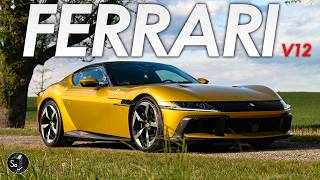

Why a V12 Ferrari Is Worth $600k
60sCombines aspirational luxury with shocking price tag and the emotional pull of a naturally aspirated V12.
▶ Play Clip"Title accurately reflects the video's core message: the V12 is a desirable engine, and the video delivers a thorough review."
This video features a comprehensive review of the 2026 Ferrari 12Cilindri, a naturally aspirated V12 grand tourer. The hosts drive the car on a racetrack and interview Ferrari engineers about the engine, body structure, and aerodynamics, highlighting the car's performance, design philosophy, and driving experience.
The Ferrari 12Cilindri is a front-engine V12 GT car with a 6.5L dry sump engine, revving to 9,500 RPM, producing 819 hp and 500 lb-ft torque. It has a dual-clutch transmission, with a future gated manual option. 0-60 mph in under 3 seconds, top speed over 210 mph.
Double wishbone front and rear, magnetic ride dampers, e-diff, rear steer, carbon ceramic brakes. Tires: 275 front, 315 rear. Not the stickiest tires, making it more entertaining on track.
Starting price in the mid-$400,000s; as tested, just under $700,000. Ferrari is not a value brand.
The naturally aspirated V12 is praised for its sound and linear power delivery. The car feels old-school with modern controls, under-tired, and requires work to drive. ESC is sophisticated, allowing slip angles.
Engineer Rudzero Cevolani explains the V12 evolution from the Ferrari Enzo. The 12Cilindri engine is derived from the 12 Competizione, delivering 830 hp at 9,250 RPM, 6.5L displacement, specific power 128 hp/L. Focus on torque delivery and driving emotion.
Engineer I'm under asantorum describes the body and white: started from scratch, simplified chassis with larger castings, reduced component count. Focus on stiffness and NVH balance to let desired engine vibrations through while filtering road noise.
Engineer Rubens Kuratola explains new cooling layout: oil radiators split to corners, water and A/C radiators in center. This allowed shaping the front corners for reduced drag and improved cooling.
The 12Cilindri is positioned as a GT car for connoisseurs, not the top performance model. It offers a unique naturally aspirated V12 experience distinct from hybrid V6, V8, and future electric Ferraris.
The car delivers a special experience focused on the engine, transmission, and feel. Electronics are seamless but interior tech may be distracting. Overall, it's about the driving experience and the V12 engine.
The Ferrari 12Cilindri is a masterful GT car that prioritizes driving emotion and the naturally aspirated V12 experience over outright performance. It successfully blends old-school character with modern engineering, making it a compelling choice for enthusiasts who value visceral driving.
What is the engine displacement and horsepower of the Ferrari 12Cilindri?
6.5 liters, 819 horsepower (830 hp in some sources).
01:20
What is the redline of the Ferrari 12Cilindri's V12 engine?
9,500 RPM.
01:20
What is the 0-60 mph time of the Ferrari 12Cilindri?
Under 3 seconds.
01:32
What is the starting price of the Ferrari 12Cilindri?
Mid-$400,000s.
02:16
What type of transmission does the 12Cilindri currently have?
Dual-clutch transmission.
01:20
What future transmission option is allegedly planned for the 12Cilindri?
A gated manual gearbox.
01:32
What is the specific power output of the 12Cilindri's engine?
128 horsepower per liter.
12:24
How much more horsepower does the 12Cilindri have compared to the 812 Superfast?
30 horsepower more.
12:39
What is the cooling layout innovation in the 12Cilindri?
Oil radiators split into two and placed in the corners; water and A/C radiators in the center.
18:57
How does the chassis of the 12Cilindri differ from the 812?
It started from scratch, with simplified construction using larger castings and fewer components.
14:13
V12 Driving Emotion
Captures the visceral appeal of the naturally aspirated V12, a key selling point.
04:44Engineer's Passion for V12
Direct from Ferrari engineer, emphasizing the heritage and challenge of keeping the V12 alive.
08:19Market Positioning as a Connoisseur's Car
Explains the strategic niche of the 12Cilindri within Ferrari's lineup.
19:54Mastery of Electronics and Feel
Highlights Ferrari's success in blending modern electronics with traditional driving dynamics.
22:23[00:30] You don't need a V12, but you want one. As since Jack speaks over 700 different languages, his conversation with the Italians was productive.
[00:44] They agreed to bring a Ferrari from Italy for us to drive. And I knew I had to get prepared for this experience. When I drove my digital Ferrari into the Olive Garden, they treated me like family.
[00:56] But when I sat down I realized there was more car than I could afford. But I learned from beauty influencers that all I had to do was work hard. But I'm going to let Jack tell you why this car is worth $600,000.
[01:08] Now before you hear directly from the Ferrari engineers and Mark and I drive this around a race track, I wanted to walk you through what this car is. This is the Dodici salundry or 12 salundry. And it's exactly what it sounds like.
[01:20] It is a front-engine V12 Ferrari. There's a 6.5 liter dry sump. It revs to 9,500 RPM and makes 819 horsepower and 500 foot pounds of torque. It currently puts its power down through a dual clutch.
[01:32] However, in the future, allegedly it will get a gated manual gearbox. It does 0 to 16 under 3 seconds. It does over 210 miles an hour, so it's definitely not slow. The purpose of the 12 salundry is to fulfill that GT car space.
[01:47] It is the successor to the 812. It's more focused on being a comfortable, long distance cruiser that you can have a lot of fun with versus being an all-in-out track weapon. Like the 849 now fills that void where the 812 used to have to.
[02:00] This car is double wishbone front and rear. It has magnetic ride dampers. It has an e-diff in the back, rear steer, giant carbon ceramic brakes, and it does not have the stickiest tire on it. It is a 275 front, 315 rear, and obviously all the latest TC and electro-mechanical systems.
[02:16] Being a GT car, it's got a big interior space, massaging seats, a large hatchback, and an eye-watering starting price in the mid-400s, and as tested, you're looking at just under 700.
[02:28] Ferrari is not known as a value brand, and I don't think that's changing anytime soon. And this car, more importantly in the world of hybridized this, and quieter that is still a N.A. all natural V12.
[02:40] So that, Mark and I are going to go rip this thing around Autobahn Country Club South.
[03:01] You're going to make my lip injections fly off my face, Jack, or not to find out, dude.
[03:19] We put this in the launch control mode, I think, wait, now, come on, the guy that we go for , I'm running, I want to hear more of the poor Pope's engine, yeah, yeah, oh my God, dude,
[03:47] we are FCT on, we're in race mode, track control is off, ESC is on, all right, first things first, in a world of hybrid and downside is engines, Ferrari knows what we want, and that is
[04:04] cylinder E-ser, 850 or 820 horsepower, 9500 RPM, God, to your dual clutch, and don't make
[04:16] engine noise, sir, oh my God, close by us, oh yeah, dude, you're going to make my spag bowl
[04:29] come up, so you drove us earlier, how was the V12? Oh, I'm just short about $699.9,000 for all of these, but it's got it here, doesn't it,
[04:44] my God, dude, I missed the naturally aspirated engines so much, I mean, this is like, oh, this is like on another level, it's so good, oh, I was a chassis controller, so gearbox, very
[04:58] good, probably the best cool clutch in the world, yeah, this is what you want out of a V12, no hybrid bullshit, pulls all the way to 9500 RPM, how does it actually drive though, I don't know, see, you're so overtaken by the enter the trance performance, that it just kind of blinds you,
[05:14] it's up at anything else, that could potentially be wrong about it, I mean, this is on a very nerve-tire design for the street, so this car is constantly struggling for grip, which makes it far more entertaining on the track is all you do is chase the ass around, which is your favorite thing,
[05:31] I'm not big on chasing ass, but if that's something you like to do, you're really going to appreciate this, so it's super under-tired, yes, you can christmas the comment as it feels like an old-school car experience with modern controls, so honestly, to me, there's a lot of like
[05:49] front to back end bobble, you feel like you're really having to work this car, and then the steering is like so fast, because of the rear-steer calibration, it's like, you turn it just the tiny bit, it's like changing direction, it's an interesting car, it's got a little bit of
[06:05] initial push that immediately turns into an oversteer, yeah, the ESC in this car is so sophisticated that you can carry a little bit of slip and it just allows you to pull through it, it's a super forgiving car driver, you want to know my favorite thing about this, because it's a GT, I'm getting a
[06:19] shiatsu, this car is ridiculous, dude, you gotta get this, because you have the money and you want the ultimate smile on your face, this is like their iteration of art, it's like the scream of the
[06:36] old-school naturally aspirated engine with a perfected gearbox, I think they have the best cowl of basically all of these sub-systems of the Ford time experience, because all of their cycles of horny, which is exactly what I want in a big car like this, oh shiatsu, that's
[06:58] everything, you're gonna be driven around some V12 Ferrari, oh my god dude, so Mark, is there anything else? No, I just want to hear it check, let it rip, now with those shenanigans out of the way
[07:16] that brings us to our title sponsor for this video, Open Track, while Track Days are the best way for you to enjoy your sports car regardless of what it is, there are inherent risks, and many of you may not realize your primary car insurance will not cover you in case of an accident, and they are
[07:31] called accidents, shit happens, yes you can be doing everything right driving within your skill level, you can run into mechanical failure, a tire blowout, brake failure, or you can hit oil, sand, or cool on the racetrack and go straight into a guardrail, that is sadly going to be the
[07:47] law of averages when you drive your car on a racetrack, you want to keep yourself covered, Open Track is a track day insurance policy company that will sell you either an annual policy or an event policy, you can set the value of your vehicle, the deductible you want to use, it gives you the peace of mind to
[08:04] actually enjoy your car on the racetrack and remove some of the risks associated with driving on track, so that was a back to the video. Thank you for calling Open Track, how can we assist you today?
[08:19] Hello, I'm Rudzero Cevolani, and I'm responsible for the development of the V12 engine in Ferrari 2D C-Cylindry. I am a mechanical engineer and I have been working in Ferrari since 2009, I have taken
[08:39] on the role of engine development and I work on several cars, a 12 competition, a 296 challenge,
[08:52] and now Ferrari 2D C-Cylindry, so the V12 140 has been born in the early 2000 and the keep for the first time the Ferrari info, okay, it was a six liter engine and during the last 20 years
[09:17] as undergone a lot of improvement and now you will find it on the Ferrari 2D C-Cylindry, but let's say
[09:29] that apart some bolts, I think I think that not there isn't one component equal then the one of
[09:43] Ferrari info, we are very well aware about the advantages of a turbocharged engine or a hybrid
[09:55] powertrain and how it will be easier, let's say, easier in 2026 to put this kind of model on the market but I think that especially for this kind of car, the choice of the V12 is something more visceral,
[10:19] okay, V12 is our history, as you know very well, the first engine that leave Maranello factory 80 years ago was a V12, so V12 is our history, our heritage, our
[10:37] passion and so it was the right choice for this car and obviously it is not easy to homologate
[10:49] such an engine in 2026 and if you want, I can share with you how we manage this challenge, at the beginning of the Ferrari 2D C-Cylindry's development, we had one key point in mind to
[11:11] improve the engine's performance compared to the V12, not just in terms of numbers but above all in terms of quality, I mean there was a clear focus on torque delivery on acceleration
[11:36] feelings and I can say on driving emotion for the drivers, so this was the clear focus,
[11:49] which choice to a keep, we choose to a keep the Ferrari 2D C-Cylindry with an engine strictly derived from the V12 competition, the special version dedicated to track lovers, let's say,
[12:11] the engine delivers 830 horsepower at 9,250 RPM, it has a displacement of 6.5 liter and this
[12:24] means a specific power of 128 horsepower per liter, the maximum rotation speed is 9,500 RPM,
[12:39] so globally we have 30 horsepower and 600 RPM more than the 812 super fast.
[12:57] So I'm under asantorum responsible for the body and white for the 2D C-Cylindry and 2D C-Cylindry spider and so basically everything that is around the backbone of the chassis, so lower body and upper body,
[13:12] I've been working in Ferrari for 10 years now, so it's a long time and at the beginning I've been dealing with carbon structures and Formula One stuff and then I switched to the road car department
[13:25] and eventually, you know, developing my career as a project manager and a CAE manager inside this department, so my last project has been, you know, the C-Cylindry and the C-Cylindry spider
[13:41] and, you know, it's been quite a journey and I'm quite proud of the work we've done so far. So from a body structure perspective, can you walk me through how the DoD C-Cylindry has evolved?
[13:54] The perception is obviously it's an evolution of the 812, which is an evolution of the F-flow prior to that, so can you walk through how the body and white and the suspension architecture has evolved? Of course, to start we just can say that the body white of the DoD C-Cylindry and the C-Cylindry spider
[14:13] basically started from scratch, so we took the 812 and basically we started from the blank sheet of paper and of course we have been learning a lot from the other projects and previous projects,
[14:29] so basically we've been building a lot of knowledge since the basic introduction of the 812 chassis, so of course with this knowledge we decided to pull everything we know about
[14:41] aluminum space frame into the DoD C-Cylindry space frame and so basically the chassis has been simplified in a way because we reduced them the number of components and we basically created bigger
[14:58] nodes and castings because as you know the chassis is a space frame chassis, so made of casting components, sheet metal components and extrusion profiles and of course the 812 was a chassis that
[15:13] had a lot of components and a lot of joining a lot of different small pieces tucked together to create the nodes and the load parts, we knew that there was room for improvement especially
[15:26] in the efficiency of the chassis and we decided to, as I said, invest especially in the joint and in the size of the castings such as the shock towers or the a-posts, the a-posts and b-posts
[15:42] and the load parts have been basically designed and calculated with use in mind. Being in body structures specifically body and white, we've had conversations or I've had a privilege of having conversations with other engineers and obviously you're trying to look for the
[15:58] the greatest gains and global and local stiffness as possible through the body structure and trying to find as many ways to reduce some of the unwanted NVH that makes its way into the body structure
[16:10] itself that said versus I know the positioning of this car isn't necessarily pure sports car track carts GT a little bit of everything but how do you balance reducing unwanted vibration and
[16:29] frequency in a car like this while also maintaining some of that feel that comes from some of the vibration that comes into the body structure. So of course the key feature of this car is its engine
[16:42] and of course V12 and A is something that is getting rarer and rarer in the car industry of course and so as you said as a chassis engineer I need of course alongside my NVH colleagues which
[16:58] you know who are you know helpful with me you know when we need to deal with this kind of challenges I need to tune the chassis and the chassis structure so that the wanted vibration can get towards
[17:14] the cabin and can enhance the driving feel of the driver but of course other vibration needs to be killed for example vibration coming from the road coming from portals debris etc you know on the road
[17:30] we measure the stiffness of the single suspension points in its frequency so of course you can imagine that you have the stiffness of the point at zero hertz so static stiffness but then of course
[17:45] this stiffness of the specific points changes if you change the frequency of the force that you put into that single point and so by looking at them and by tweaking those curves we can fine tune the chassis to
[18:04] filter some of them and let other frequencies and other vibration go through and get through the to the cabin and through the steering wheel but of course it's it's quite a fine a fine there's a fine
[18:20] limit there's a fine boundary between enhancing the right stuff or you know creating you know a mess and mixing too many frequencies and too many excitations
[18:34] hello i'm Rubens Kuratola i'm responsible for the 19 cylinder aerodynamic part of the project this car has a complete new cooling layout so for the first time we split in two the oil radiator
[18:57] put in the corner and all the central part of the car is dedicated to water radiator and air conditioning radiator so this is a complete new layout that we design in advance
[19:15] cause for the request the thermal request of the 12 cylinder engine so starting from that we start to design the shape in the y-section and also in the z-section for the front corner of the car
[19:34] because it is very important for the drag of the car and also for the cooling performance because we put the radiator on the front corner well the positioning of the Ferrari do di Cicilindri is very particular because it's
[19:54] predecessor the A12 super fast was the top of the range when it came out in 2017 it was the top of the range in terms of performance and in terms of design and sportiness now a days the
[20:07] situation is very different because we have other sportier model in the range like the sf90 now replaced by the eight for nine terrosa and the 296 GTB so the goal of the to di Cicilindri when
[20:20] it came out was different it wanted to bring back the emotions of the Gran Turismo cars from the fifties and the sixties through the natural aspirated V12 engine which is very different from all
[20:34] the other powertrains that we have in the range so the goal the main goal was not to provide the maximum performance of course the car is extremely performant but there are other models in our range it are even more performant but it wanted to create a new segment of car address to the connoisseur
[20:52] so Ferrari enthusiasts that want to drive a natural aspirated V12 engine and in this way we managed to create a very different position because it's very different from the V6 hybrid from the V8 hybrid
[21:08] from the V8 each and it's also very different from what will be the electric Ferrari that we will launch
[21:21] here we are the end of our journey big thank you to all the engineers in Italy that made this car happen and the leadership that decided to keep a naturally aspirated V12 alive in this current market thanks to our North American reps who facilitated the test at Autobahn Country Club and the
[21:36] technician that came out to make sure that the car was right so we could enjoy and not worry about it and deliver a video where you could be somewhat entertained living through us and that's what some of these cars are about that's why Autobahn Country Club exists if you have a sports car and you want to
[21:51] become a member you can drive your car and track without fearing to be put in jail because most of the the newest sports cars are so fast you can't even utilize or test the limits on the street that's why we're using Autobahn so much thank you Falcon Northwest you can thank them for a lot
[22:07] of the ability that I have to edit these videos and create some of this content and even go off the deep end with some of these ads that I'm doing if you're looking for a workstation or a gaming computer consider their frag box because this car is so expensive it's obvious that it has to deliver
[22:23] special experience and you could tell that the joke has always been a Ferrari's about an engine it's a lot more than about an engine in this car it's about the transmission it's about the way that the car feels and transmits vibration and noise to you it's not about creating perfection in
[22:38] terms of a lap time or even proficiency in every single electronic system you know this isn't the 1980s anymore where it's just pure rear-wheel drive and an engine connected to it you have so much power
[22:50] that the electronic part of it is also a part of the story and Ferrari's done an amazing job on the transcal engine calibration and the stability control systems are virtually seamless and you can
[23:02] still slide this thing around I mean it's crazy how much slip angle it gets you if you want to experience this like longer wheelbase big front engine car and rear-wheel drive it still lets you do that I think Ferrari is kind of mastered in this car what they're really good at and what their
[23:19] customers really want now clearly like many car brands they're struggling with trying to figure out where the right amount of technology on the interior is implemented and you know like this is going to be a constant argument it's something that I feel like this car would be much better suited to
[23:34] having pure physical controls it feels like an older school car the tech in it is somewhat distracting but other than that I mean there's quality of life things that you're going to find if you own this car
[23:46] but most of the time you're not going to care right this is about the engine it's about the driving experience and it delivers on all those fronts I think Jack and I will get into a deeper dive in future videos with Ferrari on newer products when they come out where we can get the engineering deep
[24:00] dives covered and handled and we'll bring that all to you then but thanks for watching this video hope you enjoyed it see you next time
[24:21] you
⚡ Saved you 0h 24m reading this? Transcribe any YouTube video for free — no signup needed.