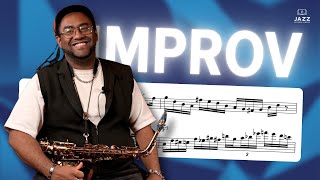

Transform One Line into Six - Rhythm Tricks
38sVisual and auditory demonstration of how simple rhythmic changes create new phrases is both educational and immediately applicable for musicians.
▶ Play Clip
[00:30] Hello, what's going on everybody? It's Patrick Bartley here and today I'm going to be talking about concepts for improvisation. So over the course of my career, I've been very fortunate to have some great students. In all of these lessons, I get a lot of common questions that I feel like I want to address
[00:45] kind of all in my videos, so hopefully this will be helpful to you. And of course, everything that we're talking about in this video today comes from our brand new course that we just launched called Approaches to Improvisation. And in this course, you'll find hours of content ranging from improving your swing field,
[00:59] playing ballots, extended range and much more. If all that sounds good to you and you want to check out the full course, go ahead and click the link in the description box below and use code improv25 for $25 off this course. So let's get into the first concept of today.
[01:12] Alright, so improvisation, we're talking improvisation. Now you've got to have things to play. So I think one of the things I want to talk about is how to build lines. How do you build nice sounding lines in improvisation?
[01:24] So in any type of improvisation of playing, but specifically jazz improvisation, there's always going to be a mixture of like things that you do on the spot and then what you can call like stock phrases. And when it comes to building your own lines, what I like to do is a good exercise.
[01:38] It's kind of building off of stock phrases. And one of the things I like to teach people is how to take those existing lines to actually create your own lines. So this might be also a way to blend in how you can take transcriptions and then make your own solos from it as well.
[01:50] So for example, let's talk about this pretty simple 251 phrase, and this could be either over one bar or two bars, however you want to consider it. And this is a 251 in B flat concert. So the 2 B and C minor, the F being, the 5 being F7, and then the 1 B and B flat.
[02:06] So let's take this very simple line, right, simple enough. So what I want to do with that line is tell you how this simple as like a stock phrase,
[02:19] it's almost like you're talking about like, you know, making a soup or a salad or a dish or whatever and having like three ingredients and like putting your own ingredients in it, taking this stuff out, whatever. What we're going to do is we're going to take this line and we're going to augment it,
[02:31] diminute it, whatever, we're going to mess it up, stretch it up to the point you might even recognize it anymore. And we're going to do it straight from these exact notes. So the first thing you can do with this is have the exact same notes and don't even change them.
[02:43] You can change the rhythm. So if I started on the down B in that phrase, what if we anticipate the phrase? Alright, so everybody knows that one, right, that's fine. So that's with an extension from the beginning of the phrase.
[02:57] But what if I try to extend it from the end of the phrase? Alright, so I extended it from the beginning and I extended it at the end. And now you can combine them together.
[03:09] What if we extend both ends of it? Sounds just a little more hip, right? Okay, let's do the inverse. Why don't we start the phrase smaller, start the phrase a little late?
[03:24] Okay, that was the beginning, let's do with the end. Alright, let's do both. So with those six examples, I just created six new lines off of one thing and that was
[03:41] just rhythm. So what happens if we start changing some notes? Alright, let's start changing some notes in here. So now we're going to mess with the theory a little bit. If you notice the scales that I'm playing here, for the most part, except with, you know,
[03:54] maybe like the bebop scale has a chromatic note in it, it's all diatonic, with the natural nine, that G, okay, what happens if we flat the nine going on the way out of the line?
[04:08] Very simple change. Okay, now instead of flatting one nine, let's flat two with the nine's. You know, better or worse, your mileage may vary, but the point is, I'm just taking this
[04:22] one phrase and just by changing a few notes, I'm not even doing anything crazy, I'm able to make some new phrases. So I have to do in that same thing a couple of times or add nauseam, however long you want to do it. You might find yourself bored with that one direction, okay, why don't we go to another
[04:37] direction? I'm going to give you now some examples that you can try on your own of this one line that can go in any different direction. I'm going to go up, down, I'm going to extend, I'm going to shorten, whatever. See if you can catch what I'm doing with all these examples.
[05:23] So I could play as many of these different examples as I like, but the point is that it's up to you to use your imagination, your creativity, and most importantly, your taste to play this line or any other line that you like from one to two bars, how many bars
[05:36] you like, and make your own phrases and try and experiment with any different directions to see what you can come up with. And now let's talk about the second concept of today's video. All right, so those of you who know me and maybe those of you who don't and just listen
[05:48] to me understand that for me, rhythm is like at the top of my priorities when it comes to harmony, melody, and rhythm, that's the top of my list. So today, we're going to talk about a very important rhythmic topic, this is degrees of swing.
[06:00] And what I mean by that is, not all swing fields are the same. You can take two swing fields from someone who listens to, for example, Lewis Armstrong or someone who listens to Elvin Jones, and they're going to sound completely different and those also might be your influences.
[06:12] So how can you incorporate that knowledge and that understanding of the different swing fields into your playing? So when talking about degrees of swing, one of the examples I love to use the most is actually one of the first solos that many of us as saxophone players learn, which is Charlie
[06:26] Parker's Operva. Now, if you spent any time with a Charlie Parker on the book, or if you spent time in your formative years transcribing a Charlie Parker blues, you probably had some time with this one. But I'm willing to bet that most of you, or maybe none of you watching this video, who
[06:38] knows, have not transcribed the Miles Davis solo from this song as well. Now, why do I bring up this solo? Well, as saxophone players, first of all, it's really important for us to stay, not just stay to our instrument, but actually kind of branch off and understand the musical,
[06:53] big picture, the big picture of all the music. But also, because it helps us to train our ears to hear the details, the details of what make the music. So right now, what I want you to do is I want you to pay attention, listen, listen to the last chorus of Charlie Parker's solo, going into the first chorus of Miles Davis's solo,
[07:10] and see if you can feel the difference immediately. It's like a switch from the time field of Charlie Parker's playing versus Miles Davis playing on this recording. So first, Charlie Parker. All right, now check out Miles.
[07:40] All right, now listen to them together.
[08:10] Okay, now that you've heard both solos back to back, what did you notice? Are there any details that you picked out?
[08:23] If you said Charlie Parker's was swung and Miles was straight, well, you're on the right path, right? That's the general, that's like layer one, right? But let's get deeper into the layers. So before I talk about any of those layers, what I want to do is first, I'm going to play
[08:37] the solo and show you how I understand the difference between the two solos.
[09:07] So I just played the last chorus of birds solo and the first chorus of Miles solo back to back. Did you notice my mind switch? Did you notice anything that changed? See for me, the reason why I said it goes deeper than just straight or swung is because
[09:19] if there's anything that I want you to take out of this lesson for today, is that those terms straight and swung, whatever, if it's a Latin feel or whatever, no one talks about a jazz feel.
[09:31] So what we talking about Latin feel. Anyway, those terms are kind of one-size-fits-all terms that are there for efficiency. It's actually your job to do the work of interpreting what those words mean. So if you just say swung, the first thing you should be thinking in your head is swung
[09:45] like what? Swung like who? What's going on? And if it says straight, your first thought should be, well, is it like kind of funk rhythm? Is it kind of more cha-cha? Is it kind of what? What's going on with it? And the reason why this is important is because it helps you get into the details that make
[09:57] the music sound and feel right. All right, now let's get into the third concept. And I want to talk about another thing that I really love, which is a very important part of learning the solo, building a solo.
[10:09] And so you got another question that talks about how do you build or create momentum in a solo? We're telling a story. So I'm really happy that today I'm going to be actually unveiling what I call my three step or three chorus solo template.
[10:22] Basically if you use this template, you're not going to be a, you know, it's not exactly the perfect guide as in you're always going to follow this. But if you're feeling lost in creating a solo and you got three or four choruses, try to use this template and it might be able to help you guide your way through a solo.
[10:36] So the reason why I came up with something like this is because I thought, okay, every solo that I like to listen to or every solo that really impresses us, whether it's in the blues, jazz, or even in classic music, a cadenza, there's always a certain type of
[10:49] flow that it has between all the great solos and history. So what exactly is that flow? So usually when I listen to a really impactful solo, I notice that there are three main phases that the solo can take in order to build. So the first phase is a phase I like to call the motivic phase.
[11:03] And basically in this phase, you're going to take like maybe two or three notes or maybe one note with a bunch of rhythms or maybe like a bunch of notes with one rhythm, whatever it is, you're going to find your motif and that's you're going to use to guide where your solo
[11:17] is going to go in your first course. Now the second phase is interesting because this is going to be where you really get to show how much you've practiced. I call it the virtuosic phase. And in the virtuosic phase, you're basically going to take something, okay, we're going to really expand.
[11:29] This is what I know about the harmony. This is what I know about this. It's not really, you're not really there to impress with dynamics or anything like that. You're just there to show, this is the maximum I can go with this. I'm going to develop and show you what I can do on these chord changes.
[11:42] And then the third phase, this is the dynamic phase. Now in this phase, you're basically going to go wild and it doesn't mean that you're going to be off on guard. It just means you're going to do what is the thing that you do that makes you unique? What is your standout thing? If you're a trumpet player, can you play really high?
[11:56] If you're a saxophone player, can you honk really low, or can you do all-tistamo really crazy? Or, you know, if you're a bass player, can you play really fast? Can you play a nice groove, or can you play really loud? Whatever it is, that last chord is your chance to really deliver your message of who you are.
[12:11] Now, if you're a fan of the blues or rhythm and blues, or even like swing tenor players like Illinois Jacket, you might have noticed this pattern actually already. And so what I want to do is now I'm going to demonstrate to you how I can conceive of this
[12:23] as an example over rhythm changes. I'm going to play three courses of rhythm changes where I'm going to demonstrate the motivic phase, the virtuosic phase, and the dynamic phase. And see if you can notice the types of devices that I use to get me through each course to kind of develop and make some type of actual cohesion.
[12:37] So as you're listening to me play these three courses, make sure you pay attention to the way I'm transitioning in between each course as well. Not only am I making use of motifs and virtuosity and dynamics, but I'm also making use of range.
[12:49] Range is also very important. So just try to keep track of that when you're listening.
[13:25] Alright everybody, that concludes this video and I hope you found today's video helpful.
[13:42] And once again, if you want to get deeper into these concepts on your own time, be sure to click the link in the description box below and make sure to use code in Prop 25 for $25 off your course. Alright, thank you all for watching and I'll see you on the next time.
⚡ Saved you 0h 14m reading this? Transcribe any YouTube video for free — no signup needed.