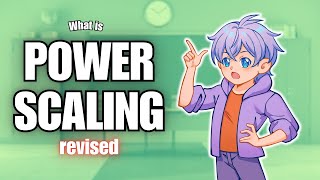

What is Power Scaling?
45sThe video starts with a clear, engaging definition that hooks viewers interested in understanding the basics of power scaling.
▶ Play Clip"The title accurately reflects the video's content: a thorough explanation of what power scaling is."
This video is the first episode of a series called 'Powerscaling 101', aiming to educate viewers on the concept of power scaling fictional characters. The host defines power scaling as a method of quantifying a character's capabilities through feats and statements, and distinguishes between inverse scaling (within a verse) and crossverse scaling (between different series). The video also addresses common misconceptions, such as confusing bad writing with bad power scaling.
Power scaling is defined as 'a method of determining the relative size or extent of something or someone’s physical strength and force that they can exert.'
A more accurate definition: 'the method of determining the capabilities and/or limits of a character by means of quantifying feats they have demonstrated and interpreting statements about or concerning the character.'
In a debate, Seth the Programmer asks Vacheeto to 'quantify reality warping' for Janemba, illustrating the need to use real-life measurements to determine how powerful a character must be to perform a feat.
Inverse scaling determines a character's standing within their own verse by comparing feats and statements to other characters. Crossverse scaling determines capabilities in a neutral setting against the rest of fiction.
Feats are achievements demonstrated by the character (direct or indirect). Statements are expressions about the character, providing context. Both are required for proper power scaling.
Direct feats are performed by the character themselves (e.g., destroying a planet). Indirect feats are inferred from direct feats and are key to inverse scaling (e.g., Goku scaling above planetary due to blocking Trunks' attacks).
To judge a statement's validity, ask: Who is making it? Who/what is it referring to? What information is provided? Does it introduce a contradiction? If yes, the statement is invalid.
Bad power scaling is often misattributed to bad writing. Power scaling is a tool (like a ruler) to measure consistency; it is not the cause of poor storytelling.
Power scaling is a systematic method for quantifying fictional characters' capabilities using feats and statements, distinct from writing quality. Understanding its proper definition and application helps avoid common misconceptions and enables more meaningful debates.
What is the technical definition of power scaling?
The method of determining the capabilities and/or limits of a character by quantifying feats and interpreting statements.
02:38
What are the two types of evidence used in power scaling?
Feats (achievements) and statements (expressions about the character).
10:13
What is the difference between direct and indirect feats?
Direct feats are performed by the character themselves; indirect feats are inferred from direct feats.
11:07
What is inverse scaling?
Determining a character's standing within their own verse by comparing feats and statements to other characters.
07:15
What is crossverse scaling?
Determining a character's capabilities in a neutral setting against the rest of fiction.
07:33
What four questions should you ask to evaluate a statement's validity?
Who is making it? Who/what is it referring to? What information is provided? Does it introduce a contradiction?
14:57
Why is 'bad power scaling' often a misnomer?
Because it is usually bad writing, not bad power scaling; power scaling is a tool to measure consistency.
16:23
Technical Definition of Power Scaling
Provides a precise, actionable definition that forms the foundation of the entire series.
02:38Quantify Reality Warping
Illustrates the core principle of using real-world measurements to evaluate fictional feats.
06:03Inverse vs. Crossverse Scaling
Clarifies two distinct methodologies that are often conflated, essential for proper scaling.
07:15Direct vs. Indirect Feats
Explains a key distinction that strengthens scaling arguments, especially for inverse scaling.
11:07Bad Power Scaling vs. Bad Writing
Debunks a common misconception, emphasizing that power scaling is a diagnostic tool, not a flaw.
16:23[00:06] What is Power Scaling?
[00:08] Something that surprisingly was debated about during the past several years.
[00:12] Although there are a few channels that actually made pretty good videos explaining that very concept and still hold up pretty well.
[00:18] But there were also some channels that didn’t know what they were talking about, AT ALL..
[00:24] So what am I doing here?
[00:25] Well hello everyone, and welcome to the first episode of Powerscaling 101.
[00:29] I'm your host Surfbone,
[00:30] and in this series I hope to educate audiences
[00:33] (especially normies)
[00:34] on the various terms, arguments, and myths related to the subject of scaling fictional characters and what they’re truly capable of.
[00:41] And what better topic to begin this series, than with a video concerning the term itself Power Scaling.
[00:46] As I referenced earlier, these YouTubers had made many videos addressing the misinterpretations of the term power scaling
[00:53] and educating their audiences on what the term actually stands for.
[00:57] In which I think they all explained the concept very well and most of their explanations about the topic definitely still hold up.
[01:02] However, I believe that a much more up-to-date, in depth, and educational video going over the concept of power scaling as a whole is very much necessary.
[01:11] and the many things pertaining to power scaling need to be addressed and properly explained to avoid any further misinterpretations going forward.
[01:18] Especially if I plan on going forward with a series called “Power Scaling 101”.
[01:23] So without further adieu, let’s get into it.
[01:26] So what is Power Scaling?
[01:28] Well, if we want to take the simplest route to explaining it,
[01:31] let’s take the term Power Scaling itself,
[01:33] and split it up the two words that coexist within the term and define them separately.
[01:37] The “Scaling” portion of the term, would be referring to this definition of scale where it is defined as, “the relative size or extent of something.”
[01:45] And the “Power” portion of the term, would be referring to this definition of power where it is defined as, “physical strength and force exerted by something or someone.”
[01:55] So, if we take these two portions and add them together, we would get a combined definition that would be somewhere along the lines of
[02:01] “a method of determining the relative size or extent of something or someone’s physical strength and force that they can exert.”
[02:08] So, that seems like a pretty fair definition, right?
[02:10] Well unfortunately, although easy to understand going off the two words that coexist within the term itself,
[02:16] it’s not technical enough to be considered an accurate definition at all.
[02:20] After all, Power Scaling doesn’t always refer to determining the strength of a character.
[02:25] It is used to also determine the speed of the character, the potency of their abilities etc.
[02:30] (Which I will cover in other videos of course)
[02:32] So what would be considered a more technical or more accurate definition of the term, Power Scaling?
[02:38] Well, this is what I came up with.
[02:40] Generally, Power Scaling should be defined as
[02:42] the method of determining the capabilities and/or limits of a character
[02:46] by means of quantifying feats they have demonstrated
[02:49] and interpreting statements about and/or that concern the character in question
[02:54] that would help better establish the character’s capabilities and/or limits.
[02:58] In case that’s a bit too wordy for you,
[03:00] a much more simpler definition would be
[03:03] the method in which we quantify a character’s capabilities through real life measurements and concepts.
[03:08] So most of you probably have gotten the gist of it by now,
[03:11] but some of you may be unaware of the word, quantify.
[03:14] Quantify being defined as “to express or measure the quantity of.”
[03:19] To help better explain what it means to “quantify something,”
[03:22] let’s look at this debate between Seth the Programmer and a normie infamously named, Vacheeto.
[03:28] For context, Seth is defending the position that Broly from DBZ is stronger than anyone from either the DBZ anime or the movies
[03:37] (not including these two of course)
[03:39] And Vacheeto, brings up a villain from the movie Fusion Reborn named Janemba who he believes to be stronger.
[06:03] So to summarize this clip,
[06:05] Vacheeto is arguing that Janemba can beat Broly mainly because he is a “reality warper.”
[06:10] In which Seth retorts with “Quantify reality warping.”
[06:14] Vacheeto then brings up Janemba’s feats of
[06:17] “changing the very nature of hell and heaven” and “bringing the dead back to life.”
[06:22] Seth then asks him “what does that mean?”
[06:25] What Vacheeto is struggling to prove here,
[06:27] is that he’s bringing up a feat that Janemba has done that can supposedly defeat Broly,
[06:32] but is unable to answer “how much power would it take to do that?"
[06:38] Which is basically one of the main fundamentals of how to power scale.
[06:42] If Janemba can change the very nature of hell and heaven,
[06:45] it’s our job to use real life measurements and concepts to determine how powerful you would need to be in order to do that.
[06:53] So now hopefully we now all understand what power scaling is.
[06:56] but you may be wondering why I’m not using this definition that most VS wiki websites have for the definition of Power Scaling.
[07:03] Well, if you read the entire page concerning the definition,
[07:06] you would know that particular definition is in reference to one of the two forms of Power Scaling, better known as “Inverse Scaling.”
[07:15] Inverse Scaling, as I define it,
[07:18] refers to the method of determining a character’s or characters’ standing(s) within their own verse/series
[07:25] by means of comparing their own feats and statements concerning their capabilities and/or limits to other characters.
[07:31] While the other form of Power Scaling
[07:33] known as “Crossverse Scaling,” again as I define it,
[07:37] refers to the method of determining the capabilities and/or limits of a character when put in a neutral setting against the rest of fiction.
[07:45] So, now that we got more concrete definitions,
[07:47] let's get into what most people don’t often bring up or even properly explain.
[07:51] What mainly makes these two separate forms of scaling different?
[07:55] Let’s first talk about Inverse Scaling.
[07:57] Now, what methods are natively used within Inverse Scaling that aren’t natively used within Crossverse Scaling?
[08:02] For the sake of brevity, I’ll use this clip from one of Seth’s old videos where he basically covers the essence of Inverse Scaling.
[08:23] Say for example, Jiren beats Golden Frieza, and Golden Frieza beats Gohan.
[08:29] Power Scaling would be to dictate that BECAUSE Jiren beat someone who beat Gohan,
[08:34] Jiren can himself, beat Gohan.
[08:37] That's what Power Scaling is.
[08:39] As said within the video, Inverse Scaling tackles the scaling of a character within their own series.
[08:45] And methods like, A is greater than B, and B is greater than C,
[08:49] can help better establish where a character stands in comparison to others native to the verse.
[08:53] But what about Crossverse, what are its main defining traits?
[08:57] Well, it most often indicates taking two characters from two different series and putting them against each other
[09:02] Hence the term, “Cross Verse.”
[09:05] For example, let’s grab Goku from Dragon Ball and Superman from DC Comics and throw them into a space that isn’t located in either verse.
[09:12] So, that means neither have a home field advantage, or outside help that can only be found in their own universes.
[09:19] Which means it's just them and their standard equipment.
[09:21] Now you may be asking, don’t you have to use Inverse Scaling in Crossverse Scaling?
[09:26] Well yeah, you’d have to in order to actually be able to scale the character.
[09:31] But unlike Inverse Scaling, you can’t use the A > B > C argument in Crossverse Scaling.
[09:38] If you did, it'd essentially sound like this,
[09:41] “Well, sense Jire can body Goku, I think Jiren should be able to beat Superman.”
[09:46] Like what, where is the logic and/or reasoning in that argument.
[09:50] How did you get from Jiren beating Goku, and then saying he can now for some reason beat Superman because of it.
[09:57] These types of arguments are commonly known as Headcanon,
[10:00] which I will be covering in a future video.
[10:02] But besides that, since we’re now completely educated on what Power Scaling is,
[10:07] let’s get into the basics of what you need to know about properly power scaling a series or character.
[10:13] So how do you Power Scale a fictional character?
[10:15] Well, we must start off by listing off the two different types of evidence that are required when power scaling a particular character.
[10:21] These two things being, the Feats demonstrated by the character and the Statements made about the character.
[10:27] A Feat being defined as “an achievement that requires great courage, skill, or strength."
[10:32] And a Statement being defined as “a definite or clear expression of something in speech or writing.”
[10:37] So, on the surface, both sound pretty simple concepts to understand, right?
[10:41] Most of you probably believe that this is all you need.
[10:44] Well, it’s time to get a way more technical.
[10:46] Let’s start off with Feats,
[10:48] like we already acknowledged, feats are essentially achievements made by someone that are worthy of acknowledgement.
[10:53] And feats can be categorized into almost anything.
[10:56] Such as, Feats of Strength, Feats of Agility, Feats of Intelligence, and the list goes on.
[11:01] I do plan to cover the complexities of each category of feats in their own separate episodes, so let’s move on.
[11:07] Feats actually have two different classifications, these being Direct Feats and Indirect Feats.
[11:12] Direct Feats being the demonstration of a particular feat that was performed by the character itself.
[11:17] For example, a character obliterating a planet would be classified as a direct feat,
[11:22] because it’s something that they have demonstrated THEMSELVES to be capable of doing.
[11:25] A character moving faster than their opponent is also a Direct Feat,
[11:29] because again, they themselves are demonstrating the ability to move faster than their opponent.
[11:33] So what about Indirect Feats?
[11:35] Well, Indirect Feats relate to what a character should be capable of that often falls back on a Direct Feat that they have demonstrated themselves.
[11:42] And what you’ll also start to notice, is that Indirect Feats are very much involved with how Inverse Scaling works.
[11:48] For example, Goku at the start of the Android Arc was shown in Super Sayian to be being capable of tanking several sword slashes from Future Trunks with only his finger,
[11:57] (which is a Direct Feat)
[11:59] but when it comes to feats that involves fighting an opposing character,
[12:03] we have to ask ourselves, what makes that fighting them actually impressive?
[12:07] Well, let’s look back at what feats Future Trunks has demonstrated so far.
[12:11] He was shown to be able to cut Mecha Frieza in half with a single slice, and then sliced him again into several pieces.
[12:17] Frieza himself, has shown at a bare minimum in a near death state,
[12:21] to survive a Planet exploding on top of him without any further injuries.
[12:25] So, because Goku during this time as a Super Sayian scales above the attacks from Future Trunks that recently cut Frieza into mince meat
[12:34] and Frieza can still tank Planets exploding when in a near death state;
[12:38] which indicates that this Super Sayian Goku has Indirect Feats of him scaling above Planetary very easily.
[12:45] So while Direct Feats are fairly easy to spot and making sound arguments using them for a character are fairly simple to make.
[12:52] However, the strongest arguments for scaling a character at a certain level often involve the usage of Indirect Feats.
[12:59] Which although strong, tends to fly over the heads of many normies that float around in the vs community.
[13:04] For now, let’s talk about Statements, something a lot of people still seem to misunderstand.
[13:09] First, we must address what Statements are in power scaling, how to judge the validity of a statement, and how they can be used as evidence.
[13:17] To properly explain what statements are, we must first ask ourselves,
[13:21] what’s the main difference between Feats and Statements in Power Scaling?
[13:24] Well, in very easy and simple terms,
[13:27] Feats are what’s being SHOWN, while Statements are what’s being TOLD.
[13:30] This explanation works, because it helps explain how you can take statements from books of literature and categorize them as feats;
[13:37] because although it might not be visually showing us what’s going on,
[13:41] feats relate to the events that are taking place within the story being told.
[13:45] They aren’t just about the big ol' pretty pictures.
[13:47] So what can statements provide that relates to Power Scaling?
[13:50] Well, there is at least one major thing that statements can provide more of, Context.
[13:56] Context being defined as “the circumstances that form the setting for an event, statement, or idea, and in terms of which it can be fully understood and assessed."
[14:05] An easy example of this is when the story gives you a quick profilo about the character.
[14:10] Or in comics where they monologue about the many great things the character has accomplished throughout their life.
[14:16] To demonstrate the importance of context,
[14:18] let’s pretend you’ve never seen this Batman scan before,
[14:21] can interpret what Batman is doing throughout all these scans without having the statements to better interpret what’s going on?
[14:28] Not really, without the context and/or statements, we couldn’t really tell what he’s doing on these panels that are worth praising.
[14:36] There’s even this meme in power scaling, that references the many instances where in a story, it seems like this character is performing all these good feats,
[14:44] but it’s later on stated that's all just a dream.
[14:48] And that it all never happened, they just dreamt this up.
[14:51] But when it comes to using statements as evidence, we must ask ourselves many important questions.
[14:57] Such as, Who is making the statement?
[15:00] Who and/or what is the statement referring to?
[15:03] What information is being provided by the statement?
[15:06] And probably the most important one, Does the statement introduce a contradiction?
[15:12] Now, what these first 3 questions do is help better establish a significance into what’s being said.
[15:19] While, the 4th one relates back to the validity of the statement,
[15:22] and whether or not the statement being true would actually go against the story being told.
[15:28] So the answers to the 2nd or 3rd questions ultimately don't matter, if you answer “Yes” to the 4th question.
[15:35] Which would then bring us back to the 1st question,
[15:38] was the statement made by someone from within the story (such as a character or narrator) or someone outside the story (such as the author, guidebook, director, etc).
[15:50] If the statement was made by a character within the story, then the contradicting statement can most often get easily explained via the context of the narrative.
[15:59] But if it was made by someone outside the story, then it can easily be dismissed.
[16:04] As the statement contradicts what occurs within the main source material and doesn’t hold any value.
[16:10] I will cover the outside the story statements in another video, so save your salt and/or questions for that.
[16:16] And this video is getting long enough so let’s get into the last section of this video, the misconceptions about Power Scaling itself.
[16:23] Doesn’t a series have bad Power Scaling if the power ups or power progression don’t make sense?
[16:27] Absolutely not!
[16:29] I believe Seth actually explained this best during the time when people were getting pissed off about how powerful Kefla was when she was first introduced into the series of Dragon Ball Super.
[16:37] In response to this, people immediately went to blame Power Scaling for this occurring.
[16:42] Which if you know anything about Power Scaling, you’d know it has NOTHING to do with this.
[16:47] Then, what is it?
[16:49] It’s WRITING.
[16:51] It’s the job for any author or writer of a series to not only make a story that is easy to follow but also easy to understand.
[16:58] Because if you don’t implement that in your writing, your audience will begin to become confused and less interested
[17:04] Because whether or not your story is set in real life or a cartoon,
[17:08] it has a level of believability.
[17:10] In writing, believability is defined as “the quality of being convincing or realistic.”
[17:15] In a shonen anime for example, you have much more freedom to make unrealistic things happen in your show than say an irl show.
[17:23] But now your job is to make what happens within the show seem convincing.
[17:27] Like, “Oh I get it, I can see that happening. That makes sense.”
[17:31] Since it can’t necessarily be realistic or you’d be taking away what makes a cartoon enjoyable.
[17:36] For example, My Hero Academia,
[17:39] the first thing that is established within the series is that the vast majority of the world’s population have super powers called quirks.
[17:45] Which can range from being something useless, to downright overpowered.
[17:49] And although where quirks came from is stated to be unknown, it is at least acknowledged by the series.
[17:54] So what My Hero has done is set a very high bar in terms of what the audience should expect to be considered believable in a world like My Hero.
[18:01] And it would probably take something like the author introducing a Saitama like character
[18:06] that just solos the entire cast and just leaves without any explanation as to what just happened;
[18:10] or a ship between Deku and Eri.
[18:12] Basically, it would take something so ludicrous and bad,
[18:16] for My Hero’s audience to truly start scratching their heads in confusion as to what they just saw and possibly just give up on the series.
[18:22] But to be honest, knowing the current My Hero fandom,
[18:24] they only get pissed off when the show doesn’t look 100% like the manga, even though their show was literally made to be the best animated shonen of all time.
[18:32] And they’ve already made fanart of that ship I mentioned earlier.
[18:34] But obviously that’s not the point I’m trying to make, and I’m getting a bit off topic.
[18:37] The point is, just because a show like Dragon Ball Super doesn’t make sense of why certain characters are this powerful,
[18:44] has nothing to do with Bad Power Scaling.
[18:48] And it actually pisses me off when people keep using the phrase “Bad Power Scaling” as an alternative for “Bad Writing.”
[18:55] When in truth, we often use power scaling to help better identify these instances of bad writing.
[19:00] Let me explain,
[19:01] imagine we have a house that was just recently built, but also happens to look kinda off on a surface level.
[19:08] So a man comes up with a ruler to take some measurements of the house;
[19:11] and with that ruler, starts to notice the flaws in the architecture of the house.
[19:16] Let’s say, he was able to tell that one side of the house is taller than the other.
[19:19] Then imagine the family that just bought the house starts ridiculing the ruler for the flaws that it just proved exist.
[19:25] Do you see the parallel?
[19:27] The reason why the ruler shouldn’t be ridiculed for why the house was poorly built,
[19:31] is the same reason why Power Scaling shouldn’t be ridiculed for why a show's poorly written.
[19:35] It’s the architect that didn’t notice the flaws when building the house and the author that didn’t notice the flaws when writing the story who are at fault
[19:42] And at the end of the day,
[19:43] Power Scaling is the ruler we use to help measure how powerful characters are in fiction.
[19:48] Luckily we are now in a time where Power Scaling is far more expected in the community than it was 2 or 3 years ago;
[19:55] and those people who still preach “Power Scaling is Dumb” are incredibly few in number.
[20:00] However, I still feel like it was important to address, especially in a video like this.
[20:03] Well anyway, that’s all I’ll be teaching for this episode.
[20:06] I have MANY other video topics planned for this series, because there is so much to talk about that I simply can’t put into one video.
[20:14] But obviously knowing what you guys want to see as soon as possible is really important,
[20:18] so please comment down below on what topics you want to see me cover next.
[20:21] But don’t forget to like and share this video, and also subscribe to my channel.
[20:26] Doing all of these things will help let me know that this is the content that you want to see, and it will especially help better motivate me to get these videos done even faster.
[20:35] Especially since A LOT of work goes into making these videos.
[20:39] And do expect me to release videos going over Attack Potency and Destructive Capacity,
[20:43] as well as a video going in depth about the Speed Tiers used within Power Scaling within the coming weeks.
[20:49] But other than that, thank you all for watching, and class is dismissed.
⚡ Saved you 0h 21m reading this? Transcribe any YouTube video for free — no signup needed.