
The #1 Mistake When Buying Studio Gear
56sHighly relatable mistake that many musicians make, leading to regret and wasted money.
▶ Play Clip"Title accurately promises three key insights, and the video delivers exactly that with clear, experience-based advice."
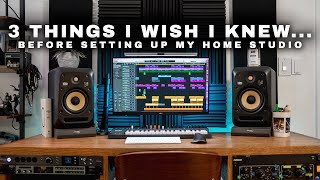
This video shares 11 years of home studio experience, focusing on three creative philosophies rather than a typical gear tour: planning ahead, enabling creative flow, and following your creative curiosity.
Invest in gear with future growth in mind, like an audio interface with enough inputs to avoid constant cable swapping.
Set up the studio so frequently used instruments and equipment are always ready to record, minimizing friction and enabling flow.
Follow unexpected curiosities—like buying a new instrument or exploring a new genre—to stay excited and avoid creative blocks.
The most important aspects of a home studio are the creative philosophies you adopt, not just the gear itself.
What is the first thing the creator wished they knew before setting up their first home studio?
The importance of thinking ahead when buying gear to avoid future limitations.
00:41
Why did the creator regret buying an audio interface with only two inputs?
It required crawling behind the desk to swap cables every time they needed to record a new instrument.
01:10
What are the three things the creator wished they knew before setting up their first home studio?
1. Plan ahead for gear purchases. 2. Set up the studio to enable creativity. 3. Scratch the creative itch by following curiosity.
00:41
Plan Ahead for Gear Purchases
Emphasizes long-term investment over short-term trends, saving money and frustration.
00:41Enable Creativity in Studio Setup
Highlights the principle of reducing friction to enter creative flow states more easily.
04:28Scratch the Creative Itch
Encourages following curiosity to maintain excitement and overcome creative blocks.
06:39[00:00] So this year marks year 11 of me having a home studio Which is kind of hard to believe but I've learned a lot over these last 11 years or so and today
[00:12] I thought I'd show you around my current home studio setup But unlike a typical studio tour. I want to show you how I have this room set up and share with you The three things that I wish I knew before setting up my first home studio
[00:25] These are like the three creative philosophies that I found to be really helpful when setting up a creative environment that just oozes with creative flow But that title wasn't quite as sexy. So here we are now thing number one
[00:41] I really wish I understood the importance of thinking ahead when you're buying your gear if you can adopt this one early Your wallet will thank you. I definitely tend to feel like I've got to have the latest and greatest when it comes to new gear
[00:53] And I'm sure I'm not alone on that one But sometimes that desire for what's new or what's cutting edge or even what's trendy has kept me from investing in gear that Really suits how I want to make music and maybe more importantly how I want this studio to grow over time
[01:10] My audio interface is a great example of this. It was one of my first big studio investments And at the time this interface was like the cool new product I bought it without considering the limitations that I was going to face with only two inputs
[01:23] Let's just say crawling behind my desk to swap out cables every time I needed to record a new instrument or track Yeah, that got old really quick And I honestly could have spent less money on an interface that was a better fit for my studio long term
[01:37] I have finally upgraded to an interface that makes my life a lot easier And it's hopefully a good illustration of planning ahead with your gear This is analog audio's Orion studio, which gives me enough
[01:49] I owe to keep a lot of my instruments in studio gear always hooked up and ready to record There's eight combination inputs on the back of the interface So my outboard gear since guitar rig are always hooked up and ready to record
[02:02] I've also got an extra stereo quarter inch cable hooked up and ready to go if I want to plug in something like the MPC There's also for additional combination inputs on the front of the interface These are great for working on the fly And even simple features like the two headphone inputs are great for when I'm working with another musician or a vocalist
[02:20] I don't need to break out a whole separate headphone mixer so we can both monitor the audio Each of the 12 inputs also has its own individual preamp, which is great for things like multi-track recording Not something I do a ton of here in this room
[02:32] But is my studio grows and I maybe have a bigger space and can accommodate stuff like that It's great to know that this interface can grow with me And yes, definitely some cool specs and maybe something like this particular interface isn't necessary for your first studio
[02:47] But I hope that illustrates the benefit of investing well, so you don't have to buy and sell and reinvest every time your studio grows Now as a little bonus point, I also wish I understood the value of investing in good quality software instruments
[03:02] There's so many great sounding software versions of the most iconic instruments that will help you get great sounds for your music Software instruments are also usually much more affordably priced than the hardware versions And they're going to take up a lot less space in your studio than this synth wall for example
[03:17] One that I've been checking out lately is the new Roads V8, which is the first and only official Roads plugin VST
[03:29] Thank you to my friends at Roads for inviting me to check out this new plugin and for sponsoring this segment of today's video As you would expect, it's a great sounding Roads plugin, it's really multi-dimensional and it's got some really cool features The V8 is a deeply multi-sampled virtual version of the Roads MK8
[03:44] capturing all the nuance and character of the flagship electric piano with 30,000 samples across 100 velocity layers Roads V8 is super customizable The setup page gives you pernote control over tamber, fine-tuned, level, and damper response
[03:59] You also have pre-app controls, EQ, great sounding effects, and a selection of mics and amplifiers that I'll help to deliver the true Roads sound Visit the video description for more info on the missing keys competition where you can try Roads V8
[04:16] free for 45 days and you can also enter to win a Roads MK8 piano Thing 2, I wish I understood the importance of setting up your studio to enable creativity
[04:28] and not getting the way of it I'm reading Rick Rubin's book right now It's really good, you should check it out But the book is just filled to the brim with all of these little nuggets of knowledge One of my favorite quotes that I've come across so far is no matter what tools you use to create
[04:45] the true instrument is you Isn't that nice? But really, I like that And the truth of the matter is as fun as all of the gear and all the toys are We are the vessels through which the creative ideas flow
[05:00] So it's important that your studio, your creative space, enables that creative flow Here's a few things that have helped me do that First, what's used the most stays set up So the instruments that I create with most often are always hooked up and ready to record
[05:17] guitars and bass are hanging on the wall, easy to grab, ready to use And things like my amps and pedals are set up, hooked up, ready to flip a switch and press record Now if it's not set up it should be easily accessible
[05:31] This main spot on my desk for example is usually either occupied by the minifreec synth or the NPC or the Akai MPK Mini Plus But whatever's not on the desk is either over here, practically an arms reach away on this side table over here
[05:46] or it's right over here on a shelf in my closet but in both cases easily accessible My mics are also out on the shelf, really easy to set up and start using And when I open my DAW to start a new session, I always start with a template that I've created
[05:59] So each of the tracks and the inputs that correspond to the IO on my audio interface All of that is set up effects and plugins are all set up And I even have my favorite software instruments set up and ready to record with
[06:11] This also really helps to enable creative flow states because you're not menu diving or searching for sounds Everything that you use on a regular basis is set up and ready to record with I guess the main idea is I want to come into my studio, flip a few switches, open my DAW
[06:27] and be ready to record anything And for this last point I thought I would completely contradict my first point and tell you to just buy the gear I'm only partially kidding but I think there is something to be said for scratching that creative itch
[06:40] and I guess more importantly keeping yourself excited about making music And this definitely isn't always gear related Sometimes exploring a new genre or a new recording technique can get you excited about making music
[06:53] Scratch the itch I always find some of my favorite ideas are on the other side of weird or unexpected curiosities It can be as simple as adding in a new instrument or as involved as changing around your entire layout
[07:09] I remember one day I was getting really frustrated trying to find like the perfect percussion sample for a track So I just got in my car and drove to guitar center and came home with a bag of percussion toys But I just feel like things like that keep the energy in the studio fresh and exciting
[07:25] and keep you away from things like creative blocks I recently got an MPC and I'm learning a completely new standalone platform which on paper seems like maybe not the best use of my time
[07:37] But I'm scratching a creative itch that I've had for a long long time and I've had so much fun making music with this thing At the end of the day I think I'll drive yourself a little crazy trying to find the right way
[07:49] to do a lot of this stuff So I've always found the best bet is to just follow your interests And listen, of course things like acoustic treatment and monitor placement and the right gear are all important aspects of the home studio
[08:04] But for me the creative philosophies you have are just as important for making great music in your studio So I hope these tips are helpful There's links in the video description for some more info on the gear I'm using As well as some ways that you can support the channel
[08:17] Thanks for hanging today my friends, I'm Patrick, I will catch you in the next one Peace
⚡ Saved you 0h 08m reading this? Transcribe any YouTube video for free — no signup needed.