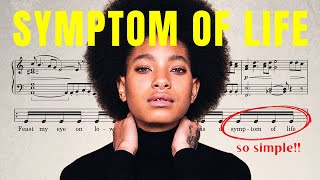

7/8 vs 4/4: The Time Signature Trick That Changes Everything
60sExplaining how a song switches from unstable 7/8 to stable 4/4 in the chorus reveals a mind-blowing songwriting technique.
▶ Play Clip"Delivers exactly what the title promises: five concrete, well-explored songwriting techniques with real musical examples."
This video breaks down Willow's 'Symptom of Life' to reveal five essential songwriting techniques: shifting time signatures, chord extensions, parallel modulation, melodic contrast, and unconventional song form. Through detailed analysis, the presenter shows how these elements create emotional impact and maintain listener engagement.
The song alternates between 7/8 in the verses and pre-choruses and 4/4 in the chorus, creating a shift from unstable to stable feel.
Switching from 7/8 to 4/4 creates momentum and mood shifts—verses feel uncertain, chorus feels confident and grounded.
The verse uses seventh and ninth extensions (Am7, Fmaj9, G9, Dm9) instead of simple triads, adding harmonic complexity and nuance.
The song borrows from both A minor and A major, with the A major chord ending the verse bringing warmth and lightness.
The pre-chorus moves from Fmaj7 to Bbmaj7, temporarily shifting the tonal center to F major before the chorus.
The chorus strips away piano chords, leaving only bass, drums, and vocals, using simple power chords like F5, D5, and Am.
The verse melody starts on the one, comes in on the two, uses leaps, and almost exclusively avoids the home note A, creating unresolved tension.
The chorus melody features a rapid series of 16th notes on a single note, making it feel like a percussion instrument that locks into the groove.
Intro is 4 bars, verse 1 is 6 bars, pre-chorus is 4 bars; the second pre-chorus is 5 bars with an extra 8-beat bar to set up the time change.
The chorus lands at 1:06, much later than the typical 30–40 second mark in pop, but the earlier twists keep listeners engaged.
Verse 3 is 8 bars instead of 6, with different melodic phrasing, acting as a variation that still feels connected to the previous verses.
The song has 23 million Spotify streams, is the most popular on the album Impathogen, and inspires songwriters to experiment with boundaries.
What two time signatures does 'Symptom of Life' alternate between?
7/8 in the verses and pre-choruses, and 4/4 in the chorus.
00:51
What effect does switching from 7/8 to 4/4 create?
A momentum shift and mood change from instability and uncertainty to confidence and grounding.
01:51
What type of chords are used in the verse progression?
Seventh and ninth extensions (e.g., Am7, Fmaj9, G9, Dm9) instead of simple triads.
03:23
What is parallel modulation as demonstrated in the song?
Drawing on both A minor and A major tonal centers, with the A major chord providing warmth after the minor sections.
04:57
Which chord in the pre-chorus is not in A minor or A major, and what key does it imply?
Bbmaj7, implying a temporary switch to F major.
06:51
How does the chorus melody differ from the verse melody?
The chorus uses rapid 16th notes on a single note like a percussion instrument, while the verse uses leaping movement and avoids the home note.
10:57
How many bars long is the first verse?
Six bars.
13:04
Why is the second pre-chorus five bars long instead of four?
The extra bar switches to 8 beats to set up the time signature change to 4/4 and build anticipation for the chorus.
13:34
Time Signatures as Emotional Tool
Shows how unstable vs. stable time signatures can be used to convey mood shifts, a powerful technique for songwriters.
01:51Parallel Modulation for Color
Borrowing from parallel keys adds warmth and complexity without abandoning the original key, enriching the harmonic palette.
04:57Avoiding the Home Note
Deliberately avoiding the tonic creates unresolved tension in the verse, making the chorus resolution more impactful.
10:16Delaying the Chorus
Breaking the pop convention of an early chorus keeps listeners engaged by building anticipation through structural twists.
14:28[00:02] recording app made for musicians by musicians.
[00:19] single off her sixth studio album, Impathogen, Willow's Symptom of Life is one of the most intriguing pop songs I have ever heard. And perhaps calling it song blends together so many different styles and genres. But whatever we're
[00:32] calling it, this song is a treasure trove of contemporary songwriting to take you through an analysis of this song, pull it apart, and share with you five valuable concepts that every songwriter needs to know.
[00:51] this song are the two time signatures that we bounce between as we move through the song form. So in the verses we have this 78 time signature. And so going back to that intro, the way we would count through that 78 time feel is
[01:04] would count through that 78 time feel is like this. unstable time signature as are any of the odd number time signatures like 98
[01:20] 54. These are all unstable. So the verses and the pre chorus are structured in 78. Then we get the chorus which is in 44. The most stable time signature we know because it's the most common time
[01:35] because it's the most common time signature that we hear. [music] from an unstable 78 in the verses and the pre choruses to a very stable 44
[01:51] time feel in the chorus. And the effect we feel when hearing these two different time signatures is twofold. Firstly, it creates a momentum shift. It changes the listening to it. It changes our bodily reaction to the music. And the second
[02:05] thing that happens is we get these mood shifts throughout the song. When we're shifts throughout the song. When we're in the 78 sections, we interpret all the other information as being a little unstable, a little uncertain, pushing
[02:17] and peeling myself out of my disguise. Looking at you now, I'm wondering who am I? If I could try to take you back, I couldn't define. Feeling absence of time, knowing all is decided. There's nothing left here to find. The story is
[02:30] all in my mind. When we hear those lyrics delivered with the 78 time feel, it creates this sense of ambiguity and uncertainty. It's not grounded. It's a little unstable. But when the chorus kicks in, we really feel that mood shift
[02:43] and that momentum shift. Suddenly, the groove feels strong and stable and confident and drives everything forward. And this is a great technique if you're trying to really emphasize the central message of the song. Using these very
[02:55] stable, grounded elements in the chorus helps to deliver that chorus in a very confident manner. In contrast to what we're hearing in the verses, [music]
[03:09] beginning really set the tone for the whole piece. And there is something this set of chords. And there are some subtle variations on these chords using and which sheet music you might be looking at. But what is consistent
[03:23] the type of chords being used. And that's really what I want to talk about now. So in this particular chart we see an A minor 7, F major 9, G9, D minor 9, and then an A major. And you'll notice that there are these nine extensions
[03:37] featuring heavily. And this is relevant because what we're not seeing are triads. We're seeing these sevens and these nines being added to the chords. And this changes the sound and the feeling of the chords. So triads are
[03:49] because they're uncomplicated, they're uncluttered, they're very direct in their sound. When we start adding sevens, nines, 11s, 13s, the extensions, the sound gets a little more complex. It gets a little more nuanced. There's more
[04:04] harmonic information inside the chord. And this often makes the chords sound a word. So, let me just demonstrate the difference between the sounds of these chords. And let's imagine that we're playing this song with triads. We would
[04:18] get an A minor, an F major, a G major, a D minor, an A [music] major. Those were all triads. Instead, what
[04:31] we're hearing in this song are chords that sound more like this. A minor 7, F major 9, G9, D minor 9, [music]
[04:45] and then A. So, when you're writing a song, knowing that the triads create a different mood and a different feeling to the chords with extensions is really important. It's valuable information. But what
[04:57] about that A major? Where does that belong? Where's that coming from? Well, this song is using what's called a parallel modulation. And that means that it is drawing on the sounds of both A minor and A major. So
[05:10] in the key of A minor, we get the chords A minor, B diminished, C, D minor, E minor, F major, G major. If we're creating four note voicings of those chords to get closer to what chords are actually being used in this song, we
[05:23] have A minor 7, B half diminished, C major 7, D minor 7, E minor 7, F major 7, and G7. So the verse begins in the key of A minor and we hear that A minor
[05:36] grounding us in the sound of that key. Then we get another chord in that key. Then we get another chord in that key. another chord in that key,
[05:49] but then the parallel modulation to A major. And ending on that A major changes the mood just for a moment. It brings this warmth and this lightness to the chord progression because everything else has
[06:04] been in a minor. Getting that little A major shift at the end breathes a little sound. But more importantly, we're being presented with these two different keys, these two different tonal centers. And that again makes it not so simple, not
[06:20] in learning more about parallel modulation, I've actually made a video that is entirely focused on that method. And in that video, I talk extensively some really beautiful and interesting chord progressions. So check that out if
[06:35] presenting both the sounds of A minor and A major. Then we get to the pre chorus and we hear these two chords [music] F major 7 to B flat major 7 back and forth.
[06:51] to B flat major 7 back and forth. [music] B flat major 7 is not in the key of either A minor or A major. And so for this moment we are really switching key to F major because in the key of F major
[07:07] B flat major is the four chord. So this is a lovely little moment where the F major has appeared in the key of A minor. It's appeared in the verses in the context of A minor. Now we're hearing it really become the tonal
[07:20] center just for the pre chorus. And then the chorus lands. And this is a beautiful moment where we hear a lot of the elements stripped away, including the piano chords. And what we're left with is really just the bass and the
[07:33] drums and the vocals. So in this section, the harmonic information is really simplified down even further from a triad. It's just the one and the five of the chord. So that would be represented as an F5, a D5, an A minor,
[07:48] back to an F5. These are simple, uncluttered versions of the chords. And it makes perfect sense that they're simple and uncluttered because the chorus is there trying to create contrast from the verses. It's there to
[08:01] drive the message of the song forward. And these beautiful simple little voicings help to do that. Time to have a quick look at Tape It, a pro audio and musicians who are looking for a better way to capture and organize their
[08:15] original ideas. Tape allows you to record in stereo, set markers on your audio files, and importantly has been designed in such a way that you can easily organize and group your recorded ideas, share them privately with other
[08:28] people, and even add photos and additional text. You can download it for free from the app store and for a 20% discount on Tape It Pro. You'll find a link in the show notes. [music]
[08:45] this song. Willow, Chris Griotti, Brad Oberhoffer, and Asher Bank. Asher Bank Oberhoffer was on the piano. And hearing Brad Oberhoffer actually interviewed, he really started with the drums, and he came in afterwards responding to the
[09:01] drum sound that Asher Bank had put down. Chris Griotti played guitar and bass on track. And Willow, of course, was responsible for the lyrics, the vocals, and also was a producer on the track. So, it was a team effort like you find
[09:14] in a lot of contemporary songwriting. And through this team effort, we get this beautiful series of melodies. So, let's start with the verse melody. And I'm going to jump over to Hook Theory so you can see it graphically in [snorts] a
[09:26] slightly different way. [music]
[09:38] [singing and music] >> So, firstly, it starts off of the one. It's coming in on the two. And this is an important note when we come to the chorus melody. Secondly, you can see and hear the incredible movement up and down
[09:51] because melody really has two key elements to it. It has the rhythmic element, left to right, and it has the pitch element, the up and down motion of the melody. But the nature of this rise and fall is interesting. It's not just
[10:03] going up and down like a scale. It's using several leaps to break up the often the part of the melody that really grabs our attention and sticks in our memory. Another fascinating thing about this melody is it avoids the home note,
[10:16] this melody is it avoids the home note, the A almost exclusively. It is barely used except for this one little moment. And avoiding the home note is most stable note option. So when you go to it, everything feels resolved. When
[10:30] you avoid it, it creates the opposite effect. It creates this unresolved avoidance of the home note in combination with the rhythm and the chorus really helps create this very intriguing and slightly mysterious verse
[10:44] section. And then in contrast, we get the chorus melody.
[10:57] got to decide how we're going to adise. >> And this is that moment when we feel in our body that change to a new time feel. And at the heart of this change is the drastic way in which the melody changes. This new construction that features a
[11:12] rapid series of 16th notes and a relentless delivery of this single note in particular. And when you hear this melody, it's really like a percussion instrument. It's like Willow is thinking as a drummer as she's delivering the
[11:25] lines, locking in with the groove, driving the whole thing forward. So, if between your sections, this is one of the most effective ways to do it by write the melodies in each section by creating different shapes, different
[11:40] forms, making them move in different directions. All of these are different factors and things to experiment with when constructing your melodies. when constructing your melodies. [music]
[11:54] arrangement of sections and how those sections are put together to create the song. This song is not a simple pop form. It has some quirks to it. It has us guessing. And one of the best ways to reveal these moments is to label each
[12:09] section and look at the number of bars in each section. So, if we're laying out this song, we have an intro, we have verse one, we have the pre chorus, we then have verse two, we have another pre chorus, and then we get the chorus. We
[12:26] then have an instrumental interlude, verse three, pre chorus, a bridge section, and then finally the chorus. Now, one of the great ways to learn songwriting and learn about song form is to listen to a song and map out the
[12:39] encourage all songwriters to do this when they're listening to music because it gets you inside the song. It shows you how the song is constructed and shows you the role that each of these sections is playing, the transference of
[12:52] energy between the sections and importantly it can give you some really own songwriting. So let's just break going to look at the numbers of bars in each section because that's going to
[13:04] reveal something interesting about this song. So we have the intro setting up this 78 time feel. It's four bars long. Then we get verse one come in. Verse one is six bars long. Then we get the pre chorus, which is four bars long. And the
[13:19] pre chorus's job is really to build up anticipation before going to the chorus, which you would expect to hear a lot of the time, but in this song, it immediately goes back to another verse, and we get another six bars before going
[13:34] into another pre chorus. But this pre chorus is different from the first pre chorus. This pre chorus is five bars long and that final bar that's been added to it switches to eight beats, not seven. This bar is really setting us up
[13:47] for the time signature change in the chorus. Not only that, the five bar section is unstable and an unstable section feels unresolved and so it builds anticipation for what's coming next. It helps transfer energy into the
[14:02] next section and that energy is then released with the landing of the chorus. looking at the numbers of bars in each section, if all of them are stable, if all of them are even, you run the risk of it all feeling too stable, too
[14:16] predictable, you can also run the risk of them being a little disconnected from each other. We want the sections to transfer energy into each other. And one of the best ways to do it is to have an odd number of bars in one section that
[14:28] builds anticipation for the next section. So then we get the chorus landing at 1 minute and 6 seconds, which by contemporary standards is pretty late in the form. If you listen to a lot of pop music, you'll often hear the chorus
[14:40] coming in around the 30 to 40 second mark because that's what's advised by a the industry. They don't want the listener to have to wait too long before they hear the main hook of the song. But this song is not a typical pop song. the
[14:54] twists and turns that we're taken through on the way to that chorus keeps us engaged, keeps us captivated, and so it allows the chorus to appear later in the form. So, it comes in at a minute six and plays over 12 bars. Then, we get
[15:10] a two bar interlude before going into verse three. Verse three is interesting because verse three is different from verse 1 and two. Structurally, it's different. Firstly, it's eight bars long, so it's two bars longer than verse
[15:23] one and two. And secondly, the melodic structure is not a replica of verse one and two. We're hearing different melodic phrasing. It almost feels like a bridge section, but it is using the same chords and similar melodic fragments to the
[15:37] first two verses. So, we hear it as a verse with variation. Then we get the pre chorus. The pre chorus builds that anticipation. We're expecting it to go to the chorus as we heard previously, but instead it goes to this new section
[15:50] which is harmonically different, emotionally different. It only lasts four bars long, but it feels like a bridge because it's a one-off section. And it serves to delay the entry of this final chorus and build up even more
[16:03] anticipation. And the chorus then over 12 bars takes us to the end of the form. But you can see that the chorus only appears twice. It appears in the middle of the song and at the very end of the song. And in between are all of these
[16:15] other moving parts that really do hold our attention and provide lots of form. [music]
[16:28] appreciate the unique blend of elements that this song contains. And I have moment I heard it, but so have millions recording this video, the song has been out for less than a year and a half, 23
[16:41] million streams on Spotify. It is the most popular song on the album Impathogen. And hearing Willow talk about the origins of this song, you get matter for her. She's tackling some serious themes about nature and how we
[16:54] coexist with nature and there are environmental concerns. There are spiritual elements. All of these themes are woven throughout the lyrics. And to the songwriter. They sound like themes that the songwriter needed to
[17:07] explore rather than sitting down and thinking what do people want to hear. The song has a very beautiful whimsical nature but holds a lot of mystery. through the piano but also this syncopated rhythm of the bass bringing
[17:21] in that mysterious element. A juosition of light and dark. And this takes us on what feels like a whirlwind journey. A journey that lasts a total of 3 minutes and 9 seconds yet feels so much longer in the best possible way.
[17:36] immersive. It's packed with little twists and turns all the way through it. And more than just enjoying this song as a listener, it really inspires me as a songwriter to keep trying different things, to keep experimenting with new
[17:49] methods and techniques. It also encourages me greatly to hear a song that is breaking some of the rules, that isn't pandering to the expectations of listeners, that isn't just using tried and tested methods, things we've heard a
[18:01] time you hear it, there are some challenging moments trying to latch on to the time signature changes, trying to count through the bars. It's not easy. You have to do a little bit of work to keep up with this song. And that's the
[18:15] joy of this song. That's the joy of the experience when you first hear it. And then when you hear it for the fifth time, it still challenges you and still draws you in with its complexity and with its blend of elements. And the fact
[18:29] great news for us songwriters because it shows that you can experiment with boundaries a little, being bold and creative with your choices, and still have millions of people love the song. And I'd love to hear your thoughts and
[18:44] when you first heard it. Was it challenging? Did it pull you in? Did it push you away? What were the moments that really stood out for you? And what thought, I want to try that in my own songwriting? Happy songwriting. Bye.



⚡ Saved you 0h 19m reading this? Transcribe any YouTube video for free — no signup needed.