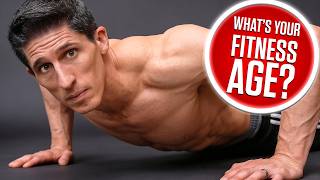

4 People, 1 Challenge: Are You Fit?
45sThe setup with diverse ages and the promise of exposing hidden weaknesses creates instant curiosity and a challenge for viewers to compare themselves.
▶ Play Clip"Title promises exercises to prevent aging; video delivers fitness tests with age benchmarks, but aging link is implied rather than proven."
This video presents seven fitness tests designed to assess overall physical fitness and identify specific weaknesses. Hosted by a physical therapist, the tests evaluate strength, stability, mobility, and endurance, with age-adjusted benchmarks for men and women. The goal is to provide a clear picture of where you stand and what needs improvement.
Tests hip and ankle stability, quad strength, and muscular endurance. Hold for 30 seconds per leg with back flat against wall, knee at 90°, one leg lifted. Failure indicates instability that can affect running and ACL injury risk.
Tests ankle mobility, thoracic spine extension, overhead shoulder mobility, and pelvic control. Stand facing a wall, toes 1-2 inches away, arms overhead, squat below parallel and stand back up. Limited mobility causes compensations like forward lean or arm drift.
Tests upper body strength, muscular endurance, and fatigue resistance. Start face down, hands outside shoulders, press up to plank, lower chest to floor, lift hands briefly, then press up. Benchmarks: men in 40s: 40 reps; women in 40s: 30 reps; decline with age.
Tests grip strength, forearm endurance, scapular stability, thoracic extension, and core control. Hang from bar with shoulders depressed, aim for 2 minutes (men 40s) or 1 min 15 sec (women 40s), with 1-second deduction per year after 40. Failure often due to shoulder or core instability, not just grip.
Tests lateral pillar strength, hip abductors, and trunk stability. Hold side plank with top leg raised to 45° for 30 seconds per side. Quality matters: hips sagging, shoulder sinking, or trunk rotation indicate weakness.
Tests single-leg balance, ankle mobility, hip stability, and proprioception. Stand on one leg, put on sock and shoe, tie it, without touching the ground or holding on. Failure indicates lack of control and balance.
Tests upper body pulling strength relative to body weight, scapular control, grip, and core stability. Full extension at bottom, chin over bar, no kipping. Benchmarks: men 40s: 15 reps; women 40s: 7 reps; decline with age. Excess body fat makes it harder.
These seven tests provide a comprehensive assessment of physical fitness, highlighting specific weaknesses that are trainable and fixable. Passing them indicates good functional fitness, while failing offers clear direction for improvement.
What is the target time for the single-leg wall sit test?
30 seconds per leg.
01:25
What does the wall squat test primarily assess?
Ankle mobility, thoracic spine extension, overhead shoulder mobility, and pelvic control.
02:47
How many hand-release push-ups should a man in his 40s be able to do?
40 unbroken reps.
04:33
What is the benchmark for the dead arm hang for a woman in her 40s?
1 minute and 15 seconds.
06:22
What muscles does the side plank leg lift test?
Lateral pillar strength, hip abductors, and trunk stability.
08:22
What is the 'old man test' and what does it assess?
Putting on a sock and shoe and tying it while standing on one leg without support; it tests single-leg balance, ankle mobility, hip stability, and proprioception.
09:30
How many pull-ups should a woman in her 40s be able to do?
7 unbroken reps.
11:11
What is the decline in push-up performance per decade after the 40s?
5-10% drop in the 50s, then 7-12% per decade after that.
04:49
What does failure in the dead arm hang typically indicate?
Shoulder instability, core weakness, or lack of scapular control, not just grip strength.
06:49
What is the target time for the side plank leg lift for both men and women?
30 seconds on each side.
08:09
Single-leg wall sit exposes instability
Highlights how a seemingly simple test reveals hidden weaknesses in hip and ankle stability that affect running and injury risk.
01:50Wall squat reveals mobility chain
Demonstrates that limited mobility in one area (ankles, thoracic spine) forces compensations elsewhere, stressing the lower back.
03:56Push-up standards by age and gender
Provides specific, evidence-based rep counts that serve as clear benchmarks for upper body endurance across decades.
05:30Dead arm hang tests whole system
Shows that grip strength is tied to overall health, and failure often stems from shoulder and core instability, not just hands.
07:02Old man test: control over strength
Emphasizes that balance and proprioception are critical for daily function and often decline unnoticed.
10:00Pull-up as bodyweight strength equalizer
Explains why pull-ups are challenging for many due to excess body fat and lack of back training, making it a true test of relative strength.
11:41[00:01] putting that to the test. We brought together four people different ages and can watch them, but so that you can measure yourself against them. Because perform, but how you would. How fit are you really? Stepping up to the plate, we
[00:18] years basically means he thinks he's indestructible. We'll see how long that lasts. A 72-year-old aiming to be a great reminder that age alone doesn't have to be a limit of what you can do. A 50-year-old, that's me, with about 15
[00:32] million people expecting me not to fall flat on my face. No pressure. And a showing up when things get tough, which is exactly what these tests are going to that you'll be performing. Each one of them exposes a specific weakness that
[00:46] most people don't even know they have. And if you can't pass them, the truth is you're just not as fit as you think you are. But, this isn't about calling you out. It's about showing you where you stand now so that you know what you have
[00:58] to fix to be better. And the good news is all of these are trainable. before we get into the ones that some people struggle with, let's start with one that actually just looks simple. And this is called the single-leg wall sit.
[01:11] It tests hip and ankle stability, static strength in those quads, and also muscular endurance. To set it up, you want your back flat against that wall, your knee bent down at 90°, and one leg lifted off the ground. The goal here is
[01:25] to make sure you can maintain this position for 30 seconds, making sure to test each leg. Now, most of you watching right now are probably thinking, "Yeah, Jeff, that's not a hard one. I can do that." However, 10 seconds in, you start
[01:37] to change your mind. Remember, the burn here is not just about your quads. It's testing your hip stability, your knee control, and how well you can maintain where most people realize it's just not as easy as it looks. If you can't hold
[01:50] it for 30 seconds on each of your legs, then you've got a problem that you just is not a punishment, it's information about what needs to be improved. If to do this right now? And here's the honest truth. If you're
[02:03] experiencing struggle while trying to hold your leg in place, imagine what unstable leg over and over and over again like when you're running. We use this test often as a sports physical therapist to test ACL integrity or ACL
[02:16] injury risk cuz we want to make sure that there's no lack of stability above more susceptible. Now, if holding your body in place exposes one series of exposes a whole lot more. This is the wall squat test, and this one tells you
[02:32] ever wanted to know. Set up facing a wall, toes about 1 to 2 in away, slightly turned out, arms straight overhead, but don't lean on the wall and don't use it for balance. Keep your chest up, your head up, and now sit down
[02:47] into a full squat below parallel. Hold it for a second and then stand back up. It looks simple, but it's not because do this right, you need ankle mobility, extension mobility of the thoracic spine,
[03:02] overhead shoulder mobility, and the ability to control your pelvis and lower any of these are off, then this breaks down really fast. Right here, you'll see what a limited ankle mobility looks like. Not enough dorsiflexion, and the
[03:15] body has to find another way to get down, which usually means either cutting the depth short or just losing position trying. Our 72-year-old actually gets down, but watch the arms. That overhead position starts to drift, and that's
[03:28] usually coming from a lack of mobility below, in this case, the thoracic spine again. If you can't extend there, then your shoulders can't stay up, and compensation that looks a lot like this. And even when you do pass, it doesn't
[03:41] it, but I'll be honest, my lower back wasn't too happy about it. It cramping like crazy because of how hard I was contracting it to keep the proper But that's what happens when the lumbar spine muscles start trying to do the job
[03:56] and below should be doing all along. Now, if that exposed how well you can control your body, this next one shows how long you can do it for. This is the push-up test, and not just any kind of push-up, the hand-release push-up. Start
[04:09] face down on the floor, arms extended out overhead. Bring your hands back to just outside your shoulders and press yourself up into a plank from there. The in the right position with the least amount of strain and stress on your
[04:21] wrists and shoulders, too. From here, your body stays rigid. Lower your chest all the way down to the floor, lift your hands briefly, and place them back down, and then press up to full extension. It looks basic, but this one adds up fast
[04:33] because now you're testing upper body strength, muscular endurance, and your ability to keep going under fatigue. And this is where things start to separate. For men in their 40s, the number's 40 unbroken reps. In your 50s,
[04:49] expect about a 5 to 10% drop from that. And then into your 60s and 70s, another 7 to 12% decline per decade. But even in your 70s, we're still talking about 32 or so push-ups. It's a lot, but it's doable. Younger guys in your 20s and
[05:02] 30s, you should be pushing closer to 50 reps. For women in their 40s, the number is 30 reps with the same general pattern with that 5 to 10% drop in your 50s and another 7 to 12% per decade after that. So, wherever you are right now, you can
[05:17] should be. And what you'll notice here isn't just who stops first, it's how they stop. The hips start to sag, the range of motion shortens, the tempo changes, and the core starts to give out before even the arms do. And all that
[05:30] not just about counting reps, but making them count and doing them the right way. And remember, if you can't hit the standard, that's not a failure. It's an of exactly what you need to focus on to get better and stronger. And again,
[05:44] because it is trainable, it's fixable. Now, push-ups showed you how long you you how long you can hold on. Literally. This is the dead arm hang. clear the ground. Your hands should be about shoulder width apart, and instead
[05:58] of just hanging there, depress your shoulders slightly by pulling them away from your ears. This will engage the scapula and provide stability to a joint hold you up there for the next 2 minutes.
[06:10] target time you're attempting to reach if you're a man in your 40s. For every year after that, you get a 1-second deduction from your expected time. So, our 70-year-old is looking at about a minute and 30 seconds. For our female in
[06:22] her 40s, you're looking at a minute and 15 seconds as your benchmark. Once deduction every year thereafter. And this isn't just grip strength. You're looking at forearm endurance, scapular stability,
[06:35] thoracic extension, and your core control to keep your body there. If any of those are lacking, you don't just fatigue, but you lose any to meet your mark. Again, 2 minutes is what you're shooting
[06:49] even make it halfway. the hands that go first. It's the shoulders losing their stable position, that core losing its stiffness, and then the body trying to compensate to catch
[07:02] Grip strength itself has been strongly tied to overall outcomes, but here You're seeing how well the entire system holds together under a very simple demand. And when you reach this point,
[07:14] bear, well, then you have to make a decision. working together for just a few more seconds, or just give up and drop. Your grip is starting to open, your shoulders are sinking, your core is
[07:27] shaking, and the clock is ticking. So, we have to find out if you were up on would your feet have already found the floor? And remember, your results are not random. They're informing you of exactly what needs work.
[07:40] shoulder control, thoracic mobility, core stability. And all of it again, well you could hold everything together overhead, this one tells you how well you can stabilize it from the side. This is the side plank leg lift. Set up on
[07:55] your side with your forearm flat on the ground and your elbow directly under Lift your hips up and create a straight line from your shoulder down to your From here, raise your top leg to about 45° and hold it. The goal here is to be
[08:09] able to maintain this exact position for 30 seconds on each leg for both men and women and for any age. This one doesn't really look like much until you actually even though you're not moving, it's all the work that goes into preventing that
[08:22] movement that makes this a challenge. You're testing your lateral pillar your hip abductors, which are famously weak even when other lower body muscles your trunk from collapsing under the load. And what you'll see here is that
[08:35] people don't usually fail by dropping all at once. They lose position slowly. finish doesn't even look like the start. The hips can sag, the shoulders sink, the trunk rotates, or even here on me that top leg starts to come forward to
[08:50] have been controlling in the first place. All of these are signs of a you made it 30 seconds, doesn't necessarily mean that you passed. Because here, quality matters just as much as quantity, and only the slightest
[09:03] to get on the floor and try this right now, would you be able to hold for 30 seconds on both sides? Or would your hips already be dropping? Remember, when it comes to optimal function, resisting movement can be just as important as
[09:16] points to the hips and lateral core muscles, which again are easily of your need to actually strengthen them. Now this next one looks simple, but it exposes a lot. This one's called the old man test. And despite what the
[09:30] lady who's older than her age might indicate as well. But, here's the catch. You do it standing on one leg without holding on Your foot stays off the ground the entire time until the shoe is on and
[09:47] tied. That's the standard. What you're testing here is single-leg balance, ankle mobility, hip stability, and proprioception, which is your ability to sense position and make constant adjustments to stay upright. And this is
[10:00] it's not about strength, it's about control. Small losses of balance, extra touches of the foot, having to reset your entire body, it all counts. You So, if you were to stand up right now, could you get that sock and shoe on, tie
[10:17] the ground, and then do it again on the other side? Because if you can't do something that you stopped training or never realized you had to in the first place. Now, this last one is the one that gets the most pushback. This is too
[10:31] many, it's not realistic, heavier people can't do this, and that's exactly why it matters. This is the pull-up, and it's the king of all upper body pulling exercises. We're talking full extension at the bottom, chin clearly over the bar
[10:43] at the top, no kipping, no half reps, no shortcuts, it's literally you versus the strength. It measures your strength relative to your body weight, and that's equalizer. If you're carrying excess weight, you don't have the strength to
[10:57] move it, this exposes it immediately. If you have the strength and control of going to shine here. This is upper body pulling strength plus scapular control, grip and forearm strength, and core stability all working together. For men
[11:11] in their 40s, the number is 15 unbroken reps. For women, it's seven. I know, it sounds like a lot, and for most people, it is. But again, look at how most towards the front side, the show muscles, right? Chest, arms, shoulders,
[11:27] abs, and not nearly enough attention being paid to the backside muscles body pulling strength. Add to that with over half the population sitting above 25% body fat for men and 30% for women, where again excess body fat becomes a
[11:41] surprise that the standard feels out of reach. But again, there's a reason for room for a lot of people to improve. But again, that doesn't make it wrong. It than where most people currently are. And if being fit is the goal, then that
[11:56] gap has to be closed. As you get older, again, that natural decline in strength decade depending on your age and your efforts to hold on to it. But even then, able to get 7 to 10 reps. And what you'll see here is that people don't
[12:10] just fail from fatigue, they actually start changing the movement, shortening at the bottom, reaching for the bar with the chin, finding ways to just make that rep easier. But it doesn't count because the standard is the standard. So I ask
[12:22] you again, if you were here up on this bar right now, how many clean reps would a lot of people realize that they may not be as well roundedly strong as they thought they were. But truthfully, that's not failure, that's direction.
[12:36] standards, and that's just a reality. Right now, a large percentage of the population is obese or overweight. So if everyone is fit, then the word doesn't mean anything. Having a standard is what gives it value, and it's not about
[12:49] starting point to let you know what you just need to work on. Every one of these tests points to something specific, a weakness you can address, a limitation close. And when you do, you don't just get better at the test, you move better,
[13:04] And understand, this isn't even everything because fitness goes beyond did here. You still got cardiorespiratory fitness, you've got just as much. And if you like, I can cover those in a future video, too. But
[13:19] for now, just take these tests for what they are, a clear picture of where you starting point of where you're about to go. Speaking of that, if you're looking following a step-by-step plan, you can find them all over at athlenex.com. As a
[13:32] physical therapist, all these things matter to me, so I build them into all they're over there, too. If you haven't done so, guys, make sure you click never miss a video when we put them out.
[13:44] All right, guys, good luck on these tests. Let's see how you do.

⚡ Saved you 0h 13m reading this? Transcribe any YouTube video for free — no signup needed.