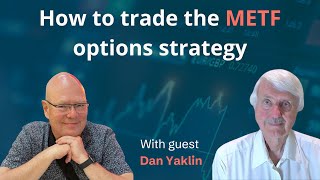

I Made 51% Returns Trading SPX Options
60sSpecific, impressive returns grab attention and spark curiosity about the strategy.
▶ Play Clip"Delivers exactly what the title promises — a detailed, honest breakdown of a real strategy with real results."
In this interview, Dan Yacklin, a retail options trader with 17 years of experience, explains his METF (Multiple Entry Trend Following) strategy for trading SPX zero-DTE credit spreads. He details his mechanical rules, entry times, and risk management, along with impressive performance results. The video also covers his use of automation and how he combines METF with a similar strategy, MEIC, to smooth returns.
Dan Yacklin, a retail trader from Dallas, has 17 years of options trading experience. He started with a course from Optionetics, then traded stocks and ETFs for 14-15 years, and discovered zero-DTE strategies on SPX in 2020.
METF stands for Multiple Entry Trend Following. It involves selling credit spreads (put or call) on SPX on the day of expiration, based on the trend direction at specific entry times.
The performance results are based on one contract, with a starting account normalized to $50,000. The account grew to $75,570, a compounded return of over 50%. Monthly returns: July 3.9%, August 5.4%, September (through 20th) -2.1%.
Entries are at 12:30, 1:00, 1:30, 2:00, 2:30, and 2:45 PM Eastern Time. He uses 20-period and 40-period EMAs on a one-minute chart to determine trend direction.
If the 20 EMA is above the 40 EMA, he sells a put credit spread; if below, a call credit spread. Spread widths are 25, 30, or 35, selected by automation to balance credit.
Strikes are selected to collect a credit between $1.25 and $2.50, aiming for as close to $2.50 as possible. A 1x stop is set on the credit received, meaning a $2.50 credit has a $5 stop, resulting in a $2.50 loss.
He holds trades until expiration and does not close early. He avoids trading on FOMC announcement days and minutes release days (three weeks later) due to market volatility.
Dan prefers mechanical trading to avoid over-optimization and because it allows him to trade multiple accounts easily. He hasn't seen a significant advantage in discretionary trading.
He uses the Trade Automation Toolbox software for automated trade execution. He manually traded for comparison and found results roughly equivalent.
Dan rates the strategy's risk around 5 out of 10, but notes it would be very high risk in a black swan event. He risks no more than 50% of his account to survive such events.
The worst case is losing the entire spread width if a black swan event occurs after 2:45 PM with all trades on. For a 25-wide spread, that's $2,500 per contract.
The automation sets stops on spreads, but later in the afternoon, it converts to a stop on the short leg when the long leg's bid becomes worthless.
MEIC (Multiple Entry Iron Condor) is a delta-neutral strategy that collects credit on both put and call spreads. Dan trades it with a 50% allocation alongside METF to smooth the equity curve.
Dan recommends Tammy Chambliss's Quantum Options Facebook group and Discord for learning more about METF and MEIC, where results are posted daily.
METF is a mechanical, trend-following options strategy that has delivered steady returns for Dan Yacklin. By combining it with MEIC and using automation, traders can achieve a smoother equity curve with reduced drawdowns.
Fixed entry times
Shows a systematic approach that avoids discretionary timing, reducing emotional decisions.
07:31Impressive returns
Demonstrates the strategy's real-world performance with concrete numbers.
04:48Mechanical over discretionary
Highlights the value of consistency and avoiding over-optimization in trading.
12:57Risk assessment
Provides a balanced view of the strategy's risk, especially regarding black swan events.
15:27Combining strategies
Shows how blending METF with MEIC can smooth the equity curve and reduce drawdowns.
19:27[00:00] Hello and welcome to this second video from Setup Profits. Today we will dig into an options trading strategy called METF, meaning Multiple Entry Trend Following.
[00:29] We will talk to an experienced retail trader who runs this strategy very mechanically and with great success. But first, a quick disclaimer.
[00:42] This is not financial advice. All information in this video is for informational and educational purposes only. Options trading can involve substantial risk.
[00:54] Do your research and trade at your own risk. Today's guest is Dan Yacklin from Dallas in Texas. Welcome Dan.
[01:06] Oh, welcome. Glad to be here. Thanks for inviting me. How are you doing? I'm doing great. Tell me a little bit about your background as an options trader. How long have you been doing? What kind of strategies have you been doing?
[01:20] Well, I started in options trading about 17 years ago. I wanted to learn more about options, so I took a course from a company called Optionetics.
[01:32] I don't think they're even around anymore. I have dabbled in it for a little bit when I first took the course. I never really found a really profitable strategy, so I just kind of put it on the back burner.
[01:46] And I was trading stocks and ETFs in and out for the past, I don't know, 14, 15 years.
[01:59] And then about in 2020, I discovered the zero DTE strategies on SPX.
[02:11] And so I've been trading those exclusively for the last four years. So that's kind of how I got started in it. Wow, that's a pretty long trading career.
[02:24] I'm very happy to have you as a guest in this video. And we're going to talk about the strategy we call METF,
[02:36] and that stands for Multiple Entries Trend Following. Could you just very briefly explain what this strategy is? So multiple entry just means that you're taking trades throughout the day at specific times
[02:52] and the trend following aspect, and you're selling credit spreads, either a put credit spread or a call credit spread on the day of expiration of SPX.
[03:05] And depending on what the trend is doing at the time of your entry, and we'll define how you determine whether it's trending up or trending down, if it's trending up you sell a put credit spread
[03:18] if it's trending down you sell a call credit spread and that's basically it in a nutshell very good let's just get to the point that so many people are always curious about
[03:32] what are the results so far you have a couple slides here Yeah, so the results you're going to see on the following slide represent trading one contract.
[03:46] The initial account allocation was using 50% buying power in the account with 50% in cash. And there was no interest on the cash that was included in the results that you're looking at or that you will see.
[04:02] And the resulting equity curve was normalized to a starting value of $50,000. So in actuality, the count was less than 50, but I just normalized it so that you could
[04:14] see what would happen if you had a $50,000 starting account. And the performance slide was generated in early July. So in the slide you're going to see, there are not results for July and August and early
[04:31] September. So the returns for July were 3.9% in METF. Returns for August were 5.4%. And the return through September 20th for September was minus 2.1%.
[04:48] So let's look at the performance slide here. These are impressive results so far. What do we see here? Okay, let's look at the bottom right graph first. The blue line you see there is the actual METF performance graph.
[05:05] That's the equity curve for the METF strategy with the percent return shown on the left scale. And the blue line is SPX, if you were buying holds on SPX.
[05:22] So you can see the comparison between the METS strategy and just the buy and holding SPX. And the red dotted line is drawdown, and it's plotted on the right-hand scale, and it is plotted from the top down.
[05:38] So if you're not in any drawdown, you're at the top. If you're in drawdown, it drops down to whatever percentage that you see on the right-hand scale. so you can see that the peak drawdown looks like it occurred early on in the
[05:54] in the year and then okay above that you see monthly returns so you can see the return of this strategy for each month And in the top right you can see the ending value you know starting value and ending
[06:10] value. If you had started with $50,000 you would have ended up with $75,570. And then you got the compounded rate of return, the max drawdown. And then CalMAR, if you're not familiar with CalMAR, it's just you divide the total rate
[06:26] compounded rate of return divided by the max well down. It's sort of a risk-reward kind of factor. How much reward are you getting for the risk you're taking? And then there's some other statistics over on the left-hand side
[06:39] that you could look through. We don't need to go into it in detail, I don't think. But these are quite impressive results, I would say, very steady results.
[06:51] So I think we are very curious about the more, to get into the more details of how this strategy is being traded, you know, when you enter or when you exit your rules and so on.
[07:06] So I'll give you a few minutes to, you know, explain this in detail and bring up your slide with some of the rules. Okay. All right.
[07:18] So METF just means, as we said, multiple entry trend following. So my rule set, this is the way I'm trading it. Now, there's an infinite number of ways you could trade this, but this is what I do.
[07:31] I enter trades, and this is Eastern Standard Time. I enter trades at 1230, 1 o'clock, 130, 2 o'clock, 230, and 245.
[07:43] And at the above times, I look at the 20-period exponential moving average of SPX, and I look at the 40 period exponential moving average of XPX
[07:55] and see which one is above the other. So if the 20 moving average is above the 40, then I assume we're in an uptrend. And if the 20 moving average is less than the 40 moving average,
[08:09] I assume we're in a downtrend. And that's on one minute. The EMAs are on one minute charts. So if the 20 is above the 40, then I assume we're in an uptrend, and I would sell a put credit spread.
[08:29] If the 20 is below the 40, then I would sell a call credit spread. And I would do that at each one of those times shown above. And I use 25, 30, or 35 wide on each credit spread.
[08:44] And since I'm using automation, it decides which width to use. It tries to balance the credit you get on each trade. So it picks 20, 30, or 35.
[09:00] And the strike, it selects strikes to obtain a credit in the range of $1.25 to $2.50.
[09:12] and it tries to get as close to $2.50 as it can without going over, but it won't take a trade for less than $1.25. And then once you enter the trade, you immediately set a stop on the credit received,
[09:28] and so you're going to have a 1x stop, which means if you collected $2.50, you would put your stop at $5, which means if you lose on that trade, since you've already collected a 250 credit
[09:41] and you lost, you know, if you got out at $5, it would be a $2.50 loss. So either you're going to make whatever you've collected in credit or you're going to lose that amount.
[09:53] So it's like a one for one. You know, whatever you collect in credit, you'll either make that or lose that amount. I hold till expiration. I don't close early. I don't take profits early.
[10:05] I just hold it and either I make my, uh you know credit or i lose that amount you know one or the other and the other thing is i do not trade on federal open market committee days when they're making their uh rate announcements because
[10:23] the market goes crazy you know that if they make their announcement and you tend to lose on those days because the market's wildly crazy and i don't trade on fomc minutes days which always follow
[10:36] the market interest rate announcement day by three weeks. So if they have an FOMC meeting and they make their announcement on a Wednesday,
[10:48] then three weeks later on that Wednesday they release the minutes. And that can also tend to gyrate the market around and cause you to have losses. So I just don't trade on those days. But every other day I trade.
[11:00] You know, every other day I enter at those times. I'm strictly mechanical. and that's a bit in a nutshell about how my rules work.
[11:12] Well, I'm curious about a couple of things. One is why have you picked these opening times? You have six times that you are opening the trades mechanically.
[11:24] Why these times? Yeah, so that's a good question. And I try not... I ran back tests when I started doing this. and you can get in the weeds and back test and try to pick, you know,
[11:39] the exact best time and the exact worst time to enter. And I just, I wanted to not trade early in the morning. I wanted to trade later in the day after the market had sort of settled down.
[11:52] So I just picked those times and ran tests on it, and it worked okay. And so I just stuck with it I don want to over That one of the things that I try not to do is over and I try not to you know look
[12:08] I could run back tests and say, oh, last month this time worked best, so this month I'm going to trade that time. But I think that's chasing fool's goals. I just don't believe that, you know, you can predict
[12:21] which is going to be the best time in the future to trade, so I just pick those times. and the second reason I like trading later in the day is that you have your risk is for a shorter period of time where if you're starting to trade early
[12:37] in the morning then you've got that risk on all day long where if you trade you know starting at 1130 or 1230 Eastern then your risk is over a shorter period of time. But why have you chosen to be so mechanical? Because you are very
[12:57] mechanical, while a lot of other traders would choose to be more discretionary, try to read the technical analysis and how the candles are moving, etc., and catch the best moment. But you are just strictly mechanical in what you do. Why
[13:11] have you chosen to be so mechanical? Well, there's two reasons. I've traded multiple accounts and I really could if I was going to try to trade those uh just with using discretion it would be very difficult uh to trade that many you know trade the several accounts that I'm
[13:27] trading and being discretionary on so I'm trading a business account and several retirement accounts um and the other reason is you know I'm open to discretionary trading if it's proven to be
[13:41] if it proves that it works better than the mechanical. And we've done some looking at, you know, there's several people that I'm familiar with that we've looked at their results and they're discretionary traders.
[13:53] And when we put our results side by side, I don't see the benefit. I just haven't seen that there's a significant advantage to go to all that effort when you can just be mechanical and get similar results.
[14:07] and you say that you are using an automated system so your trades are being placed by a boss or by a software can you elaborate a little bit on that?
[14:20] yeah so the software that I use is the trade automation toolbox it's available you can google it and it works very well I've been using it since they first came on the market two years ago
[14:35] and I've had really good results with it. And I actually manually trade a couple of accounts. And when I first started using it, I was manually trading just to compare and see how the automated results
[14:48] compared to the manual trading. And they were roughly equivalent. So I'm happy with the results that I've been getting with the automated trading.
[15:01] So if it works, stick with it, I guess. Okay, very good. And I have a question for you, because if you, you know, some strategies are more risky than others, so to speak,
[15:13] with more volatility and bigger drawdowns, etc. So if I ask you to put this strategy, based on your experience, on a scale where one is very low risk and 10 is very high risk,
[15:27] where would you put this strategy in your assessment? That's a good question. it's hard to answer probably in the middle somewhere around five or so but
[15:39] the issue with this strategy is if you had a black swan event it would be very high risk you could lose a lot of money now what's the probability of a
[15:53] black swan event that's the question you have to ask yourself and one of the things that I like about trading from 1230 to, you know, 4 o'clock, those entries, if a black swan event occurred, it would have
[16:08] to occur in one of those, in that time frame for it to, you know, impact you. And in fact, for it to impact you at the maximum, it would probably have to occur between 2.45
[16:20] and 4 o'clock in the afternoon when you got all your trades on. If it occurred, well, if you had one trade on, then it's not going to be as big of an impact on you. if a black swan event occurred and you took a max loss.
[16:34] I guess now you also answered my next question, at least partly, because that is, what is the worst that can happen with this strategy? Okay, so the worst that can happen is you can have all your trades on,
[16:50] you know, after 2.45 Eastern Standard Time in the afternoon, and you have all of your puts, you haven't stopped out of any of your puts, and you had a black swan event, you would lose the entire spread width.
[17:08] So if you had a 25-wide spread for a single contract, you'd lose $2,500. And for that reason, I don't risk my entire account.
[17:20] I don't risk any more than 50% of my account. So if I had a black swan event, you know, I would still have half my account left. I could still keep trading. And, in fact, the results you saw in the previous slides show, you know,
[17:36] only allocating 50% of your account to the strategy and keeping 50% in cash. To what extent do you experience slippage issues when you are stopped off?
[17:48] and are you setting the stops on the spreads, I understand, or on the shorts only? So the automation, I set it on the spreads, but you have to be careful when you sitting on a spread Later in the afternoon when your long becomes worthless you don want it on the spread anymore
[18:10] You need to convert it over to having a stop only on the short because it won't execute if there's no bid on the long. And so the automation takes care of that. when the bid becomes worthless on the long,
[18:25] it will automatically convert it to a stop on the short. Did that answer your question? Yes, yes, it did. I know that you also trade another strategy called MEIC,
[18:42] Multiple Entries Iron Condor. And we're not going to go into depth in that today, but I found it interesting how you look at these two strategies together. So let's just very briefly explain what is the M-E-I-C strategy.
[18:58] So the M-I-C, it's a multiple entry iron condor, and it's a delta neutral strategy. So you're not trying to pick a direction where the market's going. You just are hoping the market stays in a tight range,
[19:13] and then you collect the credit on both the put credit spread and the call credit spread at the end of the day. and I enter them at the same times as I enter the METF and what I found is that if I do both together
[19:27] I get a smoother equity curve with less drawdown than if I'm trading each one individually and so for that reason I trade right now I've started trading in the last few months
[19:40] I've started trading a 50% allocation to MEIC and a 50% allocation to METF And I find this very interesting. My bread and butter strategy is something I call Zero DG, break even, iron combo, which
[19:55] is similar to a large extent to MEIC. And I've been just testing a bit in very small Nexus X SP, something similar to your METS.
[20:07] And it's very interesting to see how they kind of smooth each other out a little bit. I'm very happy about what I see so far. So I might scale up eventually after seeing it over a longer period.
[20:20] Yeah, well, that's what I did. I ran the METF for a year just trading one contract and took a look at the results and then looked at my results for MEIC and in a spreadsheet just blended the two together
[20:36] and looked at the results and found that it definitely improved the overall equity curve. And so that's when I started to scale up and put, you know, 50% in MEIC and 50% in METF.
[20:51] So people are curious about this strategy. Do you have a tip about where to learn more about it? There are a lot of videos, I think, on YouTube that you can go look at that talk about MEIC.
[21:09] I think Tammy Chambliss is a well-known trader that has put some videos out on MEIC, and METF is very, very similar.
[21:22] I mean, once you understand MEIC, the Iron Condor, then it's just a small change to implement METF. So that's what I would recommend. Tammy Temblis
[21:36] who you mentioned she lives in Dallas too as far as I know yes she does she runs the Facebook group Quantum Options where she has to post her results
[21:48] both on the M-E-I-T and M-E-T-F every day for people to follow so I think that is actually a good Facebook group to she has a Discord group
[22:02] quantum options also, which is, you know, quite a lot of information there on both of those strategies. Our time is running out, but I would like to,
[22:14] you know, if you were to sum up about this, especially who is it a good match for, and what type of trader is it a good match for? Would you say?
[22:27] Well, I mean, you could trade it discretionarily, just like you do, I mean, that's perfectly fine. If that's your comfort level, if you want to trade it mechanically like I do, that's my comfort level.
[22:39] I think it works for both. So I think anybody could, and even with automation, somebody that's working all day could trade it. So that's a plus where if you're a discretionary trader
[22:54] and you're trying to work, you're going to have a hard time during the business day, especially if you're in the United States. Now, if you're in Europe, it's a different story. You know, you got, maybe you can overlap some and trade it, you know, and still work too.
[23:07] But, so it would be good for somebody that's working, you know, if you do use automation. And I guess it's good for those of us who have no clue about where the market is going on any single day.
[23:21] That's right. Sometimes I feel we are a minority. but it's good with a strategy that works for us as well. Yes.
[23:34] Well, Dan, thank you very much for joining in this video. I really appreciate it, you sharing your knowledge and your experience. Thank you for having me. I enjoyed being here.
[23:47] Thank you very much. Thank you.

⚡ Saved you 0h 24m reading this? Transcribe any YouTube video for free — no signup needed.