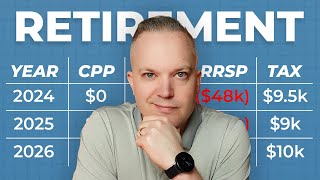

Build Your Retirement Plan: Key Steps
45sThe video opens with a milestone celebration and promises a step-by-step guide, hooking viewers seeking retirement advice.
▶ Play Clip"The title accurately promises a step-by-step guide to building a retirement plan, and the video delivers exactly that."
This video breaks down the key components of a retirement plan using financial planning software. The presenter builds a sample plan for a couple named Dave and Ruth, highlighting critical elements like CPP timing, RRSP meltdown, tax rate leveling, and income laddering. The goal is to show viewers what to look for in their own plans to maximize after-tax income and flexibility.
The video celebrates 100,000 subscribers and outlines the plan to break down key retirement planning components using Snap Projections software.
The software includes sections for general info, additional expenses, incomes (including pensions), assets, debts, and government benefits. It's crucial to include all assets like RRSPs.
The default plan for Dave and Ruth shows an after-tax income of $17,816 (in today's dollars) at age 60, with a total tax bill of $238,000. Issues include minimum RIF withdrawals and early depletion of TFSAs.
Taking CPP at age 60 results in $67,000 after-tax income; at 65 it's $70,816; at 70 it's $73,132. Delaying to 70 yields a six-figure benefit over 30 years.
By drawing down RRSPs before CPP starts, the couple can level their average tax rate around 7-7.5%, reduce total tax to $232,000, and preserve TFSAs for flexibility.
Retirement spending typically declines: go-go (to 75), slow-go (75-85), no-go (85+). A laddered income of $76k/$65k/$60k allows more spending early while maintaining plan sustainability.
If clients have excess wealth, gifting to children earlier (e.g., $200k at age 70) can be more beneficial than leaving a large estate, especially when using TFSA to avoid tax spikes.
Common fears include spouse dying, long-term care costs, or market downturns. These should be modeled in the plan to provide peace of mind.
A robust retirement plan should include CPP timing optimization, RRSP meltdown, level tax rates, and a laddered income strategy. It must address personal fears and provide clear, year-by-year income sources, not just graphs.
What is the after-tax income difference between taking CPP at age 60 vs 70 for Dave and Ruth?
Taking CPP at 60 yields $67,000; at 70 yields $73,132 (both after-tax, inflation-adjusted). The difference is over $6,000 per year.
04:50
What is the target age to empty RRSPs in the RRSP meltdown strategy?
Mid-80s (around age 84).
08:54
What are the three phases of retirement spending mentioned?
Go-go (to age 75), slow-go (75-85), no-go (85+).
12:23
What is the average tax rate target for Dave and Ruth after RRSP meltdown?
Around 7% to 7.5%.
09:56
How much total tax did Dave and Ruth pay in the default plan?
$238,000.
02:35
What is the benefit of delaying CPP to age 70 in terms of total income over 30 years?
A six-figure benefit (close to a quarter million dollars more in pocket compared to taking CPP at 60).
06:05
Why is it important to level the average tax rate through retirement?
To avoid tax spikes and reduce total tax paid, while increasing after-tax income.
09:34
What should you do if you have more money than you need in retirement?
Consider gifting to children earlier (e.g., at age 70) using TFSA withdrawals to avoid tax spikes.
14:33
What is a common fear that should be modeled in a retirement plan?
What happens if a spouse dies? Or if you need long-term care?
16:23
Quarter Million Dollar Impact of CPP Timing
The presenter reveals that delaying CPP from 60 to 70 can result in nearly a quarter million dollars more in pocket, a shocking financial difference.
06:05Tax Reduction While Increasing Income
After RRSP meltdown, total tax drops below the default plan ($232k vs $238k) while after-tax income increases, a counterintuitive win-win.
11:46Heartfelt Thank You for 100k Subscribers
The presenter expresses genuine gratitude for reaching 100,000 subscribers, adding a personal and emotional touch to the technical video.
19:14[00:00] As a huge thank you for 100,000 subscribers, which still blows me away, I want to do a video today which breaks down the key fundamental pieces that you need to make sure you have in your retirement plan. So we're going to go through the financial planning software. Now I'm going to do
[00:14] a full plan build here. I'm going to break it into snippets. Obviously a full plan build takes us many hours to do, but I want to highlight the key points so that when you meet with your financial planner, you make sure that these same points are built into your plan, things that you're not
[00:29] thinking about things, how to look at it. So let's jump into the software and see how this works. So depending on what type of software your planner is using, we use Snap Projections. We like it. We feel like it comes down to like a five-foot level, gives us the detail that we want.
[00:41] But obviously, you see along the left-hand side here, we have your general information, any additional expenses you want to have in there, any incomes that you have. So if you're still working, plug those into here so you can see how much extra money you have.
[00:53] Again, for Dave and Ruth's YouTube here, we have Ruth with a pension. So we put our defined benefit pension plan in here. Any assets. So again, make sure all of your assets work through this. It's amazing how many plans we review for clients.
[01:06] And they're like, oh, the person forgot to put in our RRSP at work and it's worth $100,000. So make sure all your assets are in here. Any debts. Again, government benefits. We'll go through this further in the video.
[01:18] But you want to figure out, like, what are you going to get at 65? What percentage or dollar amount do you get at 65? And then work with the numbers from there. So when we go look at the overall summary, what we have here, and I know there's a lot on the screen,
[01:32] and I'm not going to kind of break it all down here, but the key parts here are your expenses. So if I go to a combined view of both Dave and Ruth, we can see the real expenses. This is how much after-tax in their pocket dollars are they going to be able to have.
[01:48] And this is what we call our base plan or our default plan. Basically, data dump into the software, hit generate, and see where our starting point is. And so for Dave and Ruth, with the assets that they have, Ruth has a small pension, CPP, old age security.
[02:03] They have a very nice income. They're retiring at 60. We have this mapped out to age 90. Again, another key part is to make sure you understand the rate of return, the inflation rate, life expectancy. All these things matter in a plan, so make sure you talk to your client and understand what they're using.
[02:18] Make sure it maps out properly to what you're wanting to see. So again, $17,816. One of the issues, or a few of the issues here, is if I go to total tax and click on this, and you can see here that their total tax bill is about $238,000 on $17,816.
[02:35] This is after tax adjusted for inflation. This nominal dollar beside it. A nominal dollar is the dollar amount you will actually have in your pocket that year. So if we fast forward 10 years to 2034, you'll see they'll have $90,650 in their pocket for spending,
[02:52] which is equivalent to $70,816 in today's dollars. If I jump into each one individually, there's a lot of issues going on here. We're taking out the minimum out of the RIP every year.
[03:05] Again, as they get into their 80s, they still have over $100,000 in Dave's RIP account. They're wiping out chips and staying on registered cash right away. we haven't looked at CPP and OAS. Similar thing for root.
[03:18] Like minimum RIF amount, chance of things gone by mid-60s. Not a great plan, not a lot of flexibility. Can we do better? So that's what we want to look at. So make sure you have your starting point.
[03:30] What's the starting point? What are we working with from square one? Once we have the default, the first thing you want to consider is CPP timing. When does it make the most sense to take both CPP and OV security? CPP will have a bigger impact.
[03:42] So let's look at that and see what the impact is for Dave and Ruth YouTube on taking their CPP at 60, 65, and 70. Now, at age 65, which was the default we built, you can see their aftertact, they get to $0.
[03:55] So by the time they're age 90, we want to get to $0. So they have $595 left when they die at age 90. So they're able to spend $3,816. What happens if we change CPP to age 60 and took it right away?
[04:09] So we'll go into the CPP pension. We'll change Dave to 60. We'll go to Ruth and do the same thing for her, change that to 60. We'll go back to the planning page. And you can see here now that they're going to have CPP.
[04:22] You can see that number there starting at a 60 for Ruth and the same will be for Dave. Now, what we want to do is run, okay, based on them taking CPP earlier, what is the sustainable spending? meaning how much could they spend on an annual basis if they opted for their CPP earlier
[04:38] and took a smaller amount of CPP? Is it going to affect? As you can see here, if they take CPP earlier, their income every single year after tax adjusted
[04:50] for inflation is less So a massive difference and a massive penalty for taking their payment pension plan early So instead of spending a year for the next 30 years
[05:02] after tax, adjusted for inflation, they're only going to have $67,000. Now, again, that's a great income, but they're leaving a ton of money, over six figures of income, on the table by taking their CPP early.
[05:16] Now what happens if we delay it? So back to the benefits page here, you'll see now a bumped CPP to age 70 for both of them. So instead of taking less, much less at age 60, we bumped it all the way to 70. So let's see what that income could be.
[05:29] So again, this is income starting at 60 going all the way to age 90. So yes, there's a 10-year delay, but when we have that delay, we can use our other assets to draw on how much income. So you can see here, it's actually $2,316 more taken in at age 70 versus 65.
[05:48] But so when I look at that, I say, hey, I'll take $2,300 after pass adjusted for inflation for 30 years any day of their week. That's a six-figure benefit in their pocket. So the difference between taking CPP at age 60 versus 70 is going to be close to a quarter
[06:05] million dollars of lost income in their pocket by doing so if they live to age 90. So that's a massive amount of money. So in this case, I'd tell the client, look, here's the differences. you know based on this I would definitely recommend taking it at age 70. But again you
[06:20] need to go through this process with your planner. Everyone's situation is going to be different. What is your situation? Now one thing we always keep an eye on when we build a planner is the tax rate. So again if I click on the total tax you can see they're paying a bit more tax $268,000 but again the first step we want is the after tax income. So again $73,000
[06:39] after tax in their pocket. So if you're collecting much more in your pocket after tax even if you're paying a little bit more tax it's a net benefit to you so in this case that would be the case now when we look at this plan we've looked at ccp planning but no rfp meltdown or tax planning
[06:55] anything like that the problem with this that you can see this effective tax rate that is your average tax rate is zero percent for the first five years of retirement you can see the taxable income is 12 000 13 000 13 000 so it's below that personal exemption meaning that they're paying
[07:13] no tax. Now that's an issue because what's going to happen is you're going to have a roller coaster. They're down here, they're going to go up, and then they're going to come back down. We want to level that out as best as possible. You can see here they're still emptying out their TFSAs, so we need
[07:26] to work on that as well. We want to kind of extend that to create more flexibility in the plan and also wind down that RSP a bit better so that when they get later in life, they're not going to have a big tax bill if they pass away. So the number to keep in mind here again is that 73,132, that is
[07:43] their after tax in their pocket spending by delaying their CPP to 17 without any proper tax planning, RRSP meltdown, anything like that. Now, I'm joking ahead a bit here, but here is the RRSP meltdown. And again, I played with the numbers for a while and figured out this is kind of that sweet spot.
[07:58] So we're looking at Dave, again, he has a substantial RRSP that he needs to draw down. So you can see CPP doesn't start for 10 years. And a lot of you say, Adam, if I don't have that income, I have less to spend. But the reality is, no, no, that income just comes from other sources.
[08:12] extending that CPP gives you more money in your pocket long term you've delayed it you've got that benefit you can wind down your accounts a bit quicker and a lot of people say look at them I don't want to spend my money because if I die early it doesn't pass on look you have to look after yourself everyone's got
[08:26] their own opinion on this at the end of the day you have to use the numbers you have to use data like expectancy rate of return and also the after tax income that you're seeing in time software like this so you can see here we've got a
[08:39] down with $24,000 then later on it's about $15,000 so once the TPP starts we're winding down by about $15,000 and for Dave YouTube here his RST is emptied out by 84 so again mid 80s is typically
[08:54] our target like expectancy so we want to empty it out the side benefit of that is that look at this Dave still has a TFA account all the way through retirement he's spending a bit if he's going to
[09:06] to spend the full $73,000, he's still spending a bit of his TFSA, but he's not winding it down in the first four to five years like he was previously. Same thing for Ruth. When we look at Ruth, she has the pension, a bit smaller RRSP. We wind this down a little bit quicker. She's done by
[09:22] 69. So when her CPP starts, her risk is drawn up at that point. Again, holding on to a lot of that TFSA through retirement. Now, the column that you need to focus on. So as you build a retirement plan,
[09:34] One thing you should focus on with your planner is this effective tax rate or your average tax rate. You can see here for Root YouTube it stays pretty much at 7 to 7 all the way through retirement And so that what we want to see We want to see that level tax rate average tax rate right through retirement You don need to focus as much on marginal tax rate
[09:56] While it's important, your average tax rate will have a much more impact to your overall tax amount that you're paying. If we jump into Dave's YouTube, you can see his average tax rate around 7% and 7.5% as well.
[10:10] So not only are each of their tax rates very level, but they're also very similar to each other. Now, you can see within here, income pension splitting. So there is some income splitting here throughout the years
[10:22] that helps level up the tax bill as well. So there's a bit of that going on as well. But again, we want to create that level tax plan field. When we do that, you can see their income jumps up a few hundred dollars every single year.
[10:35] So not substantial, but you have to look at the back end of it saying, okay, I'm getting a little bit more money, not enough to like change the world, but I'm melting down my RFC better I have my CFSA for much longer creates flexibility if I have an
[10:49] issue emergency anything like that also the one thing I haven't mentioned yet is you can see here we put this additional expense of a vehicle in there so we have it coming in here every single seven to eight years of vehicle so there's two vehicle purchases for retirement now you can see
[11:06] here their total tax doesn't jump in those years where we're pulling the vehicle that's because were utilized in that tax free savings account. If we wind down the tax free savings account, we have spiked years when we need to buy a vehicle.
[11:19] And for most of you, you'll have to buy a vehicle or some other large expense through retirement. You can see if we go back to scenario with that same car purchase, you can see the taxes jump to $16,000 from $132,000.
[11:32] Here it goes to $22,000 from averaging around $8,000. So you have those big spikes in tax rates, which you don't want. So again, you want to plan for these things down the road, level out that average tax rate. So with the CPP timing bumping until 70,
[11:46] it did increase our tax rate, our total tax rate. Even though it increased the after tax in our pocket, which is the most important, it did bump the taxes up a little bit. Now, when we do this, again, income's up a little bit, and we actually got the taxes down.
[11:58] So if I click on your total tax, you're back below the original default plan at $232,000. So not only have you put more money in your pocket, you've given less the CRA. Now, these are great things for you.
[12:11] CPP timing, look at your different options, RFP meltdown, taxes, level of average tax rate. But what happens if they don't need $73,000? I need more or I need less. So typically the next step here
[12:23] is we look at a laddered income strategy. So everyone's laddered income is going to look a little bit different, but you want to have that go-go-pager retirement, which is the first typically years up to age 75. So let's do go-go-pager. That's when you're healthier, you can travel more.
[12:36] That's when you're getting to spending a lot of your income. And again, if you just get a level income through retirement, you're missing out because you'll probably get to later years and have a lot of money left over that you can't spend. So again, make sure you take advantage of those go-go years.
[12:49] Then you have the slow-go years of retirement, typically 75 to 85 range. And the no-go years is about 85 onward where it's hard to spend money. You may need a care facility as a small percentage of you, but typically spending goes down through retirement.
[13:02] So why would your retirement plan look like that as well? So again, here instead of $73,000 level through retirement, we've done it at $76,000, $65,000, and then down to $60,000. And again, in this case, they have a little bit of money left.
[13:15] So we can play around with this and figure out how much money could we give you earlier without kind of ruining the plan going forward. Now, that's one option is to create that light-eared income. Now, they may say, look, Adam, that's great, but we only spend $60,000 a year right now.
[13:30] So in our Google page, that's all we need. So what I would do here, and I'm going to do it live with you, is $60,000 all the way to 75, and then I'm going to drop it down a little bit. Not a lot, but $55,000 all the way until age nine.
[13:44] So I'm going to do a go-go phase and a slow-go phase and just wipe out the no-go phase for this scenario. Typically, we still ladder it down a little bit depending on what their need is. When I run this income, you'll see they still have $1.5 million less in this scenario.
[14:02] So instead of spending $73,000, they're only spending $60,000, which is more than they need. And trust me, I come across this all the time. Now, could they spend more? Yeah, they could maybe fly first class, stay in a metro hotel when they travel, go out more, whatever it is.
[14:16] But for a lot of people, they're happy in their current state, so why force it? So here's a scenario where they just have more than they need. So typically what we would look at here is then, you know, could we get, maybe that kids or someone they want to help out along the way, instead of passing $1.5 million later
[14:33] in life, why not look at, you know, age 70, when your kids are 45 maybe, we want to pass on you know And that going to be going to each kid So if we run that we can see look they have the money in the TFSA so it going to pull out from the TFSA It doesn drive up their tax rate which is very important here
[14:53] And this is where it makes, you know, you sit down with your client, see how much and when does it make the most sense based on what you're doing. And with that $200,000 gift, they're still up with $950,000 of investments at death.
[15:07] So there's still lots of money there. So again, what we would typically do here is say, look, if you want to pass $1.5 million at death, that's fine, but let's start playing with the numbers and see if we can pass it early if that's your wish.
[15:19] So there's a few strategies that we go through in every single plan. Now, beyond these, these will be, you'll create the structure of your retirement plan. Very important pieces, the CPP timing, the RST meltdown, the go-go, slow-go, noble stage
[15:33] of retirement. Then looking at, if I have too much money, how will we pass this on? Like a 90-year-old passing money to a 70-year-old typically doesn't create generational wealth. Maybe you pass it to your branches at that point, if you have any.
[15:45] Maybe you pass it to your kids earlier. There's a lot of parents out there in their 60s, 70s that have more money than they're going to spend, and their kids are struggling with mortgages at 6%. They're going to get that money eventually anyway, most likely.
[15:59] Why not pass it now? So sit down with your financial planner and build that into your plan. The last piece you want when you're building a retirement plan is, you don't have those fears and concerns and things that keep you up at night in the back of your head.
[16:11] Those you want to get down into the plan and get the answer to. It might be, well, what happens if inflation rates higher? What happens if my rate of return is lower? What happens if my social commonwealth partner dies?
[16:23] What if, what if, what if? Everyone has a different fear or concern in the back of your head. There's typically one or two I find that most people have. Let your financial planner know and get that on paper. For us, I would say most of the time it's, what happens if my spouse dies?
[16:37] Am I going to be okay? And often it's the spouse that takes care of money is, what happens if I die? Like, is my spouse or partner going to be okay? If you're single, it might be, what happens if I have to go to a care home?
[16:51] No one's here to take care of me. I have to take care of myself. Can I afford that? These are things you want to run within your plan. So again, your financial plan should look something like this. I see way too many plans that are full of graphs and charts, and they're not numbers.
[17:04] I don't understand where my money's coming from. Whereas in something like this, I know exactly where my money's come every single year. When we look at the software, it's like an Excel spreadsheet. I can grab any single year and say, look, at age 66, David needs some money.
[17:18] He's going to get 9808 from his old age security. He's going to have to take $3,300 in tax. We're taking $24,000 out of the RFP. That's where his income is coming from.
[17:30] okay now there's some income splitting here if you're wondering where that taxable income comes from and on Ruth's I at age 66 in the same year again she's got her pension to find benefit pension plan she's got her old age security
[17:42] we're pulling thirty six thousand dollars out of her risk we're putting it back into her TFSA and we're paying about thirty three hundred dollars in tax as well again we also can export this to an Excel spreadsheet which is
[17:54] what our clients get as well what we like about the Excel spreadsheet is everybody's seen an Excel spreadsheet. So if I pull this up, it's the same thing. Dave, you can grab any year. But if I grab H66, you can highlight it.
[18:08] And along the top two, you're going to see every different type of asset base. Look, there's this TSA. How much is coming out, what the value should be at the end of the year, rate of return. So very simple to understand.
[18:20] So if your financial plan and your retirement plan is two thumbs up saying you're going to be okay, or it's a bunch of graphs or words that don't make sense or don't tell you where your money's coming from, what your average tax rate is, what your go-go slogan and o-go stage phrases look like.
[18:34] You need a better plan. Put it back on your financial planner. If they're not able to do it, which unfortunately so many aren't, which is really sad, but reach out to our office. We do offer fee-for-service financial planning, and we'd love to help you.
[18:46] We want to make sure all Canadians enter retirement in the best way possible. They're paying serious money. You're putting more money back in your pocket. You're enjoying those go-go years of retirement. So make sure you have a good, clear plan as you walk into retirement.
[19:00] So thank you for joining us in this video. If you're not already subscribed, hit the subscribe button. We do two of these videos every week on retirement tax and estate planning. So please join us in the next video.
[19:14] And there it is. 100,000. Wow. Thank you so much, everyone. Can't say enough. Thank you, thank you, thank you. 100,000 subscribers. Many more to come. More videos to come. I appreciate all of you that watch, the community, everything you've done.
[19:29] Very exciting. Never thought I'd ever get here. Never planned to go on YouTube in the first place. So really do appreciate it. 100,000 subscribers. On to 200 and beyond. So thank you again.
⚡ Saved you 0h 19m reading this? Transcribe any YouTube video for free — no signup needed.