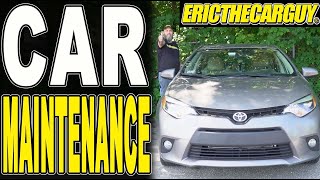

Check Your Spare Tire Pressure Now
51sMost people ignore their spare tire until they need it, and this clip shows why checking it now can save you from being stranded.
▶ Play Clip"The title accurately reflects the video's content—a mechanic explaining how to maintain a car, step by step."
Eric the Car Guy provides a practical, mechanic-led overview of essential vehicle maintenance tasks. He emphasizes the importance of tires, routine fluid checks, and visual inspections to prevent breakdowns and extend vehicle life.
Tires are considered the most important part of the vehicle. The entire car rides on four contact patches, making tire maintenance the top priority.
Never rely on eyeballing; use a tire gauge. The correct pressure is often listed on a sticker inside the driver’s door jamb. Always check the spare tire (often 60 PSI) to avoid being stranded.
Monitor tread depth, wear patterns, inflation, and overall condition. Proper tire care directly impacts safety and fuel mileage.
Look for dirt, oil, or foreign substances. Clean battery terminals improve performance. Check oil level when the engine is cold and note the oil viscosity (e.g., 0W-20) on the oil cap.
Inspect the air filter to determine if replacement is needed soon. Check drive belts for cracks, damage, or dry rot.
Check coolant level in the overflow tank (never open the radiator cap when hot). Transmission fluid checks vary by vehicle—always consult the owner’s manual.
Brake fluid doesn’t burn off; a low level often indicates worn brake pads. Check the fluid reservoir against the max/min lines.
Look for rubbing or wear points (e.g., a washer line rubbing against an A/C line). Address these before they cause failures. Wiper blades should be replaced every spring and fall.
Check all exterior lights for operation. To find a suspected leak, slide cardboard under the car overnight. Leaks almost never improve on their own.
Turn off the radio and pay attention to unusual noises, smells, or pulling during braking. Investigate anything abnormal immediately.
Ask your mechanic about common issues with your vehicle. Bringing baked goods may encourage a more detailed diagnosis. Education is key to preventative maintenance.
The manufacturer’s manual contains the most accurate maintenance schedule, fluid specifications, and filter change intervals. It is the ultimate guide for vehicle longevity.
Proactive, preventative maintenance—focused on tires, fluids, visual checks, and the owner’s manual—prevents small issues from becoming costly breakdowns.
What is the correct way to check tire pressure?
Use a tire gauge; do not rely on eyeballing. Refer to the sticker inside the driver's door for the correct PSI.
00:12
What should you do if you suspect a leak coming from your vehicle?
Slide a piece of cardboard under the engine and transmission overnight. Check it the next morning to identify a leak and its severity.
05:04
Why should you never open the radiator cap when the engine is hot?
Because you could get hurt or seriously injured by hot, pressurized coolant.
02:54
What does a low brake fluid level often indicate?
Worn brake pads. Brake fluid doesn't burn away like oil, so a low level suggests the pads are wearing down.
03:37
How often does Eric recommend changing wiper blades?
Every spring and every fall, to be ready for inclement weather seasons.
04:40
What are the two primary steps Eric suggests for a quick underhood inspection?
1. Check the overall condition for dirt or oil leaks. 2. Clean the battery terminals if corroded.
01:54
What is the best time to check engine oil, according to Eric?
First thing in the morning after the car has sat overnight, to get the most accurate reading.
02:18
Where is the recommended tire pressure usually found for a specific vehicle?
On a sticker located on the driver's door jamb.
00:12
What should you do if you hear a weird noise or smell something unusual while driving?
Check it out immediately; don't ignore it.
05:31
What suggestion does viewer Mike Choi provide for maintenance?
Ask your local mechanic what common issues they see with your specific vehicle model, so you can address them preventatively.
05:56
Tires are #1
Establishes the core principle that tire condition is the most critical safety and maintenance factor.
Check Oil When Cold
Provides a simple, actionable technique for an accurate oil level reading.
02:18Brake Fluid as a Wear Indicator
Educates that brake fluid level drops due to pad wear, not consumption—a key diagnostic insight.
03:37Cardboard Leak Test
A zero-cost, practical method to identify and assess the severity of vehicle leaks.
05:04Owner’s Manual is the Ultimate Guide
Reinforces the foundational principle that the manufacturer’s manual contains all vehicle-specific maintenance info.
06:36[00:00] Greetings viewers, Eric the car guy here, and today I'd like to share with you information of how a mechanic would maintain a car. If you've watched any of my videos, you know that I'm big on tires.
[00:12] I consider them the most important part of the vehicle. In fact, the entire vehicle rides on four spots and we call those tires, so that's how important I see these things. So as far as vehicle maintenance is concerned, I consider them one of the number one priorities.
[00:25] One of the things that I look for with tires is just generally the tire pressure. Because it looks like it's low, but don't just trust your eyeballs actually use a tire gauge and check the tire pressure. When you open up the driver's door, you may see a sticker that looks just like this.
[00:37] And this sticker tells you the type of tire and the tire pressure for that tire, both front and rear and for your spare tire. And that's something that you should check during a maintenance. You should check the air in your spare tire just in case, but if you get a flat and you put
[00:50] your spare on and that is also flat, it's not very good. This is exactly the thing that I was talking about. This tire is supposed to get inflated to 60 PSI. It's only got a little more than 20 PSI in it. This is why you want to check these kind of things now, rather than when you're on the side
[01:03] of the road and trying to replace it. Additionally, you want to look around the outside to see if there's any damage or any foreign objects or anything in the tire. And if there are, obviously you want to address them. And if you notice the tire going slowly down over time, there's a slow leak somewhere and
[01:16] you should probably find that out before it becomes a real issue down the road. For now, we'll check the tire pressure on these. And well, these are supposed to be set at 32 PSI and they are set exactly at 32 PSI. So this one's good to go.
[01:29] As I've said, many times in this video, tires are extremely important. So keep an eye on the tread depth, the tread wear, how well it's inflated, the overall health of the tire. This is imperative to the health of your vehicle and its fuel mileage.
[01:42] So the tires do a whole lot. They are number one on my list of things to keep an eye on and maintain. And don't forget, you've got three more tires. So be sure to check them all. We're good.
[01:54] Let's get a look under the hood of this Toyota. First I look at the overall condition of the engine compartment. Is it full of dirt? And junk? Is it covered in oil or other substances that really shouldn't be there? How does it generally look?
[02:06] One of the first things I notice on this vehicle is the battery. Batteries are extremely important, especially when it comes to maintenance. And keeping your battery terminals clean, well, that's a very good idea. This owner should probably clean these battery terminals and things will probably work better
[02:18] as a result. But I also want to do things like check the oil level, which you do when the vehicle is off. The time that I like to check the oil is first thing in the morning after the car is set overnight. That way I know I'm getting the most accurate oil level check.
[02:30] Additionally, what you'll find under here is what type of oil to use in that engine. And that's usually located on the oil cap. So in this case, this is zero W20. That's what this engine takes. Also while we're here, we'll get a look at the air filter.
[02:42] Well, it looks pretty good. Probably could use the change. At least we put our eyes on it and we know, well, we're going to have to do this soon, or this is great, or we need to do this right now. This is the idea of vehicle maintenance.
[02:54] It's finding problems before they become real issues while you're out driving on the road. Be sure to also inspect the drive belts for cracks, damage, or any kind of dry rot. A light is sometimes helpful to check the coolant level. And you should always check it in the overflow and never open the radiator cap when the engine
[03:10] is hot because you could get hurt or seriously injured by doing that. But it's really easy just to put a light down by the overflow. Maybe shake it a little bit, see what the level is. Checking the transmission fluid level is also important, but may not be possible on some vehicles.
[03:23] Some vehicles don't have a dipstick that you can even check that with. Some vehicles require that you check the fluid while the engine is running. Some vehicles require that you check the fluid with the engine off at engine operating temperature. Be sure to check your owner's manual for that specific information on how to check your transmission
[03:37] fluid, but yet it's something else to check if you're doing vehicle maintenance. Break fluid level. And see this level from the outside, you can see that there's a max line and a minimum line. Break fluid doesn't go away like engine oil does, it doesn't burn and go away.
[03:49] What happens is as your brakes wear, this fluid gets lower. So if you see your brake fluid being low, there's a good indication you could have worn brake pads so you should check those next. Visual inspections are important in details matter.
[04:01] I was looking at the belt on this one and what I found was a shiny spot on top of this AC line. I'm saying to myself, why would that be there? Well, looking up above it, when the hood is closed, this line for the windshield washer
[04:13] comes into contact with it. Now, if you left this alone, this could continue to rub and possibly wear through and disable your windshield washers. Details are important. So if you find something like this, address it.
[04:25] That's maintenance. Wiper blades. Pretty easy to inspect, you just look for tears or if they're coming apart things like that or if you're driving an inclement weather and you can't see, well, it's certainly time to change your wiper blades. But I usually make this part of my maintenance inspection and I change mine out every spring
[04:40] and every fall just to be ready for the inclement weather seasons. To avoid getting pulled over and to see it night, check your lights. Make sure all of your lights work. Check your headlights, check the high beams, check the low beams, check the turn signals, the
[04:52] parking lights, the brake lights, all the lights to make sure that they function properly for your safety and others. Another part of a maintenance check is to look for leaks. So just poke your head underneath a vehicle, look around, see if you see anything that might
[05:04] be leaking. If you do see something that's leaking, well, that requires further investigation, you may have to lift it up and look for it. If you're not sure if the leak is coming from your vehicle or where it's coming from, a simple test, it's just take a piece of cardboard, slide it underneath the engine and transmission and
[05:18] leave it there overnight. Come back the next morning and pull it out and you'll know if you have a leak and how severe it is. The thing about leaks is they don't get better. So if you do have leaks, it's good to address them otherwise they just keep getting worse.
[05:31] Another thing you can do to maintain your vehicle is drive it and pay attention. Turn the radio off, listen for weird noises as you go over bumps. What happens when you step on the brakes as a pull to one side or the other? Are there any noises when you step on the brakes?
[05:43] Are there any weird smells? You want to look out for things like that while you're driving just about any time. And if you hear something or smell something, check it out, don't ignore it. During the course of filming this series, I got an email from one of my viewers, Mike
[05:56] Choi, and he had a brilliant idea about how he maintains his vehicle. One of the things he does is he goes to his local mechanic and asks them, what issues have you seen with my vehicle? And he can address those during a maintenance. I think that was a brilliant idea and I recommend you do the same thing and if you do go talk
[06:11] to your mechanic, I recommend you take some baked goods or you buy them lunch and they'll probably sing like a canary. The point is, educate yourself and learn as much about your vehicle as possible so that you can address those problems before they become issues that leave you stranded along the
[06:24] side of the road. That's the whole point of maintenance, preventative maintenance. It's taking care of issues before they become problems that leave you stranded. That's the idea. There's one more thing I'd like to share with you today about vehicle maintenance.
[06:36] The owner's manual. The owner's manual was written by the manufacturer and the engineers that made the vehicle. There's nobody who knows better how to maintain and take care of it to make it last as long as possible. So, the information you need as far as when to change fluids, what fluid to use, what filters
[06:50] need changing, when those filters need changing, all that information is located right here inside the owner's manual. So, specific information about your vehicle, owner's manual, very important. I want to give a big thanks to my friends at TRQ for letting me come out to their studio and
[07:04] produce this video for you. I will link them down in the description so you can check them out. I'm also going to link at thecargai.com down in the description in case you have automotive questions. Aside from that, thank you so much for watching today. Be safe, have fun, stay dirty. I'll see you next time.
⚡ Saved you 0h 07m reading this? Transcribe any YouTube video for free — no signup needed.