[00:00]
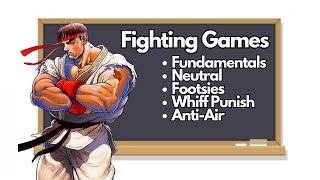
what's up goobers and welcome to my
[00:01]
comprehensive viewers guide to fighting
[00:04]
games I've been both a long time player
[00:06]
and viewer of fighting games so many of
[00:08]
these terms just come out of my mouth
[00:10]
without considering that not everyone
[00:12]
else is just a giant nerd the goal of
[00:14]
this video is to initiate any newcomer
[00:16]
to fighting game terminology that is
[00:18]
commonly used in games like Street
[00:19]
Fighter by the end I hope that there is
[00:21]
a better understanding of what is
[00:23]
happening on the screen when either
[00:24]
viewing or playing your favorite
[00:25]
fighting game if you're new to the
[00:27]
channel be sure to subscribe for more
[00:29]
videos from me if you feel like I missed
[00:31]
something or need a more in-depth
[00:33]
explanation of something feel free to
[00:35]
leave a comment below so let's begin
[00:39]
the first topic I want to go over today
[00:41]
is normals now the definition of a
[00:44]
normal is any button that is a standard
[00:46]
attack in a fighting game in Street
[00:48]
Fighter there are typically six attacks
[00:50]
each character can do this is separated
[00:53]
in two groups punches and kicks
[00:56]
each have various speeds and distances
[00:58]
and come with their own risks and
[01:00]
benefits something that falls into this
[01:03]
category but that's slightly different
[01:04]
is called a command normal this is
[01:06]
simply a normal that requires like a
[01:08]
directional input
[01:10]
not all characters have them but you'll
[01:12]
see them pop up here and there something
[01:14]
else that comes up that is not in every
[01:17]
character's kit is called a Target combo
[01:20]
these are quick strings of normals that
[01:22]
are chained together with a series of
[01:24]
button presses
[01:29]
in the next section I want to talk about
[01:30]
commands these are something that I
[01:33]
always look forward to doing whenever I
[01:35]
got my hands on a brand new fighting
[01:36]
game examples of commands are things
[01:39]
like Fireballs Sonic booms spinning pile
[01:42]
drivers things like that these require
[01:45]
directional input combinations finished
[01:47]
with a button typically commands act
[01:50]
differently when you use different
[01:51]
button strings in Street Fighter there
[01:54]
are exceptions of course but I will use
[01:56]
a basic example with reuse hadouken the
[02:00]
speed of projectile changes depending on
[02:02]
if he uses light punch medium or heavy
[02:08]
now this section can be kind of
[02:09]
complicated but I'll try to keep it as
[02:11]
simple as possible this final section
[02:13]
we're talking about today is called
[02:15]
neutral this is where a lot of the core
[02:17]
gameplay happens in particularly Street
[02:19]
Fighter both characters are standing
[02:21]
either trying to find a way to start
[02:24]
their offense or keep up a defensive
[02:26]
wall in Street Fighter you'll often see
[02:28]
both players doing this back and forth
[02:30]
thing and what they're doing typically
[02:33]
is just looking for gaps for them to
[02:35]
either start their pressure or waiting
[02:38]
for their opponent to do something that
[02:40]
they can take advantage of so things
[02:42]
that happen in this neutral State uh
[02:44]
you'll commonly see is they'll use their
[02:46]
normals they'll do things called pokes
[02:49]
which this is going to be like a
[02:51]
far-reaching normal and they're gonna
[02:52]
try and catch the opponent walking into
[02:55]
their range and try to take some damage
[02:57]
that way now a way to counter this is to
[03:00]
walk in and out of the range that you
[03:02]
expect your opponent to whiff their long
[03:05]
reaching poke and this is what a whiff
[03:07]
punish is and and a lot of times like
[03:09]
Ryu will try to walk up and catch you
[03:13]
with his low medium kick because usually
[03:15]
it's a far-reaching low normal and you
[03:17]
have to be crouching to block it now if
[03:19]
you walk in and out of a range where he
[03:21]
would stick out his foot like that
[03:23]
people can counter that by punishing the
[03:26]
whiff with something like a sweep and
[03:28]
this is where the term footsies comes
[03:30]
from because they're using low attacks
[03:32]
to counter another low attack and it
[03:34]
just looks like your feet are just
[03:36]
interacting now if you come from the
[03:37]
Dark Souls community and you're watching
[03:39]
this don't make it weird you feed people
[03:41]
and the last thing that typically
[03:43]
happens when you're in this neutral
[03:44]
state is you'll see some people jump and
[03:48]
anytime someone stops someone from
[03:50]
jumping that is considered an anti-air
[03:53]
now this can be either a command such as
[03:55]
a charyukin or Dragon punch sometimes
[03:59]
people call that a DP or something like
[04:02]
a normal that has a upward moving hitbox
[04:07]
some so a lot of characters have like
[04:09]
crouching heavy punch which just has
[04:11]
like an upward Punch or something the
[04:14]
thing that makes neutral so tense and so
[04:16]
fun is that it is essentially how
[04:19]
everything in the match starts one hit
[04:21]
can spiral into a character's full
[04:23]
offense another thing that can happen is
[04:25]
a character can literally keep an
[04:27]
opponent out while slowly chipping away
[04:29]
at their life the entire match I've seen
[04:31]
matches where people just get clipped
[04:33]
over and over again by far-reaching
[04:36]
pokes and then they just look at their
[04:38]
life and they have none left it's crazy
[04:40]
it can be very tense the whole time the
[04:43]
neutral game is ongoing because you're
[04:44]
constantly thinking about what your
[04:47]
opponent is gonna do and they're doing
[04:49]
the same thing so it's like a big mind
[04:51]
game the whole time it's fantastic
[04:52]
that's gonna wrap it up for this video
[04:54]
this was merely scratching the surface
[04:56]
as there's so many things that you can
[04:58]
talk about when it comes to fighting
[04:59]
games the focus of this video was trying
[05:02]
to cover the basics so if you want to
[05:04]
see more intermediate and complex strats
[05:06]
let me know in the comments below hello
[05:08]
thanks for making it to the end and stay
[05:10]
well I'll catch you in the next video