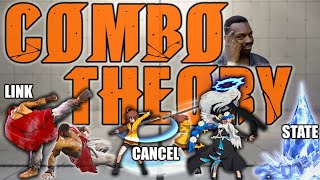

Why Combos Feel Unintuitive at First
42sRelatable experience of struggling with combos hooks viewers, then promises a universal explanation.
▶ Play Clip"Title accurately promises a universal combo theory explanation, and the video delivers exactly that."
This video explains the fundamental theory behind combos in fighting games, covering how hit stun, links, cancels, and stun extensions work. It compares combo systems across different games like Street Fighter, Guilty Gear Strive, and City of the Wolves, and emphasizes the importance of considering damage, positioning, and end state when creating combos.
A combo is a series of attacks that hit an opponent while they are in hit stun, preventing them from blocking or moving.
Links require enough hit stun to recover and use another attack; cancels skip recovery by canceling into another attack.
Wall bounces, crumples, dizzy, juggles, and OTG moves extend stun to allow longer combos.
Street Fighter emphasizes links, where moves leave you plus enough to connect another attack.
Under Night In-Birth allows any normal to cancel into any other normal, creating free-flowing combos.
Guilty Gear Strive has specific Gatling cancels and focuses on character states like counter hits and wall bounces.
City of the Wolves uses a special cancel system that locks out normals, even when plus.
When creating combos, consider damage, positioning (e.g., corner carry), and end state (e.g., oki, spacing).
Understanding a game's combo system—whether it emphasizes links, cancels, or stun extensions—helps you adapt and create purposeful combos. Personal preference determines which system feels best, but trying different games broadens your skills.
What is a combo in fighting games?
A series of attacks that hit an opponent while they are in hit stun, guaranteeing they cannot block or move.
0:44
What is the difference between a link and a cancel?
A link requires recovering from the first attack before using the next; a cancel skips recovery by canceling into another attack.
1:28
Name three types of stun extensions mentioned in the video.
Wall bounce, crumple, dizzy, juggle, OTG.
2:04
Which game is known for its link-based combo system?
Street Fighter.
2:55
In Under Night In-Birth, what is unique about normal cancels?
Any normal can cancel into any other normal, regardless of order.
3:12
What does Strive focus on for combo extensions?
Character states like counter hits and wall bounces.
3:33
What is a key feature of City of the Wolves' combo system?
Rev cancels, which allow special cancels but lock out normals even when plus.
3:55
What three aspects should you consider when designing a combo?
Damage, positioning, and end state.
4:34
Combo Definition
Provides a clear, foundational definition of a combo that applies to all fighting games.
0:44Links vs. Cancels
Explains two core mechanics that differentiate combo systems across games.
1:28Game-Specific Systems
Illustrates how different games emphasize different combo mechanics, affecting feel and strategy.
2:55Combo Purpose
Encourages intentional combo design beyond damage, considering positioning and end state.
4:34[00:00] A friend of mine recently commented on
[00:01] how the combos in Strive feel
[00:03] unintuitive, and I remember thinking the
[00:05] same thing when I first started. It felt
[00:07] unnatural to not be able to chain punch
[00:10] and kick together and weird that you
[00:12] can't use a super from a special move.
[00:14] It felt restrictive and made me question
[00:16] just how combos even work. But over
[00:18] time, especially playing different
[00:20] games, I came to understand that all
[00:22] combos fundamentally work the same. But
[00:24] the systems of a game will allow
[00:26] different ways to interact with the
[00:28] opponent and the move set. Each game
[00:30] emphasizes different aspects of combos
[00:33] and thus creates their own unique feel.
[00:35] So, let's go over combo theory in
[00:37] general, but then dig into how you
[00:39] should look to learn about combos in any
[00:42] fighting game.
[00:44] As always, let's start with the basics.
[00:46] When you hit an opponent, they are in a
[00:48] state called hit stun. They cannot block
[00:50] or move during this state. If your
[00:52] second attack can hit them before they
[00:54] recover from the hit stun, you've made a
[00:56] combo. A combo is just a series of
[00:59] attacks that the opponent is guaranteed
[01:01] to be hit by because it cannot recover
[01:03] in time from the hit stun to block. Of
[01:06] course, there are exceptions to this
[01:07] rule. Hello, burst. But generally,
[01:09] that's what makes a combo. What attacks
[01:11] you can use to hit an opponent before
[01:13] they recover from hit stun changes
[01:16] depending on the move that hit them on
[01:18] the amount of hit stun that was applied
[01:19] and the startup of the follow-up attack.
[01:22] It comes down to the frames. And if you
[01:24] need a breakdown into frame data, got a
[01:26] video on that already. There are two
[01:28] categories of follow-up attacks, links
[01:30] and cancels. A link is when your attack
[01:33] applies enough hit stun to where you can
[01:35] completely recover from that attack and
[01:38] use another one before the opponent
[01:40] recovers. Essentially, you're so plus
[01:43] that you can fit in another attack. A
[01:45] cancel is when you cancel the recovery
[01:48] of your first attack with another
[01:50] attack, thus speeding up your next
[01:52] attack. The goal is for you to be fast
[01:55] enough to hit them before they can
[01:57] recover from the hit stun. In both
[01:59] cases, it's just a matter of having
[02:00] enough frame advantage to hit them
[02:02] before they can recover. But there's
[02:04] another way of making combos via
[02:06] extending stun. The easiest illustration
[02:09] of this is a wall bounce. When you hit
[02:11] an opponent against a wall with a move
[02:13] that can wall bounce, you're essentially
[02:15] extending the stun they have to allow
[02:17] you to follow up with another attack.
[02:19] There are many different character
[02:21] states that games allow you to be able
[02:23] to combo with. Crumple, dizzy, juggles.
[02:26] These are all character states that
[02:28] extend the stun the opponent has. OTG
[02:31] moves are basically moves that let you
[02:32] interact with an opponent that's in a
[02:34] state you normally would not be able to
[02:36] when they're on the ground, thus
[02:38] allowing you to apply stun. Again, if
[02:40] any of these terms are going over your
[02:42] head, check the description for the
[02:43] fighting game glossery and look them up.
[02:45] But these concepts are what makes combos
[02:47] work. Different games emphasize these
[02:50] concepts differently, and it's what
[02:52] gives each one its own unique feel.
[02:55] Let's start with Street Fighter. Street
[02:56] Fighter is known for its links. Thus,
[02:59] you're looking for moves that apply
[03:00] enough hit stun so you can connect with
[03:02] another attack. Take this heavy kick for
[03:05] example. Ryu is plus 9 from the hit.
[03:08] Thus, if I have a move that's nine
[03:10] frames or faster, I can link to it. Now,
[03:12] compare that to Uni. Uni has a very free
[03:15] flowing cancel system. Any normal can
[03:18] from any other normal. So, I can go
[03:20] light, medium, heavy, but I can also go
[03:23] heavy, medium, light, or even medium,
[03:25] light, heavy. They can cancel regardless
[03:28] of the advantage. But if you notice,
[03:30] spacing becomes a factor. Strive focuses
[03:33] on cancels, but not so free form. The
[03:35] Gatlings are much more specific.
[03:38] However, what Strive does focus on is
[03:40] character states. Counter hits apply
[03:43] extended stun, allowing for links, and
[03:45] things like Unica's charge DP has a wall
[03:48] bounce effect to it. So, it's via
[03:50] different states that you really get
[03:52] your extensions and combos. If you think
[03:54] that's limiting, check out City of the
[03:55] Wolves. It's built around its special
[03:57] cancel system, Rev cancels. But this
[04:00] system also locks you out of using
[04:02] normals. Notice here how plus I am, yet
[04:06] I cannot connect with this normal.
[04:08] Weird, but that's how the system works.
[04:10] Whenever you pick up a new game,
[04:12] understanding what the system allows
[04:14] will help you wrap your mind around its
[04:16] combos. You can ask yourself questions
[04:18] like, "Do moves leave me plus enough to
[04:20] link attacks together? What buttons can
[04:22] be normal canceled or special canceled?
[04:25] Are there ways to extend stun?" And once
[04:27] you have the answers to these questions,
[04:30] you have the fundamentals of what that
[04:32] game's combo system is.
[04:34] As you understand and start to develop
[04:36] your own combos, there's one central
[04:39] thing you should ask yourself. What do
[04:41] you want from the combo? The first
[04:43] response is damage. That's the entire
[04:45] reason we create combos to begin with is
[04:47] to increase the number of hits against
[04:49] an opponent. Thus, they take more
[04:51] damage. But there's two more concepts
[04:53] you should consider. Firstly,
[04:55] positioning. As you hit an opponent,
[04:57] naturally your characters move. They
[05:00] move forward or upward and thus leaving
[05:02] you in a different position on the
[05:04] screen. What position you're left in
[05:06] after the combo is over is worth
[05:08] considering. Let's say you're a rushdown
[05:10] character fighting a zoner. you want to
[05:12] stick close to them as much as possible
[05:14] so their zoning becomes less effective.
[05:17] So with that in mind, maybe you want a
[05:19] combo that leaves the opponent close to
[05:21] you rather than launching them far away.
[05:24] Or maybe you're playing a character that
[05:25] does its best in the corner. So corner
[05:27] carry is much more advantageous to you
[05:29] than damage. Positioning matters.
[05:32] Secondly, end state. By this I mean the
[05:34] state you leave yourself or your
[05:36] opponent after the combo is over. Some
[05:38] combos can set you up nicely for a safe
[05:40] jump, or they leave you point blank next
[05:43] to the opponent so you can meeting them
[05:44] easily, or it pushes them far enough
[05:47] away that it allows you time to set
[05:49] something up, like a trap. The end state
[05:51] can be really influenced by your
[05:53] character's core strategy. If you're a
[05:55] mixup monster, you want to stay close so
[05:57] you can keep your pressure up. If you're
[05:59] a zoner, you want to knock them far away
[06:00] as possible. Or you just really love oki
[06:03] and want that hard knockdown every time.
[06:05] Regardless, when you're developing
[06:07] combos, think of these three concepts:
[06:09] damage, positioning, and end state. Your
[06:12] combos should have purpose, and the more
[06:14] intentional you are with your combos,
[06:16] the better you'll be.
[06:19] And that be combo theory. Quite a meaty
[06:21] topic, but one I hope helps shed light
[06:23] as to why some games feel the way they
[06:26] do and why some fit your preferences
[06:28] better. Some people want to hit buttons
[06:30] constantly, so a heavily cancelbased
[06:32] system feels great to them. Others like
[06:34] the intentionality of blinks, so they
[06:36] prefer that system. Overall, it's a
[06:39] personal preference, and no game is
[06:41] right or wrong for its system, but
[06:43] regardless, as a casual, you should try
[06:45] them all.
[06:47] [Music]
⚡ Saved you 0h 06m reading this? Transcribe any YouTube video for free — no signup needed.