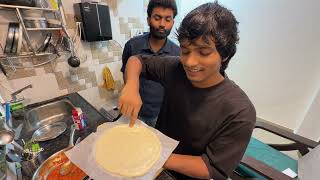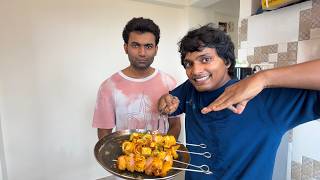

When mom roasts you while cooking
44sRelatable family interaction and self-deprecating humor about hair loss make this clip shareable.
▶ Play Clip"The title promises Chole Bhature and delivers exactly that, with step-by-step instructions and personal touches."
In this video, the creator demonstrates how to make authentic Chole Bhature at home, covering both the chickpea curry and the fried bread. The tutorial includes tips for achieving the perfect texture and flavor, such as using tea leaves for color and semolina for crispiness.
The video starts with the creator explaining they will make Chole Bhature on a Sunday. They mention needing to buy some ingredients like tea leaves.
First, prepare the bhatura dough by mixing semolina (rawa), refined flour (maida), curd, and salt. Semolina adds crispiness.
Add Eno (fruit salt) along with curd to make the bhatura fluffy. Avoid cumin-flavored Eno. Knead the dough and apply oil, then let it rest for half an hour.
For authentic taste, use black chickpeas. Boil them with tea leaves tied in a cloth or add tea leaf-infused water for color and flavor.
Crush garlic, ginger, and green chilies. Heat oil, add cumin seeds, then the crushed mixture. Once golden, add onion and cook. Then add tomato puree and spices like turmeric, coriander, and salt. Add Chole Masala at the end.
Technique for cutting dough: press in fist to get a smooth ball. Roll out with oil. Fry in hot oil, pressing down to puff up. Serve with onion and pickle.
The video successfully delivers a complete recipe for Chole Bhature with practical tips. The creator emphasizes the importance of tea leaves for color and semolina for crispiness, making it a reliable guide for home cooks.
What is the purpose of adding semolina to the bhatura dough?
It makes the bhatura crispy.
02:35
What ingredient can be used instead of curd to make the bhatura fluffy?
Eno (fruit salt).
03:04
How long should the bhatura dough rest after kneading?
About half an hour.
04:44
Why are tea leaves added to the chickpeas while boiling?
To give color and enhance the flavor.
05:11
At what stage should Chole Masala be added to the gravy?
At the end, when the masala is 80% cooked.
10:10
What is the technique to cut the bhatura dough without tearing?
Press the dough in your fist to form a smooth ball, then cut.
12:35
Semolina for crispiness
Explains a key ingredient for achieving the desired texture in bhatura.
02:35Tea leaves for color
Reveals a traditional trick to get the characteristic dark color of chole.
04:59Dough shaping technique
Demonstrates a simple method to prevent the dough from tearing while rolling.
12:35[00:04] Here goes my bhatu in the oil. You can see that our Bhatua is ready. [MUSIC] and you are seeing Deepak. So friends, today is Sunday and on Sunday we are thinking
[00:18] is Sunday and on Sunday we are thinking of making Chole Bhature. However, the day this video comes out, it may not be Sunday and it may be slightly cold too, friends. So the fun of eating Chole Bhature in winter is very different. So let's go and
[00:36] ready. Although I don't know whether I look bathed or not because I do n't have any hair on my head right now. The hair has broken. Are breaking. So right now I am going out because I have to get some stuff for Chole Bhature. These ingredients are
[00:49] not available at our home. Like tea leaves. where are you going Mom, hello friends, we are going to get the stuff. Where are you going to get the stuff? Your hair is falling so you are going to get it fixed.
[01:04] Your hair is falling so you are going to get it fixed.
[01:20] first thing you need to do before making chole bhature is to prepare the bhature dough. Okay, and by the time you start processing the chickpeas, your Bhatura dough will be ready. So that is why you have to prepare
[01:37] Bhatura first. Do you have semolina ? Yes it is. Fine flour curd, yes there is, we add yes there is, we add semolina, flour, curd and salt,
[01:49] yes we add it, yes we add it, so [laughs] apply salt now, in the drum, so come friends, gram flour, sattu,
[02:04] cumin, no, no, how did you like it, this is [laughs] just now I thought I will have to go again, friend.
[02:16] thought I will have to go again, friend. Oh my god guys I found Suji. I thought there was no semolina at all. Yes, personal preference as it is semolina. [laughs]
[02:35] No, semolina means rawa. So, what the rava does is it makes the ah bhatura a little bit crispy. It tastes good when it is crispy. It becomes a little thick. And what happens with flour is that some oil also gets mixed in it. So that's why I use semolina. So how much of it will you
[02:51] Two. I will eat. Two. How much will you eat, cat? We will eat four. Four
[03:04] friends, I have taken out the semolina and flour. Now it is very important to add curd in it. You can also add Eno instead of this. If you don't have yogurt. So I do one thing, I add both curd and Eno. Is it Ino
[03:19] ? Yes it is. It will happen, right I will have to find Ino because neither I nor my sister-in-law knows where he is. [laughs] So I'll have to find Ino. How much salt should be added?
[03:32] Two spoons. Not two friends, two will be too much. Not two friends, two will be too much. Add salt according to taste. Add salt according to taste. And what is this?
[03:46] Or let's go find Ino first. Come. Look, I found it. Hey friend, yes I got it friends. Got a simple Eno. There was two cumin seeds but we should
[03:59] not add the cumin ones. Otherwise your bhatura will become cumin flavored. We have to cumin flavored. We have to put this normal one. What is this man? And what about this? Come on. And I put this in an Eno.
[04:14] an Eno. Now we have to knead this dough. What can you say to mean kneading? or whatever you say in your language. or whatever you say in your language. And if you know any recipe of Bhatura
[04:28] then definitely write the recipe in the comment. I want to try it because this is what I know. want to try it because this is what I know. So I have made the dough friends and what do you want to do with it? You have to massage it with refined oil and then leave it.
[04:44] You have to massage it with refined oil and then leave it. Like around half an hour. Like around half an hour. After that, delicious and fluffy Bhaturas will be made. So friends, the fun of eating real chole bhature means the fun of eating bhature is only with black chole.
[04:59] So there is a process, a system, a method for making black gram. So today I will tell you how to do it. That first of all, if you have a
[05:11] cotton cloth in your house, then put tea leaves in the cotton cloth, tie it, put it in the chole and whistle it. But if you don't have, it means you don't have cotton cloth because I don't have any either. So if you do not have a cotton cloth, then
[05:27] if you do not have a cotton cloth, then like me, boil the tea leaves in water and add the water containing the tea leaves to it like this. That means filter it through a sieve means filter it through a sieve and add water and then
[05:42] add salt and put it on the whistle. Then your black chole will be prepared and the taste of it and the black chole, oh my god no commitment commitment oh my god no competition, it is the same original, the same original
[05:57] Bhatura chole, do you have anything else apart from this which looks good, yes it is there, we will have to search for it, let's assume that it is not there, let's make do with this for now, assume that it is not there, let's make do with this for now, friends, see
[06:12] friends, I have kept the flour on one side to ferment. Meaning it is not firm, what should we say to it that it has been kept for some time. Like, whatever I say, you should understand it and on one side, this whistle of the cooker means on one side, these chole have been kept
[06:27] whistle of the cooker means on one side, these chole have been kept whose whistle is about to come. And whose whistle is about to come. And after that we are going to cut onion, tomato, sorry, I mean yes, onion and tomato. And then he's
[06:44] cutting carrots with his mouth. Hmm go on. My body feels thin. But one will find it sweet. Give me one trick each. Nanu, bring it son, eat it. Would love to. trick each. Nanu, bring it son, eat it. Would love to. Here, eat it. Eat this and then eat this.
[06:58] Take it, eat it. Hold it with your hand. Hold it with this hand. Eat everything. Correct. Son Guy's mission has been successful. Now come back
[07:12] to Chole Bhature. [Music] Friends, I need spices to make chole, and I'm crushing garlic, ginger, and chilies for the spices.
[07:29] You can grind it in a mixer , but I prefer to crush it , because crushed cheese tastes good and tastes good. So friends, now our oil has become hot
[07:44] So friends, now our oil has become hot and first of all I will add cumin seeds in it. and first of all I will add cumin seeds in it. Friends, if you have whole spices, add them too. It will be much better. Cinnamon is different from all this but
[07:59] [laughs] we do n't have whole spices in our house and I had gone out so I forgot to bring it because actually friends this is not my kitchen it is my sister in law's kitchen so what stuff is there here no stuff, I don't know much because it is
[08:13] what stuff is there here no stuff, I don't know much because it is my sister in law's kitchen so I don't know so yes I have added this but it will work even without whole spices because later when we will add garam masala then it will be managed with it,
[08:28] managed with it, see friends after this our crushed garlic, ginger and chilli have to be added in it like this and when it turns red after that then we will add onion after that it will turn red after that then after that then
[08:45] later I will tell you red. What all has turned golden brown. It has turned
[09:01] golden. And now we will add this tomato puree in it and add this tomato puree in it and puree it. And along with the puree, you also have to add spices. Like I will add turmeric first. You
[09:17] stay there. Don't come in with a camera again and again. I have added turmeric. A little bit added turmeric. A little bit [laughs]
[09:30] friends, my sister-in-law has put a camera [laughs] turmeric. This is coriander and this is coriander means vegetable and its aroma is very nice. Good because it is original. Like what is available in the market. These too have been brought from the market after
[09:44] not been ground at home. Where did you bring it from? This is from the home farm. Oh sorry yes from home farm. Now I added this also. After that add salt. Salt. Add salt as per taste. I
[09:58] put it like this. And friends, I have brought this Chole Masala Everest. And I will put this at the end. In the end, that means when it reaches 80%, then there is
[10:10] In the end, that means when it reaches 80%, then there is put it. But I put it at the end because that, but come on friend, I will put it. Yes, what do you see now, take a little of this, I will add this too
[10:25] and you have to fry it till the water leaves the oil, sorry, I am water leaves the oil, sorry, I am saying oil, this water, what is this, yes till
[10:41] leave the oil, you can see, do it like this, do it like this, now do it like this, where did you put its lid, its lid will be in the vessel only. lid will be in the vessel only. Hey lid, this sorry [laughs]
[10:56] cover it, this is what it is called friends, the blind eyes of fire, so you have to cook it by covering it like this until the masala leaves the oil hidden and let us see what is the status of our Bhatura flour.
[11:12] Oh my god look how soft it has become friends. See. So friends, it seems that our masala is ready. The spices have released water, meaning they have released oil. spices have released water, meaning they have released oil. And after this I will add these
[11:26] chickpeas in it. And I have also left some of that tea leaf water in the chole. I have added a little of that too. So that our chole chole becomes tasty.
[11:38] Make it medium and leave it for 15 minutes. Yes. And yes friends, at this time, as I had told you that I will add chole masala at the end, you should add a little bit. This is the time. So friends, finally our
[11:54] chole bhature is ready. Just turn off the gas now. Just turn off the gas now. Add some coriander in it. Cover it and leave it.
[12:06] Add some coriander in it. Cover it and leave it. Chole Dun. Now it's Bhatura's turn. Of Bhatura. So friends, as you know, chole is ready. Now is the time to make Bhatura and you can see that the flour that we had kept for Bhatura has become very
[12:22] soft. Now see, there is a trick for this too. What is that ball of Bhatura? Balls. Dough. So friends, what is the technique for cutting the dough
[12:35] Dough. So friends, what is the technique for cutting the dough ? If you cut it like this, your Bhatura will tear because it will not become smooth. Therefore, the technique of cutting iron is to do it like this, bring the camera a little closer, do it like this, just come back, it's done, it's done,
[12:50] do it like this and hold it like this and hold it in your fist like this, and hold it in your fist like this, see it is cut and friends, our oil has also become hot and remember one thing that for making Bhatura, the temperature of the oil should be a
[13:08] little high. After doing this, apply some oil on it and roll it. apply some oil on it and roll it. why am I not doing this with my hands? So friends, for your disclaimer, I want to tell you
[13:23] that I am not a pro shape. I just feel that I will be able to do it and it comes to me and it happens. So, in this way, the work is still going on. So work is still going on. So
[13:36] it became smooth. Now look at this. Now I am rolling it with a rolling pin. While lifting it like this, lifting it like this, my bhatuas went into the oil. Yes. You see
[13:49] friends, bring it closer. Bring it closer. Now you have to keep this down. Don't lift it. And you have to keep this down. Don't lift it. And what is above it, when it gets up. Oh, it bloomed. Now once it rises, you have to add oil like this. This way. You
[14:07] now. Now friends, you have to serve this to yourself with onion and pickle. We [laughs] so friends, let's eat it now and see how it feels.
[14:19] so friends, let's eat it now and see how it feels. Come on son. Hey, eat the cat. We are good friends, how did you like it? You must have liked it.
[14:32] friends, with this we end this video. See you some other day in some other video. Bye-bye till then. Good night Khambagani. Ok. Bye bye. Tell me. Say bye. Bye bye. Bye. See
[14:46] you. See you in the next video.
⚡ Saved you 0h 14m reading this? Transcribe any YouTube video for free — no signup needed.