
AI Summary
The video showcases the 'Agent OS Company Map,' a visual dashboard that organizes a business into seven AI-driven departments with 29 agents, all feeding into a central morning brief. The creator demonstrates how this system automates daily operations, from generating personalized welcome messages to turning a single idea into multiple content pieces, and provides a seven-day plan for viewers to implement it in their own businesses.
Chapters
The video introduces the 'Agent OS Company Map' as a new way to visualize a business, with seven departments, 29 agents, and a central morning brief that summarizes what changed overnight.
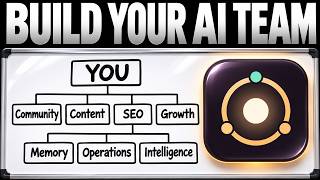
The map is described as an org chart where each 'employee' is an AI agent. Seven departments (community, content, SEO, growth, memory, operations, intelligence) are arranged around a central morning brief, with live numbers displayed at the top.
The community department contains five agents: one for welcome replies, one for answering questions, one for weekly updates, one for syncing new members, and one for turning systems into lessons.
The content department handles faceless videos, thumbnails, titles, descriptions, shorts, reels, carousels, posts, SEO articles, keyword research, and podcast pages, all from a single idea.
At 7 AM, the morning brief agent reads live numbers (e.g., 3,770 members, 111 online), checks autopilot status, and writes a brief with a 'Do this first' action item, such as posting a quick win while members are online.
When new members join, the welcome agent reads their bios and drafts personalized replies with a first step tailored to their business (e.g., sales automation, photography teaching, SEO agency). Replies are drafts awaiting human approval.
The content agent turns one idea ('Map your whole business as AI agents') into a post, a seven-slide carousel, and a spoken hook in seconds, demonstrating rapid content creation.
Growth tracks link clicks and predicts performance; Operations manages video queues and file cleanup; Intelligence provides weekly reviews; Memory logs all agent actions nightly, preventing repetitive questions and enabling cumulative learning.
The old way: business lives in your head, 10 apps to check, slow replies, one post per idea, repeated questions. The new way: one map, one brief, fast personalized replies, multiple content pieces, and a shared memory.
The map can be switched to different business types: software founder (lead reply, demo booker, onboarding), coach (inquiry replies, content, welcome packs), and real estate agent (listing replies, descriptions, client updates). The seven-department structure remains constant.
Doubts addressed: (1) It's for one-person businesses, not just big companies; (2) Agents only produce drafts, humans approve; (3) Start with one agent, not all 29.
Step 1: Write down your seven departments. Step 2: List three weekly jobs per department to become agents. Step 3: Enable the morning brief first. Step 4: Add one new agent per week, starting with the most hated job.
The Agent OS Company Map offers a practical framework for automating business operations through AI agents, centralizing information, and enabling scalable growth. By starting small and building incrementally, even solo entrepreneurs can leverage this system to save time and increase efficiency.
Mentioned in this Video
Tutorial Checklist
💡 Key Takeaways
Morning Brief Automation
Demonstrates how AI can synthesize multiple data sources into a single actionable brief, saving significant time.
03:36Personalized Welcome Replies
Shows how AI can tailor responses to individual business contexts, improving engagement and retention.
04:44Memory Department as a Game-Changer
Highlights the importance of persistent memory in AI systems, enabling cumulative learning and efficiency.
07:38Incremental Implementation Strategy
Provides a practical, low-risk approach to adopting AI automation, reducing overwhelm.
11:07Full Transcript
[00:02] and seeing your whole business run by AI agents. That's the new company map agents. That's the new company map inside my agent OS. Seven departments, 29 agents, and one brief in the middle that tells you what moved while you were
[00:15] asleep. Today, I'm going to open the map I actually use. You'll watch a real agent write my morning brief from my real numbers. You'll watch another one welcome three brand new members, each with a first step that fits their
[00:28] business. and you'll watch a third one turn one idea into a post, a carousel, and a hook in a few seconds. Then I'll show you how the same map looks for a software founder, a coach, and a real estate agent so you can see yours. Stick
[00:43] you the one department most people forget to build. And it's the one that stops you asking the same question twice. By the end of this video, you'll know how to map your own business into AI departments and which agent to switch
[00:57] on first. Let's get into it. So, what are you actually looking at? This is a page inside the agent OS called the company map. The agent OS is one app on your computer that puts every AI tool you use in one place. And the company
[01:13] map is the part that shows your business the way an org chart would, except every name on this chart is an AI agent. Seven bubbles around the outside. Those are the departments. community, content, SEO, growth, memory, operations, and
[01:30] intelligence. Each one has its own color and its own little group of agents around it. And right in the middle sits the morning brief. Every line you see moving is work flowing from a department back into that brief. Up the top are the
[01:45] live numbers. 3,770 members, 111 online right now, 2,880 tracked link clicks in the last 30 days, and six agents running on autopilot.
[01:59] come from the same places my business runs on every day. Let me click into a department so you can see what's inside. This is community, five agents. One
[02:11] writes welcome replies for new members. One answers questions in the community using the lessons as its notes. One turns the week's builds into one calm, simple update post. One syncs new members into the agent OS every morning
[02:25] on a timer. And one turns every new system into a lesson. Now content faceless videos from the script to the final render. 30 thumbnails for every
[02:37] video, titles and descriptions, shorts and reels, and carousels and posts from and reels, and carousels and posts from one idea. And SEO posts for my network of sites, articles for AI search, keyword research from Search Console,
[02:50] and podcast pages that publish six times a day by themselves. Each line here is a job that used to sit on my to-do list. And if you want this exact map for your business, it's inside the AI profit boardroom. The company map, the agents,
[03:06] skills, prompts, automation template, training, and a 30-day road map. You stop dropping balls with weekly calls, and over 3,700 members building beside like this one. The link is in the comments and description, or go to
[03:22] apiprofitboardroom.com. Now, let me show you the part that makes this feel like a real company. The agents don't just sit on a chart. They do the work and you can watch them do it. I'll show you three moments from a
[03:36] normal day. Moment one is 7 in the morning. I click the morning brief in the middle. The agent starts reading. First, it reads today's numbers. Then, it checks what's running on autopilot. Then, it writes the brief. And here's
[03:50] what it wrote. Good morning. The community is at 3,770 members and 111 of them are online right now. Members have written 7,869
[04:02] now. Members have written 7,869 posts. Track links got 2,880 clicks in the last 30 days. Then it tells me what's on autopilot. Six scheduled agents. The podcast sites publish six times a day. And the memory
[04:15] summary runs every night. And then the part I care about most as a business owner, the last line. Do this first. While 111 members are online, post one quick win and ask everyone what they're building today. That's the whole point
[04:30] of a brief. It doesn't give you 10 tabs to check. It gives you one page and one thing to do first. It's written by Claude from the real numbers every morning. So instead of opening five dashboards with your coffee, you open
[04:44] one page and you already know where your day starts. Moment two is when somebody new shows up. Three people joined the community this morning. Here are their bios, and I'll keep their names out of it. One works in revenue operations and
[04:58] builds sales automations. One teaches photography online to over 2,000 students, and one runs an SEO link building agency. Three totally different businesses. I click the welcome agent, and it reads all three bios. Then it
[05:13] matches a first step to each one. Then it drafts the replies. For the revenue operations person, it says, "Pick one sales workflow you repeat every week, like lead routting or follow-ups, and ask an agent to draft the steps." For
[05:27] the photography teacher, it says, "Collect your 10 most common student questions and have AI draft answers in your voice." And for the agency owner, it says, "Let AI prepare your outreach and give it a list of sites to pitch."
[05:41] Every reply is short, friendly, and about their [snorts] business, not mine. And nothing gets sent until a human reads it. That's the benefit. New people reads it. That's the benefit. New people feel seen in minutes, not days. And you
[05:54] never lose someone because nobody said hello. Moment three is content. Every content team has the same problem. You have one good idea and it only ever turns into one thing. So I click the content department and give it today's
[06:08] idea. Map your whole business as AI agents. Seven departments and one brief that tells you what moved. And watch what comes back. A post written in my style. It opens with, "I'm begging you." Then four short steps, one per line.
[06:25] List the seven departments your business runs on. Give each one agents that do its daily jobs. Connect every agent to one morning brief. Read what moved before you open your inbox. Then a seven slide carousel from a hook on slide one
[06:40] to comment map on slide seven and one spoken hook for a short. One idea, three pieces in the time it took me to say that sentence. That's how you show up every day without staring at a blank page. Now, let me walk you through the
[06:55] other four departments because this is where it gets interesting. Growth. Every video gets its own tracked link, so every click has a source. One agent scores yesterday's posts and predicts today's every morning. One reads the
[07:09] thumbnail tests and feeds the winners back. And one watches the join flow every morning for the first real request. Operations. One keeps the video queue moving. One clears old files before the drive fills up. One rebuilds
[07:24] the agent OS member pack and updates the lesson. And one counts the new pages on each podcast site every morning. Intelligence. That's the brief you already saw, plus an agent that picks what to make next from real performance
[07:38] data and a weekly review that tells me what worked and what stalled. And then memory. This is the department I told you about at the start, the one most people forget. Every night, every agent writes down what it did into one shared
[07:53] notebook. Every decision gets logged, and any agent can look up what the business already knows. So next week when an agent wonders how I like my titles or which offer goes in which video, it doesn't ask me. It already
[08:07] knows. That's what stops you repeating yourself forever. Without memory, every yourself forever. Without memory, every agent starts from zero every single day. With it, the whole company gets a little smarter every night. So let me put the
[08:20] old way next to the new way. The old way. Your business lives in your head. You open 10 apps every morning to work out what happened. New people wait a day for a reply. Good ideas turn into one post and then disappear and you answer
[08:35] the same questions again and again. The new way. Your business lives on one map. One brief at seven tells you what moved and what to do first. New people get a
[08:47] reply that fits their business in minutes. One idea turns into a post, a carousel, and a hook. And memory means nobody asks you the same question twice. Now, here's the part that matters for you. You probably don't run an AI
[09:01] community and a video channel. So, up the top, there's a switch, and it changes the map to your kind of business. Watch. Here's a software founder. Sales has a lead reply agent, a demo booker, and a trial follow-up agent
[09:16] that nudges trials that went quiet. Onboarding gets new users live on day one and spots anyone stuck on step two. Support sorts tickets and turns them into clean bug reports. Product groups feature requests by how often they come
[09:30] feature requests by how often they come up. Now, a coach leads answers every inquiry the same hour and books discovery calls straight from the reply. Content turns one idea into a real, a post, and the carousel. Onboarding sends
[09:43] a welcome pack the same day a client signs. Sessions sends notes and actions signs. Sessions sends notes and actions after every call, then a nudge midweek. and a real estate agent. Leads answers every listing inquiry in minutes and
[09:57] books the viewing. Listings writes the description from the photos. Clients get a weekly update on what happened with their sale and paperwork chases the missing documents before a deadline slips. Same seven department shape every
[10:10] time. Same morning brief in the middle. You just swap the agents for the jobs your business actually does. Now, you might be sitting there with a few doubts. So, let me deal with them. Doubt one. This looks like a big company
[10:24] thing. I'm one person. That's exactly who it's for. A big company has people who it's for. A big company has people in every department. You have you. The map is how one person gets a team. Doubt two. Won't the agents send things I
[10:38] didn't approve? Only if you let them. Every draft you saw today waits for a human. The welcome replies are drafts. The posts are drafts. You stay the boss and the agents do the first 90%. Doubt
[10:52] three. I don't know where to start. 29 agents sounds like a lot. You don't start with 29. I didn't either. You start with one and the next part tells you which one. Here's your plan for the next seven days. Step one, write down
[11:07] your seven departments. Use mine as a guide. Then rename them for your business. Step two, under each one, write the three jobs you do every single week. Those are your first agents. Step three, switch on the morning brief
[11:22] first. It's the one that tells you where everything else is, so it helps from day one. Step four, add one new agent a week, starting with the job you hate the most, one department at a time. Want help doing that? Join the AI profit
[11:37] boardroom. You get the company map template for your niche, the agents, skills, prompts, automation template, training, and a 30-day road map. Your business runs on one page. Weekly calls, daily updates, and over 3,700 members
[11:53] for when you're stuck, plus the whole system behind videos like this one. The link is in the comments and description, or go to aiprofitboardroom.com. So, that's the agent OS company map. Seven departments, 29 agents, a brief at
[12:08] seven that tells you what moved, welcome replies that fit each new person's business, one idea that turns into a week of content, and a memory department so the whole company gets smarter every night. Drop a comment and tell me which
[12:23] department would you switch on first, leads or content? I'll see you in the leads or content? I'll see you in the next one.