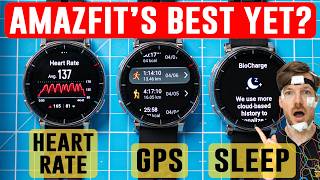

This $170 Watch Surprised Me!
43sThe opening sets up a value proposition that intrigues budget-conscious viewers, and the promise of scientific testing builds credibility.
▶ Play Clip"Delivers a thorough, scientific review as promised, with real data and comparisons, though the 'FULL' claim is slightly overstated given some limited tests."
The Amazfit Active 3 Premium is a budget-friendly smartwatch at around $170, and this video provides an independent, scientific review of its heart rate, sleep, and GPS tracking performance. The reviewer, a post-doctoral scientist, compares it against reference devices like the Polar H10 chest strap and Zeemax EEG headband, and benchmarks it against other wearables. The overall verdict is that it's a solid, mid-tier performer that delivers good value for its price, though it has some limitations in specific activities.
The Amazfit Active 3 Premium is released at a competitive price of about $170. The reviewer notes it's a good watch for the price, but has some drawbacks.
Heart rate tracking is compared to the Polar H10 ECG chest strap, which uses electrical signals of the heart. The correlation between the watch and the reference is measured, with 1.0 being perfect.
For indoor cycling, the correlation was 0.97, which is good but not top-tier. The watch sometimes detected a lower heart rate, especially at the start of sessions when the body was warming up.
The Active 3 Premium's performance is almost identical to the Amazfit T-Rex 3 Pro and Active Max, as they share the same sensor. It sits in the middle of all tested devices, not among the best or worst.
For outdoor running, the correlation was 0.95. The watch struggled at the beginning of the session but improved as the body warmed up. This is a consistent finding across activities.
The device struggled significantly during outdoor cycling, often detecting a too-low heart rate. This is a known weakness for Amazfit devices in this activity.
For weightlifting, the correlation was 0.95, but the watch missed many peaks in heart rate during sets. This is due to wrist tension affecting blood flow measurement. The reviewer does not recommend it for this activity.
Sleep tracking was tested against the Zeemax EEG headband, which measures brain waves and eye movements. It's a 'silver standard' reference, not the gold standard polysomnography.
Sleep tracking results were surprisingly good, especially for REM sleep, which has historically been a weak point for Amazfit. Agreement was around 60% for deep sleep, 65% for light sleep, and similar for REM.
The Active 3 Premium's sleep tracking is mediocre compared to top performers like Eight Sleep, Apple, Pixel, Whoop, and Oura. It's better than some Garmin devices but not as good as the best.
GPS tracking was tested by running and cycling the same route multiple times. Cycling performance was good, with minimal deviation. Running performance was decent but showed some deviations, especially near a wall.
The reviewer is impressed with the device for its price. It's a solid choice for budget-conscious users wanting Garmin-like tracking. However, for specific needs, other devices are recommended: Garmin/Coros for GPS, Oura/Whoop/Apple/Pixel for sleep, and Amazfit Helio Strap for heart rate.
The Amazfit Active 3 Premium is a good value smartwatch that performs adequately across heart rate, sleep, and GPS tracking, but it doesn't excel in any single area. It's a solid choice for budget-conscious users, but those with specific needs (e.g., top-tier GPS or sleep tracking) should consider other devices.
What is the price of the Amazfit Active 3 Premium?
About $170.
00:02
What reference device is used for heart rate testing?
The Polar H10 ECG chest strap.
01:23
What was the correlation for indoor cycling heart rate?
0.97.
01:51
Why does the watch struggle to track heart rate at the start of exercise?
Because the body needs to warm up, making it easier to measure heart rate as it warms.
02:48
Which activity showed the worst heart rate tracking performance?
Outdoor cycling, with a correlation between 0.7 and 0.9.
07:36
What is the 'silver standard' reference for sleep tracking used in this review?
The Zeemax EEG headband.
13:05
What was the approximate agreement for deep sleep tracking?
Close to 60%.
16:02
Which brands are consistently top performers in sleep tracking according to the reviewer?
Eight Sleep, Apple, Pixel/Google, Whoop, and Oura.
17:28
What is the main reason the watch struggles with heart rate tracking during weightlifting?
Wrist tension during sets affects blood flow measurement.
10:08
What is the reviewer's overall recommendation for GPS tracking?
Garmin or Coros devices.
23:56
Warm-up effect on heart rate tracking
Reveals a consistent pattern where the watch struggles at the start of exercise but improves as the body warms up, a key insight for users.
02:48Improved REM sleep tracking
Historically a weak point for Amazfit, the REM sleep tracking showed significant improvement, which is a notable positive finding.
14:39Outdoor cycling heart rate weakness
Identifies a specific activity where the device performs poorly, which is crucial for potential buyers who cycle outdoors.
07:36Value for money verdict
Summarizes the device's overall value proposition, balancing its strengths and weaknesses against its low price.
23:03[00:02] releasing a new watch every month or so at pretty competitive price points and this month is the Amazfit Active 3 Premium. Releasing at about $170,
[00:14] this is a really good watch for the price as you will see in this video. I'm generally pretty positive about it though there are some things that aren't quite as good. Now actually I said this month but this has been released last
[00:27] month. I got my hands on this quite late but I think results are super interesting. Also a bit confusing sometimes but I'll show you today my independent scientific testing of the Amazfit Active 3 Premium to help you
[00:41] Amazfit Active 3 Premium to help you decide whether this $170 watch is the watch for you or if maybe you want to get the Amazfit Active Max or maybe you want to get the Amazfit Helios strap, a Whoop strap, another device. Well, today
[00:55] I'll show you all the testing results and also how it compares to other you who are new to the channel, my name is Rob and I'm a post-doctoral scientist focusing on biological data analysis and like always that's what we're going to
[01:09] look at today, data analysis. And we're going to compare the performance in terms of heart rate tracking, sleep stage tracking and GPS tracking and we're going to find out how well the Amazfit Active 3 Premium is performing
[01:23] and given its price point I think it does pretty well. But as always let's start with the heart rate tracking performance which we're comparing to the Polar H10 ECG chest strap which is generally one of the most reliable ways
[01:37] using ECG so the electrical signals of your heart and we're comparing that to the heart rate as tracked by the Amazfit Active 3 Premium. So that's along the vertical axis right here and if both would perfectly agree all points should
[01:51] be on or close to this blue line and luckily most points are. So these are the results for indoor cycling or also called spinning. So, 0.97 is pretty good, though not as good as some of the competitors are performing because we
[02:06] see some points below the blue line indicating that it's sometimes detecting actually take a look at some of the individual spinning sessions. Here we have one example. So, I did several intervals and in most cases the heart
[02:20] though here in the beginning it struggled a bit. So, in red we have the Amazfit and as you can see it sometimes detects a slightly lower heart rate right here. The same is true for the second session.
[02:34] In the beginning it actually struggled a bit. Later on, as my body got warmer, it did a better job. This session doesn't look quite as bad, though it still struggled a bit in the beginning. So, overall it seems it's a bit sensitive to
[02:48] how warm my body is. In the end it always does really well. In the beginning it struggles a bit, but it might just be good enough for many of performance to that of many other devices I've tested in the past where
[03:01] value we're looking at before. So, here the correlation was 0.97. one, so one would be perfect correlation, which is all the way up here. And the lowest correlation of any recently tested device was about 0.8, so
[03:16] that's the lower bound here. And where do we find the Amazfit Active 3 Premium? Well, it is right here. It's actually almost identical to the performance of the Amazfit T-Rex 3 Pro and the Amazfit Active Max, which isn't surprising given
[03:31] that all of these have the same sensor. So, it's somewhere in the middle of all devices. It's not amongst the top performers, but also not amongst the worst performers. And I would say it's probably good enough, though in this
[03:43] case if you want Amazfit, the Amazfit Helio strap will definitely do a better job at least based on my testing. We can actually zoom in a bit, so just looking at those devices with a correlation of 0.95 or higher. And if you look at
[03:56] those, again, we have the Amazfit Active 3 Premium right here, close to the Amazfit T-Rex 3 Pro, and the Amazfit Active Max. It's doing about the same as some Garmin devices like the Garmin Venue X1, the 40570, the Venue 4.
[04:11] But the best devices in this case are Apple Watches, so the Apple Watch SE, Huawei devices, so some of the more expensive Huawei devices like the Huawei Watch GT 6. We also have the Huawei Watch 5 right here, and the Amazfit
[04:25] Helio Strap. Now, these Amazfit Helio Strap tests right here, indicated by an arrow, were testing I did with the Amazfit Helio Strap on my biceps right here. So, overall, the best performers right here are different Apple Watches,
[04:39] right here are different Apple Watches, some Huawei devices, and the Amazfit Helio Strap. But in this case, mostly when worn on the biceps, but even on the wrist, it's doing better than the
[04:51] probably because you're going to get a better fit with this device on your wrist, and it's going to move less because it's just so much lighter. It does have the same sensor, though. So, the potential is there, but it does seem
[05:04] like there's some influence of the weight of the device. Still, for many of you, probably the Amazfit Active 3 Premium will be good enough, though it is not doing quite as good as I had hoped. But let's next take
[05:17] a look at the results for running outside. So, those results are displayed right here, where again, we want the points to be as close to the blue line as possible. And in most cases, it was quite close, though there are some
[05:30] points here below the blue line, indicating it sometimes detected a too low heart rate. The correlation is okay, though not great at 0.95, right at that Now, I actually only did a single running session because I was training
[05:46] for the marathon, and I had to take a small break before actually running it. pretty well. Though again, in the beginning, it struggled detecting a too indicating that as my body was warming up, it was getting easier and easier to
[06:00] measure my heart rate. So that's a really interesting finding. If we compare it to the competition based on this somewhat limited test, we can again see that it's somewhere in the middle of all devices. But not that far from the
[06:14] Active Max and Amazfit Balance with a similar sensor and the Amazfit T-Rex 3 Pro. So all of these are doing about the same. And again, if we focus on the best performing devices, we still see the same ones. So the Apple Watch, the
[06:29] Amazfit Helio Strap, the Pixel Watch, and some Huawei devices potentially like the Huawei Watch GT6. So if you want the absolute best heart rate tracking during running, I would recommend one of those devices. Though I do suspect for most of
[06:44] us, this Amazfit Active 3 Premium will be good enough. And overall, it seems to be performing about the same as other devices like the Amazfit Active Max right here. So I think with the same sensor and a roughly similar weight, you
[06:56] will get similar performance for all Amazfit devices with this sensor. And basically, at the moment, all Amazfit devices are shipping with the exact same sensor. Now if you're into running and you want to get better running plans, I
[07:09] actually recommend using the Runna app, which gives you custom running plans no matter what your goal is, and also life guidance during your runs. It is how I marathon. If you want to try it out for free for 2 weeks, use my affiliate link
[07:22] up here and you'll be supporting the channel at the same time. But let's move on from running to an exercise that is sometimes harder for devices to track, cycling outside. And in this case, we see that the device is struggling a lot.
[07:36] So we want the points to be in this area right here, but there's a big cloud of points here below the blue line indicating that in many cases the Amazfit Active 3 Premium was detecting a too low heart rate. And if we look at
[07:51] some examples, we see one right here. We can see that in some areas it did quite well, but sometimes it was detecting a too low heart rate. This biking session it really struggled always detecting a too low heart rate.
[08:04] beginning my body needed to warm up, here it struggled all of the time. Also right here, also right here not doing that great. And this somewhat surprises me. Though we've seen before I believe
[08:17] that some of the latest testing I've done with Amazfit devices wasn't the best compared to the competition when it comes to cycling outside. But again, let's take a look at that overview where we want the devices to be as far to the
[08:29] top right as possible. Now it's a bit difficult to look at, but all Amazfit devices are indicated by this blue greenish color. And we have for instance the Amazfit Active Max right here, the Active 2, the Amazfit T-Rex Ultra 2, and
[08:44] we have the Amazfit Active 3 Premium right here in that same area. So that testing is quite consistent. We have more testing of the T-Rex 3 Pro right here, another test of the T-Rex 3 Pro.
[08:57] All of these are roughly, let's say, in this area right here. So between 0.7 this area right here. So between 0.7 and 0.9 in terms of correlation. So not amongst the best devices. Again, some of the best devices out
[09:12] Amazfit Helios strap especially when worn on the biceps, but also Pixel Watches, the Apple AirPods Pro 3, and also different Huawei devices. So these are the brands I would recommend if you're specifically interested in heart
[09:27] rate tracking, especially for those harder exercises like cycling outside or running. Now to close off, I wanted to take a look at the which looks okay actually, with a correlation of 0.95.
[09:41] I have seen better, but this is also a very hard exercise for many devices track. And this is actually quite good. Now, we do see quite a few points below look at some of the individual weightlifting sessions, we see that some
[09:55] peaks are detected, but also many peaks are not. Same for this one right here. This one I started late, but you can see this first peak is detected, whereas later ones aren't And these peaks are moments where I
[10:08] actually did a set of exercises. So, when I do a set of exercises, there's a lot of tension on my wrist, making it very hard for the watch to actually track those changes in blood flow, which is what it uses to try and estimate your
[10:20] So, again, I wouldn't really recommend it for weightlifting. We can look at the competition, and like I said, we saw that the Amazfit Active 3 Premium is that the Amazfit Active 3 Premium is right here with a correlation of 0.95,
[10:33] individual performance that isn't good enough. It's actually quite close to the performance of the Amazfit Balance and the Amazfit T-Rex 3 Pro right here. Only the Amazfit Helio Strap when worn on the biceps are potentially doing better.
[10:47] individual sessions, those do look better, but the only devices I somewhat recommend for weightlifting at the moment are different Apple devices, also in-ear devices, like for instance, the Powerbeats Pro 2 or the Apple
[11:02] AirPods Pro 3, and the Amazfit Helio Strap when worn on the biceps. So, those are the only devices I can really somewhat recommend accurately track your heart rate during weightlifting, just get yourself an ECG
[11:17] chest strap. That's really the most reliable way of measuring that. So, what's my overall conclusion for the heart rate tracking performance of the Amazfit Active 3 Premium? Well, it's about as we expected. It's
[11:30] doing about the same as, for instance the Amazfit Active Max or other Amazfit devices that are recently tested, which isn't surprising given that some of these have very similar weights, the same sensor. So, you don't really expect
[11:42] different devices, whether it be the Amazfit Active 3 Premium right here or the Amazfit Active Max. They actually also look quite similar. So, if you're between the two, well, the screen size
[11:56] Active Max. It has a longer battery life, but overall, it's also bigger, and there's a few small features introduced on the Amazfit Active 3 Premium. It has more premium materials. Honestly, overall, they're just very similar
[12:09] devices, and that also shows in their heart rate tracking performance. One performance during hiking, but I happened to go on a hike, and I had the Amazfit Active 3 Premium on, and there the heart rate tracking performance is
[12:22] quickly show you that. So, for the hike, most of the time it did really good job. bit, again, but potentially because my body had to warm up, but overall, that doesn't change any conclusion I have about the Amazfit Active 3 Premium. It's
[12:37] a pretty okay heart rate tracker. They're not the best we've seen, but it might be good enough for many of you. Again, this is on my body, so it's not reviewers, but I do think it's a good first indication of how good this device
[12:50] performs. But of course, in addition to tracking your heart rate during GPS tracks, which we'll get to in a second, but also your recovery during tracking is quite important. So, I also tested the sleep stage tracking
[13:05] performance of the Amazfit Active 3 Premium against the Zeemax EEG headband, measure my brain waves and eye movements, and it was specifically designed for sleep stage tracking. It's used in several scientific studies. It's
[13:18] sort of a silver standard, not the gold standard like polysomnography, but good enough to get a general impression of the performance of the Amazfit Active 3 And I'll show you those results in a second, but first I want to ask for your
[13:32] support. Running this channel next to my full-time job as a scientist is neither easy or cheap. It costs a lot of time and money. I have to buy cameras, pay my editor Alex, and I've actually bought most of the devices I've ever tested
[13:44] myself. So there's thousands upon thousands of euros just going into buying different devices, especially Garmin devices. There's a bunch right here are super expensive like this Phoenix 7 I bought at some point or
[13:56] Phoenix 7 Pro. I think it cost me like 7 or 800 euros when I bought it. So if you want to support it, there's several ways of doing that. The most easy way is by before making any purchase. So if you click that first before making any
[14:10] and it doesn't cost you any extra. You can even bookmark it with command or control D and just make it your default way of going to Amazon. Or if you want instance the Whoop Strap, my favorite overall health tracker, if you use my
[14:25] best discount possible and you support the channel at the same time. Now, give you early access to some of my videos, but let's get back to the testing results. And here we have those results for the sleep stage tracking
[14:39] And these actually look surprisingly good to me. At least the REM sleep tracking based on this initial test looks quite good. These results are only based on four or five nights, so very preliminary test, but overall the REM
[14:55] improved recently. I'm actually quite surprised to see this because usually this is where Amazfit struggles, but now it's much more consistent over the different sleep stages. So on top here we have the sleep stages as measured by
[15:09] the reference device, and we're going to mainly focus on deep sleep, light sleep, and REM sleep. So we're not going to take a look at the awake time because a lot of short arousals are detected that aren't really awake moments that they
[15:23] don't really want to focus on. And on the left, we have the sleep stages as the left, we have the sleep stages as detected by the Amazfit. And if the both devices would perfectly agree, all values on the diagonal right
[15:35] here should be 100%. Now, they're not 100%, but they're all above 50%, which is already a good start. And especially given that the REM sleep tracking, which was usually around 40% or so for Amazfit, might actually
[15:49] have improved. I do want to do more testing, maybe also with the Amazfit But generally, this is at least an improvement, though definitely not as good as some of the best performers out there. So, deep sleep agreement is close
[16:02] to 60%. Light sleep agreement is close to 65% and the same goes for REM sleep agreement. So, pretty solid across all sleep stages. But of course, we can compare this performance to some of the other devices I've previously tested.
[16:16] Where along the horizontal axis, we have the average sensitivity, and the worst So, the best devices are on the top right right here. And we have the Amazfit Active 3 Premium right here.
[16:29] sleep tracking, it's higher along this axis, but it does seem like the average other devices I've tested from Amazfit hasn't improved. So again, this blue green color Amazfit devices, and these were quite low along the vertical axis
[16:45] right here. But for deep sleep and light sleep, the performance was quite good. So, they were still quite at a good position along the horizontal axis right here. So, that doesn't seem to have changed. On average, the Amazfit Active
[16:57] 3 Premium is still somewhat in the same area as all these other Amazfit devices. tracking, at least for this initial test. So, in terms of overall to for instance, different Garmin devices, and better than other devices
[17:12] from for instance, Huawei or Coros. So, a mediocre, though not bad performance for Amazfit. Again, regular viewers will know there are five brands that tend to in my testing and also in one of the scientific studies that we did. And
[17:28] those five brands are Eight Sleep, Apple, Pixel or Google with also their Fitbit devices, the Whoop Strap, and the Oura Ring. So, the Oura Ring is a ring, the Whoop Strap is a strap similar to the Amazfit Helio Strap, which I always
[17:42] it's tested and we're done, but you can also wear it on your wrist, which is my favorite overall health and sleep tracker, the one I mainly use myself. This is my main device at the moment. It is quite expensive though because you
[17:55] have the subscription model. If you're on iOS, the Apple Watch is a really good choice, but the app of Apple isn't that great. That's where Whoop and Oura are doing a much better job. And if you're on Android, the Pixel Watch is a really
[18:07] slightly better app in my opinion than the Apple Watch in terms of giving you an overview of your sleep and your recovery and those kind of things. which is my favorite overall sleep improvement device. Well, it's actually
[18:20] currently use that I have enough faith in that it actually positively it's not a wearable, but something that goes around your mattress. It can because I can set my sleeping environmental temperature. Both the
[18:35] blanket and the surface of the mattress are cooled or heated to the temperature that I want it to be at. And when I have a partner, she can set her temperature independently. I tend to sleep a lot cooler than my partner, so I set it
[18:48] whatever temperature they want. And for me in summer, this is the only way I can get some decent sleep. It also has great sleep stage tracking, which is built into the mattress, but it is super expensive, and it has a monthly fee. So,
[19:01] If you want to try it out and get the best discount possible, use my affiliate can really afford, but again, if you want to try it out, that link is up here and down here. But, getting back to the Amazfit Active
[19:15] 3 Premium right here, it's doing about as well overall as previous testing that I've done with Amazfit devices. Though, potentially that recent sleep improved the REM sleep tracking, but maybe at the cost of somewhat decreased
[19:30] quality of some of the other stages. I want to do long-term testing now of the Amazfit Helios strap because I'm quite excited to see how that will perform you're not getting worse sleep tracking with Amazfit devices than you would get
[19:44] with, for instance, Garmin or Polar. And it's a lot more budget-friendly than those devices. Now, the final thing I want to look at is the GPS tracking performance of this device. I've actually done both running
[19:56] and cycling, and we're going to look at those results right now. And right here, you can see those results for cycling outside. And the way I test GPS tracking route or running the exact same route multiple times, and then seeing if the
[20:10] signals nicely overlap, which means there's a bigger chance it has good GPS tracking performance, or if there's a big deviation and a lot of noise in the signal, then the GPS tracking is likely less good. So, let's start with cycling.
[20:22] So, this is cycling outside, actually my cycling to work. And this is around the area right here where I started the route. Then, in the beginning, it was a still needed to acquire the most accurate signal, but the signal was
[20:34] acquired quickly, so that's good. Then, if we look at the consistency between the signals, this actually looks quite good. There are some deviation. This is not like Garmin-level quality, but very close. Here, the results look very good.
[20:46] here, so this is a real signal. Also here, looking really good. I'm really happy with this for the cycling performance, but let's also take a look at two times I cycled back from work. So, we're going to get rid of these
[20:59] signals right here. So, these are the results for two times I cycled back from work. And here, we see some deviation in in beginning, then the signal gets a lot here. Around the roundabout looking pretty solid. Many devices struggle
[21:12] of deviation. Looking quite okay. Some deviation right here. Here I took two different routes. Here looking quite okay. Now, I only had two signals here, so hard to give a full conclusion.
[21:26] But overall, my impression for cycling so far is that it's pretty good, not amazing, but probably good enough for many of you. But I actually also want to And those results are right here. So, I ran in this circle right here many, many
[21:40] where there's a big wall on this side right here and no wall on this side. And together. And this looks okay to me, though not great. There's definitely some deviation between the signals on this side.
[21:55] end of the wall, we see bigger deviations. And we've seen that for other devices as well, that near the end of this wall right here, indicated by this yellow-brownish color, they tend to deviate a lot. So, it's not perfect.
[22:08] Other devices, especially Garmin devices, tend to do a lot better. I actually recently ran a marathon where you could see that Garmin and Coros devices tended to do best at GPS tracking. But that video will come out
[22:20] soon. There I did a very in-depth test of Garmin, Coros, Polar, and Suunto. And there I was really impressed with Garmin and Coros. Suunto was also quite good. Polar showed some struggles, but more on that later. Getting back to the Amazfit
[22:35] decent job for cycling. It looked quite good, not perfect, but good enough. I'm a bit disappointed with this area right here for running. I'm not sure what's going on there. But overall, I think you will not have big deviations in terms of
[22:50] total distance measured. Though potentially, based on this right here, I imagine that the total distance traveled or pace could be slightly higher in some moments because it deviates from the straight line that you actually ran.
[23:03] But, for the price, so $170 or so, I'm impressed with this device. It does a decent job at most things. It will be a solid choice for some of you. Though, it's not the main device I could
[23:16] some struggles during heart rate, especially for cycling outside. The GPS sleep stage tracking appears to be changing, potentially improving, it's not quite as good as I would hope. So,
[23:30] if you don't have a lot of money to spend, you want sort of Garmin-like tracking and sleep stage tracking, then the Active 3 Premium is something I could recommend. It's not expensive, it has a nice screen, decent design, good
[23:44] but I don't think it does better or worse than, for instance, the Amazfit Active Max or even other devices from Amazfit because mostly the same sensors are included. Now, if GPS tracking is
[23:56] your focus, I would recommend a Garmin device or maybe a Coros device. If sleep recommend an Oura Ring, a Whoop Strap, an Eight Sleep Pod, a Pixel Watch, or an Apple Watch. And if cheap, good heart rate tracking is what you want, I would
[24:10] recommend the Amazfit Helio Strap worn on the biceps. Or if you have a bit more money to spend, Apple Watches, Pixel Watches, and also some Huawei devices do decide to get the Amazfit Active 3 Premium, maybe you want the Amazfit
[24:24] Active Max, you want to get yourself a Whoop Strap, my favorite overall device, an Oura Ring, which I really like for sleep tracking, my favorite overall Sleep Pod, another device, or anything at all on Amazon for that matter, even
[24:38] something as small as toilet paper or coffee beans, you want to get the best channel at the same time, use one of my affiliate links in the description below. Now, given that you watched this whole video on the Amazfit Active 3
[24:51] Premium, I think you might like this video on the Amazfit Helio Strap or this video on the Eight Sleep Pod. >> [music]
⚡ Saved you 0h 25m reading this? Transcribe any YouTube video for free — no signup needed.