
Why biceps beat wrists for heart rate tracking
60sSurprising science-backed tip that challenges common wearable usage, making viewers rethink how they wear their devices.
▶ Play Clip"Delivers exactly what the title promises: a data-backed comparison of two screenless wearables."
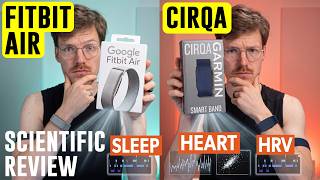
This video compares two screenless wearables, the Fitbit Air and the Garmin Circa, using systematic data collection across various exercises and sleep tracking. The creator, a postdoc scientist, tests heart rate accuracy on wrist and biceps, plus sleep stages, to help viewers decide which device suits their needs.
Both devices achieved a correlation of 0.99 on the wrist for indoor cycling, indicating excellent heart rate tracking.
Biceps tracking is better due to more fleshy area, less movement, and less tension, leading to improved accuracy.
For running on the wrist, Garmin Circa correlation dropped to 0.89, while Fitbit Air stayed at 0.99.
For outdoor biking on the wrist, both had a correlation of 0.92, but improved significantly on the biceps (0.96 and 0.98).
Weightlifting on the wrist was hardest: Garmin Circa correlation 0.73, Fitbit Air 0.93.
On the biceps, Fitbit Air outperformed 91% of devices for running and 82% for weightlifting, while Garmin Circa was in the top three-quarters.
Fitbit Air scored 79 for sleep stages on both wrist and biceps, while Garmin Circa scored 64 on wrist and 73 on biceps.
Garmin Circa showed a slight edge in resting heart rate accuracy, while HRV tracking was comparable.
The Fitbit Air outperforms the Garmin Circa in sleep stage tracking, while both are excellent for exercise heart rate when worn on the biceps. Choose based on your priorities: Fitbit for sleep, Garmin for sports ecosystem integration.
What was the correlation for both devices on the wrist for indoor cycling?
0.99 for both on the wrist for indoor cycling.
01:54
Why is biceps tracking usually better than wrist tracking?
Biceps tracking is better because of more fleshy area with better blood flow, less degrees of freedom, and less tension.
02:21
What were the correlations for running on the wrist?
0.89 for Garmin Circa and 0.99 for Fitbit Air.
03:29
What were the correlations for weightlifting on the wrist?
0.73 for Garmin Circa and 0.93 for Fitbit Air.
07:45
Which device performed better in sleep stage tracking?
The Fitbit Air outperformed the Garmin Circa, especially in REM sleep (73% vs 45% on the wrist).
13:18
Which device had a slight edge in resting heart rate accuracy?
The Garmin Circa showed a slight edge in resting heart rate accuracy.
20:29
What were the total sleep scores for each device?
The Fitbit Air scored 79 on both wrist and biceps, while the Garmin Circa scored 64 on wrist and 73 on biceps.
18:32
Biceps tracking advantage
Explains why biceps placement improves heart rate accuracy, a key insight for users.
02:21Weightlifting wrist correlation gap
Shows a significant performance drop for Garmin on the wrist during weightlifting.
07:45Fitbit's sleep stage superiority
Highlights a clear differentiator between the two devices for sleep tracking.
13:18Choose based on priorities
Summarizes the decision framework: sleep stages vs sports ecosystem.
22:29[00:00] Which is the better screenless wearable? The Fitbit Air at $100 or the Garmin Circa at $200? Well, part of that depends on what you need, because they do have different features.
[00:12] But which is the better tracker, both on the wrist and on the biceps? Well, that is something we can test more objectively, which is exactly what we will do today, and I'll have the data to back it up.
[00:24] I systematically collected a lot of data during many different types of exercises like biking, running and the gym. And I also used an EEG device at night to see if the Garmin Circa or the Fitbit Air is closer to the truth.
[00:39] I will put both side by side so you can judge which device is the best for you or if it's just good enough. Now, for those of you who are new to the channel, my name is Rob and I'm a postdoc for scientists specializing in biological data analysis.
[00:53] And that is of course the main focus of this video, data and data science. Now there are inherent limitations to my testing, the main one being that I'm the sole test subject for this video, but I still think the data is very valuable and it does tell
[01:08] us a lot about the quality of these devices and what they're good at and not so good at. So let's dive right in and let's start with the exercise heart rate tracking. And I always want to start with the easiest exercise to track indoor cycling, also called spinning.
[01:24] Now in these overviews, I will mostly put the Garmin Circa on the left and the Fidget Air on the right. And always indicate if we're looking at a wrist-based test or a biceps-based test.
[01:36] Now in this overview, we're going to use the Polar H10 ECG chest strap as a reference. Now ECG chest straps can measure your heart rate very reliably, so that's why we use it as a reference. And if either the Garmin Circa or the Fitbit Air agrees very well with the reference, most points should be on or close to the blue line.
[01:54] And in addition, we calculate an R-value, a correlation, which in this case is the same for the Garmin Circa and also the Fitbit Air. So both have a correlation of 0.99, which is already really good.
[02:09] So I'm happy enough with both of them on the wrist for indoor cycling. Now as I said, this is an easy exercise and luckily also both of them become even better when you wear it on the biceps.
[02:21] Now the reason that biceps tracking is usually easier likely has several reasons. The first is that you're measuring it in a more fleshy area, so an area with better blood flow to measure. Second, there's less degrees of freedom, so less noise in terms of movement.
[02:36] And third, there's also less tension for a lot of exercises. So on the wrist, for instance, if you're holding your steering wheel, there'll be a lot of tension and also bumpiness there that interferes with the heart rate signal. And that's probably less so on the biceps.
[02:49] So usually biceps tracking will be better than wrist-based tracking. And we see the same here for both the circa here on the left, which now has a rounded correlation of 1.00. And the correlation cannot be higher than 1, so 1.00 is really good.
[03:03] And the same for the fibid air. So both of them are just doing really well. But we can make things a bit more difficult and look at the results for running outside. Now here things start to change a little bit.
[03:17] Now for the Garmin Circa on my wrist there were some troubles when running, or at least the Garmin Circa struggled a little bit itself. So there are some points now below the line and also points above the blue line.
[03:29] This indicates that sometimes it's actually too low and sometimes it's too high heart rate and the correlation is quite a bit lower now at 0.89 whereas the Fibit Air are still doing a decent job i would say with the correlation of 0.99 and most points being on or close to the
[03:47] do line so for running at least on my body on the wrist the Garmin Circa starts to struggle but then if we go to the biceps both do very well again the Garmin Circa has a correlation of 0.98
[04:01] and the Fitbit N has a little bit higher correlation at 0.99 but I would say both are doing a good job here and they're better than much of the competition as you will see in a second now I also want to look at harder exercises even like
[04:14] biking outside but before looking at those results these two trackers are both at getting a lot of value for your money at a hundred and two hundred bucks which is also a good description of Surfshark the sponsor of this video now
[04:26] I've actually been paying for Surfshark for years before they now sponsored me is the first sponsor video with them. I've tried several VPNs before and Surfshark is the one that I kept in the end. Now privacy is one reason, but honestly I mostly use it
[04:40] for changing my virtual location. When I'm traveling for instance I can still watch the shows I normally watch at home, at the moment for instance The Mentalist on Amazon Prime. I also like watching the World Cup and especially the Tour de France. And living here in Austria
[04:53] I can now connect through the Netherlands and watch with Dutch commentary instead, which is what I grew up with. Now I actually also use it during smart band and smart watch research because I want websites to open to their US version which usually has the best information
[05:06] for me. Surfshark also comes with antivirus protection which I run across all my devices for instance instead of the pre-installed bloatware antivirus it came with my Windows laptop but also my iPad and even my Android based AYM store. Now one subscription works across
[05:22] unlimited devices so I don't have to decide which ones are worth protecting. If you want to try it, go to surfshark.com slash TQS or use my code TQS at checkout to get four months extra of Surfshark
[05:36] VPN. That helps you get the best VPN and at the same time support the channel. You can even try it first with a 30-day money-back guarantee. I can honestly really recommend Surfshark and it is my VPN that I use on a daily basis. Now thanks to Surfshark and let's get back to the testing.
[05:53] And I already teased these results for biking outside which is a much harder exercise than biking inside because of that extra tension on the wrist and bumpiness. And we can indeed see that both the Garmin Circa on the left and the Subit Air on the right struggle more than for
[06:08] biking indoors especially when worn on the wrist. So both have a correlation of 0.92. Now I have to make a manual small correction here because there's a small bug in my
[06:20] code later on you will see all the correct values listed but there was a small mistake there but overall basically they doing about equally well I would still say if you look at the patterns in the plot
[06:32] maybe more often the civet air has a slightly bigger deviation, but then again it has a smaller percentage of deviating points, so overall in terms of correlation they end up the same. But what about when it's worn on the biceps?
[06:46] While both the Garmin Circa and the Civic Air increase substantially in their performance and do very well. When worn on the biceps for biking outside, the correlation is 0.96 for the Garmin Circa and 0.98 for the Civic Air.
[07:02] Both are doing really well. The Civic Air is doing slightly better because there are more points close to the blue line. So on the biceps, there appears to be an even bigger improvement here for the Civic Air. Now weightlifting tends to be the hardest exercise for device to track and we can see
[07:19] that especially for the Garmin Circa ride here where there are many points below the blue line in the higher heart rate range. This indicates that the moment that you're doing a set of exercises it's just not able
[07:32] to track that increase in heart rate. Now the Fit Air also has a little bit of these issues but just less severe I would say. You can also see the date on the correlation which is 0.93 for the fitted air on the wrist
[07:45] which is a lot higher than the 0.73 on the wrist for the Garmin Circa. Now if we now look at the biceps results, both increased substantially in their performance. Again a reason to wear it on your biceps.
[07:58] Now the Garmin Circa still has a few more points here below the blue line in the higher heart rate range. but the correlation is now a lot higher at 0.91 compared to the correlation of 0.96 for the Fibit Air.
[08:12] So overall both are doing very well on the biceps, but we can actually compare this performance to the competition and that is displayed right here. I'm going to show you four of these plots so for both devices on the biceps and the wrist and then you can see what percentage of devices are doing
[08:29] worse or better than the Fibit Air both on the wrist and biceps and in all these plots will be the four main exercises for indoor cycling, outdoor cycling, running and weightlifting. And along the vertical axis, we're using that R-value, that correlation, which we want to be as high as possible.
[08:45] And in this case, the Garmin Circle at any device that we look at is indicated by a red dot and a red line. And the higher that line, the better. In this case, with a correlation of 0.99, the Garmin Circle is doing better than 63% of devices for indoor cycling.
[09:01] And that's when worn on the wrist. Now we can already see that percentage dropping a little bit for outdoor cycling right here, so it's doing better than 54% of devices when worn on the wrist, with a correlation of 0.92.
[09:14] For running, it's not doing that great, with a correlation of 0.89, doing better than 27% of devices. And during weightlifting on the wrist, the Garmin Circa is really struggling with a low correlation of 0.73,
[09:28] and it's only doing better than 19% of devices. So that's the exercise on the wrist where it really struggles. And the Subit Air does tend to do a bit better when worn on the wrist.
[09:40] So it's doing better than 61% of devices for indoor cycling, better than 55% of devices for outdoor cycling, better than 80% of devices for running, and better than 72% of devices that I tested for weightlifting.
[09:55] So when worn on the wrist, we mostly see a difference for running and weightlifting in my testing. However, on the biceps, as we saw, both start to do a lot better.
[10:07] So first, the Garmin Circa for spinning is doing better than 77% of devices, for biking, 75%, for running, 63%, and for weightlifting, 68%. So it's really amongst the best three-quarters, roughly, of devices.
[10:21] Now, this is it. Air on the biceps is doing a bit better in my testing, better than 84% of devices for biking inside, 80% for outside, 91% for running, and better than 82%
[10:34] of devices for weightlifting. Again, there is some difference, especially for running and weightlifting, where for especially those exercises, this is doing better. But I would say that the correlations of the Garmin Circa are still by far high enough to warrant using them for exercise
[10:51] when worn on the biceps. So even though at least my test in the civic air is doing better, I don't think that's a good argument not to get the Garmin Circa if you're okay with wearing it on your biceps. We don't always need sort of the best or perfect performance as long as it's good and good
[11:08] enough. So as always, we can give scores to these ratings. So we have a scoring system which is completely based on these numbers. So I don't go by my internal feeling. We're really just using those correlations for the cardio exercises and then the Cibit Air on the wrist gets the score of
[11:24] 97 on the biceps 99 whereas the Circa on the wrist gets the score of 93 and on the biceps the score of 98. Now this means that on the biceps both are scored as being great and if it can get a minute
[11:40] percentage point higher the Cibit Air on the biceps would even be perfect in my score and just now but added data just falls below that, but I would call it almost perfect, since a rounded score of 99.0 is almost in the perfect range.
[11:55] On the wrist, it's just great, and only the Garland Circa, when worn on the wrist, has a slightly lower score at 93, which is only marked as good. I would say, when worn on the biceps, both of them are good enough and doing pretty well, actually.
[12:11] I only have some issues when both of them are worn on the wrist, and the issues are a bit bigger for the Garmin Circa. But what about sleep tracking and sleep stage tracking? Can they actually track when you're in deep sleep, light sleep, and REM sleep?
[12:25] As always, we'll compare that against the ZMAX EDT headband, which can actually render my brainwaves more specifically designed for scientific sleep studies, so that they're still worth standing up, not perfect, but good enough to give us a general impression of the performance of both the Garmin Circa and the Fit Air.
[12:41] So let start with the circa on the wrist and there we see a deep sleep agreement is quite okay at 82 so the reference is here on top and the circa is here on the left The light sleep agreement is okay at 67 REM sleep agreement
[13:01] is not very good at about 45%. So a lot of what was REM sleep according to the reference was instead predicted as being light sleep instead. So that is where it mostly struggled. In this case, this to the air on the wrist is doing significantly better. So deep sleep agreement is about 85%,
[13:18] light sleep agreement about 80%, and REM sleep agreement about 73%. So significantly higher than what we have up here for the Garmin Circa, especially for REM sleep, but even for light
[13:32] sleep agreement. Now, when we wear the Garmin Circa on the biceps, for some reason, at least on me, the performance increases and I don't know why that is. So deep sleep agreement is a lot better now at 91 percent. Light sleep agreement is not perfect but still good at 69 percent and ramp
[13:49] sleep agreement also increased a lot at about 58 percent. Now as I said in my Garmin Circular review this could be by chance or it could be because the data quality as we also saw for heart rate tracking
[14:01] is just better on the biceps both because there is less noise and there's also a cleaner signal that you had because there's less degrees of freedom in moving the device at night. Whatever the reason, these are my testing results. They could be by chance, they
[14:14] could be real, but if we look at some of the individual nights for the Garmin Circa on the biceps, we can indeed see that most of the deep sleep detected by the reference device here on top is also detected by the Garmin Circa on the
[14:27] biceps, just some extra deep sleep is sometimes detected. And we see the same for this night right here. Most of the deep sleep agrees, but just some extra tends to be detected. And if we look at REM sleep, where the one on the wrist struggled a lot more,
[14:40] we do see better agreement here between the reference and the garment circa on the biceps. Still, some of it is mispredicted. You can see that especially for this night, where some of the segments are completely correctly detected, but some are also completely
[14:54] missed. But overall, at least in this first test on my biceps, it functions significantly better. But what about the pivot air on the biceps? Well, there we don't see such a big difference between the fitted air on the wrist versus the fitted air on the biceps.
[15:09] Deep sleep agreement is about 86%, light sleep agreement about 77%, and REM sleep agreement about 75%. So if we keep that in mind, 86, 77, and 75, we actually don't see a big difference.
[15:22] So 86 becomes 85, basically the same thing. 77 becomes 80, basically the same thing, and the same here, 75 becomes 73. So there, there's not a big difference for the fitted air. basically performs the same on the biceps and on the wrist and if we take a look at some example
[15:38] nights for the fitted air on the biceps we indeed see that most deep seat is correctly detected here actually some is missed however for this night right here for instance some extra deep seat is detected and ram seats usually agree very well as we can see right here so basically all of the
[15:54] segments agree between the reference and the fitted air on the biceps and the same thing here There might be some deviation, but this is very good performance. And as always, we can compare this performance against the competition,
[16:07] and that's shown in this overview right here. I used the average sensitivity along the horizontal axis, and the worst out of the three C-stages along the vertical axis. So the better the agreement, the more to the top right the device is.
[16:20] And the Civic Air on the biceps and on the wrist are basically on the same position here, and doing very well amongst the top performers. The Garmin Circa on the biceps actually did quite okay, but on the wrist it did significantly
[16:34] worse. Again, this could be by chance, but this is the finding that I had. Funnily enough, the Garmin Forna 570 on the biceps also did better than when I wore it on my wrist, so I cannot really explain those differences, but these are the differences
[16:48] that I found. So when it comes to sleep stages, this is it, air at least on me does significantly better than the Garmin Circa. And in this case, all Fitbit and Google devices are on the first tier devices, whereas the
[17:01] Garmin Circa on the biceps is in the high second tier of devices, whereas on the wrist right here, I would say it's in the low second tier of devices. Again, best devices are towards the top right.
[17:14] Still, the Garmin Circa on the biceps isn't bad at all, it's just that Fitbit is doing better and it does make sense given how much Google has invested into making this better, is just not a core competency of Garmin. They are more focused towards the sports part, whereas
[17:29] Fitbit and Google are more geared towards the health part. At least that's my opinion and how I interpret what they do. Now, in the first tier of devices here, we have also the Pixel Watch 4,
[17:41] the Pixel Watch 5. There's also the Oura Ring 4, different Apple Watches, the Whoop Strap, and of course the 8C Pod, my favorite sleep improvement device. You know the spiel by now.
[17:53] It's something that goes around your mattress, can cool and heat each side of the bed independently, but it's extremely expensive. So I wouldn't use it as a dedicated sleep stage tracker. But if you also want to cool and heat your bed and your partner likes a different temperature,
[18:07] then I can really recommend how well it works. Again, very expensive. If you want the best discount possible, I do have an affiliate link up here or down here, which also lets you try it out. Overall, in terms of sleep stages, results are clear.
[18:19] Fitbit is outperforming Garmin here. And again, we can give a score to this. So the total sleep score for the fitted air, both on the wrist and the biceps, is 79, whereas for Garmin there's a much bigger difference.
[18:32] So the score on the wrist is 64 and on the biceps 73, which gives the fitted air in both cases a rating of great, whereas the Garmin Circa on the wrist only gets a score of okay,
[18:45] whereas on the biceps it's actually good. And again, that's mostly because of this REM sleep tracking, which is the worst in both cases, both on the wrist and the biceps. But what about other seat metrics like your racking heart rate and your heart rate variability?
[18:59] Well this I also tested. Let's start with the heart rate at night. So here we have the Garmin Circa on the wrist, and here we can see a super good agreement. So we have the reference along the horizontal axis the Garmin Circa along the vertical axis This is just doing very well especially given the narrow range from about 38 let say to 55 bpm This is just very reliable and I would say it more or less the same for the Filet Air
[19:23] I tested this a bit longer, but both of these are doing very well in this relatively narrow range. I actually tested the Filet Air for a bit longer and just before the Garmin Circa and it had a relatively high range of values to work with, which
[19:37] also increases the R value, but I would say both are doing about equally well, and they are doing very well. On the biceps, the Garmin Circa keeps performing very well, not much of a change there, again
[19:49] we're working in a very narrow range, some nights my heart rate dropped to about 30-60 BPM, up to about 60 BPM, so very well. And when I collected a lot of data for the switch air on my biceps now, we do see a pattern
[20:04] where in the lower heart rate range, this is an area that has slightly higher heart rates, and in the higher heart rate range, it detects slightly lower heart rates. So this blue line doesn't exactly match the black line,
[20:16] which indicates there might be a tendency for in the lower heart rate range, especially to detect slightly higher heart rate ranges. This is less true for Garmin. So here I need to give props to Garmin. Potentially, if you collect a lot of data,
[20:29] the trend of Garmin might be slightly more in line with the real ECG values than that of Fitbit, which has a slight tilt right here. Again, nothing drastic. But here, props to Garmin. They might be doing slightly better.
[20:42] But what about HRV or heart rate variability? This is something that people want to improve quite a bit because it tells you something about your recovery at night, for instance. And the Garmin Circa on the wrist did a decent job.
[20:55] We do see it in the higher heart rate range. It affects the slightly lower HRV. But this might be a question of definition. I don't know exactly how Garmin defines HRV values. Overall looking very good.
[21:07] And that deviation might be even stronger for the Fitbit AirRide here on the biceps. I think both are doing very well. I cannot say if one is doing better than the other. Here we have the Garmin Circa on the biceps.
[21:19] The same type of pattern and the same pattern here for the Fitbit. So this could really be a difference on how I calculate it versus how they calculate it. So whether they use the mean, the median, the max, the min in a certain range, I have no idea what they are using.
[21:33] I try to get the best fit and I think both of them over time will give very good values. So I actually think that in terms of heart rate at night, the Garmin Circa is winning out by just this little amount.
[21:45] And heart rate variability seems to be a more or less the same. So there I cannot make a judgment if one is better than the other. I think both on the wrist and the biceps, both of them are doing a good job. So besides sleeve stages, the other nightly metrics are good on both devices.
[21:59] So that was a lot of data. Let's quickly recap. Nightly measurements like heart rate and heart rate variability, more or less the same. Maybe a slight edge for the Garmin Circa. Sleeve stages, definitely better based on my testing on the Fitbit Air.
[22:14] And heart rate tracking during exercise. Here we see a big difference between wrist and biceps. For both of them, I would recommend getting a bicep band. and there, the fitbit did outperform the Garmin by maybe this amount, but I would say both of them
[22:29] are good trackers. I think they will just work well for most people out there and then it depends on what you want from your tracker. If you care about these stages, it's clear, there I recommend a Fitbit. If you care about heart rate tracking during exercise, get a biceps band, both will do
[22:45] well and then it really depends on what you want to use it for. If you mainly want to use it during exercise. As I said, both will do well in terms of heart rate tracking and then the app experience is just different. Do get yourself a Bison's band, but if you already own a Garmin watch or another
[23:00] Garmin device and you want to use it in conjunction with a screenless wearable, then for sure there's nothing wrong with getting a Garmin Circa and I think you'll be very happy. Also, the Garmin ecosystem as a whole is designed more to also connect other sensors and other devices. In that
[23:15] sense if you want to do a lot of different sports and you also want a cycling computer and a power meter. Definitely Garmin is the better choice. You cannot do most of that with the Google Health app so you will be more limited with the Civic Air. Now as I said if you mostly
[23:29] want to track sleep metrics then I do think the Civic Air wins out overall because those sleep stages are a lot better and also the whole app experience for tracking your health is just better on the Civic Air. So if I had to summarize in a few bullet points what are my conclusions?
[23:44] Well, first of all, get a biceps band, especially during exercise, and that's true for both of them. Two, for some stages the sit-bite is clearly outperforming the ground circa, and I'm willing to say that will be true for most people.
[23:57] Not everyone, but probably most people. Three, for other feet metrics, like resting heart rate, heart rate variability, both will probably serve you well. I cannot make a big distinction there. And the fourth is... What was the fourth?
[24:09] Now I lost my train of thought. 12 seconds later. before, are these good devices? I would say yes, they are a very good deal and especially when one of the biceps, both of them will serve you well. So think about what you want to do with them
[24:23] if you want other products from the same brand and make your decision based on that. I don't really think you can go wrong because the price is not that crazy and no subscription is needed with either and I think both function well enough. I don't think there's a huge added value to either
[24:40] description for the basic tracking things and getting insights into your health and sport. Now this video is actually a lot of work to make, so if you want to support, don't forget to like and subscribe. If you do decide to get yourself a Garmin Zirka or a Figurier, using my Amazon affiliate
[24:55] link doesn't cost you any extra and supports the channel. And if you want to keep supporting, there's also a general Amazon affiliate link, so even if you buy coffee beans or toilet paper, you keep supporting the channel. And there's also, of course, a bunch of other affiliate links which give you the best discount
[25:08] possible, the Wolf Trap or the Aura Ring. Also thanks again to Surfshark for sponsoring this video. I know VPNs are known for sponsoring YouTube videos, but I can genuinely say I've been using them happily for many years and I would really recommend them. The link is down below. Now give
[25:24] me to watch this video on the Garmin Zirka and the Silicaire. I think you will like this video on the Pixel Watch 5 and this video on the 8Q Pod.
⚡ Saved you 0h 25m reading this? Transcribe any YouTube video for free — no signup needed.