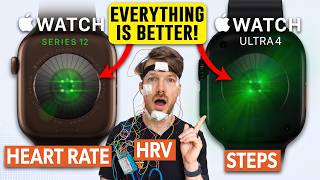

Apple Watch's Biggest Health Upgrade Ever?
45sThe claim of a major health tracking upgrade in Apple Watch is highly engaging and sparks curiosity among tech and fitness enthusiasts.
▶ Play Clip"Title promises a breakdown of Apple Watch health upgrades, and the video delivers detailed technical insights, though some sections are padded with personal commentary."
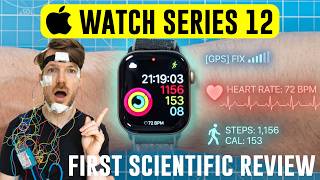
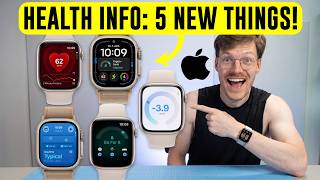
The video covers the major health tracking upgrades in the new Apple Watch Series 12 and Ultra 4, focusing on a redesigned heart rate sensor, more frequent data collection, improved step counting, and new features like Readiness score and Health Age. The presenter, a postdoctoral scientist, plans to objectively test these claims.
Both Apple Watch Series 12 and Ultra 4 feature a redesigned optical and electrical heart rate sensor powered by the new F11 chip, aiming for better heart rate tracking during exercise and daily wear.
The optical sensor uses repositioned photodiodes and larger, more power-efficient green LEDs for better signal detection. The electrical sensor is redesigned to improve ECG measurements.
Apple changed hardware and firmware to collect heart rate and HRV data much more frequently. Previously, background measurements occurred roughly every 5 minutes; now they are every 5 seconds, extending the foreground workout frequency to passive monitoring.
Historically, Apple prioritized accuracy over availability, withholding noisy measurements. The presenter notes that during weightlifting, the watch sometimes stopped detecting heart rate due to wrist tension, but prefers this over wrong readings.
A new machine learning algorithm improves all-day step counting and distance estimates. Apple claims it's the most accurate step counting of any smartwatch based on a 1000-step test, but the presenter wants to test for false positives (e.g., steps while driving).
HRV can now be measured as often as every 5 minutes, up to 24 times more frequently. HRV gets a dedicated section in the Heart Rate app, included in overnight vitals, and is split into Recovery HRV and Overall HRV.
Readiness combines activity, training load, vitals, and sleep score into a 0-10 score with four recommendations: recover, pace yourself, ready, or go for it. It updates throughout the day and allows users to inspect contributing factors.
A new Insights tab will create summaries using heart, sleep, readiness, fitness, vital, and cycle tracking. A For You section offers personalized recommendations, and a Longevity tab includes a Health Age metric.
Health Age compares measured health (VO2 max, resting heart rate, sleep, HRV) with chronological age. At-home movement evaluations use the iPhone camera to assess flexibility, strength, balance, and cardio fitness, with on-device processing.
In the US, users can purchase a laboratory panel through the Health app for $119 via Quest, including over 50 biomarkers at nearly 2,000 locations.
Series 12 retains 24 hours of normal use, with outdoor workout battery life increased to 10 hours. Ultra 4 offers up to 50 hours normal use and up to 84 hours in low power mode, with extended workout modes up to 45 hours.
New features include sound recognition, Live Rewind (text of previous 15 seconds), Siri Recap, and Shazam integration. Audio is processed on-device in a secure enclave and deleted, with summaries end-to-end encrypted.
Apple has improved the sensing platform and increased sampling frequency. The presenter will test accuracy during difficult workouts, reliability of increased sampling, and the usefulness of Readiness and Health Age using reference devices.
The Apple Watch Series 12 and Ultra 4 bring significant health tracking upgrades, particularly in sampling frequency and new metrics like Readiness and Health Age. However, the presenter emphasizes that these claims need objective testing, which he plans to conduct.
Sampling frequency increase
Extending 5-second heart rate sampling to passive monitoring is a major technical shift that could significantly improve data quality for health insights.
01:35Step counting accuracy claim
Apple claims the most accurate step counting of any smartwatch, a bold assertion that needs independent verification.
03:36Readiness score transparency
Allowing users to inspect factors driving the Readiness score is a step toward more explainable health metrics.
05:25Health Age as a motivational tool
Biological age metrics can motivate users to improve health behaviors, as the presenter personally uses Whoop Age.
07:18Need for objective testing
The presenter's commitment to testing claims with reference devices underscores the importance of independent validation in health tech.
11:31[00:00] The biggest update in the new Apple Watches is also the biggest upgrade to any Apple Watch in a long time when it comes to health tracking. So the new Apple Watch Series 12 and Apple Watch Ultra 4 have a new health sensing system.
[00:13] Now both watches contain a redesigned optical and electrical heart rate sensor powered by the new F11 chip. All these upgrades should lead to a better heart rate tracking during exercise,
[00:25] also better heart rate tracking during the day at a much higher frequency, and also better step counting and better heart rate variability. By the way, for those of you that are new to the channel, my name is Rob and I'm a postdoctoral scientist specializing in biological data analysis,
[00:39] which is why this release is so cool. Now, according to Apple, the optical heart rate sensor, so the thing that measures your heart rate, uses repositioned photodiodes, so the things that measure the incoming signal, and larger, more power-efficient green LEDs,
[00:53] so basically brighter green lights and better sensors to detect the reflections of that light, which should improve heart rate even more. Now, the electrical sensor also has been redesigned to improve ECG measurements,
[01:05] and the Series 12 starts at $309 in the United States, while the Ultra 4 starts at $799. Now, heart rate on the Apple Watch was always one of the strong points, one of the best, if not the best, on the wrist heart rate measurements.
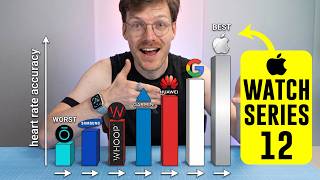
[01:20] And now they say they are the best, or based on the new study that they did with the new sensor, and I'll actually make a separate video about that. However, what I think is potentially even more important is that Apple has changed the hardware and firmware in such a way
[01:35] that they can now collect heart rate and heart rate variability data at a much higher frequency. Now, to understand why that might be an even bigger improvement, we first need to look at how previous Apple Watches measured heart rate.
[01:48] Now, during a user-initiated measurement, as they call it, basically opening the heart rate app or starting a workout, The foreground algorithm used the green PPG signals together with the accelerometer data
[02:00] and then measured one heart rate value roughly once every five seconds. And background measurements, so during the day, during normal daily wear, were much less frequent with low-powered infrared light,
[02:13] and they looked for measurements when the user was relatively still, and the sensor could provide roughly one heart rate value every five minutes. That now is reduced to every 5 seconds with the new Apple Watch Series 12 and Ultra 4.
[02:25] So it does seem that the approximate 5 second frequency that was previously associated with the foreground exercise measurements is now being extended to also passive background monitoring. And this was a complaint of some people that I know.
[02:38] Because this is especially important when you're active but you for instance forgot to start your exercise. Now you should also get better data for that. Now historically Apple prioritized accuracy over availability. That basically means that the watch may withhold a value or remove a value when the signal is too noisy, rather than give you a potentially incorrect number.
[02:59] In my testing, Apple watches have generally been among the better smartwatches for heart rate tracking, but they were obviously not perfect. Difficult exercises so rapid changes in intensity or wrist tension could impact the heart rate sensing and especially during weight lifting for instance it missed some of the peaks in my heart rate so it didn detect the wrong heart rate but it just
[03:21] stopped detecting for a while because of that increased tension risk. Now I do prefer this over wrong measurements but I would be really curious to see if the series 12 and ultra 4 agree even better with an ECG reference and also if it keeps reporting the measurements even during the most
[03:36] difficult sections of a workout. And again, especially during weightlifting, it would be super interesting. But in addition to better heart rate tracking, there's now also a new step counting system on the Apple Watch Series 12 and Ultra 4. Apple says that a new machine
[03:51] learning algorithm improves all-day step counting as well as distance estimates during indoor walking and running workouts. Based on Apple's comparison with other leading smartwatches, using a 1000
[04:03] step test validated by video counting, the company claims this is now the most accurate step counting of any smartwatch. That's of course a very strong claim, so it will be interesting to see how it performs in my testing, also to see if there's now
[04:16] false positive steps, so if you get steps for instance when you're driving or when you're riding a bike. Now in addition to steps and heart rate, there's also a heart rate variability or HRV update. Apple says that the Ultra 4 and Series 12
[04:29] can measure HRV as often as every 5 minutes and up to 24 times more frequently than before. HRV is also becoming much more visible in Apple's software, so it's getting a dedicated section in the Heart Rate app.
[04:43] It's included in your overnight vitals as well. And there's a new daytime vitals view. Apple is additionally separating HRV into two parts. Recovery HRV is intended to help identify daily signals,
[04:56] for instance associated with stress and recovery, while on the other hand, overall HRV is intended to provide a broader context around general and cardiovascular health. Apple says that overnight recovery HRV will be compared to the user's personal baseline,
[05:12] while daytime view may identify changes before they become apparent overnight. Apple has traditionally reported HRV primarily as an FD and N value, whereas most people use another metric called RMSFB.
[05:25] I couldn't find anywhere which one of these two Apple users are to use something else completely. Now, the additional heart rate and HRV data feed directly into Apple's new Readiness feature.
[05:37] Now, Readiness combines recent activity, training load, vitals, and sleep score to produce a score from 0 to 10, and then assigns one of four recommendations, recover, pace yourself, ready, or go for it.
[05:51] So that's really sort of a readiness score, as you also know it from Aura or Whoop. A lot of these companies have these kind of scores. Now, Apple's score can update throughout the day, so it's not just in the morning. And a more demanding workout or a change in daytime vitals may therefore alter the results after the initial morning calculation.
[06:08] So it's not just a single score, but sort of a dynamic score that changes over time. Also, according to Apple, users can inspect the factors that drive the score. rather than receiving only a single unexplained number.
[06:21] So I would be really curious to see what actually makes up this score and how sort of linear that contribution is so maybe you can even influence it directly Now again conceptually this is similar to the readiness or recovery scores offered by companies such as Aura Garmin Whoop and Fitbit Now I
[06:36] Now I reached my activity goal during my recording. I guess I'm moving a lot. Apple is actually also redesigning the health app, I think, later this year, and the new Insights tab will create summaries that update throughout the day
[06:51] using heart, sleep, readiness, fitness, vital, and cycle tracking information. And then a For You section can present personalized recommendations and educational material. For instance, it might suggest a wind-down routine after several late nights.
[07:06] And finally, there's also a new Longevity tab that takes a longer-term view across heart health, sleep, mental well-being, movement, metabolic health, hearing, and nutrition.
[07:18] Its most prominent new metric is called health age, so something like a biological age, which in the end compares parts of your measured health with your chronological age. So is your body in a way younger or older than your actual age?
[07:33] A lot of companies have this now. For instance, there's Whoop Age, and Apple says that the calculation can include VO2 max, resting heart rate, sleep, and HRV, end users can enrich this analysis with laboratory values such as A1c and LDL cholesterol.
[07:49] What Apple has not yet publicly explained, at least not in detail, is the exact formula and the weighing of each of the variables. So how this in the end is actually calculated and if it matters if you give it also lab measurements or not.
[08:03] Now I actually asked the question to Apple, so once I know more I will of course let you know. But it's good that they make something like this as well because I actually use, for instance, my wolf biological age actively to sort of keep myself fit.
[08:15] Now, interestingly, the redesigned health app will also include at-home movement evaluations. You can see some examples here in the screenshot that I took. So using the iPhone camera together with heart rate information from the Apple Watch,
[08:28] these assessments can, for instance, examine flexibility, strength, balance, movement mechanics, and cardio fitness. Apple actually says that the camera-based analysis runs entirely on the device and that
[08:40] the video is not recorded, stored or shared. And there's also a dedicated test right here for a VO2 max estimate, which is really cool. Let's actually see how accurate it is. Apple says that this assessment can be done with an Apple Watch, but also with AirPods
[08:54] Pro 3 or a compatible third-party hard-hide sensor. Finally, they also announced that at least in the United States, a lot of these things are still first rolling out in the US. will be able to purchase a laboratory panel directly through the Health app.
[09:08] And this will cost $119 and go through this Quest service. This includes more than 50 biomarkers, and it should be available, I think, at close to 2,000 Quest diagnostics locations.
[09:20] But of course, you can also import existing lab measurements or do your own. Now, we're almost done, but there's a few important things left, and one is battery life, which is particularly relevant because the watches are collecting heart rate data much more frequently.
[09:32] Apple Watch Series 12 retains a clean 24 hours of normal use battery life, but outdoor workout battery life increases to 10 hours which Apple says is 25 more than previous models 15 minutes of charging can add up to 12 hours of use so that really good And the Apple Watch Ultra 4 receives an even larger improvement
[09:55] with up to 50 hours in normal use and up to 84 hours in low power mode. But what you might want to know about is endurance sports. Now, the Apple Watch Ultra 4 can track an outdoor workout for up to 18 hours in a normal workout mode.
[10:08] extended workout mode increases this to 25 hours so i can get removed some things like your running form and stuff like that but there's still heart rate and gps while max extended mode can track
[10:20] outdoor runs walks and hikes for up to 45 hours now all these longer modes do preserve heart rate and gps including gps readings every second in max extended workout but they do reduce or disable
[10:33] other features and metrics to extend the battery life. Both watches also gain audio intelligence, although some of these features are scheduled to elate later in beta in 2026. Sound recognition can identify selected sounds,
[10:46] such as alarms, sirens, and doorbells. Live Rewind can actually show you a text representation of the previous 15 seconds after you've pressed the digital crown two times. Siri Recap can then create a high-level title and key points from a conversation,
[11:01] and Shazam can automatically surface the text and music in the smart text. Now, Apple says none of these features store your audio recordings and raw audio is processed inside a hardware-isolated secure X-Play and then deleted.
[11:16] But of course, the live rewind text and Siri recap summaries are safe, but they should be end-to-end encrypted. Now, some of these features do require an Apple intelligence-compatible iPhone and will be initially limited to English and not initially available in the European Union.
[11:31] So again, the US gets a lot more. Okay, to summarize, Apple has actually substantially improved or at least changed its existing optical and electrical heart sensing platform, hopefully improving but at least dramatically increasing sampling frequency
[11:46] and building even more interpretation on top of these measurements. So that means heart rate every 5 seconds throughout the day, HRV as often as every 5 minutes, daytime vitals and a continuously updating readiness score.
[12:00] And all of this could make watches much more informative than previous generations. However, the most important claims still require objective testing and that's what I'm here for. I want to know whether the new sensor is more accurate during difficult workouts,
[12:15] whether this increased sampling during the day also gives reliable measurements and whether the new HRV outputs are really good as well and what they're actually based on. Finally, I am really keen to see how the readiness and health age work, and if they change quickly or if they're very stable.
[12:30] These are questions I will try to answer once I can actually test the Apple Watch Series 12 and Apple Watch Ultra 4. I already ordered them, and of course, I'll use all my appropriate reference devices, including EEG chest straps, EEG devices, and manual step counters.
[12:45] Now, don't forget to like and subscribe, of course, and after I finish this video, So I'll immediately make the one where we're going to go over Apple's study where they compared their heart rate tracking performance to other brands. And once that's up you can find that video right here and also check out this video right
[13:01] here.
⚡ Saved you 0h 13m reading this? Transcribe any YouTube video for free — no signup needed.