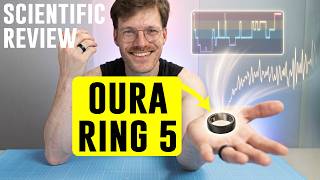

Oura Ring 5: Smaller but Worse?
60sChallenges the main selling point (smaller size) and hints at potential performance compromises, sparking curiosity and debate.
▶ Play Clip"The title promises a scientific test and delivers exactly that, with detailed data and comparisons, though the 'initial' caveat is accurate."
This video presents an initial scientific evaluation of the Oura Ring Generation 5, comparing its performance against reference devices for heart rate, heart rate variability, and sleep stage tracking. The host, a post-doctoral scientist, shares both strengths and limitations, particularly noting its excellent nighttime metrics but subpar exercise tracking.
Oura launched the Ring 5, with the main selling point being its smaller size compared to the previous generation. The smaller form factor required fitting a battery and sensor set into a smaller space, potentially compromising performance.
The Oura Ring 5 was tested against an ECG chest strap during sleep. The heart rate measurements showed excellent agreement, with only 1-2 BPM difference at most, and a high correlation, indicating reliable nighttime heart rate tracking.
HRV measurements, which require precise inter-beat intervals, also showed strong agreement with the reference device. The correlation was very high, with most data points close to the line of perfect agreement, making it reliable for nighttime HRV tracking.
During indoor cycling, the Oura Ring 5 showed only 'okay' agreement with a Polar H10 chest strap, with a correlation of 0.85. It struggled to detect rapid changes in heart rate, such as peaks and dips, and was not recommended as a primary exercise tracker.
Running results were more promising, with a correlation of 0.94. However, there was a notable instance of 'cadence lock' where the ring tracked running frequency instead of heart rate. Despite this, it was considered 'quite okay' for a ring, though better devices exist.
Outdoor cycling was the weakest area, with a correlation of only 0.74. The pressure from handlebars and finger tension likely interfered with the sensor, causing it to miss heart rate peaks and dips. This was a significant limitation.
Using a scoring scheme, the Oura Ring 5 received an overall heart rate score of 84.1, categorized as 'meh'. It was not the worst, but not recommended for exercise tracking, showing no significant improvement over the Ring 4.
Compared to a ZMax EEG headband, the Oura Ring 5 showed excellent deep sleep agreement (94%), and good agreement for light sleep (70%) and REM sleep (70%). This placed it among the top performers for sleep stage tracking.
The Oura Ring 5 received a sleep score of 78, categorized as 'great'. It was very close to the Ring 4 in performance, and both were among the top five brands for sleep tracking, alongside Fitbit, Whoop, Apple Watch, and Eight Sleep.
For existing Oura Ring 4 owners, there is no compelling reason to upgrade unless the smaller size is a priority. The Ring 5's performance is similar, and the main difference is the form factor, which may be a matter of personal preference.
The Oura Ring 5 excels at nighttime metrics like heart rate, HRV, and sleep stage tracking, making it a top-tier sleep tracker. However, its performance during exercise, especially outdoor cycling, is a significant limitation, and it offers little improvement over the Ring 4 for most users.
What is the main selling feature of the Oura Ring 5?
It is smaller than the previous generation.
00:17
How did the Oura Ring 5's nighttime heart rate compare to an ECG chest strap?
It showed excellent agreement, with only 1-2 BPM difference at most.
02:26
What was the correlation for heart rate tracking during indoor cycling?
0.85
06:09
What is 'cadence lock' in the context of heart rate tracking?
When the device tracks the frequency of running instead of the heart rate.
08:15
What was the correlation for heart rate tracking during outdoor cycling?
0.74
09:50
What was the overall heart rate score for the Oura Ring 5 during exercise?
84.1, categorized as 'meh'.
11:15
What was the deep sleep agreement percentage for the Oura Ring 5?
About 94%.
12:42
What was the sleep score for the Oura Ring 5?
78, categorized as 'great'.
15:59
Should existing Oura Ring 4 owners upgrade to the Ring 5?
No, unless they prefer the smaller size, as performance is similar.
16:13
Nighttime Heart Rate Accuracy
Demonstrates the ring's core strength, showing it can match ECG-level accuracy for resting heart rate.
01:28Exercise Tracking Limitations
Reveals a critical weakness for a wearable, showing it struggles with dynamic heart rate changes during exercise.
04:29Top-Tier Sleep Stage Tracking
Positions the Oura Ring 5 among the best sleep trackers, validating its primary use case.
11:45Upgrade Advice
Provides practical guidance for consumers, preventing unnecessary spending on a marginal upgrade.
16:13[00:01] wearable market. We just saw the Fitbit Air launch, which is competition for the smart rings coming out, which are competition for the Oura ring. So, to my surprise, Oura launched the Oura ring 5, which main selling feature is that it's
[00:17] smaller than before. But, is that enough to sell it, and has this actually compromised its performance? Because they have to fit a battery and the sensor set in a smaller form factor, which is actually led to a smaller
[00:30] sensor set inside the new Oura ring 5 honestly, I don't care that much that it's smaller. I actually like the larger size of the Oura ring 4. So, today we'll do an initial scientific test of the
[00:44] Oura ring generation 5 to find out what things it's good at, but also its limitation. And I have to say there are some things where it's really still not doing well. But, today you'll find out the good and the bad. Now, for those of
[01:00] is Rob, and I'm a post-doctoral scientist specializing in biological data analysis. Now, to be very clear, there are plenty of things I found in my initial test that the Oura ring seems to be really good at. But, there's quite a
[01:14] few things that I think you should know about before getting the Oura ring because it has its limitations. And I think this is mostly a form factor thing, though it does seem to be improving a little bit. So, let's get
[01:28] right to the data. And what I want to do is compare the Oura ring 5 during sleep to different reference devices. And let's start with the heart rate and heart rate variability measurements during the night. So, can something as
[01:43] small as an Oura ring be as reliable as ECG measurements that can directly measure the electrical activity of the heart? Well, I did exactly that for several nights. I wore both an ECG chest strap to bed, and also the Oura Ring 5.
[01:58] Then I extracted all that data and calculated their similarity. So, let's first actually take a look at some example nights. So, we have the time since going to bed along the horizontal axis, and my heart rate along the
[02:10] vertical axis for one night with my heart rate as measured by an ECG chest strap, which I stored using Elite HRV, which is an app, compared to the Oura blue-green, the app and ECG chest strap is in red. And we see a really nice
[02:26] agreement for this night. So, maybe one to two BPM different max, but really nothing major. Now, if we look at the second night, also very good agreement, nothing to complain about. Though there were some nights where I had a bit of a
[02:40] reference, so I'm not sure why there's this difference right here. For this other night, no big complaints, very good agreement. And also here, very good agreement. And we're really looking into a narrow range. So, a heart rate from,
[02:53] let's say, 42 to 49 BPM. So, it's really having to measure really small We can actually calculate a correlation between the heart rate according to the reference and the Oura Ring Gen 5. And
[03:06] this just looks really good. So, nothing to complain about. For perfect agreement, all dots should be along this black line right here, and they're all super close to it. A few were tiny bit lower, so those were those peaks that we
[03:19] Otherwise, I'm just super happy with this. So, heart rate during the night really reliable with the Oura Ring Generation 5. Now, currently I'm testing it on my ring finger, which might not be the optimal finger yet. I actually have
[03:32] a second one on the way that I should be able to wear on my index finger. But for now, this is actually my most comfortable finger, so I tend to wear my Next, let's take a look at heart rate variability, which is harder to measure
[03:45] because you need to exactly measure the distances between individual heartbeats. good agreement right here for this night. Also this night, some of the best Here for this night, a little bit more deviation, but still generally good
[04:01] agreement. And also this night right here looks pretty good. There are some details that are different, but again, if we calculate that correlation right here, this looks super good. Almost all points are on or close to the black
[04:14] line, and the best fit, so this blue line also is really close to the black So, if you want to measure your heart rate and heart rate variability during body, the Oura Ring seems to be performing very well. But, of course,
[04:29] to measure more things, both during the night and during the day. So, let's next take a look at heart rate tracking during exercise. So, can this thing actually measure your heart rate during indoor cycling, outdoor cycling, and
[04:44] running, for instance? Cuz normally, you wear either something on your wrist, so a smart watch, maybe on your biceps, or an ECG chest strap, which is the most reliable way. And rings are still relatively new form factors, and
[04:57] traditionally, rings have been very bad in my testing. So, let's see if the Oura Ring 5 can break that spell. Let's start with the easiest exercise normally, which is indoor cycling, so spinning. And here we can see okay agreement
[05:14] between the Oura Ring 5 and the Polar H10 chest strap. Well, okay for the fact that it's a ring. So, we want those points to be as close to the blue line as possible, and in many cases, it was close, but there are a few moments where
[05:29] it seems to be deviating. It seems to have measured a steady heart rate where let's take a look at the individual spinning sessions. So, here we have the looks quite good. A little bit of deviation, but for a ring, this is quite
[05:43] However, here for this spinning session, this is an example of where we have an issue. So, it's good here near the end, but in the beginning it kept detecting steady or increasing heart rates that were too slowly increasing. And also
[05:57] here it didn't fully detect a dip. So, here it's really struggling. And overall, this is an initial test that doesn't put it among the good performers. So, we have the Oura Ring 5 right here, and the better devices here
[06:09] are to the top right. So, the further to the top right, the better the agreement with the reference. We're actually using this, the correlation value, which was 0.85 for the Oura Ring. Compared to the
[06:21] tested in the last year, this just wasn't very good. And it's actually very close to the Oura Ring 4. So, my recent testing of the Oura Ring 4. So, there, doesn't seem to be a significant improvement. Again, I'll be testing it
[06:35] over many more exercises and many more nights to give you a more detailed test. But in this initial test, I still wouldn't recommend it as your main heart rate tracker during exercise. But let's actually take a look at the
[06:49] results for running. And these are actually promising. But before looking at those results, I quickly want to ask for your support. to my full-time job as a scientist, which is neither easy or cheap. I pay my
[07:02] editor Alex, for instance. I buy a bunch of different camera gear, and I buy many of these devices myself. I've actually ordered two Oura Rings now, and Oura So, I actually have a third ring now that I'll test on an independent person
[07:17] the Oura Ring actually is as a tracker also on a second individual. Now, if you doing that. The easiest way is just using my general Amazon affiliate link before making any purchase. So, if you do that, I get a small kickback each
[07:32] even if you buy something as small as toilet paper or coffee beans. I also have specific Amazon affiliate links, and And other links to, for instance, link to the Oura Ring. But as you see,
[07:46] all the bad things with the Oura Ring. And I actually think you can now get a 10% discount link with the Oura Ring, so I'd recommend that over using my link. discount some other way. Thank you so much for considering, but let's get back
[08:01] the heart rate tracking during running. Again, the reference along the horizontal axis, the Oura Ring 5 along the vertical axis. And those points are now quite close to the blue line. There's just one moment right here of a
[08:15] cloud of deviating points. And I think here what might have been happening is that there's cadence lock, meaning the Oura Ring tracked my frequency of running and not my frequency of the heart rate. But let's take a look. The
[08:27] correlation for ring is quite decent at 0.94. individual runs. This first run, it did a good job. It was quite close to my actual heart rate. So again, the Oura Ring 5 in red and the reference in blue
[08:40] But for this run here, we see the moment of cadence lock where in the beginning it likely tracked the frequency of my running, then it bent back to the real heart rate. So overall, not the worst I've seen on Oura Ring, quite good. And
[08:54] And if we then compare to the competition with a correlation of 0.95 in that initial test, it's quite okay for a ring. It's quite okay.
[09:06] though, there are still plenty of better devices out there. And this is only based on three runs, so a very initial test. But compared to my initial testing of the Oura Ring 4, it does seem to be potentially better. But more testing is
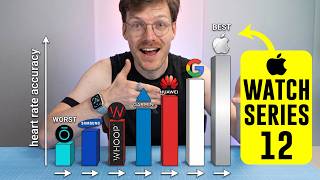
[09:22] needed. Again, if you want some of the best heart rate tracking out there, at least on me, we have, for instance, Apple Watch is right here, but also the Amazfit Helios strap and even, for instance, the Fitbit Air, a device I'm
[09:35] now testing in much more detail. So, for running, I'm not disappointed, rate tracker just because of those cadence look issues that we seem to see. And now, let's take a look at the results for cycling outside. And this is
[09:50] where we really see it starts to struggle. It has a correlation of only 0.74, and there's many points both below and above the blue line. And what I expect is happening here is
[10:03] that I'm holding on to the handlebars that this tension on my finger and also the pressure of the handlebars on my finger and the ring will influence the much harder for it to track my heart rate accurately. I always try to twist
[10:17] correct position, but I just expected the form factor of a ring is not ideal if you look at the individual cycling session. So, we really see some variations in my heart rate as I need to brake and can go again. And here, the
[10:32] Oura Ring wasn't able to detect that. This session was a bit better, but it still missed most of the peaks in my heart rate. Same here. It sort of gets the median heart rate overall, but it doesn't track the peaks and the dips.
[10:46] And this is just what we generally see for all the bike rides that I tried it. So, for biking outside, again, the Oura Ring generation five is very close to the Oura Ring generation four. So, it definitely appears not to have gotten
[10:59] worse, maybe even a tiny bit better, but just not good enough as my main heart rate tracker during exercise. During the night, it appears to be great. Some of heart rate measurements I've seen. Just for exercise, I don't really trust it.
[11:15] And we can actually use my new scoring scheme to give it a score for heart rate tracking during exercise. So, the overall heart rate score is 84.1, which means it falls into the category of meh. It's not the worst I've ever
[11:31] seen, but not really recommended at this point. So, that's the heart rate tracking during exercise. Now, this is not the main purpose of this device, and variability measurements during the night were great. Now, I don't have a
[11:45] scoring system for that yet. That's to come still, just because I cannot test it for every device, but I promise that's coming in the future. But, next else many of you will care about, the sleep stage tracking. Now, here I had an
[11:59] issue with my reference device. The battery started swelling on one of them, break off, so I have a limited set of data, but I got two good nights of data with the reference device, which is the ZMax EEG headband, that can actually
[12:13] specifically designed for sleep stage tracking. And we'll compare that to the sleep stages as tracked by the Oura Ring. And we have those results right here, with the reference device on top and the Oura Ring 5 on the left right
[12:28] here. Where I want all the values on the diagonal right here in yellow to be as close to 100% as possible. Now, first of all, for deep sleep agreement, that's all, for deep sleep agreement, that's actually very good. About 94%
[12:42] of what was deep sleep according to the reference was also detected as deep agreement is a little bit worse at about 70%, still very good compared to the competition, but not the great, I would say. And REM sleep agreement is about
[12:57] the same, at about 70%. Also, overall very good compared to the competition, potentially. We can actually look at some individual nights, so here we have one night with the reference on top and the Oura Ring 5 on the bottom. So, first
[13:14] I marked the deep sleep as detected by the reference here in blue purple, and the Oura Ring. Just a little bit of extra deep sleep was detected, and for REM sleep we mostly see the same thing. Quite good agreement, almost the same
[13:28] segments were detected. Maybe near the end here, tiny bit of difference. Otherwise, very good. Just the exact duration might be a bit longer here according to the ordering, and sometimes a tiny bit is missed. Overall, actually
[13:41] very good. And again, we can compare this to the competition. So, we use the average sensitivity over those individual sleep stages, so deep sleep, light sleep, REM sleep here along the horizontal axis. And the worst out of
[13:53] those three along the vertical axis. So, the worst was 70% roughly. And the the worst was 70% roughly. And the average should be 70 + 70 + 93 or 94 / 3, which means that the Oura Ring Generation 5 ends up here. Which means
[14:10] performers. It's actually very close to the Generation 4. And given the limited amount of nights I was able to test it, I cannot say which one is better or worse. But we can see that both Oura Rings are amongst the top performers
[14:25] right here. So, with all that data in there, I would say the top five brands at the moment are still, well, the Oura Ring, so a really good performer, both the Oura Ring Generation 4 and Generation 5. The Google and Fitbit
[14:38] with, for instance, the Fitbit Air, but also the Pixel Watch. We have the Whoop then there's of course the Apple Watch, a really good sleep stage tracker, at least on me. And finally, the Eight Sleep Pod, my favorite sleep improvement
[14:50] device. That's another way you can support if you are planning on buying said, my favorite sleep improvement device. I also have the best discount out. Now, this is super expensive, so only buy it if you can really afford it.
[15:04] something that goes around your mattress and can cool and heat each side of your bed independently. Also, the blanket is cooled and heated. So, I don't use it mainly for the sleep stage tracking. I use it especially now in summer because
[15:18] I suffer in the heat, and it allows me to cool down my side of the bed to a comfortable temperature. And when I have a partner, she can set her temperature sleep much cooler than most people out there. Again, if you want to try it out,
[15:31] gives you the best discount possible and support the channel. But the Oura Ring 5 is also doing a really good job in terms of sleep stage tracking. And I would be really curious for my long-term testing to see if that remains. But I don't
[15:45] and I'm hopeful it might even be a little bit better than the previous generation Oura Ring. So I don't expect major improvements. Now, before I forget, of course, we also have a sleep score for the Oura Ring, which is the
[15:59] average value of the different sensitivities, which means the Oura Ring gets a score of 78, which falls into the category of great sleep stage tracking. So based on this initial test, the Oura Ring is really a
[16:13] great sleep stage tracker and amongst the top performers. My feeling is so far, if you already own the Oura Ring 4 and you're happy with it, there is no real reason yet to upgrade. The Oura Ring 4 also had really good heart rate
[16:26] and heart rate variability tracking during the night. It also wasn't that great at tracking your heart rate during exercise. And in addition, the sleep stage tracking doesn't appear to be majorly changed. So the main reason I
[16:38] can see you could potentially upgrade is if you find the Oura Ring 5 too big. So if you put them side by side, let me get this out of the way. We can actually see this out of the way. We can actually see the Oura Ring 5 and 4 side by side. And
[16:51] yes, the 5 is a lot smaller than the 4. So these are both size eight rings and you can really see a major difference between the two. However, for me as a man, I don't mind this larger size. I actually like this size maybe even more
[17:06] than the smaller size. It really depends on your personal preference. I also don't notice it in terms of wearing comfort. For me, both sizes work well. smaller one is a little bit more comfortable, but I think you will get
[17:20] used to it over time regardless. So, if you're new to Oura, then the Oura Ring 5 is a great choice if you care about night time metrics. If you're not new to Oura, I don't know if I would upgrade. I think the old one was already
[17:34] perfectly fine, but of course, I'll do more detailed testing over the next few weeks and give my full review with all the metrics, but with much more data behind it. So, if you want to see that, don't forget to subscribe to the
[17:47] channel. That really helps. I'm trying to get to 400,000 subscribers and your help would be greatly appreciated. Now, as I said, if you do decide to get an Oura Ring and you cannot find a 10% discount code somewhere, using my
[17:59] again, search for those discount codes and use those instead. Or if you want to get yourself a Whoop Strap, a Fitbit Air, an Eight Sleep Pod, another device, or anything at all on Amazon for that matter, even something as small as
[18:14] to support the channel, there's a bunch the easiest way of supporting. Now, given that you watched this video on the Oura Ring, I think you will like this video on the Fitbit Air and this video
[18:29] on the Eight Sleep Pod. >> [music]
⚡ Saved you 0h 18m reading this? Transcribe any YouTube video for free — no signup needed.