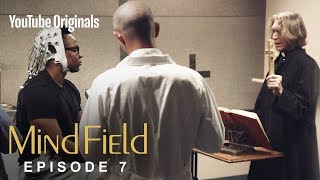

Humans Love Lies - Belief vs Truth
45sOpens with a provocative statement about human nature and the psychology of belief, grabbing attention immediately.
▶ Play Clip"The title accurately reflects the video's core exploration of behavior and belief through experiments."
This video explores how humans form superstitious beliefs and the power of suggestion. Through a replication of B.F. Skinner's superstitious pigeon experiment and a staged reverse exorcism, the host demonstrates that people readily invent rituals and experience altered states when confronted with uncertainty and suggestive cues.
B.F. Skinner's experiment showed that pigeons develop superstitious behaviors (like hopping or spinning) when food is delivered at regular intervals, because they believe their actions caused the reward.
Participants in a fake game show developed superstitious rituals (e.g., pressing buttons, dancing) when money was dispensed at random intervals, believing their actions controlled the reward.
When the reward stopped aligning with the ritual, participants abandoned their superstitions, demonstrating Skinner's concept of 'extinction'.
Unlike pigeons, humans enter with preexisting beliefs, leading to varied superstitions (e.g., performing for cameras, avoiding buttons).
The host proposes that if a lie is believed enough, it can produce real effects, like a placebo, leading to a reverse exorcism experiment.
Using props from religion and science, the team creates a ritual to induce a spirit possession experience, leveraging suggestion and expectation.
Subjects reported feelings of presence, joy, and even seeing deceased relatives, despite the ritual being entirely fabricated.
The psychologist notes that while priests believe they facilitate divine communication, the mechanisms are psychological; the results can be the same.
Humans create beliefs to avoid uncertainty and gain a sense of control, even when those beliefs are disconnected from reality.
The video concludes that humans are belief-making machines, prone to superstition and suggestion, but this does not make us fools—it highlights our adaptive nature.
What did B.F. Skinner's experiment with pigeons demonstrate?
Pigeons develop superstitious behaviors (e.g., hopping, spinning) when food is delivered at regular intervals, believing their actions caused the reward.
02:20
What is 'extinction' in Skinner's terms?
When the reward stops aligning with the ritual, the superstitious behavior ceases.
06:30
How did participants in Victory Vault develop superstitions?
They performed rituals like pressing buttons or dancing, believing these actions caused money to dispense at random intervals.
04:21
What was the purpose of the reverse exorcism experiment?
To see if a fabricated ritual could induce a spirit possession experience through suggestion and expectation.
15:51
What did participants report during the reverse exorcism?
Feelings of presence, joy, seeing deceased relatives, and other spiritual experiences.
23:27
According to the video, why do humans form beliefs?
To avoid uncertainty and gain a sense of control over their lives.
26:58
Skinner's Superstitious Pigeons
Classic experiment demonstrating how animals (and humans) form superstitious beliefs.
02:20Placebo Effect and Belief
Introduces the idea that lies can produce real effects if believed.
13:56Brains as Belief-Making Machines
Core insight that humans create beliefs to cope with uncertainty.
26:58[00:03] Just kidding. My name is actually Michael. that was a lie. Humans love lies.
[00:18] we love things that aren't entirely true-- Completely proving something can be difficult, So instead, we have the faith of the believer,
[00:33] What we think we know, we really only believe we know. a kind of lie we tell ourselves.
[00:47] And I'm going to use belief to turn a lie...into a truth. ( theme music playing )
[01:09] I need to find a good way to study belief and behavior. So I'm paying a visit to UCLA's Dr. Aaron Blaisdell, "Greater Good" Trolley Problem episode.
[01:23] Dr. Blaisdell, great to see you again. Thank you for your help last season, I started thinking a lot about belief
[01:36] Specifically beliefs about what causes our behavior. and just look at how people respond to the environment around them Well, a Skinner Box is a great place to start.
[01:51] a Skinner Box, for a psychologist like myself, Dr. Skinner, what are you doing with this pigeon? I'm getting ready to demonstrate a fundamental principle of behavior.
[02:05] a Skinner Box is a chamber in which animals In one of his landmark experiments, at regular intervals.
[02:20] that whatever they happened to be doing actually caused the food to appear, for example, hopping around or spinning in circles.
[02:34] Skinner called this "superstitious behavior." So what do you want to do-- what's your dream test? Basically a replication of Skinner's superstitious experiment,
[02:46] I would love to see: will people develop their own sort of superstitious rituals or beliefs. I don't think such a rigorous test of this has been done.
[03:01] I think primarily, from the literature I know, it's pretty much pigeons. regularly deliver a reward to a pigeon,
[03:14] the pigeon won't figure that out. Instead, the pigeon will develop superstitious behaviors despite the lack of any evidence that it is.
[03:27] Watching people form new superstitions You can't just put a person in a Skinner Box. along with Dr. Aaron Blaisdell,
[03:41] Welcome to Victory Vault. Michael: "Victory Vault" is a fake game show we made up
[03:54] into taking part in a human Skinner Box. and constructed what appeared to be a game show set, We outfitted the room with a checkboard floor,
[04:08] multiple cameras and a live microphone, all of which have absolutely no connection to winning the game. We also included an ATM slot on the wall where, instead of food,
[04:21] at regular intervals. of the executive producer of this new game show Our first subject is Rebecca.
[04:34] Excellent, excellent. One, you will get to keep all of the money that you get today. The object of the game is to collect as much money as possible.
[04:48] - OK. ( laughs ) - Now, you will have ten minutes, - Go. OK? - OK. - Rebecca: OK. - Michael (over loudspeaker): All right, Rebecca, begin
[05:04] in three, two, one, go! she's definitely looking around there. if there's, like, a puzzle, or what this is about.
[05:19] No, not supposed to get out. OK. Rebecca: I've earned one dollar. ( laughs )
[05:32] I mean, she thinks she caused it to happen. - with this door, maybe? - Uh-huh. came out really shortly after she manipulated the door.
[05:48] She accidentally just happened to be doing something, Look, it reinforced that behavior, look how strong it's become. and this dancing, just like one of Skinner's pigeons.
[06:03] Rebecca believed a specific combination She had created a superstitious ritual. But when her old ritual ceased to line up with the reward being delivered,
[06:17] Would you like to keep sending money? Michael: This change in Rebecca's behavior indicates that she stopped believing that pressing the button
[06:30] Skinner called this "extinction." Michael: Not it seems she believes - Five, four, three, - ( Rebecca yelps )
[06:43] - zero, stop. - And... OK. Michael: Rebecca! You got some money, huh?
[06:55] So, first of all, how'd it go? I wasn't able to fully figure it out, Something to do with the red button as well, like a pattern, maybe?
[07:11] Oh! Maybe I should have tried clicking on the button 20 times. Yes. It's probably something really crazy. - It has nothing to do with what you do. - Ohh!
[07:25] - ( laughing ) - Yeah. based on some work done by B.F. Skinner, and we are looking at the kinds of behaviors people invent
[07:40] - But I think this was fascinating. - Blaisdell: Yeah. - Rebecca, thank you for your help today. - Cool. Thank you, guys. that she thought performing for the camera
[07:54] Her beliefs about TV shows informed But will other people develop the same superstitions? The object of Victory Vault
[08:08] Oh, OK. Well, let me take these accessories off there really quickly. I don't get to ask questions? Michael: See you in ten minutes.
[08:23] Where's the cash? It's like an escape room. Blaisdell: Some people really wanted instructions. Michael: Yeah.
[08:37] Michael: Like Rebecca, all of our subjects That button is so salient. Push the button?
[08:49] ( Michael, Blaisdell laugh ) Oh! OK, I think I get it. Is it push the button? ( rapping ) ♪ If you're gon' push the button, then you're goin' with the button ♪
[09:05] Michael: It was clear that most of the superstitions very quickly, including this guy, was doing absolutely nothing.
[09:19] Michael: Yeah. Will he do something...? Maybe taking the money is...bad?
[09:33] Blaisdell: Is he gonna dance? I hope he doesn't strip for us. I can't dance like that. It's just giving me money at this point.
[09:47] He's not really showing much superstitious behavior. not all the pigeons showed superstitious behaviors. Michael: Obviously there's a game, I called it a game show.
[10:01] Oh, look! He really doesn't want to push it. - Press it four times? - Out comes the money.
[10:18] Press it four times, out comes the money. She believes that pressing the button is necessary, is a cause. And the ritual consists of a few actions strung together.
[10:33] Five, four, three... two...one, stop. Stay where you are. We will see you very soon.
[10:46] Michael: Pigeons don't enter a Skinner Box Humans come in with a rich diversity of expectations. Some think they need to perform for the camera, or make the producers laugh.
[11:01] This guy thought that the secret was to just be different. Take a seat. What made the money come out?
[11:14] It was a test not to push the button, like phrase and "button," it kept coming out. Hit that button. Hit it a lot.
[11:27] I was thinking, "What would people not do?" So I was like, well, let's just stand there and see what happens. - You started doing exercises. - Man: Yeah.
[11:42] for just being-- doing crazy things. That it was dispensing like a dollar every, You're right.
[11:56] You had no control over when the money came out. - if that's because of who you are... - Yep. That's just like my thought process, I think,
[12:09] entering-and-exiting-the-room thing. Because the money didn't start coming out and nothing came out until after I left and came back in.
[12:23] You made a sistah work hard for her money. a.k.a. human Skinner Box experiment. We're really finding that humans are susceptible
[12:38] You know what? I totally agree. with some degree of confidence that they didn't have control.
[12:50] Some people were probably just skeptical from the get-go. Yeah, the beliefs that people brought into that room - ...they created in the room once the game started. - Yeah .
[13:06] And there's even a belief that in psychology and in anthropology that may be the way a lot of rituals got started, by accidental reinforcement.
[13:19] And then it becomes codified into a religion or a cultural practice. ♪
[13:31] showed that when confronted with uncertainty, under the belief that they do have control.
[13:43] would make the money come out any faster. So those superstitions were lies. But sometimes if a lie is believed in enough,
[13:56] like a placebo. and they gave me an idea. If I'm able to find just the right preexisting beliefs
[14:10] could I literally make people believe I want to perform a sham reverse exorcism.
[14:22] Exorcisms are not some Hollywood fabrication... In fact, in the United States alone, endorsed by the Vatican's International Association of Exorcists,
[14:39] But what's a reverse exorcism? where instead of removing a spirit from someone, I want to do that because I don't think it's ethical
[14:53] But I'll need some help, and I know just who to ask. I had a blast last season.
[15:08] related to our power-of-suggestion work together on placebos Well, Michael, it's a real pleasure. It also is why you're the person I thought of
[15:23] Building on the work we did last season, and what I can and cannot control. I want to perform an accessory- assisted reverse exorcism.
[15:38] because I'm not gonna tell you that you have a demon in you What I can do is make you feel like you're losing control.
[15:51] a spirit possession experience. All right, let's talk details here. Are there things we can do to increase the effectiveness
[16:04] of our reverse exorcism ritual? Yeah. I'm thinking we could probably use some tricks from hypnosis. we need to suggest those experiences to them specifically.
[16:17] We would be using a lot of props from both religion and science and then we will throw in some suggestions. and we've got the paraphernalia of medical science.
[16:33] Michael: Almost everyone feels a certain way and, even though not everyone observes the same religion. belief in a religious symbol
[16:47] Consciously, they may say it doesn't, but unconsciously, it will. mock up our lab with plenty of scientific
[17:01] and religious iconography. ♪ everything is in place for our reverse exorcism.
[17:16] pre-screened and vetted by a psychologist, in a broad study on the science of religion.
[17:28] that would convince them of the seriousness such as filling out extensive paperwork. Michael: And an extended period of time in the waiting room
[17:42] We even used a fake participant in earshot of the real subjects. - Yeah? - That was something else.
[17:58] we used multiple actors, like a fake receptionist, and a pretend priest to add credibility fascinated by the power of the ritual.
[18:14] if a guy in a white lab coat is taking it so seriously? Now, I'm watching hidden cameras that we have
[18:26] Let's see what sorts of altered states of consciousness we can create today. Now, this is Jeremiah, and Jeremiah's been waiting for about an hour. It's called an EEG cap, it just measures
[18:43] This is a really important part of selling Jeremiah, very pleased to meet you. Thank you so much again for your patience.
[18:57] how what's about to happen is special, In fact, it's not a ritual that any lay people really know about yet. so we're looking at neural correlates and physiologic markers
[19:11] I have run this experiment about 30 times, some kind of encounter with - Jeremiah: How's it goin'? - Michael: Here comes the priest.
[19:25] "Father Callahan," the Stephen King character. Actor/Priest: Jeremiah, what I'd like you to do... is relax, and I'd like you just to casually stare
[19:40] Michael: We had our "priest" guide Jeremiah which we told him was a thousand years old. just before the demonstration.
[19:55] that you want to let your hands raise Michael: Getting someone to literally act possessed is definitely a difficult test of the placebo effect,
[20:09] However, I'm at least hoping that we learn from this Actor/Priest: Whatever the spirit needs to speak, it will speak.
[20:24] Jeremiah sat very still during the whole ritual, So what did that feel like? but I could feel like the presence,
[20:38] if some, like, cut my head off. Michael: People don't normally have feelings so either we've stumbled upon a way to summon a spirit,
[20:52] or our belief manipulation is working. and I was observing you from the other room. Which one had the biggest kind of visceral effect on you?
[21:06] OK, it's religious, and the nurse comin' in, science-- it kinda goes back and forth, so I want to say "even." Well, more has been going on than what you know at this moment.
[21:20] - Mm-hmm. - He's an actor, We're looking at how a thing that has no known causal link
[21:32] can nonetheless induce a feeling. Michael: Jeremiah's experience was pretty curious, and since nothing too serious happened-- his head didn't spin around--
[21:45] we felt more comfortable pushing things a bit further. this is my colleague Dr. Stevens. before the ritual, to build up their expectation
[21:59] of something happening-- like...possession. So today, you will be listening to a reverse exorcism. - OK. - I'm already possessed. I'm already possessed.
[22:13] to decrease their inhibitions and increase the atmosphere. I mean, it's spooky stuff. I'll simply just invite you to kind of relax...
[22:29] so that he could use to harness the power of suggestion. for the subject to focus on.
[22:42] gradually fade and disappear as your body is now approaching the divine. your fingers tingling a little.
[22:56] You may feel your mouth... needing to tweak a little. Her mouth is opening... slowly. As the divine tries to speak through you,
[23:11] gently, ever so slowly. Good. each of our participants had something very interesting to report.
[23:27] the Father. this everlasting joy and peace of God just covering me. There was like a glowing figure, man,
[23:40] We've got medical science and we've got ancient religious symbols. is how the accessories play into your expectations.
[23:56] - Interesting. - I wasn't connecting with it. ritualistic parts of church, they just never appealed to me. because that's just the way I was raised.
[24:11] Michael: One of the most intriguing was our final subject, Miriam. Um, I went to another place. I immediately felt my mother's-- her spirit with me,
[24:24] - ...to come towards her. - OK. - OK. - Um, and I heard an angel say, And I continued to see wings.
[24:40] Michael: Miriam's experience seemed to have but I wanted to hear more about what exactly happened to her. describe for me what that was.
[24:55] Was it like a daydream, or was it more like, um, really there? Um, I could feel the wind when it started going across, - She looked beautiful. - Wow.
[25:11] and saw her deceased mother, was almost puzzling, because everything we did in the room was a lie. the ritual was not a thousand years old,
[25:25] and those of the other participants were real. The thing that surprised me the most today was how personal every single moment was.
[25:41] I think because of a combination of the powerful imagery, it becomes the most powerful experience they've had. a cross and a lectionary,
[25:54] We seem to have found that by using those cues, and to relinquish their sense of self-control. What's the difference between what we did today
[26:10] and what an actual priest can do? Um, I think the difference is that, unlike the priest, we understand the mechanisms through a more psychological route,
[26:27] that they are facilitating communication with the divine. The results can be the same, There's no way to prove whether or not
[26:44] I guess ultimately, with the tools of science, no, there isn't. These are still some really difficult philosophical questions.
[26:58] our brains are belief-making machines. Rather than accepting confusion and uncertainty, that make us feel like we have control over our lives.
[27:14] or belief or guess about the world around us even when superstitions are unconnected to reality.
[27:26] Our "reverse exorcism" ritual But the mere existence of our subjects' beliefs in them
[27:39] So does that make us all fools? And as always...
[27:51] ♪
⚡ Saved you 0h 28m reading this? Transcribe any YouTube video for free — no signup needed.