
Why Vancouver Never Plays Itself
45sRelatable and surprising fact about movie locations sparks curiosity and shares well on social media.
▶ Play Clip"The title accurately reflects the video's focus on the role of place in Belle and cinema."
This video explores how movies use geography, from substituting locations (like Alberta for Montana) to distorting real places for narrative convenience. It contrasts this with the 2021 film *Belle*, which meticulously grounds its real-world half in specific locations in Kochi, Japan, to emphasize the authenticity of physical space against the virtual world 'U'.
Many films use locations to stand in for other places (e.g., Vancouver often plays itself, Alberta stands in for Montana in westerns). Geography is often distorted for plot convenience.
Most movies create a liminal version of a place—evocative but not accurate. Animated films have even more freedom to create spaces that are 'nowhere' yet feel real.
The film *Belle* contrasts the virtual world 'U' (surreal, chaotic) with the real world set in and around Kochi, Japan. The real locations are extremely specific and accurately depicted.
The protagonist Suzu's daily routes—submersible bridges, trains, schools—are geographically accurate. The film preserves real spatial relationships, down to train interiors and two train styles.
The specifics of place are important to the story: Kamaida is remote, Ino's paper mills survive due to industrialization, Kochi Castle survived WWII because the area was unimportant. These details ground the narrative.
U is a hyper-modern global crossroads, contrasting with Kochi's provincial pace. It represents the internet as a real place where connections are meaningful, not fake.
Suzu's physical space is not treated as doomed; challenges like dwindling class sizes are realities to be dealt with. The film argues that online interactions are as real as physical ones.
The video concludes that the internet is a real place with real people, and *Belle* grounds its story in real locations to emphasize the value of both physical and virtual worlds.
The video argues that *Belle* uses precise real-world geography to contrast the virtual world, emphasizing that both physical and online spaces are real and meaningful. This approach highlights the importance of place in storytelling.
What is the name of the 2021 film directed by Mamoru Hosada that contrasts virtual and real worlds?
Belle
02:25
Which Japanese prefecture serves as the real-world setting for Belle?
Kochi
02:41
What is the name of the virtual world in Belle?
U
02:41
Why did Kochi Castle survive World War II?
The region was considered too unimportant to bomb.
05:49
How does the film Belle treat the virtual world U?
As a real place where connections are meaningful, not fake.
07:42
Belle's Dual Worlds
Introduces the central contrast between the virtual world U and the specific real-world setting of Kochi.
02:25Significance of Place
Explains why the precise geography matters to the story, linking remoteness and history to character experience.
05:19Internet as Real Place
Articulates the film's argument that online interactions are as real as physical ones.
09:26[00:01] Every movie is set somewhere, but that somewhere is often in disagreement with the actual somewhere that the movie is shot. Famously Vancouver never plays itself, but Vancouver is not alone in that plight.
[00:16] Unforgiven, Legends of the Fall, Revenant, Interstellar, Prey, Brokeback Mountain, and almost countless other westerns have used my home province of Alberta to play somewhere else, sometimes somewhere specific, like Montana, Wyoming, or the Dakotas,
[00:30] but just as often simply the general concept of The West, Here I am with the bobsled from the movie. Even when places do play themselves, the geography is typically distorted.
[00:45] New York often gets cast as New York, but characters move around the city at the speed of plot Characters will hop from Wall Street to Astoria to Bushwick to the Upper West Side effortlessly.
[01:00] it actually plays the general concept of New York, And that's for places that actually exist.
[01:12] so settled for the closest substitute in New Zealand. The Marvel movies are mostly shot in a green or blue sound stage in Georgia that animators will later fill with physically impossible spaces.
[01:26] Speaking of animators, while animation is no stranger to drawing on real world locations, animated movies, more than almost any other format, have the freedom to create a space that evokes a somewhere while being set nowhere.
[01:40] The gorgeous landscapes of Princess Mononoke and Spirited Away aren't anywhere in specific, they are simply the idea of Yakushima Island and Dogo Onsen. What should be clear in citing masterpiece movies like Spirited Away is that this is not a criticism.
[01:56] It is in many regards the strength of cinema that space and time can be bent or to evoke a version that feels true to our memories
[02:08] or to create a space that simply cannot otherwise exist. Most movies take place in a liminal representation of somewhere. That's what makes it stand out when a movie does things differently.
[02:25] Belle, a 2021 film directed by Mamoru Hosada, is a film split between two worlds. a visual representation of the internet writ large, full of impossible architecture and magical creatures,
[02:41] and our world, specifically the area around Kochi, Japan. U is phantasmagoric, surrealist and discordant, a chaotic maximalist space unbound by the constraints of gravity or the loadbearing limitations of concrete.
[02:57] To contrast this the other half of the film isn’t just set in the real world, it is set somewhere extremely specific. It takes about 8 hours to get to Kochi from Tokyo by rail,
[03:12] first taking the Shinkansen from Tokyo to Okayama before transferring to the Dosan line which winds through the surreal mountainous interior of Shikoku island before spitting passengers out into the fertile but narrow plains on the southern coast.
[03:26] The centerpiece of Kochi is its 17th century castle, the only one in Japan where the original tower and keep remain intact. On the west edge of the city, about 20 minutes from downtown by train,
[03:38] for its paper mills that were situated along the Niyodo River. A nearly forty minute car ride up river from Ino is a tiny community called Kamaida, nestled into a bowl in the mountains, that is the home of Belle’s protagonist, Suzu.
[03:54] Suzu crosses one of the region's iconic submersible bridges to catch a bus that takes her into Ino, where she transfers to the Dosan line and rides the train into Kochi where she attends school, visits the open air arcade mall, and walks along the Kagami River.
[04:09] a former elementary school that shuttered as attendance dropped, though one angle of the exterior is modeled on the Nozu elementary school a few kilometers down the road.
[04:21] Belle is, obviously, an animated film, unbound in the worlds it creates, a power which is used in full force with the virtual half of the film, which is why it is so significant that the places that Suzu frequents aren’t simply real places,
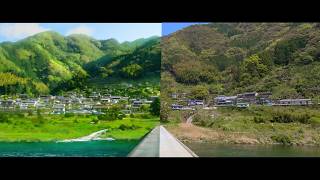
[04:37] are not merely sketched from a photograph of somewhere you can visit, The very real geography that the fictional Suzu needs to deal with every day is preserved.
[04:50] The paths she takes around her world are as accurate as movies ever get. When she rides the train, the interior of the train is accurate enough to capture that there are two different styles of train that run on the track.
[05:04] The film would likely not be criticized at all for simply being evocative of Shikoku, and the advertisements in Kochi and Ino inviting tourists to see the sights from the movie would likely be just as prevalent if the locations on the map were all inspiration
[05:19] While the movie doesn’t drive home the point, the specifics of place are important to the overall story. Kamaida is beautiful, but it is on the outskirts of the outskirts of the outskirts.
[05:37] Ino's historic paper production survives because with industrialization Kochi Castle still stands because during World War II,
[05:49] the region was simply too unimportant for LeMay to burn it to the ground. It is a beautiful city with a truly delightful vintage streetcar system, that has survived because Kochi isn't a place that can afford to rip out perfectly functional streetcars,
[06:06] It's honestly an absolutely phenomenal place. If you're standing on Katsura Beach, you are actually looking out at open ocean, there is just nothing for hundreds and hundreds of kilometers,
[06:20] and you’re right that that sounds like a tourist trap, so these are American style hotdogs adjusted to the palette of Japanese tourists coming down from Osaka,
[06:35] a local hero who became highly influential in the movement and the daily bakery in the JR station sells hat bread, and I mean, come on,
[06:51] who doesn't want a hat bread at the end of a long day of taking the train up to see a 3,000 year old twin cedar named Sugi no Osugi? U, in contrast to Kochi's provincial pace, is immensely important, new, and glossy,
[07:06] a hyper-modern global crossroads of social and political forces. Celebrity is nucleated and grown in U in a way it never could in Kamaida, Ino, or even Kochi, becomes a global pop star under the persona of her freckled avatar Belle.
[07:24] But U is also a vast, undifferentiated metropolis of ideas and noise. a web of semantic connections. They are not unreal, of critical importance is that Belle does not treat it wondrous virtual spaces as fake,
[07:42] contrasting with the no less wondrous, but bounded grounded real place. it embraces the idea that the connections and relationships
[07:58] formed through the membrane of the virtual are as real and potent as any other, U is wholly fictional, an expression of what the internet feels like rather than a depiction of what it is.
[08:13] Suzu's daily life could have been set in a place evocative of the Shikoku interior, in places that exist with an authentic spatial relationship between them.
[08:28] Suzu's physical space is not treated as doomed or abandoned or depressed. the graduating class sizes on the wall of the elementary school are shown dwindling
[08:44] from multiple home rooms to single digit students, but these are treated simply as realities to be dealt with. Challenges, yes, sad in the way loss always is, Part of the movie is ultimately about us and our relationship with the internet
[09:02] and our relationship with one another via the internet. it's about the ways the internet affords us both hazardous amounts of anonymity
[09:14] and it’s about the fact that the internet is kinda actually a real place YouTube is fake,
[09:26] you can’t actually go to YouTube in the way that you can go to the Joker stairs, but it is real in that there are people on the other end of the tube, and those interactions are as potent and meaningful
[09:40] as the ones that happen between people who just happen to be in the same room. Belle argues that the online world isn’t another realm, isn’t an alternate reality, and to drive home the value of this world, chose to ground its story in places that exist,
[09:58] stones you can walk on, [sounds of flowing water and distant bird song]
⚡ Saved you 0h 10m reading this? Transcribe any YouTube video for free — no signup needed.