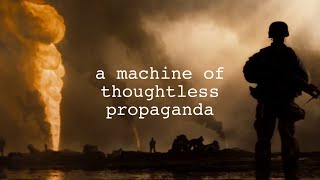

Do You Want Jarhead Sequels?
30sThe iconic, meme-ready line and glitchy delivery make this an instantly shareable hook that sets up the entire video's premise.
▶ Play Clip"Title perfectly matches content: the video thoroughly explains how the Jarhead sequels came to be."
This video analyzes the Jarhead film franchise, contrasting the original 2005 anti-war film with its three direct-to-video sequels. It explores how the sequels invert the original's themes, transforming a critique of military indoctrination into pro-military propaganda. The video also examines the industrial machine behind these sequels, revealing that they are products of a system designed to exploit intellectual property for low-budget, formulaic content.
The Iraq war was an illegitimate conflict rooted in corporate interests and warmongering, making support a mandatory social performance.
The story that producers bought Jarhead rights to 'fix' it is fictional; the sequels were made by Universal's direct-to-video arm to exploit the brand.
Jarhead (2005) depicts the Marine Corps as a cult that indoctrinates and damages soldiers, even without combat, leaving them hollow.
The Standard is a counter-documentary that glorifies military-style endurance events but reveals arbitrary, improvisational methods and cult-like initiation.
Jarhead 2 inverts the original's message, treating hardship as honorable and using generic pro-military tropes, with a budget-conscious production.
Jarhead 3 is a bottle movie set in an embassy, fully embracing military propaganda and reducing the original's themes to superficial elements like voiceover and title cards.
Jarhead 4 is a generic action movie with no coherent message, static characters, and a plot resembling a Call of Duty campaign, set in Bulgaria.
The sequels were produced by Universal 1440 Entertainment, led by Glenn Ross, who focused on low-budget sequels to existing IP for DVD sales at Walmart.
The rise of blockbusters and streaming killed mid-budget films, leading to more low-budget franchise sequels that are formulaic and often propaganda.
AI will calcify this trend, endlessly regurgitating existing content and reinforcing hegemonic structures, producing more thoughtless propaganda.
The Jarhead sequels are not the result of a conspiracy but of a machine that churns out low-budget, formulaic films to exploit brand recognition. This system, now accelerated by AI, will produce increasingly thoughtless propaganda that reinforces dominant ideologies.
What is the central theme of the original Jarhead film?
The Marine Corps is a cult that indoctrinates and damages soldiers, even without combat, leaving them hollow.
03:11
Who produced the Jarhead sequels?
Universal 1440 Entertainment, led by Glenn Ross, produced the sequels.
39:23
What is the 'Known' portion of The Standard documentary?
It is the US Army Physical Fitness Standard Exam: 55 pushups, 65 situps, 5-mile run in 40 minutes, and 12-mile ruck in 3.5 hours.
11:29
How does Jarhead 2 invert the message of the original?
It treats hardship and sacrifice as honorable and worth it, rather than pointless and damaging.
24:10
What is the main strategy behind Universal 1440's film production?
To create low-budget sequels to existing IP for direct-to-video sales, primarily through Walmart.
40:14
What does the video claim about the story that producers bought Jarhead rights to 'fix' it?
It is completely fictional, a folk story recycled from the 80s about Rambo.
36:15
What is the significance of Bulgaria in the Jarhead sequels?
Many of the sequels were shot in Bulgaria due to lower production costs, with back lots that can double for Middle Eastern settings.
38:54
What does the video predict about AI and future movies?
AI will calcify the trend of thoughtless propaganda, endlessly regurgitating existing content and reinforcing hegemonic structures.
43:49
Jarhead's Core Message
Defines the original film's critique of the Marine Corps as a cult, setting up the contrast with the sequels.
03:11The Standard as Counter-Documentary
Reveals how a supposedly rigorous military endurance event is actually arbitrary and cult-like.
08:52The Fictional Origin Story
Debunks the common myth that the sequels were made to 'fix' the original, highlighting the industrial reality.
36:10Death of Mid-Budget Movies
Explains the economic shift that led to the proliferation of low-budget franchise sequels.
41:39AI and Propaganda
Connects the trend to AI, predicting a future of calcified, thoughtless propaganda.
43:49[00:00] Oh my god
[00:02] If you are discussing the ending
[00:06] these scenes and how they inform
[00:11] you aren’t actually discussing the ending
[00:15] This is how you get Jarhead sequels.
[00:17] Do you want Jarhead sequels?
[00:19] [gliching] ‘Cus this is how
[00:25] [High energy stock music]
[00:32] This makes me cringe, it’s embarrassing
[00:39] Hey, that’s kinda messed up, right?
[00:46] Love being a marine. Oorah!
[00:50] The Iraq war was never popular, or rather
[00:56] It was transparently an illegitimate
[01:00] Evangelical Millennialism,
[01:04] The sort of thing that’d never happen today.
[01:06] As an illegitimate conflict the supporters
[01:11] like just really snowflake-y, if you said
[01:16] which made support of it a
[01:19] Everybody remembers Freedom Fries, but let’s take
[01:34] [midi piano music]
[01:42] The anti-woke Ben & Jerry’s, Star
[01:47] $76 for four quarts of flavours like “Iraqi Road”,
[01:51] “Fightin’ Marine Tough Cookies & Cream”, “Navy
[01:57] "Among a dozen randomly selected taste
[02:01] one called the taste ''undistinguished,''
[02:05] ice cream in elementary school,
[02:09] Famously, the band formerly known as The
[02:13] ended as a result of speaking out
[02:17] And that was just two years
[02:20] “I can’t watch. And Neither can you.”
[02:24] Okay, so, there’s these two producers, Philip
[02:28] capital-P producers, they’ve each got a
[02:33] they’ve made a lot of movies, and
[02:37] there in 2005 watching Jarhead,
[02:42] So, like, how it depicts the marine corp, how
[02:47] as a setting to comment on George
[02:52] They get so offended that a couple years later
[02:56] property rights specifically to turn it into an oh
[03:04] Now, before we can talk about
[03:07] ask ourselves a question: What is a ‘Jarhead’?
[03:11] Jarhead is a 2005 film starring Jake
[03:15] written by William Broyles Jr., adapting a 2003
[03:21] Swofford served in the Marine corp as a
[03:25] and his memoir focuses heavily on the
[03:29] the way that the Soldier Mentality
[03:34] and over, and yet the reality
[03:39] Jarhead the movie takes this strand and
[03:44] the movie is that the Marine Corp, the military
[03:49] that war can and will destroy the lives of its
[03:55] It is, in effect, pointing at the way
[03:59] men and trains them to be killers,
[04:03] makes killing a virtue, and goes
[04:08] Like, that’s probably going to do some
[04:12] to bring home with them regardless
[04:17] “You want a brand? You gotta earn it.”
[04:19] Jarhead basically argues that the Marine Corp
[04:24] acute stress, repetition, vocabulary
[04:29] techniques straight out of the
[04:33] “This is my rifle” [In unison] “This is my rifle”
[04:37] In fact not only does it do this, it openly
[04:43] a conscious pressure point, tells recruits
[04:48] and places a tremendous amount of shame
[04:54] Not only that, it is able to do so by
[04:58] culture to instill the submission to that
[05:07] “What the fuck are you even doing here?” “Sir,
[05:14] “A flashlight was a moonbeam. A pen was
[05:20] was a bulkhead. A shirt wa a blouse. A tie was
[05:28] things would never be the same.” “That’s Vietnam
[05:35] Now, this isn’t unique to the US military,
[05:37] it’s almost certainly as old as
[05:41] And there’s a certain logic to it in part:
[05:44] deployment and combat are prolonged
[05:49] one factor a military wants to filter
[05:54] But that logic becomes mythologised. It becomes an
[06:00] warrior defined by purity rituals that ultimately
[06:06] “How the fuck are you going to fire your rifle
[06:11] This process irrevocably damages the characters,
[06:14] and while stories about soldiers who can never
[06:20] Jarhead leaves that completely unvarnished because
[06:27] See, the standard narrative for
[06:31] soldiers who are left changed forever
[06:35] that was paid for something noble
[06:41] “Earn this”
[06:45] That is wholly absent in Jarhead: there is no
[06:51] and the human lives broken by the process
[06:55] and tells himself, that without his rifle
[07:03] “I never shot my rifle”
[07:05] Troy, who is about to be discharged for an
[07:10] identity that the Corps imbues him with that
[07:16] Even if the institution kicks him
[07:21] It’s, in part, their attempt
[07:25] the damage is already done and
[07:29] When the boys return home from Kuwait,
[07:33] congratulate them and commiserate, but
[07:37] he’s a pathetic figure, damaged
[07:40] still clinging to the mythology of
[07:44] no good over a decade after it tossed him
[07:50] It all ends with the affirmation
[07:51] another always belong to the
[07:51] “And he sees that whatever else he might do
[08:00] change his son’s diaper, he
[08:09] But this is in no way a celebration of the
[08:12] esprit de corps of belonging
[08:15] It’s bleak, it’s cynical.
[08:17] The label “jarhead”, a self-deprecating military
[08:23] treated literally. The Marines have hollowed him
[08:29] Jarhead, as it turns out, pretty
[08:33] You could see how someone who really
[08:37] identity might take offense to that,
[08:41] in the myth of it all, especially in
[08:51] [indistinct yelling]
[08:52] Now, this is gonna feel off-topic, but I’ve
[08:56] and now is as good a time as any.
[08:57] I want you to understand that we aren’t making
[09:04] kind of dude, the tactical operator,
[09:10] The Standard is a 2020 documentary
[09:14] by GORUCK Media. You probably haven’t seen
[09:19] It’s a really good example
[09:21] one where the clear intent of the piece, the
[09:26] conveyed by the filmic language, are completely
[09:31] The Standard is ostensibly about the
[09:35] tactical badassery training: US Special Forces.
[09:39] “GORUCK SELECTION is not only the toughest
[09:44] an attempt to bridge the military-civilian
[09:48] combat veterans, this 48-hour challenge is a
[09:54] Assessment and Selection. For the participants,
[09:59] paying tribute to those who serve. For the
[10:03] an opportunity to honor their roots and connect
[10:08] finished the first 18 iterations of the event.
[10:14] So, the frame here is that the US Special Forces
[10:19] to perform to in order to be selected
[10:23] and the GORUCK Selection is an endurance
[10:28] Now, the word “standard” calls to mind something,
[10:34] something measured, something standardized.
[10:40] that special forces need to meet.” It’s right up
[10:46] But then you watch the actual documentary.
[11:10] First off, just to get it out of the
[11:13] The Standard is just an ad for GORUCK, a company
[11:18] a reputation for being extremely durable but
[11:24] The movie is broken into two
[11:29] The Known portion is the first
[11:32] and it’s explicitly the US Army
[11:36] participants must be able to do
[11:40] sixty-five sit ups in two minutes,
[11:44] and complete a 12 mile ruck in three and
[11:48] By the way a “ruck” is just a hike, but you’ve got
[11:54] mostly full of GORUCK slab weights to simulate
[11:59] After this Known portion we move into the Unknown
[12:04] 15 minutes of the movie. The Unknown portion
[12:10] Rancid vibes, but still vibes.
[12:13] It becomes pretty obvious pretty
[12:17] are having the participants do
[12:21] There’s a schedule of sorts, and
[12:24] been planned ahead of time, but that
[12:29] They come up with an activity and then just make
[12:32] everyone do it for an hour
[12:36] There’s no numbers, there’s no goal,
[12:38] and additional goals are added and removed
[12:42] that’s the term for the ex-special-forces
[12:46] whether or not they like you.
[12:48] And they’re actually pretty transparent about
[12:53] “We’re basically saying ‘hey, you’re doing
[12:57] because we’re looking to create
[13:02] that’s the, that’s the methodology.
[13:04] So, the creation of distance, it’s the same
[13:09] why pick on the fast one?”
[13:11] This is what I mean about it
[13:14] they really want you to think that this is some
[13:18] that there’s something quantifiable in all this,
[13:22] but then the truth is they’re just winging it.
[13:24] They’re trying to stress everyone out,
[13:26] but they do so based on convenience and bias,
[13:29] and the amount of abuse you’re subjected to
[13:34] “You still have a place to find comfort because
[13:37] that candidate over there is
[13:39] “This event is about fucking winning. Right now
[13:42] you’re getting special attention
[13:46] They pick on contestants
[13:48] the highest performers get
[13:51] and they make things harder
[13:54] there’s too many people left in the competition.
[13:56] They’re an elite, exclusive event, after all,
[14:02] Eventually it’s accidentally revealed that
[14:06] Jason McCarthy, the event organizer, is a former
[14:12] from 2003 to 2008, and he’s also the founder and
[14:18] happening in his back yard, and they haven’t
[14:25] If I say “military fitness endurance event” you
[14:28] maybe conjure in your mind the image
[14:33] The climbing walls, the ropes, the mud pits,
[14:38] No one’s timing anything, no one’s keeping notes.
[14:41] There’s a whole bit where they just kinda mess
[14:46] Like, they’re not doing log drills,
[14:51] and this is 100% anti-teamwork hyper-isolationist.
[14:57] “we’re looking to create distance
[15:00] So, yeah, this isn’t a log drill,
[15:05] There’s a clip of the winner of
[15:08] this whole sort of ceremony at the finish line,
[15:11] so they’re standing in front of
[15:15] family is behind him with congratulatory signs,
[15:17] but the whole time someone’s standing just
[15:22] because this is just something
[15:25] At one point they just have
[15:27] stones for Jason’s gazebo
[15:31] And the fact that the cadre, you
[15:34] they all seem like dudes
[15:37] but none of them have ever actually
[15:41] and frankly most of them wouldn’t.
[15:44] “I don’t want to show up for this, do
[15:50] Blain saw the POI, he goes
[15:54] There’s kinda two things happening here at
[15:58] what degree this does resemble actual
[16:02] that behaviour and conditioning
[16:06] “Dominate the man in front of you”
[16:08] and second, the cultural mythology
[16:14] Having this reedy dork yell
[16:18] because it gives you a taste of the
[16:23] “I don’t want to show up for this, do you?”
[16:25] Frankly all of the cadre look
[16:28] an absolute nightmare to have any
[16:31] people who have absorbed exactly the
[16:36] “Trample the weak, hurdle the dead, let’s go”
[16:42] And you can easily imagine how someone like
[16:47] I have no proof of this but I have to imagine
[16:52] Jason is probably more of a Jarhead 2 kinda guy.
[16:58] [gunfire]
[17:01] Jarhead 2: Field of Fire is a
[17:04] in 2014. This is where Philip J. Roth
[17:08] These guys have, no joke, over
[17:12] these guys are regularly producing anywhere
[17:18] mostly via Roth’s production
[17:22] While it lifts some aesthetic
[17:24] like a framing voice over, a few parallel lines,
[17:31] it is otherwise different in every way.
[17:34] There are no returning characters
[17:37] Like, as a reminder, Jarhead is
[17:41] and Jake Gyllenhaal was playing
[17:45] There’s none of that here, the only thing that
[17:51] Though from the sheer number of last names
[17:54] to assume this was shot somewhere
[17:58] The movie follows supply marines, who run
[18:03] And there is a really interesting
[18:08] Supply marines have a job that is both
[18:13] Like, early in the movie, the team
[18:16] when they spot some garbage on the road
[18:20] So they stop and phone it in, and are instructed
[18:23] and the team has to sit there for hours,
[18:26] waiting for the experts to
[18:28] The marines are, simultaneously,
[18:33] There is a tension between the mundane and
[18:38] And while having bomb specialists
[18:41] the middle of the desert is arguably
[18:45] there are numerous examples of the
[18:49] suspicion - typically rooted in racism.
[18:51] “We’ve got movement at 12-o’clock!” “Donkey!
[18:58] carrying water to his village!” “I
[19:02] So this could have been a movie about
[19:07] A movie about soldiers who are taught to treat
[19:12] and are then dropped into the middle of it.
[19:14] A movie that confronts Western
[19:18] and explores the ways in which those atrocities
[19:24] …That is not Jarhead 2.
[19:26] The garbage pile has no thematic purpose,
[19:31] standing around waiting is a really
[19:36] Where Jarhead was a simmering character
[19:40] victims of a machine,
[19:42] Jarhead 2 is a troop movie about troops doing
[19:48] driving through a gravel quarry or standing
[19:52] or diffusing bombs in a gravel quarry.
[19:55] It starts with a big ensemble of characters,
[19:57] but most of them are killed off about
[20:00] and the bulk of the movie is the
[20:04] a ripped-from-the-headlines type story of
[20:09] “She’s a keynote speaker at the
[20:13] she’s scheduled to be in New York in 36
[20:17] she’s the president’s guest of honor.”
[20:20] marines are willing to die for her without knowing
[20:27] "You're willing to die for this chick?
[20:33] Anyway, there’s a bunch of gun fights,
[20:36] and a female marine who is in every way shape and
[20:43] “if I weren’t married and you
[20:47] “I don’t care what she looks like as long as
[20:51] “cringe, there’s no other word for it.
[20:55] There are several moments
[20:57] could be straight out of an Asylum production.
[21:00] [Explosion]
[21:02] “my leg’s all the way over there bro”
[21:04] “my leg’s all the way over there man!”
[21:08] [Explosion]
[21:10] [Wilhelm scream]
[21:11] The sequel loses the edge of
[21:14] is both hard to describe but extremely palpable.
[21:17] In the first movie, the character of
[21:22] which he names Ahab the A-rab and objectifies
[21:28] and it’s explicitly said that
[21:32] “The Army may pull this type of shit,
[21:33] but the Marines don’t. When we get back
[21:39] Here in Jarhead 2, a character executes a wounded
[21:42] Taliban fighter in a vengeance killing
[21:46] While it’s not depicted positively, it is treated
[21:54] “Cowboy up, you hear me? Get
[21:58] While the marines in Jarhead 1 are
[22:02] with a bloodlust that drives them mad,
[22:07] on the ground for the opportunity to end
[22:12] to get your standard issue “it’s them
[22:17] “Before yesterday, I never even
[22:24] “They died today, and we
[22:30] Jarhead 2 opens in an identical style for
[22:35] anti-war. The narration asks what the point is
[22:41] “He will go to the desert and fight and die.
[22:46] Why is he fighting? Why is he
[22:55] But at the end of the movie,
[22:56] the narration answers that question with
[23:02] “So what’s the fucking point? I guess the point
[23:10] a way of life. Are we on the right side of
[23:18] Even the first movie’s use of “always
[23:23] gets reframed to mean “mourning the
[23:29] “And the marines who killed and bled
[23:34] Jarhead 2 pays lip service to the
[23:37] but its criticism of the military and the
[23:44] Just banal pet peeves that people bond over
[23:49] that their boss wears really squeaky shoes or is
[23:55] It’s trivial and shallow stuff.
[23:59] “Hot as hell. All this sand. Goat
[24:06] So while Jarhead 2 is not hardline propaganda,
[24:10] it does invert essentially every
[24:13] Its ultimate point is that the hardship
[24:17] is a greater good to be served
[24:21] In other words, it’s an entirely
[24:25] “Alright Marines, six militants have just
[24:31] Jarhead 3: The Siege is a 2016
[24:36] This isn’t a sequel, at this point we can
[24:38] officially consider Jarhead
[24:41] If Jarhead 1 was about men going
[24:45] and Jarhead 2 was about soldiers doing
[24:50] Jarhead 3 is about a cowboy who blows up
[25:00] [Explosion]
[25:01] It’s very telling that in my note taking for the
[25:04] Jarhead movies each installment’s
[25:08] One might instinctively attribute
[25:11] and I’ll admit I didn’t control for
[25:16] but where Jarhead has several
[25:20] and we managed to squeeze some
[25:24] the most prominent note I made on Jarhead 3
[25:30] It seems like at some point in making these
[25:35] down Jarhead, really juice out the essence of it,
[25:41] Troops
[25:41] Courier font
[25:43] Time of day titles
[25:44] An on-screen penis
[25:46] Jarhead 1 and 2 both had the courage
[25:50] the third installment, they’ve all but
[25:53] Jarhead, all that’s left behind is
[25:58] Jarhead has this really compelling voice over,
[26:00] it’s one of the defining bits
[26:03] you inside Swofford's head where he can say
[26:09] admit to feeling and thinking terrible things,
[26:12] and because we’re in Swofford’s
[26:15] Mendes uses this to create really
[26:19] like when the camera pulls back and
[26:23] like visiting his sister in the hospital,
[26:27] interesting breakfast conversations with dad,
[26:33] Jarhead 2 at least uses the narration to
[26:39] “And if we’re lucky, somewhere in all the
[26:45] Jarhead 3: The Siege retains this voice over
[26:52] identity and is ultimately a fully
[26:57] It’s also pretty stupid. “I
[27:01] kick some ass and show ‘em how it’s done.
[27:05] The budget has gotten even smaller: this
[27:09] the events take place inside one small building,
[27:12] a US embassy in an unspecified middle eastern
[27:17] though it looks suspiciously like somewhere
[27:23] The embassy gets attacked for reasons, and
[27:27] And then the voice over comes in, in
[27:31] like “I’ll always be a ‘jarhead’
[27:35] “sometimes you get so caught up in thinking
[27:39] see what you need to do, which is take a
[27:44] “Convincing ourselves of what we
[27:49] that sometimes we don’t see what we’re
[27:58] [Explosion]
[27:58] Whatever shallow resistance was still present in
[28:01] Jarhead 2 is here fully replaced
[28:05] That’s the message of Jarhead 3:
[28:08] and the only reason to not join is because
[28:13] “I joined the Marines to be the best.”
[28:16] This is, to me, a particularly funny
[28:21] which was, you know, kinda a really
[28:27] I got lost on the way to college, sir!”]
[28:30] Most reviews about this movie complain about
[28:32] the fact that b-movie big guy Scott
[28:36] which is a true fact about this movie,
[28:39] and you might find that
[28:42] He plays this guy who is named... Gunny Raines.
[28:47] “All you care about is yourself and trying
[28:51] ‘Gunny’ is the Marine Corps
[28:54] I do know that, but I’m allowed to find it funny.
[28:58] Didn’t you hear?
[28:59] Comedy is legal again.
[29:01] But with the whole “being the best” thing,
[29:05] is going to be learning to quell his ego,
[29:10] Throughout the whole movie,
[29:11] his squadmates mockingly refer to him as
[29:16] “You don’t always have to be first,
[29:18] Albright. Sometimes being a good
[29:24] But it swings the complete opposite.
[29:26] When Gunny Raines dies, spoiler alert for
[29:31] our protagonist, the new guy, because he likes
[29:37] “He was the only one of you who tried to
[29:42] And so our protagonist spends the rest
[29:46] being the first man in, being
[29:49] movie the Major says “hell of a job”
[29:53] Like Corporal Albright himself, the
[29:57] It loves the Marine Corps so much that it shoots
[30:03] Again, the villain of the
[30:05] who Albright explodes by shooting a propane tank.
[30:10] [Explosion]
[30:11] Now that I think of it, the movie goes
[30:15] are “security guards” who’ve “never seen combat”,
[30:19] but man, they’re out here racking up
[30:27] [Gunfire]
[30:30] “I never shot my rifle.”
[30:33] Otherwise this movie is boring and
[30:37] happens except the hot data analysis
[30:41] It’s Always Sunny is actually CIA so
[30:47] “Not gonna lie, man, that’s hot.”
[30:49] Anyway, semper fi, I guess.
[30:57] [Indistinct yelling]
[30:57] Jarhead 4, a direct to video movie from
[31:02] art that aggressively references video game box
[31:07] named Ronan who is the son of a senator
[31:12] He lives in a massive house with
[31:15] but then he goes off on a mission of some
[31:20] he’s shot down by an Iranian controlled Shiite
[31:26] Now, it might seem like the field
[31:29] in is an odd choice, not really
[31:33] due to their tolerance for heat
[31:36] sunflowers are a popular crop for vegetable oil
[31:41] So, you know, props to the movie
[31:44] stereotypes about what Syria looks like by
[31:49] Most of the movie follows an
[31:52] squad who were in Israel as part of a
[31:56] Syria to rescue Ronan mostly because
[32:01] And so a member of that squad, Torres,
[32:03] shares protagonist duties and is
[32:07] That’s a pretty loaded setup, but this movie,
[32:11] more than even the previous two, is
[32:15] It’s not a very coherently told
[32:19] populated with a roster of unmemorable
[32:24] At this point the only vestige of Jarhead that
[32:30] Funny enough the movie is pretty
[32:34] dress codes are all over the
[32:38] chain of command doesn’t really seem to exist,
[32:41] but spiritually this is absolutely reverential to
[32:45] the nebulous concept of the Warrior
[32:50] If we’re looking at all the stuff
[32:54] at the civilians to make them feel like soldiers,
[32:57] all the stuff about grabbing
[33:00] weakest zebra because you want to know
[33:04] this is easily the most in
[33:10] “I like hair on my balls”
[33:11] Despite the movie's emphasis on Israel, and
[33:16] the film doesn’t even have the courtesy
[33:20] It’s just the usual lines about
[33:24] America and Israel have a very
[33:28] entwined with politics, military, and money,
[33:31] and there’s a whole philosophical angle
[33:35] Leibensraum and Christian Zionists are
[33:39] manufacture prophecy that they believe
[33:42] and Jarhead 4 is part of that soft power system
[33:49] but it is not a particularly
[33:54] As propaganda it is tepid and insubstantial:
[33:57] we’ve already spent more effort explaining
[34:01] This isn’t Wolf Warrior 2, a movie where
[34:06] piled high with Chinese goods, flanked by a
[34:11] into the camera while eating fruit. Jarhead:
[34:17] that could be set basically anywhere that was
[34:22] Jarhead 3 at least pretended to
[34:25] but the characters in Jarhead
[34:29] Nothing is learned, nobody changes
[34:33] Jarhead 4 has ostensibly the exact same climax as
[34:39] but while Jarhead 2 ratcheted
[34:42] Malala Yousafzai proxy in the enemy stronghold,
[34:46] Jarhead 4 has them intercept the convey so we can
[34:57] [Gunfire]
[34:58] So “the good guys” win the gunfight,
[35:00] find the hostage and the movie
[35:04] But we know it isn’t over, because
[35:07] So you know something is coming, but what
[35:11] Ghost to snipe Torres dead and then
[35:16] And here’s the final word on that.
[35:20] “What the fuck just happened?”
[35:23] Same same.
[35:24] And then the credits then roll to a sad
[35:27] so I guess this was a movie
[35:41] [minor key, downtempo singing] “we’ll give
[35:41] So there’s a pretty clear divide here,
[35:43] with Jarhead in one column and the
[35:47] It’s not just a shift in budget, but a seeming
[35:52] from derogatory Jarhead to proud Jarhead.
[35:56] So, who are the guys who did this?
[35:58] Who was so offended by Jake Gyllenhaal’s
[36:05] “Do you want Jarhead sequels? ‘Cus
[36:10] Okay, so, I lied to you, but maybe
[36:15] The whole story about a couple producers
[36:18] shape? Completely fictional.
[36:22] In fact it’s not even original, it’s a folk
[36:26] how Rambo went from PTSD-addled drifter
[36:32] to re-litigating Vietnam into an American
[36:38] It’s also not true with Rambo, it’s a
[36:43] So, what’s the actual story here?
[36:45] If you figured out it was a fib, the thing
[36:50] said that Roth and Beach have 120 movie credits
[36:56] because that’s a number so absurd
[36:59] either these guys are fake and I made them
[37:04] who care at all about what Jarhead
[37:10] If you scrutinize the movies
[37:12] pattern becomes very obvious almost instantly.
[37:16] Python 2, Lake Placid 2, Boogyman 3, The Grudge
[37:23] Lake Placid: The Final Chapter, Sniper: Legacy,
[37:29] Oh, but it’s not just sequels, it’s also
[37:34] Post Impact, and the absolutely inexplicable
[37:39] produced to siphon off of Zumeckis’ animated
[37:44] I mean, it’s gotta be that, right?
[37:46] The only other nearby option is the
[37:51] Beowulf & Grendel starring Sarh Polley and
[37:55] moving naturalistic re-telling of the
[37:59] and it only made like $92,000 in theatres because
[38:06] it’s a dreary Canadian art film, and that’s
[38:13] Sorry, where were we.
[38:15] Right, Post Impact, starring Dean
[38:18] from back when Dean Cain was just a sad
[38:24] These movies, this strata of movie,
[38:28] just from the generic ass titles, but if you’re
[38:33] “This is really screwed up, I mean to
[38:37] This was everyone’s first night
[38:41] “Looks like everyone’s last
[38:45] Now, hold on to your asses, ‘cus this
[38:49] like, fall off, or something,
[38:51] but would you believe me if I told you that
[38:54] Philip J Roth just happens to
[38:58] Would it shock you to learn that
[39:02] in Bulgaria with a “generic Middle
[39:06] that nevertheless can easily play as
[39:10] No, no, of course you wouldn’t.
[39:13] This is all so mundane that it’s borderline
[39:19] The other party in all this is
[39:23] which is just Universal’s direct-to-video arm.
[39:26] Universal owns the rights to Jarhead,
[39:28] no one ever “bought the rights” just to
[39:32] The hidden hand here is a guy named Glenn
[39:37] Executive Vice President of Universal 1440
[39:44] Glen’s whole job, which he
[39:47] at given that he held the job for
[39:52] was to find budget conscious opportunities
[39:57] “I mean what we were designed to do
[40:01] So if you look at the studio’s
[40:04] for films that were released theatrically
[40:09] and see if there’s anything there that
[40:14] The main strategy here, which was
[40:18] was a primary focus on direct media
[40:22] sold through budget-conscious
[40:26] To the amazement of absolutely no one, there
[40:32] How you get Jarhead sequels is simply that there
[40:38] that relies on making frictionless films that
[40:44] Shopper in Ohio, and that hypothetical
[40:50] “Why are you still here filling
[40:54] fast. Move out, fast. Pack your shit up, fast.”
[41:00] The machine wasn’t built to “fix” Jarhead,
[41:04] because it doesn’t need to be.
[41:09] “Grab your fucking shit and go.”
[41:12] In talking about the thematic and structural
[41:17] really good chance that not a single one of
[41:22] but was just a preexisting script pulled
[41:27] boxes of troops, Middle East, R-Rated, with
[41:33] Hence all the aesthetic similarities to Jarhead
[41:39] One last factor in all of this,
[41:42] Marvel Cinematic Universe and Netflix the
[41:47] studios went functionally all-in
[41:51] A big part of how you get Jarhead sequels is that
[41:54] you just don’t get Jarheads
[41:58] Outside a smattering of movies
[42:01] and smaller studios the budgets for
[42:06] movies are either insanely
[42:10] This shift happened very quickly, leading to a lot
[42:13] more of Universal’s bottom line
[42:17] leading to Glen pulling out
[42:21] got that can put something recognizable on a box:
[42:24] everything’ gotta be a franchise
[42:28] So, yeah, maybe I won’t be terribly surprised
[42:34] International release Annihilation 2: Absolution
[42:41] alongside a couple character actors you recognize
[42:45] bottle episode set in a suspiciously Bulgarian
[42:52] arctic facility that is surfaced with
[42:57] Just kidding, it’ll be an AI
[43:05] “Coming this fall.” “A movie literally
[43:14] sloshed together for your eyeballs.”
[43:18] Okay, okay, we’re not gonna do that, we’re
[43:22] originally just a one-off gag about some slop
[43:27] about it the more I realized it’s relevant,
[43:32] We’re talking about this machine that just, like,
[43:35] creates propaganda by virtue
[43:39] It’s just trying to appeal to a
[43:42] generates this military propaganda as a matter
[43:49] AI’s gonna calcify that.
[43:51] It’s just going to endlessly
[43:55] Every movie from here to the heat-death of the
[43:58] universe is just going to star
[44:03] So the way this is going is we’re going to
[44:08] to reenforce the hegemonic structures of our
[44:14] All of the stuff that we’ve
[44:17] the fuel to make even more
[44:22] That’s just movies now. That’s just
[44:29] So, anyway, I guess that’s a kinda
[44:35] But I dunno, maybe things aren’t so hot right now.
[44:39] Maybe a video about propaganda and
[44:46] Maybe it doesn’t need a chipper final note.
[44:50] Maybe it should just let the credits roll, and,
[44:54] like, if you wanna watch more Folding
⚡ Saved you 0h 45m reading this? Transcribe any YouTube video for free — no signup needed.