Why I Changed My Mind on Blade Directives
45sContrarian take on popular Laravel practice sparks debate.
▶ Play Clip"The title promises a change of mind, and the video delivers a clear, concise argument—though it's brief and lacks depth."
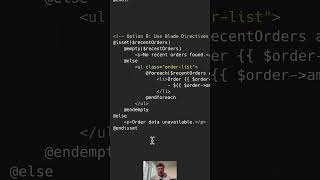
The video discusses a shift in preference within Laravel Blade, where the creator now favors plain if-else statements over Blade's specialized directives like @isset, @empty, @auth, and @guest. The reasoning is that standard if-else is universally understood by developers, improving code readability and maintainability across teams.
Blade offers directives like @isset, @empty, @auth, @guest, @production, and @env to replace traditional if-else statements.
The creator argues that plain if-else is more readable because any developer, regardless of their framework background, will understand it, whereas Blade directives may be unfamiliar.
When other developers fix bugs or modify code, they can immediately grasp if-else logic without needing to learn Blade-specific directives.
The creator has 'rediscovered' and now prefers plain if-else statements, inviting community feedback on this preference.
The video advocates for prioritizing universal readability over framework-specific shortcuts, suggesting that plain if-else statements can be more maintainable in collaborative environments.
What Blade directives are mentioned as alternatives to if-else?
@isset, @empty, @auth, @guest, @production, @env
Why does the creator prefer plain if-else over Blade directives?
Because if-else is universally understood by developers from any background, improving readability.
00:15
Universal readability
Highlights a key principle: code should be understandable by any developer, not just those familiar with a specific framework.
00:15Team collaboration
Emphasizes the practical benefit of simpler code for team maintenance and bug fixing.
00:29[00:00] I recently changed my mind on something in Laravel Blade. So Blade is full of directives that should replace regular if-else statements. Like, for example, is set and empty instead of doing regular if-else.
[00:15] Also, there's auth and guest instead of if-auth check. For checking the environment, there's production or env. But the more times I've been reviewing the code of others in Blade, the more I realized that this is actually more readable.
[00:29] Imagine any other developer on the team comes here to fix some bug or change something, and they may not know what some blade directives are or how they work, but they will definitely understand if-else statements,
[00:43] no matter what programming language or framework they're coming from. So my point is, recently I rediscovered and became a big fan again of good old plain readable if statements. What do you think, guys? Are you on the same team? Let's discuss in the comments.




⚡ Saved you 0h 00m reading this? Transcribe any YouTube video for free — no signup needed.