
Movie Pitch Gone Wrong: 'Four Old Women Talking About Sex'
45sThe humorous pitch and the fun fact about the Pink Power Ranger create an intriguing and shareable hook.
▶ Play Clip"The title is a vague question, but the content is a sharp, insightful analysis of the film industry's economics—delivering far more than the title promises."
This video is a detailed analysis of the movie 'Book Club', focusing not on its quality but on the business model behind its creation. The creator explains how such films are made for broadcasters rather than audiences, using the 'budget title strategy' to generate profit. It also highlights the film's connection to Fifty Shades of Grey and the production shortcuts that define its cheapness.
The movie is a cheap cash-in on brand recognition, with a cameo from E.L. James.
The target market is broadcasters, not audiences, as the film is sold to cable channels and distributors.
Catwoman was a theatrical bomb but continues to make money for producers through broadcast sales.
Herschel Gordon-Lewis's strategy was to lock in one or two exhibitors with a cheaper price and a bigger cut.
The writers absorbed Fifty Shades through cultural osmosis, leading to incorrect references like the contract signing.
The film uses product placement, like Waze, and green screens for locations to save money.
Diane Keaton's character is named Diane, and she seems checked out, doing the bare minimum.
The film becomes bearable once it stops focusing on Fifty Shades and lets the talented cast shine.
The Real Audience Is Broadcasters
Reveals the hidden business model where films are made for distributors, not moviegoers.
01:37Catwoman's Post-Bomb Profitability
Shows how a box office bomb can still be a financial success through broadcast sales.
03:15Herschel Gordon-Lewis's Strategy
Provides a historical example of the budget title strategy in action.
04:26Cultural Osmosis Over Reading
Highlights how brand deals can lead to superficial and inaccurate references.
06:46Green Screen and Cost Cutting
Demonstrates the production shortcuts that define low-budget filmmaking.
11:30[00:00] So what's this movie you're going to pitch me? Okay, so, there's four women talking about sex, but they're old. You mean like 32? Older.
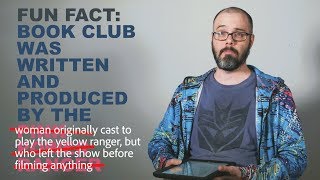
[00:13] 37? Older. fun fact book club was written and produced in part by the pink power ranger aaron sims
[00:30] it doesn't it doesn't mean anything but it's it's there it's a it's a fact book club is an incredibly cheap movie that looks like it was written in about a week uh and then shot in
[00:43] another week and then cut in three days. There's not a whole lot to really, really say about the movie itself because it's more or less exactly what you would expect. It's a very quick and cheap cash-in on some brand recognition, co-promotional power with
[01:05] the Fifty Shades tie-in aspect, including a cameo from one Erica Mitchell, a.k.a. E.L. James. She walks through the background at one point, and yeah.
[01:21] What I would rather talk about with it is how a movie like this kind of comes to exist and the ways that a movie like this goes about making money. So the target market for a movie like this is actually not audience, really, at all.
[01:37] This is the kind of movie that is basically a made-for-TV-plus type movie. It has the budget and production value of a slightly expensive made-for-television movie,
[01:50] but stars theatrical actors. And the actual target market for it is not audience, but is broadcasters. So you get this movie that once it's made, it goes to theater.
[02:03] So it is a theatrical movie. And then from there, really who you're selling it to is you're selling it to distributors and broadcasters and other middleman vendors.
[02:16] So as a producer, that's where you end up making your money. is you sell it to some cable channel in Germany who needs to fill out a 7 p.m. slot on Thursday,
[02:30] and then they, in turn, convince advertisers to buy slots during that run. And all along this, basically, everybody is just selling this movie to other people
[02:45] who are then going to turn around and try to sell it to other people. and it's not until you get to like the very end of the line and in fact because it's advertisers who are buying that spot on television at no point do you ever really need to worry about selling it to an audience.
[03:01] You worry about it a little bit during the theatrical phase but not actually that much. So if you look at a movie like Catwoman, Catwoman was a huge theatrical bomb but it continues to make actually a lot of money for like the producers
[03:15] and the producers, the writers, the actors, anyone who receives royalties on it, they continue to make a decent amount of money because, in part because it was a bomb, it's then really easy to sell.
[03:27] Sure, it's being sold to broadcasters for a budget price, but it's being sold. Whereas if you have a, you know, prestige movie where you're asking a lot for it,
[03:39] fewer people are going to go in. So this is really just a different sort of strategy for selling it. It's the budget title strategy. And actually, I had the opportunity a few years back to work with Herschel Gordon-Lewis on his last film, Blood Mania.
[03:56] It's terrible. Don't watch it. But we spent a good bit of time when we were on set talking about sort of his original strategy back in the 60s, how they would make movies.
[04:10] and he would say that they would make a movie and they wouldn't actually worry about distribution, really. The distribution would kind of end up taking care of itself because what they would do is they would just lock in, like, one or two exhibitors.
[04:26] Like, you know, drive-ins usually. They would get one or two exhibitors in, like, Ohio. We'll give it to you for, like, a cheaper price and we'll let you take a bigger cut. So even if fewer people come to see it, you'll take home more money.
[04:46] Disney's big movies look like the Star Wars movies. They taking a huge cut from the Exeggers for the first three four weeks that it in there So if you think about a movie that going to take a 75 80 90 cut
[05:01] that's all going back to the studio, well, as an exhibitor, you're making very, very little money off of that, even if you're selling out every single show in every single theater for days on end. So if another movie comes in where the distributor,
[05:18] You're like the distributed studio. Everybody is only taking, say, 50% cut, 40% cut. And you then don't even need to pack that house. You can get it half full, two-thirds full, less even.
[05:32] And you're going to be pocketing more money than if you had sold out another theater of Star Wars. This was Herschel's strategy at the time.
[05:44] And this kind of maneuvering within the industry is still alive and well. You see it with films like Book Club, which are no doubt incredibly cheap, and it all gets very hazy and very complicated,
[06:00] but sort of the root of it is that people are making money without anybody actually needing to buy something, without audiences actually needing to buy something. and it's kind of
[06:14] it shows this is a movie that was very definitely made to be trimmed down ever so slightly to air at 8-9pm
[06:26] on a Thursday on basic cable I guess I actually do have a bit that I want to say I guess I actually do have a bit that I want to say about the movie itself because I am reasonably certain that neither of the writers have read the books.
[06:46] Like, okay, this is very much a movie that was written by people who have absorbed Fifty Shades purely through cultural osmosis. Like, they don't actually...
[06:59] They didn't read the books beforehand because they figured they didn't bother. Like, they didn't need to. It's like, why bother? So there's a number of moments in the movie that, like, directly reference the book 50 Shades,
[07:14] like, things that happen in the book, but are wrong. One character, like, okay, so one character says to another that it's like, you know, she should not have signed that contract.
[07:28] She doesn't. Like, in the book, she doesn't sign the contract. That's the entire conflict. They spend so long, they spend so much time in the back half of the book
[07:43] arguing about the fact that Anna hasn't signed the contract and that she doesn't sign it and she never signs it. It is a substantial part of the book is that Anna doesn't sign the contract
[07:56] and it's not just a character in the movie getting the detail wrong because the other characters in the scene just, like, agree and go with it.
[08:08] Like, this is a scene that was written by somebody who, like, just has absorbed 50 Shades but wasn't aware of the details. I was like, oh, we need some specific references
[08:20] because we're in this, like, co-production brand deal. One of the things that I'm actually trying to unravel that I'm actually super curious about is whether,
[08:34] basically, who approached who first? Was there a pitch about, like, hey, we're going to do a, like, Fifty Shades-related movie
[08:46] that they would then approach they then approached E.L. James and her representation about like hey can we basically license 50 Shades for this purpose
[08:59] or were they shopping around a garbage rom-com to make a quick buck and and sent out theories
[09:11] and were like hey anybody interested and then E.L. James and her people came and said, like, yeah, we'll participate with you on this. Here's sort of our expectations.
[09:23] So it's like, basically, I'm wondering what's the chicken and what's the egg. Did E.L. James and the Fifty Shades Camp commission the movie, or did the movie go out seeking sponsorship or brand deals or, you know, whatever?
[09:38] Whose people called whose people first? Did they pay for the rights to use Fifty Shades or is Fifty Shades being you know just getting like a cut of things or did Fifty Shades in fact like initiate and realize like that they paid the movie for
[10:00] inclusion? Like, is it product placement? Because there is a bunch of product placement. There is actually some really funny product placement. Not just the Fifty Shades stuff. Okay, so Jane Fonda's character, like, jumps in a car to get driven to the airport to, like, you know, head off her love interest before he gets to the airport.
[10:26] Okay, so there's a big declaration. He makes this big declaration of love. Actually, he makes this small declaration of love. It's super tiny. They're building up to a classic 90s airport gate moment.
[10:43] And they're driving in the car, and they get stuck in traffic. And the driver's like, I don't think we're going to make it on time. And Jane Fonda says, are you using Waze?
[10:59] Yes, ma'am, I am. And then it just ends. It just ends right there. and then they go back to a previous location that they had already filmed at because, you know, one, the old, like, meet at the gate just doesn't happen anymore
[11:14] because of the way that, like, airports just operate. And two, that would mean another location to secure. So basically any location that isn't a private residence or a hotel room
[11:30] is, um, green screened, actually. Uh, yeah, there's a lot of very weird, weird green screen in this movie
[11:45] that shows Big Romantic Dinner Beside the Ocean green screened, like, to a point that it looks just completely hyper-real. Like, it almost, they wound up, like, softening and smoothing it so much that it looks CG.
[12:04] Very, very quickly shot, a lot of continuity errors, like, not just the kind of things that you would, it's like, okay, that you kind of come to expect in a cheap comedy, like hand positions, but there's another scene, Mary Steenburgen spends, like, three minutes just filling the same cup with ice over and over again
[12:23] because of all of the continuity overlap. So one of the things that's sort of unavoidable is the fact that, like, it's like, okay, Jane Fonda's in this, and Jane Fonda currently has a very funny, very touching dramedy on Netflix
[12:41] called Grace and Frankie. And the whole way through, the whole way through this movie, I couldn't help but just go over in my mind how so much of the subject matter that the movie tries to touch on and, like, make jokes out of is done so much better in Grace and Frankie.
[13:08] so Jane Fonda's thing now I guess her role in these days is to be the 60 year old who talks about sex
[13:23] and in Grace and Frankie that's really well done because it's woven with a lot of good character relationships and a lot of really funny well crafted jokes and here that is the joke
[13:37] That's the sum entirety of the joke, is that she talks about sex and she's old. And that's the joke.
[13:49] She's a woman over 60 and she's talking about sex. Laugh. Diane Keaton. Diane Keaton's in this and she is just, she is so checked out.
[14:01] She's just amazingly checked out. She is not here. She is not mentally or emotionally present for anything. And to the point, to the point that her character, her character is named Diane.
[14:16] Sometimes, sometimes it's just a coincidence. But in this case, it just, it really felt like, like she told them that she was only going to give them, like, five days, seven days.
[14:28] and they have to shoot out all of her stuff super fast, and she was, like, not going to do... Like, she... It's like she just straight-up told them, like, look I am not doing more than the absolute bare minimum for this so my character going to be named Diane so that nobody needs to call me anything other than Diane or Miss Keaton You will call me Miss Keaton or you will call me Diane
[14:51] And her character just dresses like Diane Keaton. Like she doesn't dress like a Diane Keaton character. She just dresses like Diane Keaton. But she doesn't behave like Diane
[15:05] Keaton. She behaves like Diane Keaton who has not been told who her character is and didn't really read the script and is just looking forward to getting home. She actually
[15:18] gets to be part of one of the weirdest things in the movie. Her entire subplot is that her adult children want her to move out to Arizona to live in their basement so that they can
[15:33] keep an eye on her because she's old now. You see, she's so old and she's old. And in her climactic scene, she's moved to Arizona and is having lunch with her adult daughters
[15:55] and they're, like, bugging her about how she shouldn't have driven her car out. She should have got somebody else to do it for her because she's so old now.
[16:08] And she's just like, you know what? I don't need to deal with this. I'm not moving in. And just goes out and gets in her car and drives off with her U-Haul.
[16:20] She just says, I'm leaving and leaves. And they're like, okay, bye, Mom. I did end up actually kind of settling into the movie eventually.
[16:32] Like, after kind of the first third, like, really once we got into the second act, I did actually kind of settle into it. It stopped being painful. Basically, once they stopped talking about Fifty Shades,
[16:47] once they stopped trying to look like anyone gave a crap about this book, And once they stopped gushing about it in ways that were clearly not grounded in any sort of actual engagement with the book,
[17:04] once they got past that and it was just like, okay, you still at the end of the day have these immensely talented actors, even if the material they're given is just thin and hacky and not very good, like, you know, they can sell a line.
[17:21] There's charisma and there's charm there. Just fantastic, talented, talented cast. So even with just garbage material, there is a charisma there. And when they can just kind of like bounce off of just whatever,
[17:36] like you can kind of get into it. It's bearable. But, oh, my, during the actual book club scenes, And when they're reading the book, like, there's a few moments where they actually do, like, quotes from the book that you're reading from the book.
[17:58] And, you know, you can just tell that it was just like, okay, all right, we got a copy. Okay, I don't know, just flip through until you see something. His hand moves back to concentrate on my nipple once more and his teeth scrape along my jaw.
[18:14] do you know how hot you are Anna? his voice is hoarse as he rocks harder against me oh god this is actually almost exactly the moment in the book that they wound up at in the movie one of the things that was also funny
[18:26] I know way too much about these books like there's a moment where you know they're sitting there watching like you know they're showing a character who's like reading and she's got the book open and she's like oh my this is so hot
[18:39] but I can see I can see it's like this far into the book, into the first book, and I'm just like, no, no, you're not even out of the interview.
[18:54] There is nothing happening in that chapter. The part that you're reading right now, nothing happens there. That is not a hot chapter. That is a chapter about Anna arguing with Kate about nothing.
[19:07] you are not reading a hot chapter because the sex in the first book doesn't show up for, like, a while. So, I feel sad now.
[19:29] I can't actually use my copy of the first book, for example, because we basically destroyed it while we were doing all of those close-ups for the actual video. Go watch my video.


⚡ Saved you 0h 19m reading this? Transcribe any YouTube video for free — no signup needed.