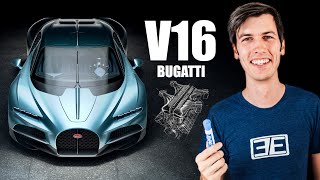

Why Bugatti named after a watch?
41sContrarian take on luxury watches vs. cars creates immediate engagement and debate.
▶ Play Clip"Delivers detailed specs and thoughtful analysis, but the title's 'Insane' hype is justified by the engineering marvel."
The video explores the Bugatti Tourbillon, a hybrid hypercar named after a watch mechanism, combining an 8.3L naturally aspirated V16 engine from Cosworth with three electric motors for a total of 1,800 horsepower. It covers specifications, design choices, and an in-depth analysis of whether the car can exceed 500 km/h, ultimately questioning battery limitations despite adequate power.
The Tourbillon is named after a complex watch mechanism, reflecting the luxury watch culture among wealthy enthusiasts, and draws a parallel between transcendent engineering in watches and cars.
The car features two electric motors in the front for torque vectoring, a 25 kWh battery between the seats, an 8.3L naturally aspirated V16 engine from Cosworth producing 1,000 hp and 900 Nm of torque, and an 8-speed dual-clutch transmission with a third electric motor at the rear.
Four drive modes: Hybrid (all motors + ICE, 1,800 hp AWD), ICE-only (1,000 hp RWD), EV-only (800 hp AWD, 60 km range), and Charge mode (engine recharges battery).
Despite having a larger engine, three electric motors, and a battery pack, the Tourbillon weighs less than 2,000 kg, undercutting the Chiron thanks to advanced engineering.
Naturally aspirated engines offer superior sound and throttle response. For the Tourbillon, this choice is complemented by electric motors for low-end torque, and a V16 layout allows equal-length intake runners for optimal naturally aspirated performance.
The V16's narrow profile enables a 2-meter-long diffuser with an 11-degree angle, maximizing downforce without excessive drag, crucial for high-speed stability.
The car is limited to 445 km/h, but the speedometer shows 550 km/h. Analysis using assumptions from the Chiron suggests about 1,815 hp is needed to reach 500 km/h, close to the 1,800 hp rating.
The 25 kWh battery has an exceptionally high discharge rate of 24.2 C. At full throttle, the battery's power output may drop significantly after about 30 seconds, as seen in the Rimac Nevera, which lost 32% of power in 30 seconds.
Using the combustion engine alone to 400 km/h then adding electric boost may not sustain enough power due to battery limitations. The presenter doubts the Tourbillon can break 500 km/h, despite having enough peak power.
The Bugatti Tourbillon is a marvel of hybrid engineering with a rare naturally aspirated V16, but its top speed ambitions may be hampered by battery discharge limitations, making 500 km/h an uncertain milestone.
What is the total horsepower of the Bugatti Tourbillon?
1,800 horsepower (1,000 from ICE, 800 from electric motors).
03:11
What is the engine displacement and configuration of the Tourbillon?
8.3 liters, naturally aspirated V16.
02:01
Who developed the V16 engine for Bugatti?
Cosworth.
02:01
How many electric motors does the Tourbillon have and where are they located?
Three: two in the front for torque vectoring, one at the rear on the transmission.
01:48
What is the weight of the Tourbillon compared to the Chiron?
Under 2,000 kg, lighter than the Chiron.
04:44
What is the battery capacity and maximum power output from the electric system?
25 kWh, 800 horsepower (600 kW).
03:25
Why did Bugatti choose a V16 over a W16 for natural aspiration?
A W16 has uneven intake runner lengths due to offset cylinders, which is problematic for natural aspiration. A V16 allows equal-length runners for optimal pulse tuning.
05:40
What is the discharge rate (C-rate) of the Tourbillon's battery, and how does it compare to other EVs?
24.2 C, which is very high; e.g., Rimac Nevera is 11.3 C, Lucid Air Sapphire 7.6 C.
12:25
What was the power drop observed in the Rimac Nevera after 30 seconds of full throttle?
From about 1,330 kW to 960 kW (68% of rated power).
16:15
According to the presenter's analysis, how much power is needed to reach 500 km/h?
Approximately 1,815 horsepower.
09:25
Weight Efficiency
Despite adding a hybrid system, the Tourbillon weighs less than the non-hybrid Chiron, demonstrating remarkable engineering.
04:44Natural Aspiration Rationale
Explains why a V16 was chosen over a W16 for naturally aspirated performance, highlighting intake runner length importance.
05:11Battery Discharge Challenge
Identifies the critical flaw: the high discharge rate and rapid power fade may prevent sustained top speed, a nuanced point often overlooked.
09:39Top Speed Prediction
Presenter doubts the car will exceed 500 km/h, offering a data-driven counterpoint to hype.
16:27[00:03] you might wonder why is the new 1,800 horsepower V16 Bugatti called the torban and the answer is very simple Rich dudes love watches you can spend house money as in the amount of money needed to buy a house on a little device that sits on
[00:17] your wrist and tells you what time it is and while I try not to yuck anyone's yum it's something I've simply never understood but saying that hits me with an immediate realization of hypocrisy because if a watch is a device to tell
[00:30] what time it is well then a car is simply a device to transport you from one location to another nobody needs 1,000 hor power naturally aspirated V16 engine but the mere thought of it fills me with joy delighting the inner child
[00:44] inside me so if a car can transcend its mechanical form to become an icon of Timeless Elegance in engineering so too can a watch no no no I'm sorry I can't I
[00:56] can't this tells me what time it is that's all I need watches they're just they're just I'm sorry it's dumb so while the tbon is named after a complex mechanism within pointlessly expensive watches well show me a watch that can
[01:09] [Music] sound I rest my case so to better understand this Bugatti I want to discuss four main subjects first of all we have all the specifications now let's go over it second why did they choose to
[01:23] go naturally aspirated third why did they choose a V16 engine and finally how fast can it actually go if it didn't have that limiter at 445 kmph and that
[01:36] final question leads us to a very interesting problem this car suffers let's start off with an overview of the powertrain in the front we have two electric motors you have true torque
[01:48] vectoring up front just behind that and sandwich between the seats you've got your battery pack this is about a 25 KW battery behind that you have the battery behind that you have the naturally aspirated V16 8.3 lers
[02:01] developed by Cosworth super cool Cosworth is just you know the name of another one of their high revving applications in a hyper car and we've got that matched up with an 8-speed dual clutch transmission and finally on the
[02:15] back of that another yes the third electric motor so three electric motors electric motor so three electric motors plus an 8.3 L naturally aspirated V16 engine so the V16 engine producing 1,000 horsepower 900 NM of torque and revving
[02:29] to either 9 ,000 RPM or 9500 RPM so everything I have written in red the spec sheet says one thing mat remac has said another thing I don't know which is correct so I've reached out for clarification I'll share it if I get it
[02:42] but regardless it may rev to 9500 RPM it looks like it based on the tack that they share and then also these electric motors can produce about 400 horsepower motors can produce about 400 horsepower each and 240 Newt M of torque yet the
[02:55] total system torque is 2300 newm so if you take 9 00 new M and you take 240 * 3 you take 9 00 new M and you take 240 * 3 you get what, 1620 new M which is not what the numbers are right they share different numbers but the thing that we
[03:11] do know is 1,800 horsepower this is the big important number 1,800 horsepower powertrain a thousand of which is coming from the combustion engine and 800 which is coming from the electric motors because they are limited by the battery
[03:25] pack the battery pack can only Supply a maximum of about 600 KW or 800 h power so you have that power to play around with between these three motors each capable of about 400 horsepower now what's really exciting are the different
[03:38] Drive modes so it had been previously reported that it was going to have three what we didn't know is that that third motor was sitting on the back of this 8-speed dual clutch transmission so this enables something pretty cool they can
[03:51] run it in hybrid mode where of course you're just running all three electric motors plus the combustion engine 1,800 horsepower all-wheel drive or you can shut off the Electric System entirely and just run the V16 so a 1,000
[04:04] horsepower rear wheeel drive this thing is two completely different animals in the same car so that's very cool as you've got that electric motor on the disconnect it not worry about it and have the engine running everything super
[04:17] cool plus it has an EV only mode for perhaps cities which may ban combustion engines driving through them you've got this EV only mode for about 60 km of driving range super cool with 800 horsepower so still decently quick you
[04:30] know and all-wheel drive of course and then finally it has a charge mode so you can use that engine to spin up this electric motor and put some energy back into the battery pack okay so electric motors big battery big engine surely
[04:44] this thing is going to weigh more than the shiron right wrong incredibly this is going to weigh less than 2,000 kg and it's going to weigh less than the shiron despite having a larger engine three electric motors and a battery pack at it
[04:59] so hats off to the Bugatti team for keeping the weight of this thing you know relatively low considering how much power it has and how much is going inside of this car now to answer the question why go naturally aspirated well
[05:11] the thing is from a driver's standpoint naturally aspirated has always been the answer because of the sound and because of the response but they're power electric motors to help out going naturally aspirated makes a lot of sense
[05:25] naturally aspirated makes a lot of sense for a car of this caliber but why a V16 well Bugatti actually did look into using a naturally aspirated w16 engine in order to continue to use that unique powertrain but with a w16 engine it
[05:40] doesn't work great with naturally aspirated as the induction style reason being you using VR blocks and so you have your cylinders offset which means your intake Runners are in varying lengths as well as your exhaust Runners
[05:54] and for a naturally aspirated engine in order to get all of your pulses to line up and work out for IDE feel pressure within your cylinders you don't want to have these uneven Runners so as a result okay we need to go to something
[06:06] different like a V16 which is super special with the Bugatti Chiron using this was no problem because you've got turbochargers so it's kind of a dumb have high pressure and the air is forced to go in doesn't really care how long
[06:21] that intake runner is now at the back of the vehicle you'll notice a clever perk of the result of using this V16 engine and that is we have this massive diffuser now the challenge with diffusers is that you don't want a
[06:33] really steep angle they become less effective so you want an angle of about 11° but what that means is you need the diffuser to extend really far up the car and so if you have this you know 4.7 about meter length car well that
[06:46] diffuser needs to be as long as possible and so it's actually about 2 m on the tbon which is quite long and it puts it about halfway through the car now if you were to have a wide engine well then you're suddenly in the pad
[07:00] narrower engine they're able to have that really long diffuser and also have it go around the engine and they even have the engine at a bit of an angle to take advantage of the space underneath it so keep in mind this new engine has
[07:15] about a meter long crankshaft that for scale is about the center of my nose to the edge of my finger just slightly longer to that I mean it is a massive crankshaft absolutely enormous and so the good news with using a big diffuser
[07:29] is that you can get a good amount of downforce without a high drag penalty so that's good for top speed which yeah it's kind of Bugatti's thing so speaking of top speed the tbon is limited meaning it's capable of faster to 445 kmph but
[07:46] what happens if we take that limiter off I mean why would the speedometer go to I mean why would the speedometer go to 550 kmph if it isn't capable of Crossing 500 kmph something we've never seen a production car do now when effectively
[08:01] asked by Top Gear about going after speed records Bugatti CEO mate remx simply said well Bugatti is about pushing the limits let's
[08:14] released all the specs on this car so we're going to have to make some available information about the Chiron so we're able to make relatively accurate guesses so the question is can the tbon exceed 500 k
[08:30] hour and we can figure out how much power is needed to do that by looking at all of the resistive forces acting against it at 500 km per hour now we do have to make some assumptions but sometimes you can learn things from
[08:42] manufacturers by what they don't tell you for example they told us that it has a lower frontal area than the Bugatti Chiran they told us that it's lighter than the Bugatti shiran they told us it has more power than the Bugatti shiran
[08:56] they said that it has a lower height than the Bugatti shiran but they did not tell us that it has a lower drag coefficient so I suspect the drag slightly worse and part of the reason for that is the open air the exposed
[09:10] engine that you have in the back which is increasing its drag coefficient but it looks beautiful so using as accurate of assumptions as I can come up with we get a guesstimate of the total power output required for the tbon to hit 500
[09:25] output required for the tbon to hit 500 km per hour of about 1,800 15 horsepower so super close to the actual number within the error range of these assumptions absolutely so yeah it has the power to do it simple as that it can
[09:39] do it right unfortunately there's a pretty big problem here people are used to discussing top speed as it relates to combustion cars but with EVS it's a different story all right so there's a bit of logic we need to work through so
[09:53] the first thing we need to understand is the power required to overcome aerodynamic drag is a function of velocity cubed so what the heck does this mean well here we have a plot looking at horsepower versus speed how
[10:07] much power is required to go a certain speed of the Bugatti Chiron 300 plus so the fastest version of the Bugatti shiron so you can see at 100 km/ hour you only need about 20 horsepower versus at 200 km/ hour you need 120 horsepower
[10:24] so this function increases dramatically again it's a function of velocity cubed so So the faster you get there's a dramatic increase in how much power is required so with 1,600 horsepower the Bugatti shiron is hitting its top speed
[10:38] of about 490 km per hour okay just shy of 500 km it's a very powerful step to just go those additional 10 km per hour it could
[10:50] take as much as 100 horsepower in order to make it work out and why do I bring all of this up well you see this steep curve here the problem with this is as you get to these higher and higher speeds the time required in order to go
[11:04] that little bit Step Up is significant so the Bugatti Chiron Super Sport 300 plus was at Full Throttle for 70 seconds before reaching its top speed that is a
[11:16] before reaching its top speed that is a lot of time okay so the turbon has 1,800 horsepower but the question is for how long because this 1800 is comprised of 1,000 horsepower from the combustion engine versus 800 horsepower from the
[11:30] electric powertrain so how long does this 800 horsepower last now why do I ask this question well a combustion engine will deliver its full power until it runs out of fuel they're very happy to do that as long as you keep them at
[11:42] the right temperature battery limitations however exist so the size of a battery determines how much power can it put out the larger the battery the better and then also there is a limited duration on how much time a battery can
[11:56] supply its maximum output now there's a lot of reasons for this but the point is the longer you floor it in an EV without letting off that accelerator pedal eventually that power starts to drop now this is especially true if you're really
[12:11] pushing the limits of that battery with a really high discharge rate so here I'm going to show you some of the discharge rates of different Vehicles out there today we're looking at kilowatts delivered by the powertrain divided by
[12:25] the amount of kilowatt hours that that battery pack has the discharge rate so for a Tesla Model 3 Performance you're delivering about 4.6 times as many kilowatt as you have kilowatt hours in that battery pack Lucid air Sapphire 7.6
[12:39] that battery pack Lucid air Sapphire 7.6 remag NOA 11.3 Bugatti turbon 24.2 this is a very high number if you plot it against the other vehicles out plot it against the other vehicles out there it's this weird super high outlier
[12:52] crazy to look at though I did think well what about the new 9911 GTS though it has a much smaller battery pack but also has a very high number 25.3 though only limited to that power output for 10 seconds so again at some
[13:09] point as you're flooring it that power is going to start to drop and again top speed runs take a lot of time so I started to try and think what can Bugatti do in order to get the maximum top speed possible and we have 1,000
[13:23] start off with we don't have to use the electric motors to first start accelerating right so we can get as fast as a combustion engine can take us first to save that battery for that last little stint okay well how fast can we
[13:37] get with 1,000 horsepower for the Bugatti turbon again making those same assumptions we made previously if you do the math you get a number of about 400 the math you get a number of about 400 kilm per hour or about 250 mph that you
[13:52] can get to just using the combustion engine alone so we're pretty close right engine alone so we're pretty close right we only have 100 kmph to go to hit that 500 kmph Mark but again that's the part that takes the most time because we're
[14:06] using we're up against all that aerodynamic drag so if you look at the ss300 plus what Bugatti did with the shiron it took them 45 seconds about to shiron it took them 45 seconds about to go from 400 km/ hour to 490 km/ hour so
[14:22] what's the problem here well there's several problems first of all if you're just using the combustion engine to accelerate up to 250 mph it's going to take longer meaning you're eating up more distance so you need an even longer
[14:34] stretch of road to make this happen second if you're taking 600 KW from that battery this is a 25 KW hour battery well that means you're eating 40% of the batteries charge every minute so you don't have a ton of time but plenty of
[14:48] time to make a top speed run but does that mean if you get to those lower percentages of battery state of charge do you have less power to offer and finally you have those power limitations as far as duration so if you're flooring
[15:00] it for you know 45 seconds that power is going to start to come down which means you're not going to have 1,00 horsepower which is about what we need in order to hit 500 kmph okay but we don't know how or if this battery will be limited with
[15:15] continuous output so what's an example we can look at well how about the remac NAA which is an Eevee that has basically smashed all of the records for performance cars so the remag NOA has about 1,400 KW of power about 9 00
[15:29] horsepower it has a better drag coefficient than the Bugatti shiron and they have similar Dimensions so about the same frontal area which means if it has more power it should be able to easily exceed 500 km per hour right but
[15:44] it doesn't its top speed was measured at 412 km hour by rimac now why is that number so much lower if the rimac has so much more power than the shiron well you can look at the strategy that they use so they kept it at about 20% throttle
[15:59] until they reached 250 kmph impressive that it can do that with 20% throttle and then they used 100% throttle for about 30 seconds and what you saw is the peak power output went from about 1330 Kow by the end of that 30 seconds was
[16:15] all the way down to 960 KW in other words it was at 68% of its rated power after 30 seconds of Full Throttle okay so if we take that 68% number multiply
[16:27] so if we take that 68% number multiply it by our 800 hor power and say after 30 seconds of Full Throttle acceleration we have 68% of 800 that puts us at 1544 horsepower which probably isn't enough to hit 500 km per hour so they
[16:43] have a very real challenge here with this battery in order to hit a top speed of 500 kmph so I'll close this out by making a statement I hope to later regret I don't think it's going to break 500 km hour I don't think it can do it
[16:58] aerodynamics and if there's one thing dudes love more than watches it's being right so I hope to one day see Bugatti challenge the 500 km perh barrier if you have any questions or comments feel free to leave them below thanks for watching


⚡ Saved you 0h 17m reading this? Transcribe any YouTube video for free — no signup needed.