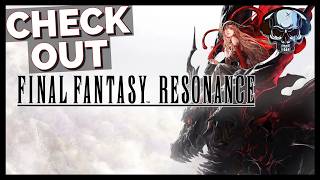

This Final Fantasy Spinoff Removes Gacha!
46sFans are curious about a Final Fantasy game without gacha mechanics, and this reveal sparks discussion.
▶ Play Clip"An honest first-impressions video that matches its title, though it includes a standard call to subscribe at the end."
Mortem presents an overview of Final Fantasy Resonance, an upcoming JRPG based on the gacha game Brave Exvius. The video focuses on the game's demo, highlighting its connection to the Final Fantasy franchise, unique progression systems, and combat mechanics.
Mortem introduces the video, stating that he's showcasing a demo of the upcoming JRPG Final Fantasy Resonance, which he finds interesting due to its art style.
The game is set to release on October 22nd, and the demo, which launched a day or two before the video, allows progress to carry over to the full game.
Final Fantasy Resonance is a remake of the gacha game 'Brave Exvius', stripped of gacha mechanics to be a traditional release using the original game's story.
The core progression mechanic involves 'Visions', equippable crystals that take the form of heroes from across the Final Fantasy franchise (like Cloud, Terra), which you bond with to gain their skills.
The game opens with a flashback to 700 years prior, showing a war between magitek users and mages, leading to an Archwitch being sealed in a giant crystal and splitting the world into fragments.
The story jumps forward 700 years. The player is a captain of an airship from the kingdom of Grandshelt, sent to investigate a weakened barrier around a crystal, which leads to the return of an ancient threat.
The game includes standard JRPG features such as leveling up, gaining stats, and equipping weapons, armor, and accessories to enhance combat abilities.
While equipped with a Vision, the player levels up their bond, unlocking abilities that are passively active. Learned abilities can be equipped in active slots even if the Vision is swapped out for another.
Each main party member and Vision has a specific role, such as damage, tanking, or healing. This influences how you mix and match your equipped Vision and abilities.
Near the end of the demo, the player unlocks the ability to upgrade Visions, which enhances the power of the skills they provide.
In turn-based combat, enemies have a stagger bar. Lowering it completely causes the enemy to become staggered and take extra damage, triggering a bonus round for the attacking character.
Exploiting enemy elemental weaknesses is the most effective way to lower the stagger bar. The main characters (Rain, Lastwell, Fina) each have different elemental affinities (fire, ice/water, light).
If all enemies are staggered in one turn, a 'stagger sweep' is triggered, granting every party member an extra turn. In these bonus actions, the player must queue all their characters' attacks simultaneously.
The content demo ends after the game's first chapter, with the player reaching level 15. The reviewer is curious to see how combat evolves in the full game.
The game features a world map and random encounters, which are indicated with a flashing red animation before they occur. The presentation blends HD 2D pixel art with more modern graphics, creating a unique aesthetic.
What game is Final Fantasy 1 based on?
A gacha game called the game.
00:49
How does the 'Visions' system work?
Visions are equippable crystals that take the form of heroes, which the player bonds with to gain their skills and passive abilities.
03:44
What is the key to triggering a 'bonus' round?
Lowering an enemy's stagger bar to zero, which stuns them and grants the player an extra turn.
05:12
What causes a 'stagger sweep'?
Triggering the stagger on all enemies in a single turn.
06:10
What is the primary role of the character Lina?
She is primarily a healer, but she also has light-based abilities.
05:41
Gacha to Traditional Remake
Explains the game's origin and its strategic shift to a traditional game model.
00:49700-Year-Old Flashback and World Setting
Provides the foundational lore that drives the main plot and world design.
02:07Vision Upgrade System
Details a key mechanic for character progression and customization.
04:38Flexible Vision Build System
Highlights the deep customization that sets this game apart from transitional releases.
03:44Visual Identity of Pixel vs Modern Graphics
Describes the interesting and unique visual juxtaposition used throughout the game.
07:22[00:00] What's going on everybody, Mortem here, this time bringing you a look at Final Fantasy Resonance, an upcoming JRPG, of course taking place as part of the Final Fantasy franchise,
[00:17] but this game caught my attention for a few reasons, not least of which because I really enjoy this particular art style, even if they have made some changes here I would say. Either way, however, I am bringing you this video via a publicly available demo that launched a day or two ago.
[00:33] So, the game itself is releasing towards the end of October, October 22nd, I believe, to be specific, and they've released this demo in the meantime, and as is usually the case with JRPGs, your progress from this demo will carry over into the full game if you choose to pick it up.
[00:49] Something else probably worth mentioning, It is my understanding that Resonance here is based on a gacha game, Brave Exvius, I think it was called. And they are remaking that, of course, taking all of that gacha stuff out of it and making it just a traditional release using that game's story.
[01:06] Just so you understand the nature of the spinoff. Now, where it gets maybe a little more interesting than that, I would consider Resonance personally a mashup of a lot of other stuff from the Final Fantasy franchise.
[01:18] not least of which are the Visions, which are effectively like equippable crystals that take the form of a hero that you bond with from the franchise. This includes people like Cloud, Terra, the very first main character, you could say, the Warrior of Light, and plenty of others from what I understand.
[01:37] And that kind of plays a central role in progression. But it doesn't stop there. There's also a few things in terms of, like, battle mechanics and things like that that I kind of see taken from other places, which isn't terribly surprising given the name.
[01:50] But, you know, sort of first impressions-wise, that is what I noticed. However, jumping into it, this game does seem to have a few different difficulty options, kind of the usual story-through-hard type of stuff. And you'll choose that before jumping into the game in full, which is where the story kicks off, of course.
[02:07] Now, this is the kind of game that actually starts with a bit of a flashback to apparently about 700 years before the actual game begins. We get this really awesome pixel art cutscene actually kind of depicting what is going on here But way back when there was a war between people using magitek alongside other machinery and then they were all fighting off various mages and
[02:29] the like. Now, at the time, an archwitch, a woman who could actually summon an espers and everything, fought some of the people involved in this war, lost, got turned into a giant crystal, and this sort of triggered some sort of event that split the world into a bunch of fragmented
[02:45] pieces. Then the game flashes forward 700 years, and we are a captain of sorts of an airship belonging to the kingdom of Grandshelt. We get sent on a mission to investigate one of those crystals who has a barrier erected around it that has weakened,
[03:01] and that's where the game kicks off, because when you go to investigate this crystal, it turns out those people from 700 years ago are back and are destroying things again, and you've got to find a way to stop that, and that kind of seems to be the main plot.
[03:14] But where it goes from there is particularly interesting to me, namely in terms of what it does progression-wise. So there's your very standard JRPG stuff. You'll be killing things and leveling up. As you level up, you gain a bunch of stats.
[03:27] You can also equip things like weapons, armor, accessories to then have a bunch of different effects on you, and that will play into combat, of course. But where it starts getting interesting are the visions. So the visions, as I mentioned, are effectively just heroes of the other games that you can then equip onto yourself
[03:44] and then you'll get access to their skills. In addition to that, while you fight with them equipped, you will level up your bond with them, and this will unlock abilities for them. These abilities, while you have them equipped, are just passively active.
[03:57] However, once you've learned them, if you choose to switch to a different vision, you can equip the abilities that you have learned in the available slots for active abilities. That is to say, the abilities from the ones you do not have equipped.
[04:11] So, mix and matching the visions you have equipped, plus the abilities you have equipped from the ones you don't have equipped, plays a big role in customizing your characters. But speaking of the word role, every single one of your main party, as well as these visions themselves, have a specific role.
[04:26] These are, for the most part, pretty straightforward. Things like damage, tanking, healing, etc. And so that's something to keep in mind as you mix and match your role with the role of the vision you are equipping.
[04:38] Naturally, though, it's not done there. A short ways into the game that is to say towards the end of the demo the end of chapter one you get the ability to upgrade these visions which effectively upgrades the skills that they will give you All of that however has the knock effect of actually being useful in combat as you
[04:56] would expect, and so we'll talk a little bit about that. For the most part, standard JRPG turn-based stuff, but the visions alongside elemental weaknesses of your enemies are really the big deal here. So enemies have a stagger bar, and when you lower it all the way, they become staggered
[05:12] take a bunch of extra damage, and trigger bonus rounds. The best way to lower that stagger bar is, of course, to hit enemies with whatever they are weak to, which is where your elemental and just different damage types in general are going to come in,
[05:26] because between you, the visions you have equipped, and all of your different party members, you should have a nice variety. Your main character, Rain, seems to focus on fire damage by default. Your sort of second-in-command, Lastwell, focuses on ice and water.
[05:41] And then later on you get a character named Fina, who seems to be primarily your healer more than anything else, but also gets some actual light abilities. But using all of those, staggering an enemy, is of course what you want to do to take their turn and deal extra damage, but what's really interesting about it are the bonus rounds.
[05:58] So when you stagger an enemy, the character that staggers that enemy gets a bonus round, where at the end of combat they can just take a turn again. This is a great way to push through extra damage, yes,
[06:10] but what's really interesting is if you can't manage to stagger every single enemy in a turn, even if it's only one enemy, then you trigger a stagger sweep. This is where every character in your party gets an extra turn in that bonus round,
[06:23] which is an opportunity to do a ton of extra damage. But what I did notice that was a little bit interesting about that is that where regular turns you go one at a time, the bonus round you have to queue up every single one of your characters
[06:36] who are involved in the bonus rounds turn at the same time, which is an interesting little touch, I thought. But that seems to be the core of the combat system as far as the extent of this demo goes, which ends at Chapter 1 and only lets you get up to Level 15,
[06:51] and so I'd be curious to see how it evolves over the course of the full game in about six weeks when this thing launches. Otherwise, we've got the gameplay and stuff to talk about, so like many a JRPG, you've got your world map and then your individual locations you'll go to.
[07:04] There are random encounters in this one The mini actually flashes red when they about to happen so you do have like a little bit of notice ahead of time which is interesting but it otherwise what you expect You know run around the world map find your dungeons find your settlements You can
[07:19] often find side quests and chase those down. Those are all marked as well, which will give you other rewards and kind of just let you see some side content. There is a great one about some orphans, in fact, just here in Chapter 1. That was a really well-done side quest, but what's
[07:32] interesting thing to me here is less so the exploration itself, but more how it's like visually presented to you. So in many ways, I would consider this part of their sort of HD 2D graphics system that they have been updating. But this one looks a little different
[07:46] in the sense that there's more pixels involved, I would say. And while that part is always going to be very subjective, what I thought was most notable about all of that is actually where they are blending, I would say, more modern graphics with the pixel graphics oftentimes.
[08:01] like when you summon your visions for their big attack at the end of the stagger sweep the vision that you summon in is like given art that matches the most recent game that they were in so like if you're using cloud it just shows him from like the final fantasy 7 remakes and
[08:16] then even in those pixel art cut scenes occasionally parts of them are more modern let's say in terms of their presentation it's like a really interesting juxtaposition of pixel art versus
[08:28] more modern stuff, and I'm not quite sure how I feel about it just yet. Curious to see more of it at any rate. But bringing all of that together, I would say that is what there is to know about Final Fantasy Resonance at the moment, at least until it launches in full, and I will be reviewing
[08:43] this one, so expect that video around the time it releases, I would imagine. Square Enix likes to give me review copies the day things release, but either way, I'll get a bit of a head start via this demo that I've already ran through, so there's that.
[08:55] But as for today, that is pretty much going to do it. Certainly hope you enjoyed the video. If you've checked out the demo for yourself, I'd love to know what you think about it down in the comment section below, which naturally means to like, comment, subscribe.
[09:07] I love it. YouTube jazz. But regardless of any of that, truly, just thank you so much for watching. I really do appreciate it. May you wander in wisdom and have an amazing day.
[09:25] you
⚡ Saved you 0h 09m reading this? Transcribe any YouTube video for free — no signup needed.