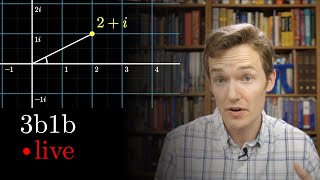

Why 'Imaginary' Numbers Are Real
50sChallenges common perception by questioning what numbers are real, sparking curiosity and debate.
▶ Play Clip"Delivers a solid, engaging primer on complex numbers, though the live format includes some technical delays and filler."
This video is the third episode of the Lockdown live math series, focusing on the fundamentals of complex numbers. The host, Grant Sanderson, uses a live interactive format to explore the concept of imaginary numbers, their geometric interpretation as rotations, and their practical utility. The session begins with a poll asking viewers which numbers they consider 'real', setting the stage for a discussion on the nature of mathematical existence.
The host introduces the topic of complex numbers, calling them a favorite piece of math with a 'terrible name'. He starts a live poll asking viewers which numbers (2, sqrt(2), sqrt(-1), infinity) they consider to really exist.
A viewer question asks about renaming complex numbers. The host suggests 'sneaky numbers' but prefers names that connote spinning and rotation, hinting at the geometric interpretation to come.
The poll shows a split between 'all of them' and 'all except infinity'. The host shares his view that any numerical construct helpful in the real world is 'real', including complex numbers.
The host mentions that complex numbers make trigonometric addition formulas less error-prone and more meaningful, contrasting with rote memorization.
The host introduces the concept of i as a number that lives perpendicular to the real number line, making numbers two-dimensional. He acknowledges this is a strange starting point that requires taking some things on faith.
Addition of complex numbers is explained as straightforward, operating like vector addition in a 2D plane.
The host demonstrates that multiplying by i rotates a number by 90 degrees. He shows that i times (3+2i) equals -2+3i, which is the 90-degree rotation of the point (3,2).
The host explains that the rotation property of i provides a computational mechanism for all rotations. He outlines three crucial facts about multiplication: z times 1 equals z, z times i is the 90-degree rotation of z, and the distributive property allows scaling and combining.
A viewer asks if i is the same as the vector i in physics. The host clarifies that while similar, in this context i is treated as a number. He expresses delight at the high level of audience participation.
The video effectively introduces complex numbers as a two-dimensional number system where multiplication by i corresponds to a 90-degree rotation. This geometric interpretation provides a powerful and intuitive framework for understanding complex arithmetic, making it a valuable tool for real-world applications.
What is the defining property of i?
i squared equals negative 1.
06:43
How does multiplying by i affect a complex number geometrically?
It rotates the number by 90 degrees.
21:56
What is the result of i times (3 + 2i)?
-2 + 3i
20:36
How is addition of complex numbers similar to vectors?
It operates essentially the same as vector addition in a 2D plane.
11:57
What are the three crucial facts about multiplication by a complex number z?
1) z times 1 equals z. 2) z times i is the 90-degree rotation of z. 3) The distributive property allows scaling and combining.
24:24
Reality of Numbers
The host's personal view that any useful numerical construct is 'real' challenges traditional mathematical philosophy.
03:13Complex Numbers Simplify Trigonometry
Shows a practical application of complex numbers in making trigonometric identities less error-prone.
06:00Two-Dimensional Numbers
Introduces the key geometric insight that complex numbers live in a 2D plane, with i perpendicular to the real line.
08:09Rotation as a Computational Mechanism
Demonstrates how the rotation property of i provides a powerful tool for all types of rotations.
21:56[00:00] Today we are going to talk about one of my absolute all-time favorite pieces of math. to quantum mechanics, but it's something that has a terrible, terrible name.
[00:12] And worse than that, the things that bring about And before we get into any of it, what I want to do is start with kind of a poll,
[00:24] just to poll the audience on seeing what you guys can consider to be, well, real. So we've already been doing a couple polls in the warm-up animations, but as a serious poll of sorts, one that's actually going to help me see where
[00:39] I just want to ask you a very simple question. Pull it on up. And, oh, for whatever reason it seems like we're having trouble polling this one up.
[00:57] Took a little delay there. Among the values 2, square root of 2, square root of negative 1, and infinity, which would you personally consider to really exist,
[01:10] So in theory, if you guys go to 3b1b.co slash live, you should be able to answer this, and then the statistics based on your answers are going to start populating the screen.
[01:22] At the moment, all we know is that, you know, someone who has a lead, as the servers kind of digest them, we'll start to see some of the stats here.
[01:36] If you go to that page, by the way, 3b1b.co slash live, which redirects to itempool.com, what you're going to find is at the very top, you can ask a question on Twitter, and all that's going to do is basically open up a tweet that's going to have the hashtag
[01:49] in it, lockdown math, and that's the way that we're going to be doing questions to this. Instead of a live chat, anytime you have a question or a comment that you want to, it's going to be pulled up here, and it looks like we already have one.
[02:04] This is from Yash Dave, who asks, if you could rename the complex numbers and the to a name that conveyed the fact that they have numerous applications in the real world,
[02:16] I couldn't be happier that you asked, Yash. the fact that we should call them sneaky numbers. Personally, I'm very fond of trying to connote spinning and rotation,
[02:28] is the fact that what we call complex numbers, what we call imaginary numbers, some of the main uses that they have come from very elegant descriptions of how to rotate stuff, and I hope you'll kind of see what I mean as we proceed with that.
[02:44] So on our poll, asking you guys which numbers you consider to really exist, which is of course a subjective question, there's no right or wrong answer here, because it's not at all a strong consensus in one direction.
[02:58] It seems like we've got three top contenders, and then three that are falling pretty evenly behind that, so let's go ahead and take a look. What do you consider to really exist when it comes to numbers?
[03:13] but I'm very curious about the fact that there's three all kind of coinciding with each other there, and it looks like I'm getting a little bit of a delay before the reveal,
[03:25] I'll tell you, for me personally, I feel like it's very silly to answer anything that's either that's not all of them or none of them. I can maybe understand if someone wants to treat infinity as something different,
[03:39] because it's ill-defined. There's lots of different things that that might mean, but insofar as numbers exist at all, if you consider what a number is to be a real thing, then it would... oh man, I can't believe that we're stalling out on this one.
[03:52] oscillation between when it works and when it doesn't. So, for me, I think that the question is, well, man,
[04:08] I can't believe that we're stalling out on this one. t has a kind of reality in our minds, and things like the square root of two,
[04:21] square root of negative one that don't show u But for me personally, basically, anytime that you have a numerical
[04:37] construct that's helpful in the real world, you know, I consider that real.
[04:51] which imaginary numbers are useful, the complex numbers are useful, an d from there maybe try to imbue them with a little more reality. I won't assume that you know what they are yet, it's meant to be a basic primer,
[05:06] but let's just dive right in, okay? The end, by the way, the very end here, or things like the square root of negative 1 that don't show up among real normal and I understand that maybe, oh, these complicated identities from trigonometry
[05:21] oh yeah, complex numbers, they're really useful, you're really going to love th What I'd like to do for you today, basically, is show you the sense
[05:33] I won't assume that you know what they are yet, I remember when I was in school and we learned these addition formulas, it's this kind of long thing in te
[05:47] And I understand that maybe, oh, these complicated identities from trigonometry is not going to be the best way to lure some people into understanding, oh yeah, complex numbers, they're really useful, you're really going to love them.
[06:00] But I do think it's interesting that you can have a fact that has nothing to do with complex numbers or the square root of negative one, it's just trigonometry, it's everything we were talking about last time.
[06:15] I remember when I was in school and we learned these addition formulas, that if you want to know the cosine of the sum of two different angles, you know, it's this kind of long thing in terms of cosines and sines of the original two angles.
[06:30] y who's going into serious math, they'll tell you that complex numbers are as real a part of their work and their life as real numbers are. But the starting point looks very strange, okay? When you start introducing this,
[06:43] thing you do is to say, assume that there's some number i so that i squared is equal to negative 1. And I think to a lot of students It's something that's very error-prone if you're just trying to memorize it as it is.
[06:59] However, if you come at it with complex numbers, this is not only much less error-prone,
[07:12] it has a very beautiful meaning and it just falls right out. d says, oh no no it exists, we've defined it so that that's the case.
[07:27] I think the other reaction someone can have is, hang on a second, you can do that? If you talk to anybody who's in engineering, anybody who's going into serious math,
[07:42] they'll tell you that complex numbers are as real a part of their work and their life as real numbers are.
[07:55] But the starting point looks very strange, okay?
[08:09] do when you start talking about complex numbers is to say, Instead of the real number line, which you know all of these numbers we know when we
[08:21] t we do is say i lives in a different dimension. i lives perpendicularly, there's one above and then there's one below, negative i, and you can have negati
[08:33] ve 2i, you scale it however you want. Essentially it's proposing that numbers be two-dimensional and that i has a very specific home, one unit perpendicular, uh, perpendicularly above the real number line.
[08:46] if I take negative five for example and I square it, well a negative times a negative is a positive, so I get 25. Any number that you square, if it's positive, well that just stays positive.
[09:14] So it seems like no matter what, when I'm squaring numbers I always get a positive number.
[09:35] I'm never going to get anything negative.
[09:53] and then you move in that perpendicular direction into the extension of our number s ystem, which again, you're kind of asking the students to take a lot on faith here I think the other reaction someone can have is, hang on a second, you can do that?
[10:06] oh I've defined things so that we now magically have a solution. So if you're uncomfortable with this, you're definitely not alone.
[10:29] like there's a, there's a back and forth between answers f and d, so f is all of them, saying that all of these should be considered real.
[10:41] The second weird thing that you do when you start talking about complex numbers Instead of the real number line, which you know, all of these numbers we know when we square them, you can't get a negative,
[10:53] i lives perpendicularly. There's one above and then there's one below, negative i, and you can have negative 2i.
[11:09] You scale it however you want. And okay, if we want to extend our number system, I get it,
[11:30] maybe it's useful to put some kind of number up there, but why i, right? solve before and you make up an answer to, why should that live there?
[11:45] So I hope to answer this for you.
[11:57] At the very beginning, let's just talk about how if you're adding numbers that are two-dimensional like this, the rules are pretty straightforward and it operates essentially the same as vectors for any of you who might be familiar with vectors.
[12:13] and you can follow along at home, see what the addition might be. It turns out to be relatively straightforward. If you're moving four units to the And then I'm going to take a second number and it's helpful to draw them as vectors,
[12:36] kind of an arrow from the number zero, and this one is going to end up at negative two plus two i.
[12:50] So what I'm saying is you take the real number negative two and then you move in that perpendicular direction into the extension of our number system,
[13:05] which again you're kind of asking the students to take a lot on faith here that you're okay to do that, that you're allowed to just pretend that the numbers extend
[13:20] can get you something like it. But the rules end up being very different You can't do things like assume that if two numbers multiply to make zero, end up behaving much like the real numbers, s
[13:36] Now assuming that our question system has not broken down, I should be able to do this as a proper poll and let me go ahead, I guess we can first check the previous poll, okay things seem to be working so we
[13:55] can take a little step back in the lesson so I'm just genuinely curious, I want to know how you guys answered on this one. It looks like there's a there's a back and forth between answers f and d,
[14:11] so f is all of them saying that all of these should be considered real, and interesting d is the one that says you should consider two square root of two and
[14:23] negative one but not infinity, so there's a good contingent of you out there who would just reject infinity as being considered real but are very comfortable with the square
[14:35] root of negative one, that's awesome, and then after that it looks like c, people who reject the square root of negative one, fascinating, I actually would have thought that none of them would have come higher than that,
[14:52] none of them is much lower at a, okay so it looks like we've got a cohort of people who are comfortable with negative one, a large cohort are uncomfortable with infinity,
[15:04] that's a topic for another day, don't worry about it, and then a number of people who are kind of in that middle ground of maybe not being super comfortable with the idea that negative one might be real,
[15:19] let's see if we can convince you of the difference of that. So what we've done here is we've taken three, two and then we convert it to negative two,
[15:37] three. Something which maybe in our original system you know looks like this negative two and then three.
[15:53] Before I've taught you how to add them, make a guess at how it might work, addition is actually the least interesting part of this, but it is, it's definitely one of those operations that you are going to need to know.
[16:09] Unfortunately, and you can tell by the fact that I'm stalling and what I'm saying here, it looks like the question is still not loading completely correctly,
[16:24] so I'm going to have a stern word with Cam and Ider behind the scenes who have otherwise built such a beautiful, beautiful interface that's
[16:38] helpful for this kind of back and forth between you guys and me. if we do that same very mechanistic operation again twice and I'm b but then that first one becomes negative. So that was another 90
[16:54] degree rotation. Well what's happened here is we've just made both of the coordinates
[17:08] negative and that's reassuring because if I take some point sitting at a b an
[17:21] It turns out to be relatively straightforward. h is just taking both of the coordinates and making them negative negative a negative b okay so that's reassuring this operation that does a 90 degree
[17:36] rotation actually behaves like you would expect it to. Now why am I asking you this? Well I'm being told that supposedly I'm allowed to ask you questions again so I Oh look a lot of people did submit answers very good.
[17:50] Great let's let's grade the complex addition actually let's l how much explanation is demanded. Okay so it looks like a majority of you did so maybe just the fact that there's some vertical component and you need to
[18:03] vertical components or maybe those of you who answer 2 reject the reality of imaginary numbers so you just don't even acknowledge that vertical component.
[18:23] Addition doesn't really have anything complicated going on, which is great. Well where everything becomes interesting is when them to get two vectors back, at least when we're in the 2d plane.
[18:37] Aha! Wonderful! Very simple question I want you to take the number i and I want you to multiply it by 3 plus 2i and even though I haven't really talked about
[18:53] You can't do things like assume that if two numbers multiply to make zero, then one of them has to be zero, but complex numbers are going to end up behaving much like the real numbers, so rules from algebra can carry over,
[19:08] but to understand what that rotation rule is, oh no I'm giving things away, what that multiplication rule is, I just want to ask you a simple question, we're not even going to think of it as a complex number per se,
[19:26] if I just have some sort of coordinate grid and I go to the point with x coordinate three and y coordinate two, what is the 90 degree rotation of this? delightful to me. Okay this is this isn't necessarily a question I was
[19:41] we have a very strong majority in one direction hopefully in the correct So what we've done here is we've taken three two and then we convert it to
[19:59] negative two three, something which maybe in our original system, you know, looks like this, negative two and then three, that's going to be the 90 degree rotation.
[20:23] it looks like the majority of you answered negative two plus three i which is absolutely correct absolutely correct so there's two ways to think about this okay one of them is to walk forward with the algebra and
[20:36] just do it a little bit mechanistically okay so if we pull ourselves up our sheet if we take i times three plus two i three plus two i it just distributes i times three
[20:49] is going to be three i i times two i is going to be two times i squared by definition i squared is negative one which means that our final answer is going to look like nega
[21:02] like I said it looks like a majority of you correctly did that product now it's one thing to just walk through it mechanistically it's another to step back and say what just happened geometrically right because what we just talked through was the fa
[21:16] ct that if you want to rotate numbers 90 degrees the rule is to swap the two coordinates and then multiply that first one by negative two well look at what's happened here we've got three
[21:32] and two those coordinates have been swapped two is now the real part three is the imaginary part but that two got multiplied by a negative
[21:44] one because i has this defining feature of squaring to become negative on by i has this action of rotating things by 90 degrees maybe tha
[21:56] Well what's happened here is we've just made both of the coordinates negative and that's reassuring because if I take some point sitting at a b and then I rotate it 90 degrees, so this will be my initial 90 degree rotation,
[22:09] and then another 90 degrees that's the same as a 180 degree roto- oh no I've have a number that behaves this way it gives you a computational mechanism for all
[22:22] of the other types of rotations that you might want to do that might not necessarily be 90 degrees and to show you why this works i'm going to go ahead and pull up an
[22:35] animation so let's say we have any number z and in this case z is going to be let's see So that's reassuring this operation that does a 90 degree
[22:48] rotation actually behaves like you would expect it to. ask what is z times one where does it take the number one well z times one is going to be
[23:11] Well I'm being told that supposedly I'm allowed to ask you questions again, so I'm going to have you do your very first complex product.
[23:30] tch that arrow up to the point where z is great a kind of trivial fact even though it's trivial i'm actually going to take
[23:48] a moment to write that down just so that we can oh no no no that's for that's for later that is randy don't you guys worry about him he'll be coming in in just a
[24:06] moment so i just want to write down three crucial facts that are getting an influence rotation three facts i'll call it three facts about multiplication the first two
[24:24] Okay so it looks like a majority of you did get the correct answer which is 2 plus 3i, 52 of you answered simply 2 which would have been the real part of the answer so
[24:38] add those vertical components or maybe those of you who answered 2 reject the hatever the 90 degree rotation point for z itself is okay so z does to any other possible number well it turns out those two is really
[24:54] all we need to work with if we have the distributive property so the third fact that's going to look kind of innocuous is let's say i take this z and i multiply it by c plus d times i where c and d are just any two
[25:10] numbers okay well this is going to distribute so z times c i'm actually going di which again i'm going to write in kind of a funny order and write that as d times o if we're just scaling them up by some other constants that
[25:33] completely constrains where we need to go so let me go ahead and wr
[25:45] ite this down with an example okay let's say that we go back here and i want to know what multiplying by z does to anything i want to tell i want to convince you that it
[26:07] n a way that keeps these lines parallel it keeps them evenly spaced keeps them and really just think through any one particular point for this let's say that we and then negative one unit in the vertical direction well after the product where
[26:23] nds okay and we see that right it's two times this yellow vector and it'll be negative one times the gree
[26:42] n vector so here even before you actually work out the product we could just read off
[27:00] Very simple question.
[27:14] ds up popping out from this and then we'll try to see how that squares with the hopefully on pencil and paper it looks like we've got a question from the audience
[27:27] which is is i the same as i and j the vectors in physics great question actually Other than that just treat it like it's a normal
[27:39] number okay and then proceed forward with the product. Wonderful okay so it looks like we've got quite a
[27:54] few of you coming in to answer which is always lovely. Super exciting for me by the way just how many people are enthusiastic about coming and like getting back to the fundamentals of math in this
[28:09] lockdown and just you know we're gonna sit back for an hour and we're gonna learn about complex numbers and we're actually gonna participate we're actually gonna answer questions as you do rather than sitting and passively watching.
[28:25] This is genuinely delightful to me.


⚡ Saved you 1h 22m reading this? Transcribe any YouTube video for free — no signup needed.