
AI Summary
This video provides a clear and concise explanation of the differences between concurrency and parallelism, two fundamental concepts in system design. It uses relatable analogies and practical examples to illustrate how each concept applies in real-world applications, from web servers to machine learning and video rendering.
Chapters
The video defines concurrency and parallelism and explains why understanding the difference is essential for building efficient and responsive applications.
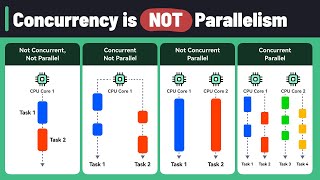
Concurrency allows a program to manage multiple tasks efficiently, even on a single CPU core, by rapidly switching between tasks via context switching, creating an illusion of simultaneous progress.
The CPU works on each task for a short time before switching to the next. This process, called context switching, saves and restores task states, but comes with overhead that can hurt performance if excessive.
Parallelism involves executing multiple tasks simultaneously using multiple CPU cores, where each core handles a different task independently, like two chefs cooking different dishes at the same time.
Concurrency is great for tasks that involve waiting, such as I/O operations, because it allows other tasks to progress during the wait. A web server can handle multiple requests concurrently on a single core.
Parallelism shines for data analysis, rendering graphics, and other compute-heavy tasks that can be divided into independent subtasks and executed on different cores.
Web applications use concurrency to manage user inputs, database queries, and background tasks for a responsive user experience.
Machine learning, video rendering, scientific simulations, and big data frameworks like Hadoop and Spark all leverage parallelism to speed up processing.
While concurrency and parallelism differ, concurrency is a foundation for parallelism by structuring programs into smaller independent tasks that can be distributed across multiple cores for efficient parallel execution.
Concurrency manages multiple tasks for responsiveness, while parallelism boosts performance by executing computation-heavy tasks simultaneously. Understanding both allows for more efficient systems.
Mentioned in this Video
Study Flashcards (6)
What is concurrency?
easy
Click to reveal answer
What is concurrency?
Concurrency is the ability to manage multiple tasks at once, even on a single CPU core, by switching between them.
[00:00]
What is context switching?
medium
Click to reveal answer
What is context switching?
The process where the CPU saves and restores the state of tasks as it switches between them, creating an illusion of simultaneous progress.
[00:27]
What is parallelism?
easy
Click to reveal answer
What is parallelism?
Parallelism is the simultaneous execution of tasks using multiple CPU cores.
[00:54]
Which type of operation benefits most from concurrency?
medium
Click to reveal answer
Which type of operation benefits most from concurrency?
I/O operations—because they involve waiting and other tasks can progress during the wait.
[01:25]
Name one example of a task that benefits from parallelism.
easy
Click to reveal answer
Name one example of a task that benefits from parallelism.
Video rendering, machine learning training, scientific simulations, or big data processing (accepted answers).
[02:14]
How can concurrency enable parallelism?
hard
Click to reveal answer
How can concurrency enable parallelism?
By structuring a program into smaller independent tasks, it becomes easier to distribute those tasks across cores and execute them in parallel.
[02:53]
💡 Key Takeaways
Concurrency explained
Provides a clear definition of concurrency as managing multiple tasks, using a relatable multi-chef analogy.
[00:00]Concurrency ideal for I/O-bound tasks
Makes a practical connection between concurrency and web server efficiency, explaining hypothesis behind responsive apps.
[01:25]Concurrency enables parallelism
He clarifies the interplay between the two concepts, showing how concurrency serves as a foundation for parallel execution.
[02:53]Full Transcript
[00:00] Today, we're exploring an important topic in system design, concurrency versus parallelism. Understanding the difference between these concepts is essential for building efficient and responsive applications. Let's start with concurrency. Imagine a program that handles
[00:15] multiple tasks like processing user inputs, reading files, and making network requests. Concurrency allows your program to juggle these tasks efficiently, even on a single CPU core.
[00:27] Here's how it works. The CPU rapidly switches between tasks, working on each one for a short amount of time before moving to the next. This process, known as context switching, creates the illusion that tasks are progressing simultaneously, though they are not.
[00:42] Think of it like chefs working on multiple dishes. They prepare a dish for a bit, then switch to another, and keep alternating. While the dishes aren't finished simultaneously, progress is made on all of them.
[00:54] However, context switching comes with overhead. The CPU must save and restore the state of each task which takes time Excessive context switching can hurt performance Now let talk about parallelism This is where multiple tasks are executed simultaneously
[01:09] using multiple CPU cores. Each core handles a different task independently at the same time. Imagine a kitchen with two chefs. One chops vegetables while the other cooks meat. Both tasks happen in parallel and the meal is ready faster. In system design, concurrency is
[01:25] great for tasks that involve waiting, like I.O. operations. It allows other tasks to progress during the wait, improving overall efficiency. For example, a web server can handle multiple requests concurrently, even on a single core. In contrast, parallelism excels at heavy computations
[01:43] like data analysis or rendering graphics. These tasks can be divided into smaller independent subtasks and executed simultaneously on different cores, significantly speeding up the process.
[01:55] Let's look at some practical examples. Web applications use concurrency to handle user inputs, database queries and background tasks smoothly providing a responsive user experience Machine learning leverages parallelism for training large models By distributing the training data across multiple cores or machines
[02:14] you can significantly reduce computation time. Video rendering benefits from parallelism by processing multiple frames simultaneously across different cores, speeding up the rendering process.
[02:27] Scientific simulations utilize parallelism to model complex phenomena, like weather patterns or molecular interactions across multiple processors. Big data processing frameworks such as Hadoop and Spark
[02:40] leverage parallelism to process large datasets quickly and efficiently. It is important to note that while concurrency and parallelism are different concepts, they are closely related. Concurrency is about managing multiple tasks at once,
[02:53] while parallelism is about executing multiple tasks at once. Concurrency can enable parallelism by structuring programs to allow for efficient parallel execution. Using concurrency we can break down a program into smaller independent tasks making it easier to take advantage of parallelism These concurrent tasks can be distributed across multiple CPU cores
[03:15] and executed simultaneously. So, while concurrency doesn't automatically lead to parallelism, it provides a foundation that makes parallelism easier to achieve. Programming languages with strong concurrency primitives
[03:27] simplify writing concurrent programs that can be efficiently parallelized. Concurrency is about efficiently managing multiple tasks to keep your program responsive, especially with IO-bound operations.
[03:39] Parallelism focuses on boosting performance by handling computation-heavy tasks simultaneously. By understanding the differences and interplay between concurrency and parallelism, and leveraging the power of concurrency to enable parallelism,
[03:53] we can design more efficient systems and create better performing applications. If you like our video, you might like our system design newsletter as well. It covers topics and trends in large-scale system design, trusted by 500,000 readers.