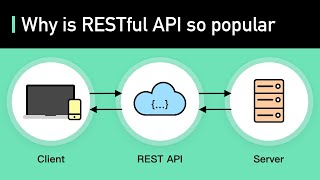

What is REST API?
45sQuick, clear definition of a core concept that many beginners seek, making it highly shareable.
▶ Play ClipREST is the most common communication standard between computers over the internet. This video explains what an API is, defines REST (REpresentational State Transfer), and covers key principles like statelessness, resource URIs, HTTP verbs, status codes, pagination, and versioning. It concludes by noting REST’s simplicity and comparing it briefly to GraphQL and gRPC.
REST is the most popular API standard used by mobile and web applications to talk to servers.
API is a way for two computers to talk; REST stands for REpresentational State Transfer and is a set of rules for building web APIs.
Examples include Twilio, Stripe, and Google Maps.
Resources are organized by URIs and should be grouped by noun, not verb (e.g., /products not /getAllProducts).
POST creates, GET reads, PUT updates, DELETE removes (CRUD).
Requests may contain an optional JSON body; responses include an HTTP status code and optional data payload.
2xx success, 4xx client error (e.g., bad syntax), 5xx server error (e.g., service unavailable).
Idempotent APIs (GET, PUT, DELETE) allow safe retries; POST is typically not idempotent.
REST should be stateless—each request/response is independent, making scaling easier.
Use pagination (limit/offset) for large datasets; version APIs (e.g., /v1/products) for backward compatibility.
REST remains widely used because it is simple, effective, and good enough for most applications. Other options like GraphQL and gRPC exist and will be compared in future videos.
What does REST stand for?
REpresentational State Transfer
0:27
List the four HTTP verbs used in CRUD and their meanings.
POST (create), GET (read), PUT (update), DELETE (remove)
1:49
What does a 404 status code indicate?
Not explicitly stated, but 4xx codes mean client error. 404 specifically means 'not found' (common knowledge). In the video, 4xx means 'something was wrong with our request' (e.g., incorrect syntax).
2:45
What is the key benefit of statelessness in REST?
It makes web applications easy to scale.
3:38
Why is a POST request usually not idempotent?
Because making multiple identical POST requests can create multiple resources, unlike GET, PUT, or DELETE.
3:05
Why REST is popular
Defines REST as the de facto standard for web APIs since the early 2000s.
0:14URI naming convention
Concrete rule: group resources by noun, never verb.
1:10HTTP status code usage
Clear explanation of 2xx/4xx/5xx codes and their meaning for API behavior.
2:38Statelessness as scaling enabler
Identifies the critical architectural property that makes REST easy to scale.
3:38[00:07] REST is the most common communication standard
[00:14] is it so popular? Let's take a look. API stands
[00:21] a way for two computers to talk to each other.
[00:27] web applications to talk to the servers is called
[00:34] It is a mouthful. What does that mean? REST is not
[00:41] has been the common standard for building web API
[00:48] standard is called a RESTful API. Some real-life
[00:56] Let's look at the basics of REST. A RESTful API
[01:04] Uniform Resource Identifiers. The URIs
[01:10] on a server. Here are some examples. The resources
[01:19] get all products should be slash products and not
[01:27] resource by making a request to the endpoint for
[01:34] specific format, as shown here. The line contains
[01:41] The URI is preceded by an HTTP verb which tells
[01:49] A POST request means we want to create a
[01:55] the data about an existing resource. A PUT is
[02:02] for removing an existing resource. You might have
[02:10] In the body of these requests, there could be
[02:15] a custom payload of data, usually encoded in
[02:23] and formats the result into a response. The first
[02:31] to tell the client what happened to the request.
[02:38] HTTP status codes. The 200-level codes mean the
[02:45] something was wrong with our request. For example
[02:52] level, it means something went wrong at the server
[02:59] A well-behaved client could choose to retry a
[03:05] said "could choose to retry" because some actions
[03:12] when retrying. When an API is idempotent, making
[03:19] as making a single request. This is usually not the
[03:26] The response body is optional and could contain
[03:34] There's a critical attribute of
[03:38] A REST implementation should be stateless. It
[03:44] information about each other, and every request
[03:50] This leads to web applications that are easy to
[03:57] to discuss to round out a well-behaved RESTful API.
[04:05] use pagination. A common pagination scheme
[04:12] an example. If they are not specified, the server
[04:20] versioning of an API is very important. Versioning
[04:27] compatibility, so that if we introduce breaking
[04:33] can get enough time to move to the next version.
[04:40] straightforward is to prefix the version before
[04:48] RESTful API is simple and effective when
[04:54] choice for all companies, but it is simple and
[05:00] There are other popular API options like GraphQL
[05:09] separate videos. If you would like to learn more about system
[05:14] Please subscribe if you learned something new.

⚡ Saved you 0h 05m reading this? Transcribe any YouTube video for free — no signup needed.