
AI That Writes Its Own Code?
45sThe concept of a self-extending AI that creates new features on demand is mind-blowing and highly shareable.
▶ Play Clip"Title promises self-upgrading AI and the video delivers on that core promise, though it includes a sponsor segment and some fluff."
DeepSeek has released a free and open-source AI harness that allows users to customize and extend AI systems, with the unique ability for the program to rewrite itself. The video explains the four key features of this harness, the underlying technical mechanisms, and its practical applications.
DeepSeek provides a free and open-source harness that gives AI 'arms and legs' to perform tasks, and it can rewrite itself upon request.
The harness stands out due to: 1) fully customizable user interface, 2) customizable agents (e.g., code review mode), 3) the program can rewrite itself, and 4) it is lean and efficient.
Users can ask for features that don't exist, like a research mode or a local AI lab, and the system creates them specifically for the user.
An 88-page paper explains the system's design, including automatic cleanup instructions and reversible changes, ensuring stability despite modifications.
The undo machinery works like a coat check ticket: separate from the action but enables safe reversion, baked deeply into the system.
AI operating systems can now be recreated on the fly, tailored to individual users, with hundreds of plugins already available days after release.
DeepSeek's harness represents a significant step toward adaptive AI systems that can be customized and extended dynamically, offering both power and flexibility for users.
What are the four key features of DeepSeek's harness?
1) Fully customizable UI, 2) customizable agents, 3) self-rewriting capability, 4) lean and efficient design.
00:33
How does the undo mechanism work in the system?
It works like a coat check ticket: separate from the action but enables safe reversion, baked into the system.
03:00
What is the significance of the 88-page paper?
It describes the background of the harness, including automatic cleanup instructions and reversible changes.
02:28
Self-Rewriting Program
This is the core innovation: the program can rewrite itself, not just be customized by users.
01:32Undo Mechanism Analogy
The coat check analogy makes a complex technical concept accessible and memorable.
03:00Adaptive Operating Systems
Highlights a paradigm shift: AI operating systems can now be recreated on the fly for individual users.
03:31[00:03] program that writes itself. Just ask for something that doesn't exist, and there something that doesn't exist, and there it is. A self-extending AI, if you will. Okay, so what is this? Deep Seek has given us amazing free and open weights
[00:18] AI systems, and now a free and open-source harness. This is what gives open-source harness. This is what gives your AI arms and legs to actually make it able to do things for you. But, wait. Harnesses are not new. There's Spy,
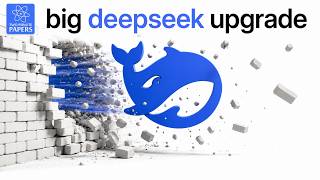
[00:33] there's Open Code. How is this different? Why use it? Well, four things. One, the user interface can be completely rewritten. That is the thing with the flying whale or putting the snake in the harness that you see in the
[00:48] promo video. By the way, snake in the harness, that's not a term you use very often, is it? But, in this corner of the internet, it is normal. Welcome to Two Minute Papers. Two, the
[01:01] agents inside the harness can also be customized. You see a code review mode added here that tells the AI to look at a code base, find issues, and rank them by severity. That was just made up on the spot. So, every major part can be
[01:18] rewritten. But, three, this is the most important. Now, hold on to your papers, fellow scholars, because it's not you who rewrites the program, but the program rewrites itself. Now, that is
[01:32] the key. Just ask for something that doesn't even exist, and it creates it specifically for you. Ask it for a research mode where it checks a document's claims against real research papers. Super good. Ask for a local AI
[01:46] lab that monitors your token speed and GPU memory. Doing video production? Ask [clears throat] for a storyboard and for an agent for planning your shots. This is incredible. Four, it does all this
[02:00] while it is incredibly lean and efficient. You can save some time and efficient. You can save some time and money using it. Brilliant. Okay, so how the heck did they do that? What is this black magic? Dear fellow scholars, this
[02:12] is Two Minute Papers with Dr. Károly Zsolnai-Fehér. Well, it's not just finger practice. We have a proper 88-page paper describing the background of it. And I am going to give you some beautiful hieroglyphs and then actually
[02:28] try to explain what they mean in simple words. Now, all this tinkering sounds great, but it sooner or later will have the program fall apart. So, why is this not falling apart? Well, look at this beauty. This beautifully says that with
[02:44] every change comes clean up instructions and the system remembers them automatically. New components can be safely removed. Everything is reversible. And the key is that it is baked deeply into the system. And an
[03:00] additional tasty tidbit for you brilliant fellow scholars, here is another clever part. The undo machinery can live beside the original action without changing the action itself. So, you hand over your coat at the coat
[03:16] you hand over your coat at the coat check and you get a ticket. Yes, the ticket is separate from the coat but gives the system what it needs to revert this action later to get your coat back. Okay, so where does this put us? Well,
[03:31] AIs are getting so smart and so fast that the operating system around them should no longer be fixed. It is now able to recreate it on the fly and
[03:43] tailor it specifically to you. That is unbelievably amazing. Thank you so much. And only days after release, it already has hundreds of plugins by you brilliant
[03:55] fellow scholars. So, run all this locally on your own machine or on Lambda. No tracking, no games with token limits. What a time to be alive. Subscribe and hit the bell if you enjoyed this. I use Lambda to reproduce
[04:11] AI research papers often in minutes. It's also great to train your own models or fine-tune an existing one. Run inference or text-to-image or video, easy-peasy. Running a deep fake chatbot or agent, super fast, super reliable.
[04:27] Lambda gives you powerful Nvidia GPUs to run your own experiments. I test ideas from the papers I cover and moments later, results. Love it. Seriously, try
[04:39] later, results. Love it. Seriously, try it out now at lambda.ai/papers.


⚡ Saved you 0h 04m reading this? Transcribe any YouTube video for free — no signup needed.