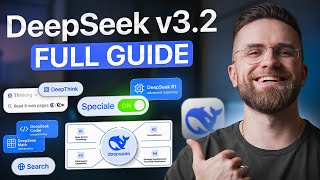

Free AI Beats GPT-5?
45sOpening with shocking benchmark comparisons (96% vs 94.6%) challenges viewer assumptions about paid AI, creating immediate curiosity and engagement.
▶ Play Clip"The title mentions DeepSeek vs Gemini 3.0 but the video is almost entirely a tutorial for DeepSeek V3.2, with only a brief comparison. However, the content does deliver a full guide and tutorial, matching the core promise."
DeepSeek V3.2 is a free, open-source AI model that rivals top premium models in math and reasoning benchmarks. The video guides users on how to use its web interface, showcasing its capabilities in writing, data analysis, and coding. The creator discusses the two available versions and provides a practical tutorial for integrating the tool into daily workflows.
DeepSeek V3.2 is a free AI model that scored 96% on the American Invitational Mathematics Examination (AIME) and matches or beats GPT-5 and Gemini 3 Pro on reasoning benchmarks.
DeepSeek V3.2 has two versions: Standard V3.2, an everyday workhorse for general tasks, and V3.2 Special, a high-compute model focused on deep reasoning and competition coding.
DeepSeek V3.2 integrates thinking directly into tool use, preserving reasoning traces across multiple tool calls for better multi-step problem solving.
Setup takes about 60 seconds: go to chat.deepseek.com, sign up with Google, and access the chat interface with 'Deep Think' toggle for reasoning mode.
With 'Deep Think' mode enabled, DeepSeek creates detailed outlines for articles, breaking down the structure and audience needs before generating output.
DeepSeek can upload CSV/PDF files and return structured summaries, such as sales data insights or key takeaways, without coding.
No coding knowledge is needed: DeepSeek can generate and preview playable games or web apps (like a snake game or to-do list) right in the chat window.
Using 'Deep Think', DeepSeek reasons through a complex business prompt (growth plan) and delivers a structured output with specific action items.
DeepSeek wins on cost (free), transparency (visible thinking), math reasoning, and open weights. ChatGPT and Gemini win on polish, integrations, and stability.
Eight tips are provided: structure prompts with markdown, use 'think and answer' format, be hyper-specific, use personas, ask for multiple approaches, request self-checks, use placeholders, and iterate.
DeepSeek V3.2 is a capable, free alternative to ChatGPT and Gemini for most daily tasks, especially writing, analysis, and coding. Its open-weight nature and transparent reasoning make it a strong choice for users who do not rely on premium ecosystems.
What score did DeepSeek V3.2 achieve on the American Invitational Mathematics Examination (AIME)?
96%
1:18
What are the two versions of DeepSeek V3.2 and their primary differences?
Standard V3.2 is for everyday tasks (fast, GPT-5 level performance); V3.2 Special is for deep reasoning (higher token usage, API-only research preview).
1:44
Why will the DeepSeek V3.2 Special API endpoint expire on December 15, 2025?
Because it is token-hungry (uses 77,000 tokens to solve one codeforces problem) and inference costs are high. It is a research preview.
2:43
What is the unique feature of DeepSeek V3.2 regarding tool use compared to other models?
It preserves the reasoning trace across multiple tool calls, so it does not need to restart reasoning from scratch after each call.
2:20
What is the scoring of DeepSeek V3.2 on Codeforces (standard version)?
2386, which puts it in the top 1% of competitive programmers globally.
3:34
In which languages should you prompt DeepSeek for best results, and why?
English or Chinese. Other languages go through a translation layer that can produce hit-or-miss results.
7:07
What prompt format is recommended for reasoning tasks to get more tailored responses?
Use 'think and answer' format: a 'think' section for background context and an 'answer' section for the specific request.
19:39
According to the video, what scores did GPT-5 and DeepSeek V3.2 get on AIME 2025 without tools?
GPT-5 scored 94.6%; DeepSeek V3.2 scored 87.5%.
16:26
What is the main difference in how ChatGPT and DeepSeek show their reasoning process?
DeepSeek often shows its visible thinking process (chain of thought), while ChatGPT and Gemini usually show only the result and a brief explanation.
16:09
How many parameters does DeepSeek V3.2 have, and how many are active per token?
671 billion total parameters, but only 37 billion active per token due to mixture of experts architecture.
4:37
What toggle should be turned on for complex multi-step problem solving in DeepSeek?
The 'Deep Think' toggle, which enables extended reasoning mode.
5:36
What are the three areas where ChatGPT and Gemini still win over DeepSeek?
Polish (more refined interfaces), integrations (GPTs, Workspace), and stability (fewer server busy messages).
17:00
DeepSeek’s Quiet Rise
Shows how a free open-source model has silently achieved top-tier benchmark results, often beating premium models.
0:51Thinking Integrated into Tool Use
DeepSeek’s unique architecture preserves reasoning across tool calls, enabling smoother multi-step workflows without restarting logic.
2:14No-Code Game Creation
Demonstrates that users can generate and play interactive code in the chat interface without any programming skills.
11:02Honest Comparison with Premium Models
Provides a balanced view of when DeepSeek can replace paid tools and where it still falls short, helping users make informed decisions.
15:36Prompt Engineering Best Practices for DeepSeek
Structured, persona-based, and iterative prompting techniques maximize output quality, forming a practical guide for users.
18:45[00:00] You're paying $20 a month for Gemini or
[00:03] Chad GPT. Meanwhile, there's a free AI
[00:06] model that just hit 96% on the toughest
[00:09] math benchmark in the world, matches
[00:12] GPT5 in reasoning, and won gold medals
[00:15] at international coding competitions.
[00:17] And I'm willing to bet most of you have
[00:19] never even tried it. It's called
[00:21] Deepseek V3.2. It dropped December 1st,
[00:24] completely free, completely open source,
[00:26] and it's shockingly good. Most people
[00:28] forgot Deepseek even exists. That's a
[00:30] mistake because in the next 20 minutes,
[00:33] I'm going to show you how to use this
[00:35] thing for real work, writing, research,
[00:37] coding, data analysis, all without
[00:40] touching a single line of code. You'll
[00:42] see which version to use when thinking
[00:44] mode actually matters and whether you
[00:46] can finally ditch your Chat GPT or
[00:49] Gemini subscription. So, let's go. So,
[00:51] here's the situation. Back in January,
[00:53] Deepseek made headlines with their R1
[00:55] model. cheap to train, open source,
[00:57] performed like the big boys. Then
[00:59] everyone moved on. Open AAI launched
[01:02] GPT5. Google dropped Gemini 3 Pro. The
[01:06] hype cycle kept spinning and Deepseek
[01:08] just kept building. On December 1st,
[01:10] 2025, they quietly released version 3.2
[01:14] and the benchmarks are wild. 96% on the
[01:18] American Invitational Mathematics
[01:20] Examination. That's M, one of the
[01:22] hardest math test on the planet. For
[01:24] context, GPT5 High scored 94.6. Deepseek
[01:28] beat it. On the Harvard MIT math
[01:30] tournament, Deepseek hit 99.2%.
[01:33] Gemini 3 Pro scored 97.5.
[01:36] Again, Deep Seek wins. But here's the
[01:39] thing. This isn't just one model.
[01:41] Deepseek V3.2 comes in two flavors.
[01:44] Standard V3.2, which is your everyday
[01:47] workhorse. Fast, reliable GPT5 level
[01:51] performance. Think of it as your Chad
[01:53] GBT replacement. Then there's V3.2
[01:56] Speciial. And Special is the beast.
[01:58] Maxed out reasoning, deep chain of
[02:01] thought. This thing won gold medals at
[02:03] the International Mathematical Olympiad,
[02:06] the International Olympiad in
[02:07] Informatics, second place at the ICPC
[02:10] World Finals. We're talking elite
[02:12] competition level AI. And here's what
[02:14] makes this release different. Deep Seek
[02:16] V3.2 2 is the first model to integrate
[02:20] thinking directly into tool use. Most AI
[02:23] models lose their train of thought every
[02:25] time they call an external tool. They
[02:27] have to restart reasoning from scratch.
[02:29] Deepseek preserves the reasoning trace
[02:32] across multiple tool calls. That means
[02:34] smoother workflows, better agent
[02:36] performance, and way more reliable
[02:38] multi-step problem solving. Now, there
[02:40] is one catch with special. It's API only
[02:43] right now and that API endpoint expires
[02:46] December 15th, 2025. Why? Because it's
[02:49] token hungry. To solve one code forces
[02:52] problem, Special uses 77,000 tokens.
[02:55] Gemini uses 22,000. The inference costs
[02:58] are insane. So, Deep Seek is treating
[03:00] Special as a research preview. After
[03:02] December 15th, they'll likely roll it
[03:05] into a more efficient production version
[03:07] or just keep the standard model as the
[03:09] main offering. But the standard V3.2 too
[03:12] that's available right now free on the
[03:14] web on mobile open source under an MIT
[03:17] license no credit card no limits and it
[03:20] performs at GPT5 level this isn't a toy
[03:23] this is production ready AI let me break
[03:26] down the two models so you know which
[03:27] one to use standard V3.2 2. This is the
[03:30] daily driver. It scored 93.1% on Emmy
[03:34] 2025. Code forces rating of 2386.
[03:38] That puts it in the top 1% of
[03:40] competitive programmers globally. It's
[03:42] fast, it handles tool use, and it's free
[03:45] via the web interface at
[03:46] chat.deseek.com.
[03:48] Use this for writing, brainstorming,
[03:50] quick analysis, code, and tasks, and
[03:52] anything you'd normally throw at chat
[03:55] GPT. Then there's V3.2 special. This is
[03:58] the high compute reasoning monster. 96%
[04:02] on Amy, 99.2 on the Harvard MIT math
[04:05] tournament, gold medals at IMO, IOI,
[04:08] ICPC, and the Chinese math Olympiad.
[04:11] Special is designed for deep reasoning,
[04:14] multi-step proofs, complex research,
[04:16] heavy analysis, but it doesn't support
[04:18] tool calling right now. It's pure
[04:20] thinking mode, and it's only available
[04:22] through the API until December 15th. Why
[04:25] can't you install Special locally yet?
[04:28] It's in a research beta phase. The model
[04:30] is publicly available on hugging phase,
[04:32] but running it requires serious
[04:35] hardware. 671
[04:37] billion parameters total, but only 37
[04:40] billion active per token thanks to the
[04:43] mixture of experts architecture. You'd
[04:45] need multiple high-end GPUs and
[04:48] distributed compute to run it smoothly.
[04:50] The standard V3.2 too. It's easier to
[04:54] self-host if you've got the hardware,
[04:56] but for most people, the web interface
[04:58] is the way to go. Rule of thumb,
[05:00] standard for speed, special for depth.
[05:02] But since Special is temporary and API
[05:05] gated, I'm going to focus this tutorial
[05:07] on the standard V3.2 model, which is
[05:10] what you can actually use today without
[05:12] jumping through hoops. All right, let's
[05:14] get you set up. This takes about 60
[05:16] seconds. Step one, open your browser and
[05:19] go to chat.deseek.com.
[05:21] You'll see a simple landing page. Click
[05:23] sign up. I just used the Google signin
[05:25] option. One click. No password to
[05:27] remember. Done. Step two. Once you're
[05:29] in, you'll see the main chat interface.
[05:32] The prompt box is right in the center.
[05:34] Below it, you've got two toggles. One
[05:36] says deep think. That enables extended
[05:39] reasoning mode where the AI thinks
[05:41] through your problems step by step. The
[05:44] other toggle is search, but as of right
[05:46] now, it's not reliably working. When it
[05:49] does work, it functions like Chad GBT's
[05:51] web search, but don't rely on it yet.
[05:53] You also see a file upload button.
[05:56] Deepseek is multimodal. You can upload
[05:58] text files, spreadsheets, PDFs, images.
[06:01] It'll extract the text and work with it.
[06:03] No video or audio support yet, but for
[06:06] documents and data, it's solid. On the
[06:08] left side, you've got your chat history.
[06:10] You can rename or delete chats by
[06:12] clicking the three dots next to each
[06:14] one. There's also a QR code button to
[06:17] download the mobile app, which I'll show
[06:18] you in a second. Step three,
[06:20] understanding the interface. In normal
[06:22] mode, Deep Seek gives you a
[06:24] straightforward answer. Simple, clean,
[06:27] fast. But when you enable deep think,
[06:29] something interesting happens. The AI
[06:32] thinks for several seconds first. You
[06:34] literally watch its thought process
[06:36] unfold in real time. Then it delivers
[06:39] the final answer. This is where you see
[06:41] the reasoning chain, the trade-offs.
[06:42] it's considering the logic behind its
[06:44] response. Step four, enable deep think
[06:47] when you need it. If you're doing
[06:48] something simple like writing an email
[06:50] or brainstorming ideas, leave it off.
[06:53] The model responds faster. But if you're
[06:55] working on complex problem solving,
[06:57] research, or multi-step tasks, turn on
[07:00] Deepthink. The model will take longer to
[07:02] respond, but the quality goes way up.
[07:05] Pro tip: Prompt in English or Chinese
[07:07] only. Deepseek's training is optimized
[07:09] for those two languages. Other languages
[07:11] go through a translation layer and the
[07:14] results can be hit or miss. If you need
[07:16] the output in another language, prompt
[07:18] in English first, then ask DeepSk to
[07:21] translate the final answer. That's it.
[07:23] You're set up. Now, let's put this thing
[07:25] to work. This is where it gets
[07:26] interesting. I'm going to show you five
[07:28] real use cases. Some are practical, some
[07:32] are just fun. All of them work without
[07:34] coding, without APIs, and without local
[07:36] installs. Just your browser and a
[07:38] prompt. Let's start with writing. I'm
[07:41] going to ask Deepseek to create a long
[07:43] form article outline. I'll turn on deep
[07:46] think so it thinks through the structure
[07:49] prompt. Create a detailed outline for a
[07:51] 2,000word article on remote work
[07:53] productivity. Include five main
[07:55] sections, each with three sub points.
[07:58] Target audience is freelancers and small
[08:00] business owners. Make it actionable.
[08:02] Watch what happens. Deepseek thinks
[08:04] first, breaking down the prompt. It's
[08:07] identifying the audience, thinking about
[08:08] pain points, structuring the flow. Then
[08:11] it delivers a clean, hierarchical
[08:13] outline with specific subtopics. No
[08:16] fluff, just structure. This is where
[08:18] Deep Seek shines for content work.
[08:21] You're not just getting an answer.
[08:22] You're seeing the reasoning. And if you
[08:24] don't like a section, you can ask it to
[08:26] revise just that part without starting
[08:28] over. Here's something cool. We've been
[08:30] using Deep Seek for text, but what about
[08:33] video? Because that's the other part of
[08:35] content creation. most people struggle
[08:37] with. I've been testing Luma AI's RA3
[08:40] modify for the visuals in this video.
[08:42] And the workflow is honestly
[08:44] fascinating. It's not just type a prompt
[08:46] and hope for the best. There is this
[08:48] reasoning engine built in that actually
[08:50] thinks through what you're trying to
[08:52] create before it starts generating.
[08:54] Here's how it works. You either type a
[08:56] detailed prompt or upload an image as
[08:59] your starting point. Ray 3 modify
[09:01] analyzes your creative intent, figures
[09:03] out the physics, lighting, motion paths,
[09:06] all of that. Then it gives you two
[09:08] generation modes. Draft mode, which is
[09:10] incredibly fast and cheap. Use that to
[09:12] experiment and iterate. Once you nail
[09:15] the concept, you upscale to hi-fi 4K HDR
[09:19] for your final render. But the real game
[09:22] changer, it's visual annotation. Instead
[09:24] of writing a 10-line prompt trying to
[09:26] describe motion, just draw on the image.
[09:30] Circle an object, draw an arrow showing
[09:32] how you want it to move. Ray 3 modify
[09:35] handles the rest. The physics, the
[09:37] lighting transitions, the camera work,
[09:39] it all just works. I tested this with a
[09:41] product demo concept. Started in draft
[09:44] mode, tweaked the motion a few times,
[09:46] then rendered the final 4K version. The
[09:49] output was clean enough to use straight
[09:51] out of the box. no post-processing. And
[09:54] compared to other AI video tools I've
[09:56] tried, this one actually preserves
[09:58] anatomy and handles complex motion
[10:00] without the usual AI artifacts. If
[10:03] you're building content, product videos,
[10:05] or anything visual, Ray 3 modify is
[10:08] worth trying. You can find it at
[10:09] dreamachine.lumalabs.ai.
[10:12] They give you credits to start so you
[10:14] can test draft mode and visual
[10:16] annotation yourself. Link below. All
[10:18] right, back to Deep Seek. Now, let's
[10:20] test file handling. I'm going to upload
[10:22] a sample CSV file with sales data. Then
[10:25] I'll ask Deepseek to analyze it. Prompt:
[10:28] Analyze this sales data. Give me the top
[10:30] three insights and identify any
[10:32] concerning trends. Deepseek reads the
[10:34] file, processes the data, and returns a
[10:37] structured summary. It highlights that
[10:39] Q3 revenue dropped 15%, identifies the
[10:43] underperforming product category, and
[10:45] flags a regional sales dip. All in plain
[10:48] English. No pivot tables, no formulas,
[10:51] just insights. You can also upload PDFs
[10:54] and ask for summaries, key takeaways, or
[10:57] specific extractions. For research work,
[11:00] this is a massive timesaver. All right,
[11:02] this is the showstopper. I'm going to
[11:04] show you three things you can build in
[11:06] Deep Seek right now. No coding knowledge
[11:08] required. These are instant playable
[11:11] visual demos. First, let's start with
[11:14] something fun. generating a simple
[11:16] JavaScript game and playing it right
[11:18] inside DeepSseek prompt. Create a simple
[11:21] snake game in HTML and JavaScript that I
[11:24] can play right now. Deepseek writes the
[11:26] code. A preview button appears. I click
[11:29] it. Boom. The game loads in the
[11:31] interface. I'm playing Snake inside the
[11:34] AI chat window. No libraries, no
[11:37] installs. 15 seconds from prompt to
[11:40] playable game. Now, let's take it a step
[11:42] further and build a simple space shooter
[11:44] arcade game. Prompt: Build a simple
[11:47] space shooter arcade game with HTML 5
[11:50] canvas. Make it playable. Again, Deep
[11:53] Seek generates the code. I hit preview.
[11:55] The game loads. I'm firing shots at
[11:58] targets. It works. Chad GPT would give
[12:01] you the code and tell you to paste it
[12:02] somewhere. Deep Seek lets you run it.
[12:05] And now, let's switch gears and create a
[12:07] simple to-do list app. Prompt. Create a
[12:10] to-do list app with add and delete
[12:12] functionality. Full web app, interactive
[12:14] UI. I can add tasks, delete tasks, check
[12:17] them off. It's live. It's functional.
[12:20] And I didn't write a single line of
[12:22] code. Now, before I move on to comparing
[12:24] Deep Seek with CHG GBT and Gemini, let
[12:26] me show you something that we've built.
[12:28] While you're learning DeepS or any AI
[12:31] tool for that matter, I can't stress
[12:33] enough how helpful it is to have
[12:35] everything in one place. That's exactly
[12:38] why I built AI Master Pro. It's an
[12:40] all-in-one AI hub where you're not just
[12:43] watching tutorials. You're actually
[12:44] applying what you learn in real time.
[12:47] Here's what's inside. The AI Master
[12:49] Method course which walks you through AI
[12:51] foundations, workflows, and how to
[12:53] actually sell AI services. Over a 100
[12:56] lessons, templates, PDFs, everything you
[12:58] need to go from beginner to building
[13:00] real AI products in four weeks. But the
[13:03] course is just the starting point. What
[13:04] I actually use every single day are the
[13:07] AI tools built right into the platform.
[13:09] There's a personal AI master trained on
[13:12] unique data that can teach you anything
[13:14] about AI 24/7. You can generate
[13:17] highquality prompts on the fly and with
[13:20] integrated tools like Sora, VO, Nano
[13:23] Banana directly into the platform. So if
[13:26] you join before the end of 2025, you
[13:29] will get bonus generation credits. You
[13:31] also get Prompt Lab Pro, 300 plus
[13:34] readyto-use prompts you can copy and
[13:36] paste, discounts on other AI tools, and
[13:38] a curated weekly AI digest so you never
[13:41] fall behind on what's new, so you can
[13:44] learn AI and use AI in the same place.
[13:47] No tab switching, no trying to remember
[13:50] which tool does what. Everything's
[13:52] organized. Everything's accessible and
[13:54] honestly, I'm on the platform every
[13:56] single day. If you want to check it out,
[13:58] we're offering a huge discount for the
[14:00] first thousand people who join the
[14:02] annual plan. Link below. All right, back
[14:04] to Deepseek. Let's push it harder. I'm
[14:07] going to give Deepseek a multi-step
[14:09] business problem and watch how it
[14:11] handles it. Prompt: I'm launching a
[14:13] subscription software product. Price is
[14:15] $49 per month. Target market is
[14:18] freelancers. I need a six-month growth
[14:21] plan. include customer acquisition
[14:23] strategy, price and experiments, and
[14:25] retention tactics. Show your reasoning.
[14:28] With Deepthink on, Deep Seek spends
[14:30] about 6 seconds thinking. It's breaking
[14:33] down the problem, customer personas,
[14:35] acquisition channels, pricing,
[14:36] sensitivity, retention metrics. Then it
[14:40] delivers a structured six-month plan
[14:42] with specific action items for each
[14:44] month. This is where the extended
[14:46] reasoning really pays off. You're not
[14:48] getting a generic answer. you're getting
[14:50] a plan that actually considered
[14:52] tradeoffs. Finally, let's test tool use.
[14:55] This is where V3.2's new architecture
[14:58] shines. I'm going to ask it to calculate
[15:00] compound interest and show me the
[15:02] formula step by step. Prompt, calculate
[15:05] the compound interest on $10,000
[15:08] invested at 5% annually for 10 years.
[15:11] Show each step of the formula and the
[15:14] final result. Deepseek doesn't just give
[15:16] me the answer. It breaks down the
[15:18] formula. explains what each variable
[15:20] means, shows the calculation at each
[15:23] step, then gives the final number in a
[15:25] clean box. This is thank plus tool
[15:28] execution in one flow. For anyone doing
[15:30] research, analysis or learning, this is
[15:32] huge. You're not just getting results.
[15:34] You're seeing the work. Let's talk
[15:36] honestly. Can Deepseek actually replace
[15:39] Chat GPT or Gemini? The answer is it
[15:42] depends. Here's where Deepseek wins.
[15:44] Cost. Deepseek Chat is free, but API
[15:47] usage is paid. Chat GPT Plus is $20 a
[15:50] month. Claude Pro is 20. Google AI Pro
[15:53] with Gemini is about $19.99 per month in
[15:57] the US and around €21.99
[16:00] per month in Germany. Varies by region
[16:02] and taxes. If you're just using the chat
[16:04] interface, Deep Seek cost you nothing.
[16:07] Transparency. Deepseek often shows you
[16:09] the visible thinking process. Chad GPT
[16:12] and Gemini usually show the result and a
[16:14] brief explanation without the full chain
[16:17] of thought for learning debugging or
[16:19] understanding why you got a certain
[16:21] answer. Deepseek's transparency is a
[16:24] massive advantage. Math and reasoning.
[16:26] Deepseek R10528
[16:29] scores 87.5%
[16:31] on Me 2025 while GPT5 reports 94.6%
[16:36] without tools. So GPT5 is ahead, but
[16:39] Deep Seek is still very strong. If
[16:42] you're doing data analysis, research, or
[16:44] technical problem solving, Deep Seek
[16:46] holds its own against most models. Open
[16:49] weights. You can download the weights,
[16:51] run locally, and use commercially
[16:53] depending on the license. No vendor
[16:55] lockin. For businesses worried about
[16:57] data sovereignty, that's a big deal.
[17:00] Here's where Chad GPT and Gemini still
[17:02] win. Polish. Chad GBTs and Gemini's
[17:05] interfaces are more refined, better
[17:07] onboarding, smoother UX. Deep Seek feels
[17:10] more utilitarian integrations. Chad GPT
[17:14] has GTS with tools and actions, built-in
[17:17] image generation, browsing, data
[17:19] analysis. Gemini integrates with Google
[17:21] Workspace. Deepseek is bare bones. You
[17:24] get the model. That's it. Stability.
[17:27] Deep See can show server busy messages
[17:30] during peak demand. Paid incumbents
[17:32] often feel more consistent, but no
[17:34] service is immune to outages. Custom
[17:36] instructions. Chat GPT has account level
[17:39] custom instructions. Deepseek doesn't
[17:41] yet offer the same kind of persistent
[17:44] personalization in its chat UI, at least
[17:46] not at the same level. Here's my honest
[17:48] take. Can you replace chat GPT or Gemini
[17:51] entirely? If you're doing writing,
[17:53] research, analysis, and coding, yes,
[17:55] absolutely. Deep Seek is good enough. If
[17:57] you rely heavily on GPTs, need
[17:59] guaranteed uptime, or want a more
[18:02] polished experience, not yet. But for
[18:04] 80% of tasks, Deep Seek is shockingly
[18:07] capable and it's free to use. Let me
[18:09] show you a quick side by side. Same
[18:11] prompt, both models. Prompt: Explain how
[18:15] to improve website conversion rates in
[18:17] five steps. Chad GPT gives a clean,
[18:20] structured answer. Five steps, good
[18:22] advice. Deepseek gives a clean,
[18:25] structured answer. five steps. Also,
[18:28] good advice. In this quick test, the
[18:30] quality looks nearly identical. For most
[18:32] everyday tasks, the performance gap is
[18:35] minimal. The question is whether you
[18:37] value the Chad GPT or Gemini ecosystem
[18:40] or whether you just need a smart AI that
[18:43] gets the job done. Now, let's talk about
[18:45] prompting because the way you ask
[18:46] matters. Deepseek isn't Chad GPT. It has
[18:49] quirks and if you learn them, you'll get
[18:52] way better results. Tip one, formatting
[18:54] matters. If you're doing something
[18:56] complex, structure your prompts with
[18:59] clear sections. Deepseek responds
[19:01] incredibly well to markdown style
[19:03] formatting. Here's the template I use
[19:05] for any non-trivial task. Task colon
[19:08] what you want. Constraints colon any
[19:10] limitations. Output colon how you want
[19:13] the response formatted. For example,
[19:15] task analyze this sales report.
[19:18] Constraints focus on Q3 data only.
[19:20] Ignore outliers above $10,000. output
[19:24] bullet list with top three insights.
[19:26] Each insight under 50 words. Watch how
[19:30] clean that is. You've told the model
[19:31] exactly what to do, what to avoid, and
[19:34] what format you expect. No ambiguity, no
[19:37] back and forth. There's also a second
[19:39] format called think and answer. This
[19:42] one's powerful for reasoning tasks. You
[19:44] split your prompt into two sections
[19:46] using tags. The think section is your
[19:48] background context. The answer section
[19:51] is your specific request. Here's an
[19:53] example. Think I'm a freelance designer
[19:55] launching a new service. My target
[19:57] clients are small startups with budgets
[20:00] under $5,000. I need a pricing strategy
[20:03] that feels premium but accessible.
[20:06] Answer: propose three pricing tiers with
[20:09] specific dollar amounts and
[20:10] justifications for each. The thank
[20:12] section primes the model's reasoning.
[20:14] The answer section narrows the output.
[20:16] You get better, more tailored responses
[20:19] this way. Tip two, be hyper specific.
[20:22] Deep Seek needs detail way more than
[20:25] Chad GBT. Don't just say write an email.
[20:28] Say write a 200word professional email
[20:31] to a client named Sarah explaining a
[20:33] twoe project delay caused by supply
[20:36] chain issues. Tone should be apologetic
[20:38] but confident. Include a revised
[20:40] timeline and next steps. See the
[20:42] difference? You've given the model
[20:44] length, tone, recipient context, reason
[20:47] for the email and deliverables. Now, it
[20:49] has everything it needs to nail it on
[20:51] the first try. This applies to every
[20:53] task. If you're asking for a comparison,
[20:55] name both options and specify what
[20:58] criteria matter to you. If you're asking
[21:00] for a plan, state your constraints
[21:02] upfront. Time, budget, team size,
[21:05] whatever is relevant. Vague prompts give
[21:07] you vague answers. Specific prompts give
[21:10] you work you can actually use. Tip
[21:12] three, use personas. Tell Deepse seeek
[21:15] to act as someone. A career counselor, a
[21:17] financial analyst, a creative director,
[21:20] a systems engineer. This shapes the
[21:22] style and knowledge it brings to the
[21:24] response. Example, act as a senior
[21:26] product manager. Review this feature
[21:28] road map and identify the three biggest
[21:30] risks to hitting our Q2 launch date. The
[21:33] persona tells the model what lens to
[21:35] use. You're not just asking for generic
[21:37] feedback. You're asking for product
[21:39] management feedback. The output changes.
[21:41] I use this constantly for content work.
[21:43] Act as a copywriter specializing in
[21:46] landing pages. Rewrite this headline to
[21:48] be more benefit driven and under 10
[21:51] words. Boom. Focused output. No wasted
[21:53] tokens. Tip four. Ask for multiple
[21:56] approaches. Instead of asking how do I
[21:58] solve this problem, ask give me three
[22:00] ways to solve this problem with pros and
[22:03] cons for each. This forces the model to
[22:05] think deeper and consider trade-offs.
[22:07] You're not getting one solution. You're
[22:09] getting options. and options let you
[22:11] make better decisions. Example, I need
[22:13] to grow my email list by 5,000
[22:16] subscribers in 3 months. Give me three
[22:19] strategies. One, high effort, high
[22:21] reward, one loweffort, lowreward, and
[22:24] one experimental. Include estimated time
[22:27] commitment and success probability for
[22:29] each. That prompt gives you a strategic
[22:31] breakdown, not just ideas, evaluated
[22:34] ideas. Tip five, request selfch checks.
[22:37] After getting an answer, ask what are
[22:39] the potential risks with this approach?
[22:42] Or what assumptions are you making here?
[22:44] Deepseek's reasoning mode makes this
[22:46] especially powerful. You'll literally
[22:48] see it questioning its own logic. This
[22:50] is how you catch blind spots before they
[22:52] become problems. I do this on any high
[22:54] stakes task. Legal advice, ask for
[22:57] risks, financial projections, ask for
[22:59] assumptions, strategic plan, ask what
[23:02] could go wrong. The model will walk
[23:04] through failure modes you might not have
[23:06] considered. Tip six, placeholders for
[23:09] templates. If you're writing something
[23:10] reusable like an email template or a
[23:13] sales script, use placeholders. Prompt,
[23:15] write a cold email to potential clients,
[23:18] use company name, your name, and product
[23:21] name as placeholders. Then in the
[23:23] response, every mention will use those
[23:25] brackets. You just find and replace
[23:27] later. This is huge for batch work. And
[23:30] by the way, if you want 300 plus prompts
[23:32] like this already written and ready to
[23:34] copy paste, check out Prompt Lab inside
[23:37] AMS Pro. I use them constantly.
[23:40] Everything from freelance templates to
[23:42] business automations saves me hours
[23:44] every week. Tip seven, comparison
[23:46] prompts. One thing I love doing is
[23:48] setting up a pros cons list and then
[23:51] asking the model to pick the best option
[23:52] for a specific situation. Example,
[23:55] compare working from home versus
[23:56] co-working spaces. Give me five pros and
[23:59] five cons for each. Then recommend which
[24:01] one is best for a freelance software
[24:04] developer with a tight budget and no
[24:06] team. You get both the analysis and the
[24:08] recommendation. And because DeepSeek
[24:10] shows its reasoning, you can see exactly
[24:12] why it picked one over the other. Tip
[24:14] eight, iterate without fear. The first
[24:16] response is rarely perfect. Follow up.
[24:18] Make that more concise. Revise the
[24:20] second paragraph to be less formal. Give
[24:22] me a version that's more data driven.
[24:24] The back and forth is how you dial in
[24:26] exactly what you need. Don't treat the
[24:29] first output as final. Treat it as a
[24:31] starting point. Let me show you a quick
[24:33] before and after. Bad prompt. How do I
[24:35] market my product? Result from deepseek.
[24:38] Vague, generic advice, social media,
[24:40] email marketing, maybe try ads. Nothing
[24:43] you couldn't Google in 5 seconds. Good
[24:46] prompt. I'm launching a B2B SAS product
[24:48] for small marketing teams. Budget is
[24:51] $5,000 for the first quarter. What are
[24:54] three lowcost customer acquisition
[24:56] channels I should test and what metrics
[24:58] should I track for each result from
[25:00] deepseek specific actionable advice
[25:03] LinkedIn organic outreach with reply
[25:06] rate as the key metric content marketing
[25:09] via SEO optimized blog posts track and
[25:12] domain authority and organic traffic
[25:14] partner referrals with conversion rate
[25:16] and cost per acquisition clear next
[25:18] steps for each that's the difference
[25:20] specificity wins every time is this to
[25:23] Chad GBT or Gemini Killer? No, it's an
[25:25] alternative. For most people, it's good
[25:27] enough to save $240 a year. The real
[25:30] question is this. Do you actually need
[25:32] Chat GPT's ecosystem or Gemini's Google
[25:35] Workspace integration, or do you just
[25:37] need a smart AI that writes well,
[25:40] reasons clearly, and handles data? If
[25:42] it's the latter, Deepseek delivers. My
[25:44] recommendation, try it for one week. Use
[25:47] it for your actual work, writing,
[25:49] research, analysis, whatever you
[25:51] normally throw at Cad GBT or Gemini. See
[25:53] if you miss anything. I'm betting most
[25:55] of you won't. And if you do need Chat
[25:57] GBT for specific GPTs or Gemini for
[26:01] Google integration, fine. But use
[26:03] Deepseek for everything else. There's no
[26:06] reason to pay for tasks a free model can
[26:08] handle just as well. One more thing, the
[26:11] fact that this model is open weight
[26:13] matters. You can download it, you can
[26:15] modify, you can run it on your own
[26:17] hardware. If you've got this setup for
[26:19] developers, researchers, and businesses
[26:22] building AI products, this is a
[26:24] gamecher. You're not locked into OpenAI
[26:27] or Google. You've got options now. And
[26:30] if you want more AI tools like this,
[26:32] free, powerful, and actually useful,
[26:34] subscribe. I test these every week and
[26:37] break them down so you can start using
[26:38] them right away. And if you are serious
[26:41] about mastering AI beyond just one tool,
[26:44] check out AI Master Pro in the
[26:46] description below. That's where I keep
[26:47] all my workflows, prompts, and training
[26:49] in one place. And see you next time.




⚡ Saved you 0h 26m reading this? Transcribe any YouTube video for free — no signup needed.