The #1 Mistake After Workout
50sChallenges common post-workout habits and teases a game-changing exercise, sparking curiosity.
▶ Play Clip"Delivers exactly what the title promises — a clear, actionable guide to the face pull with no fluff."
This video is a detailed guide on how to perform the face pull exercise correctly, emphasizing that most people do it wrong. The instructor covers the proper setup, grip, and tempo, and explains two distinct approaches: one for neuromuscular re-education and one for hypertrophy. He also provides programming recommendations for different training splits.
The face pull is the most commonly misperformed exercise in the gym; doing it wrong trains the wrong muscles.
Use a long rope (about two feet) or attach two short ropes to allow proper elbow positioning.
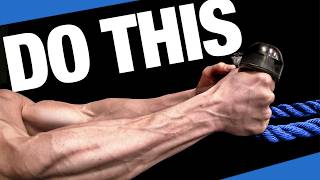
Grab the rope from underneath with thumbs up; palms down is wrong.
Elbows should be at 90 degrees at the top, like a double bicep flex, to set up the back muscles.
Avoid shrugging the traps; force shoulders down to open the chest and target the rotator cuff, rhomboids, and rear delts.
For neuromuscular re-education, pull back slowly, hold for 3-5 seconds, and return slowly.
For hypertrophy, use 8-12 reps with a deliberate pace, allowing a struggle at the end but stopping at form failure.
For a two-day split, do one corrective and one hypertrophy session; for three days, end with corrective; for five days, alternate.
Hypertrophy sessions: 2-3 sets to failure. Corrective sessions: 3-4 sets if once a week, 2 sets if twice, 1-2 sets if three times.
The face pull is a versatile exercise that can fix imbalances and build muscle, but only when performed with the right setup, grip, and tempo. By choosing between corrective and hypertrophy approaches and programming them appropriately, you can maximize its benefits.
Thumbs up grip
A simple grip change can shift the exercise from trap-dominant to targeting the weaker muscles.
01:42Neuromuscular re-education
Highlights an often-overlooked aspect of training that improves brain-muscle synchrony and reduces compensation.
03:52Quality over quantity
The idea of '15 sets of one high-quality rep' reframes how to approach corrective exercises.
04:27Hypertrophy variation
Shows how the same exercise can be adapted for muscle growth while maintaining form.
05:22Programming across splits
Provides concrete guidance on how to integrate face pulls into different training frequencies.
06:17[00:00] You just finished your workout, but what you do next is going to determine whether you have a great workout or just another missed opportunity. Maybe you stretch. It's a good thing, especially now, but not the thing.
[00:12] Or maybe grab some water. It's always good to rehydrate, but not necessarily, again, the most important thing. But maybe you'll even break out that foam roller and roll out that mid-bath of yours. Again, it has its place, but it shouldn't take the place of what I'm going to show you.
[00:25] And see what you could have done before you left that gym is prioritize an exercise that most people relegate to either laugh or not at all.
[00:37] And we're talking about the face pull. And this is one of those videos where knowing what to do is not nearly enough. Knowing how to do this exercise is going to make all the difference in the world. The tempo, when to do it, how to perform it. I'm going to show you how to do all of that guys.
[00:50] Make sure you stick around. Now it doesn't matter whether you're weight training two days a week, three days a week, or even five days a week, there's always room for face pulls. But it starts with knowing how to do the exercise.
[01:03] Because if there is one exercise that is more commonly misperformed than any other in the gym, it's the face pull. And when you do it wrong, you're actually training the wrong muscles. So there's a few things that you have to get straight. Number one, the rope.
[01:15] If you can get a long rope, this is around two feet in length. If you can get a long rope, it's a good investment because it's going to allow you to do the exercise properly. If you can't, what you have to do is set the machine up with two of the traditional ropes that you see at the gym and pull them all the way to the end.
[01:30] The reason why is going to allow you to get your elbows in the right position without having to force yourself into the wrong one. When we grab the rope, you don't grab face down. People do this all the time, palms down.
[01:42] Thumbs down means the wrong way. Thumbs up means the right way. What you do is you grab from underneath here, thumbs come up this way and that means you're going to do the exercise the right way. You step back arms are at arm length here so you can get the rope again positioned right around the level of the face So figure But when we come back now because the rope is long enough I can get my elbows out wide enough when the rope is short you cannot do that
[02:11] you are restricted in terms of how wide you can get the elbows out or at least the hands you can't get the hands far enough apart because the rope isn't long enough your hands can get in the right position which sets the elbows up in the right position what is the right position 90 degrees
[02:26] You should feel as if you're doing a double bicep flex at the top of the repetition here. And what this does is it sets up the muscles of the back in a prime position to actually
[02:38] do the work. When we do it with an overhand grip and we start pulling this way, the traps will definitely want to do most of the work. This is not a trap exercise, not for me at least, because you're missing one of the biggest benefits which is to train the rotator cuff, the rhomboids, the rear delts, the muscles
[02:53] that tend to be weaker and dominated anyway by the trap. So in this position, hands up, when I get to this wide position, now I want to make sure that I don't do the other thing again that I just referenced, which is to over involve the trap. A lot of people will do this as they
[03:09] pull and they shrug up their trap. You're going to take away the focus of the exercise when you do that. Don't do that. Force the shoulders down. And what that will do is allow you to get an open
[03:22] chest. It's impossible to get your chest open if you're slugged. You can try this yourself right now. I can't open my chest. The only way I can is by getting those shoulders down and opening the chest. Now, that's the way to do it properly. However, there's two ways to do the exercise.
[03:40] One can be done for the purpose of just building up muscle for hypertrophy, and the other is doing it as a neuromuscular re-education exercise. And that's a very overlooked aspect of any exercise in any programming.
[03:52] Neuromuscular reeducation allows you to get better synchrony between your brain, your muscles, your nerves. Everything can be working so that we can get less compensation in movement and get muscles that tend to be dominated by compensation to actually do the work that they supposed to do So when we do this this way we have to do it two ways
[04:12] Very slowly and very precisely. Neuromuscular reeducation for a faithful demands that I pull back slow. That I make sure that the traps are staying down. That I get them back in this position and I hold for about three to five seconds to
[04:27] make sure that I'm not shifting the load somewhere else. Come back slow. This is not about a race to the finish, this is about doing every repetition with high quality. I always say this is not one set to 12 or 15, this is 15 sets of one high quality repetition.
[04:43] Back, hold. Now you have the option here to not just stay statically in this isometric position, but I can actually dynamically move straight up overhead, which then involves the lower traps.
[04:55] postural muscle that tends to be weak and dominated by other muscle groups. I'm still getting that five second hold on just moving dynamically through that part of it so that isometrically those rhomboids, rear delts, rotator cuff are
[05:10] still having to hold me in that position. Now if I wanted to do this for more hypertrophy because this exercise is an amazing hypertrophy exercise for your rear delts to actually build up the rotator cuff which is not a bad thing.
[05:22] thing the more strength and the more high pressure you get there the more four to five your entire shoulder girdle is well then I could go slightly heavier I'm then using something around the eight to twelve rep range I'm still gonna do the same thing and I'm gonna come back and treat it like a regular
[05:36] repetition still a good deliberate pace still making sure to unshud the shoulders but when I get down towards the end of the set it's okay for it to look like this I get nice struggle I give it a breath and I come back and I
[05:49] And squeeze. And I can't do it anymore. But again, as always is the case when we talk about failure, you never want the rep to degenerate to the point where you don't even recognize what the hell you're doing anymore. It should still be a good high rep So we call that form failure You take it that way guys you can build up a great back with this exercise and again how we do it either way there both a purpose for each one and like i said it not just about knowing how to do the exercise but importantly when to do the
[06:17] exercise the right way we have both the corrective and the hypertrophy when we have that two day a week workout split where you're just training with weight twice i want to see one of them be done as a corrective and one as a hypertrophy focus the corrective i usually put at the end of
[06:32] week. If you are doing a three-day split, then again at the end of the week, corrective. And I like to say if we're going to have an odd number, do more corrective sessions to get that neuromuscular re-education. And then we have the hypertrophy session in the middle. And if we're doing that
[06:45] five-day a week split, we're working out five days with weights. Then again, we end with corrective. And we start here with hypertrophy. We do a corrective after that, hypertrophy after the day off, and then one more corrective again to keep the balance in favor of the corrective session.
[07:00] in terms of the sets that we want to do. The hypertrophy sessions going to failure should be in the two to three set range. So that's what you're going to do every time you see the hypertrophy programming. When we're looking for correctives, that should be variable.
[07:13] If you're only going to do this once a week, then I'd like to see three to four sets on that day. If you're doing it twice in the week, then we could do two sets here and two sets here, which again gives us that total set volume of four sets.
[07:27] And if you're going to do it here three times a week, that I like to see one to two, one to two, and one to two, which puts us at the low end of three sets and against the high end of six sets. Usually you can handle more of that workload
[07:39] because of the higher volume that you're accustomed to training to. Guys, if it's not just your rotator cuff and your upper back weakness that's suffering right now, and there's other things that are messing up here, like the fact that we're giving you something to do every day, make sure you watch this video over here
[07:51] on what to do every morning to make sure you feel a hell of a lot better than you do right now. If you're also screwing up the second most commonly screwed up exercise, the Bulgarian split squat, watch that video over there to make sure you're doing it right. Guys, full programs over at fns.com.
[08:03] I tell you how to do it right every single time, every single day. Alright guys, good luck. See you soon.

⚡ Saved you 0h 08m reading this? Transcribe any YouTube video for free — no signup needed.