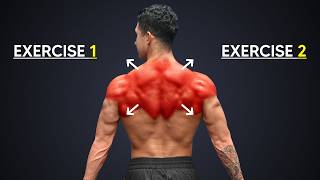

The #1 Mistake Killing Your Back Gains
43sReveals a common mistake that prevents back growth, which many viewers can relate to, sparking curiosity and engagement.
▶ Play Clip"The title promises two exercises for a thicker back, and the video delivers exactly that with detailed form guidance."
This video presents two key exercises for building a thicker, more defined back, focusing on the mid and upper back muscles. It explains proper form, common mistakes, and an advanced technique to maximize muscle growth.
The mid and lower traps, rhomboids, and teres muscles are responsible for back thickness. Each has a unique function often overlooked in typical back workouts.
Wide grip barbell or Pendlay rows demand a lot from the lower back and are challenging for those with longer torsos. Training lower back separately and isolating mid/upper back with a stabilized low-to-high row is more effective.
The sweet spot for the row is around 45 degrees (arrow shape). Elbows tucked hit lats; too high hits other muscles. Use a lat pulldown bar with wide grip, adjusting width so forearms line up behind hands when pulling.
Choose an angle where it feels like mostly back and a little up. If it feels like a shrug, you're too high. Lean back slightly to replicate a low pulley if needed, but lock your torso to avoid shrugging.
If your arms move but shoulders stay in place or roll forward, you're an arm puller. Focus on scapular retraction: open shoulder blades at start, then pull back and out with elbows.
Think of opening and pulling your chest towards the bar (like an inverted row) rather than pulling the bar to your chest. Motion should feel like a breast stroke.
Set an incline bench to 30 degrees, lay chest on it, hang arms down. Pull elbows back in arrow shape, keep forearms below elbows. Alternatively, use single-arm stance with bench angled up.
Targets rear delts and upper traps. Use a higher bench angle (60 degrees). Pull elbows flared out wider, in a reverse dip motion. You should feel tension higher in upper traps.
After failure on full reps, keep arms straight and focus on scapular retraction (for exercise 1) or shrugging (for exercise 2) for 4-5 reps to take back to true failure.
Do these two exercises for 3-4 sets of 8-12 reps once or twice a week. Don't forget back width (lats). The video promotes the Built with Science app for full programs.
By focusing on these two exercises with proper form and the isolation finisher technique, you can effectively build back thickness and definition. Consistency and mind-muscle connection are key.
What is the ideal arm path angle for the low-to-high row to target midback?
Around 45 degrees (arrow shape).
01:17
What grip should you use for the cable row to avoid wrist discomfort and better target midback?
A wide grip on a lat pulldown bar, slightly outside shoulder width.
01:33
How can you tell if you are an 'arm puller' during rows?
Your arms move but your shoulders stay in the same position or roll forward.
03:20
What is the main role of the mid traps and rhomboids?
Scapular retraction (pulling shoulder blades back and in towards the spine).
03:32
What bench angle is recommended for the dumbbell version of exercise 1?
30 degrees (2-3 notches up from bottom).
04:36
What bench angle is recommended for exercise 2 (upper back focus)?
60 degrees (2 notches down from top).
06:08
What is the bonus technique to take the back to true failure?
After failure on full reps, keep arms straight and focus on scapular retraction (exercise 1) or shrugging (exercise 2) for 4-5 reps.
07:26
How many sets and reps are recommended for these exercises?
3-4 sets of 8-12 reps, once or twice a week.
08:17
Optimal Arm Path
Provides a clear, actionable cue for targeting midback muscles effectively.
01:17Arm Pulling Mistake
Identifies a common error that limits back growth and offers a fix.
03:07Mind-Muscle Connection Cue
Offers a unique mental cue (pulling chest to bar) to improve form.
04:10Isolation Finisher Technique
Introduces an advanced method to maximize muscle fatigue and growth.
07:00[00:02] responsible for giving your back a thick, powerful look? But each one has a unique function that most people's back workouts overlook. I know because after years of doing the best back exercises, my back still look flat. But once I
[00:15] muscles, my back thickness and definition completely transformed. exercises you need to grow these muscles, plus an underrated technique
[00:27] that can help you build the kind of back most guys never achieve. The first exercise will focus on this area right here, the mated and lower traps, romboids, and terry's muscles. Usually, people will use wide grip barbell or
[00:39] penlay rows to target this area. Now, while these can build an impressive back, they demand a lot from your lower back to keep you stabilized. Plus, if you have a longer torso like me, the increased lever makes the movement more
[00:51] challenging to recover from, especially as it gets stronger. Nowadays, I've seen much better results by training my lower back separately and isolating my mid and upper back with a stabilized low to high row. Now, I'll show you this on cables
[01:04] first and then show you a version on dumbbells, but there's two things you need to get right with the setup. First is the arm path. If you do a row with your elbows tucked to your sides, you'll hit more of your lats. Go too high and
[01:17] you'll not only limit how far back you can pull, but you'll also start hitting exercise two. The sweet spot for this exercise is right around 45° or an arrow shape. Now, most people row using the Vgrip here. While this can work, it just
[01:33] quite like we want, and it can get really uncomfortable on your wrist, especially at the end position. A better option is a simple switch. Use a lat pull down bar and a wide grip. You want to grab it just slightly outside of
[01:47] grip is actually correct based on your body by paying attention to your forearms when you pull. If your forearms angle in, you'll want to go wider. If they angle out, go narrower. They should line up directly behind your hands as
[02:01] you pull. Next, you want to set up your pulling angle. And to hit the most back muscles at once, you'll want a row that goes from low to high. However, there's goes from low to high. However, there's a sweet spot. You should choose an angle
[02:14] where it feels like it's mostly back. I see. And just a little up. If it starts feeling like it's more of a shrug than it is pulling back, then then basically exercise. That's Coach Kassm, a biomechanics expert obsessed with
[02:27] finding the best way to trainish muscle. Now, his pulley was adjustable, so we angle. But if you're just using a standard pulley like me, you can replicate this by bracing your core and then leaning back slightly. You can see
[02:41] now how the pulling angle is as if the cable was set lower. You can quickly tell if you lean back too far if it starts to feel like more of a shrug rather than a row. Once you get that angle right, lock your torso and don't
[02:53] let it move. Then you'll want to avoid making the biggest mistake that'll stop most of the day, especially if you're slouched over, you're never really using your back muscles. And so, when you go to do a row where even if you try to use
[03:07] your back muscles, guess what takes over instead? Your arms. It's what I call the arm pulling mistake. I know because I was one of them. My biceps basically stole all my back gains until I learned how to actually use my back. Now, you
[03:20] can tell you're an arm puller if when you row, your arms are moving, but your shoulders are staying in the same position or they're actually rolling forward. Now, to fix this, you need to understand that the main role of the
[03:32] retraction, pulling your shoulder blade back and in towards your spine. And so, you want to let them open up fully at the start of each rep. Then, start the
[03:44] rep by thinking about pulling back and out with your elbows and then keep pulling back as far as you can. I've also found it helpful to actually watch not only move forward at the beginning of each rep, but actually move backwards
[03:58] as I pull the weight rather than staying in the same place and letting my arms do is rather than thinking about pulling the bar to your chest, think about opening and pulling your chest towards
[04:10] the bar as if you're doing an inverted row. The motion should almost feel like a breast stroke. And when done properly, you should feel your midback and some of your upper back muscles work it. But what if you don't have cables? Well,
[04:22] dumbbells, if you're smart about what exercises you do, you can still hit the approach that we take with our Built with Science Plus app, where if members whatever reason, one tap of a button,
[04:36] the same muscles. Now, in this case, you want to set an incline bench to about 30°, usually two to three notches up from the bottom. Lay your chest on it and hang your arms down. Notice how this now replicates the same low to high pull
[04:50] that we did on cables. From here, pull your elbows back in that arrow shape I mentioned earlier. Now, in this case, your arms might try to take over your back by bending your forearms in as you pull. Maintain tension in your back by
[05:02] keeping your forearms directly below your elbows. It can also be helpful if rather than thinking about pulling the weight, you think about pulling your chest through the bench. Now, if you have longer arms or you just find this
[05:14] awkward with your female pillows against the bench, you can do a single arm stance and supporting one hand on an angled up slightly to replicate that low to high pulling motion and then simply
[05:28] angled out. But although this first exercise is great for building thickness in your midback, we need exercise two to make sure your upper back muscles don't get left behind. mainly the rear delts and the upper fibers of the traps. When
[05:42] well developed, these muscles pop not just from the back but from the front as the mid traps and romboids are mainly responsible for retraction, the upper fibers of the traps lift the shoulder
[05:54] blades up in what's called elevation. So we still want to do a row, but one that involves more of an upward shrug motion. Now you could simply perform the cable steeper lean back. A better option though is to use the same bench and
[06:08] dumbbell setup from earlier, but this time use a higher angle. Around 60° is a sweet spot, which on most benches is two notches down from the very top position. Once you have that set, while standing, rest your chest on the bench and then
[06:21] pull your elbows back. But this time, keep them flared out wider than we did in exercise one. It's not quite an upright row. It's essentially a very low to high row with the elbows going up and slightly back. Basically, if you can
[06:35] imagine a reverse dip motion, that's exactly what we're going for. Now, if you do this properly, after you do a set and the blood starts flowing into your muscles, you should still feel this in your midback, but most of the pump and
[06:47] tension should be higher in your upper traps. Now, as for weight, if you use dumbbells for exercise one, you should be able to go about 10 to 15 lbs heavier here. But even with these two exercises, your back's not going to grow as fast as
[07:00] it could without the bonus technique that I promised from earlier. Here is exactly how it works. Your traps are not likely to be the thing that fails in that exercise. Your romboids are not likely to be the thing that fails in the
[07:12] other exercise. So, these are good candidates to finish with just the candidates to finish with just the elevation or just the retraction motion. For the first exercise, after you can't do any more full reps, rather than
[07:26] trying to bust out more reps by using your arms or momentum, take your back to true failure by keeping your arms straight and focusing on simply opening up your shoulder blades and then using your midback muscles to squeeze them
[07:39] at least four or five reps like this. And then for exercise two, you want to do the same thing, but this time focus more on shrugging the weight up using your upper traps. And it's probably going to feel natural to let the elbows
[07:53] flare a little bit on these, but as long as you're just emphasizing the shrug motion and not trying to really pull on the dumbbells, then whatever whatever elbow flexion happens is is fine. Now, I personally do this after every single
[08:05] set. But start out with just trying this on your last set or you could even do a fourth set where you focus just on this motion and then consider ramping it up from there. But guys, remember this video focuses on back thickness and
[08:17] definition. And if you do these two exercises for three to four sets of 8 to 12 reps once or twice a week, that's going to do the job. But you can't forget about back width, which is where the lats come in. And for the two best
[08:29] exercises to help you grow the lats, give this video a watch next. But if you need some more help and you want me to take care of all the guesswork for you for both your workouts and your nutrition, then try 2 weeks free of my
[08:41] new app over at builttoize.com. It's transformed thousands of people and I guarantee if you follow the plan, it'll work for you, too.



⚡ Saved you 0h 08m reading this? Transcribe any YouTube video for free — no signup needed.