
Why Fibonacci Betting Fails in Blackjack
45sDirectly challenges a popular betting strategy, sparking curiosity and debate among gamblers.
▶ Play Clip"The title promises a breakdown of the Fibonacci system, and the video delivers a thorough simulation and analysis, though it's padded with gameplay footage."
This video explores the Fibonacci betting sequence as applied to blackjack, contrasting it with other casino games. The host demonstrates why progressive betting systems are risky in blackjack, using a $1,000 bankroll and a $10 betting unit to simulate sessions. The video concludes with statistical insights from Michael Shackelford (Wizard of Odds) and a caution against using such systems.
The video discusses the Fibonacci betting sequence specifically for blackjack, noting it's different from other games like craps, roulette, or baccarat. The host explains why blackjack is a 'whole different animal' for progressive betting strategies.
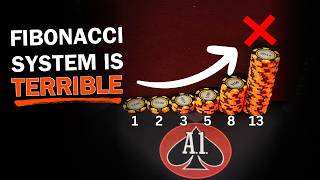
The Fibonacci sequence is a math sequence where each number is the sum of the previous two. It starts with 1, 1, but most users ignore the first 1, resulting in 1, 2, 3, 5, 8, etc. The host, a former math teacher, explains this clearly.
The host references Michael Shackelford from Wizard of Odds, who has run simulations on the Fibonacci system and explained why it works until it doesn't. This sets up the video's core analysis.
The goal is to win $100 or lose the entire $1,000 bankroll. The host assumes viewers interested in Fibonacci likely have a bankroll of $1,000 or less, making the strategy risky.
The host uses a $10 betting unit, multiplying Fibonacci numbers by 10 for bets. The system: lose → move forward one spot, win → move back two spots, similar to Martingale but with a twist.
The red line tracks cumulative losses. If a win occurs, the player moves back two spots to recoup losses. For example, after losing $190, winning $80 moves the bet to $30 to recover.
The host begins a real blackjack simulation, shuffling cards fairly and noting that blackjack requires extra bets for splits and doubles, which complicates progressive systems.
Blackjack requires splits and doubles, which increase bets beyond the system's plan. The host decides not to split or double, deviating from perfect basic strategy to stick to the system.
The host plays through hands, avoiding doubles and splits, and wins some hands, moving back to the beginning. The simulation shows the system working initially.
The host reaches $80 in profit, then $100, achieving the goal. The simulation shows the system can work when losing streaks are short.
Michael Shackelford's data: stop loss at 50 units → 91% success, 80 units → 94%, 13 → 96%, 21 → 97%, 34 → 98%. However, the 2-9% failure rate results in losing the entire $1,000.
The system wins 98% of the time but loses everything in the other 2%. This makes it a 'nine steps forward, ten steps back' situation, as the rare losses wipe out all gains.
The host resets and plays again, hitting a losing streak. Bets escalate to $210 and $340, risking over 20% of the bankroll, leading to a total loss.
The simulation ends with the bankroll going from $1,000 to zero. The host emphasizes that the 2% failure rate is inevitable and devastating, making progressive systems unviable.
The Fibonacci betting system can work in the short term but is fundamentally flawed due to the risk of catastrophic losses. The host strongly advises against using progressive betting systems like Fibonacci or Martingale, recommending card counting as a better alternative for blackjack players.
What is the Fibonacci sequence?
A math sequence where each number is the sum of the previous two, starting with 1, 1.
00:30
In the Fibonacci betting system, what happens after a win?
You move back two spots in the sequence.
03:02
What is the success rate if you stop at a bet of 80 units?
94% success rate.
15:43
Why is blackjack different for progressive betting systems?
Because splits and doubles require extra bets, deviating from the system.
05:05
What happens in the 2% failure rate of the Fibonacci system?
You lose your entire bankroll, e.g., $1,000.
16:00
Fibonacci Sequence Definition
Provides a clear, foundational explanation of the sequence used in the strategy.
00:30Progression Rules
Explains the core mechanics of the system, crucial for understanding its logic.
03:02Statistical Success Rates
Reveals the system's high success rate but highlights the devastating failure risk.
14:39System Failure Demonstration
Shows a real example of the system losing everything, proving the risk.
23:27[00:00] We're talking all about the Fibonacci betting sequence today, and we're going to show you how that applies to blackjack, as opposed to some of the other games where you've maybe heard of the Fibonacci sequence more, like in craps, or roulettes, or maybe even baccarat.
[00:13] Alright, and so because of that, we're going to show you why blackjack is a whole different animal when it comes to these specific kind of progressive betting strategies, and why you probably don't want to do them. And if you do, you definitely don't want to use blackjack as the means to your strategy.
[00:30] All right. That said, what is the Fibonacci sequence? As a former math teacher myself, it's a math sequence where you add the previous two digits to get the next one.
[00:42] Now, normally it starts out with 1, 1. However, when most people use it, they ignore the first one, which would be right here. and so if I take those, 1 plus 1 is 2 and then you use these two now
[00:54] 1 plus 2 is 3 2 plus 3 is 5 3 plus 5 is 8 and so on until forever, right? It goes on, it's an infinite series like that Okay, now there's a couple other numbers I'll talk about at the end
[01:07] They come from Michael Shackelford from Wizard of Odds He's run several simulations on this and he's talked about why exactly this works until it doesn't and we'll probably find that out here as well.
[01:21] But most people, when they use a Fibonacci sequence or even Martingale, you typically have a goal when you go to the casino. Let's say that our goal today is to win $100 or we're going to stop when we lose all of this.
[01:34] This is $1,000. I would imagine if you're someone who is interested in the Fibonacci betting sequence, you probably are not going to the casino with more than $1,000. because if you have more than that, you are definitely going to look at less risky ways to build your bankroll,
[01:50] and we're going to see pretty quick that this is a terrible idea. All right? That's it. Got $1,000 here for you. We have $400 in black, $500 in green, and then $100 in red, and we're going to use a $10 betting unit.
[02:04] That's going to be our first one. All these numbers, if you multiply them times 10, are going to be the bets that we play with, right? The way that it works, I'll use a coin here to kind of keep track, is if we bet the first one at $10 and we win, we obviously get $10.
[02:19] That's how blackjack works, right? If we lose, then I'm going to move this to the second one, and we'd have to bet $20. So, so far, it's the same as martingale, if you're familiar with the martingale betting system.
[02:33] You double your bets every time you lose. However, there's a couple differences, right? Let's say we're over here at the 80s. Lost one, two, three, four in a row. And I have $80 out there.
[02:47] Oops. Like this. Right. $75.80. And let's say that we win. All right. So we're going to get $80. Now, instead of going all the way back to the beginning, like in Martingale, we are going to actually go back two spots.
[03:02] So if you lose, you go forward one. If you win, you go back two spots. The reason for that is this next line here, the red line, says kind of what our cumulative loss has been.
[03:14] So if we lose once, that's $10. If we lose twice, now it's 10 plus 20, which is $30. If we lose three times, now that's 30 plus 30, which is 60, 110. And like in our example here, that's 190.
[03:28] All right, so let's say that we win this one. Well, 190, I only won 80. So if I go back two spots, now I'm playing with $30. All right. So now I can hopefully recoup that, you know, $190 plus $30.
[03:45] And that will help us get all the way back to the beginning. And if I win this one, I go back two more. All right. So we kind of go forward one spot if we lose and then backwards twice. If I were to win here, then I can't go back two spots.
[03:59] I'm just going to go back to the beginning. we start over until we reach our goal of $100 one or we lose it all which can happen a little bit quicker than you might think alright so I'm gonna reset
[04:11] this and then we'll get started all right I'll put this off to the side so you can still see there it's in frame I think let's see yeah I think that may be best we will burn a car actually play what just so you know this is fair let
[04:27] me take the first chunk and I'll shuffle these. Now those are shuffled, the order of the rest
[04:40] will be all messed up. I'm going to put these right at the beginning of the shoe here. Since I don't know what those are, there's no possible way for me to figure out what those cards
[04:53] darks, I'm not rigging this in any way, they are absolutely shuffled, okay? One thing that we do have to be a little bit conscious of is that, and this is why you probably don't want to use blackjack if you're using any progressive betting system, which
[05:05] please don't use it anyway, and that is, with blackjack, let's say we get pairs that need splits, well, instead of betting one unit, now we have to bet two units, and then if
[05:20] We get another of those things. I'll say it's like a pair of threes versus a deal or six. We get another three. Well, now all of a sudden we have three units out there. If that's a really big unit like in that $80 unit we were using before,
[05:32] that's $80, $160, $240. That is a lot of money out there just to try to recoup some losses. And so because of that, we really can't play perfect basic strategy. Instead of doing that, we're going to not split.
[05:46] We're going to not double down. We're not going to do anything that requires an extra bet on our part. We're only going to be playing the one unit or whatever unit is being asked of us at the time.
[05:59] If we get a blackjack, that's kind of bonus, right? Because we can alter the rules that the dealer has to play by However we can alter basic strategy and not play perfect basic strategy according to our betting system So we going to do that to
[06:14] kind of make up for the splits and doubles and things. We'll see kind of how it goes from there. All right, I got a burn card. We'll throw into the discard tray. Let's try it here. All right, so here's a great example of this first one. We can't double down here.
[06:30] now you I suppose since the very first one if you want to you could but I'm gonna stick to the rules that I came up with instead we're gonna treat this like a multi card 11 which is a 5 3 3 maybe where I'll just have to hit this okay
[06:46] now if you're yelling at me in the comments that's fine I don't care I'm just doing what I saw in mine and we'll see probably this sale pretty quick alright so we had 19 dealer has too many and so we won and so I don't have to
[07:00] move this at all because I'm back to the beginning. If I would have been further, remember I would have gone back two spots. I'm going to keep this here at the first one. Alright? We're currently up $10.
[07:12] Okay, next hand. I'll try to do less explaining because I think you probably get it here. Stand on $20. Dealer also has $20 up a push. For pushes, you just stay wherever you are. Again, if I was at
[07:24] the $30 bet, the next one would also be $30 because I didn't win or lose. stand on 17, dealer has 20, so we lost this, we're going to move forward one spot, and my next bet
[07:38] will be $20, okay, 8, going to hit, 10 is a hit,
[07:50] 13 you can stand, so we're playing a basic strategy for the rest of this, and if you're a card counter, don't, one, you're not going to be playing with the strategy, but two, you know, if there's a deviation, I guess you could use it.
[08:06] All right, so we lost there, so now we're going to move this forward one spot, 17 beats 13, and we need a $30 bet now.
[08:18] Let's do this, use the green. Okay, here's another one where I can't split this, again, because of my rules, and so I just have to hit. All right, so I have 8, and 18 can stand.
[08:33] Dealer has 7, 10, and 21. All right, so we lost $30 there. So I've got to move forward to the $50 bet, because 2 plus 3 is 5.
[08:46] Five times our unit of 10 is 50. Oh, man, another double down opportunity, but I just got to hit it.
[08:58] Okay, so you probably, that's the reason why you should double normally. That's 21. All right, and dealer would have had 20, so we could have ended up with plus 100,
[09:10] but instead we only get plus 50. All right, now we are still down money. um and because of that we have to go back two spots here it's now we're at the 20 bet
[09:25] 10 20. oh man another double opportunity but we hit it's so weird not to double that 11, stiller hits, 21, once more, dealer has 15, and too many.
[09:43] Okay, so now we are not going to go back two spots because I can't. I'm just going to go back to the beginning because that's here. And it looks like we are, let's see, that's one more.
[09:58] I'll do that so I know. And that's one short, I think, yeah. So we are up $20. Okay, so not to our goal yet of 100.
[10:12] 18. This can stand. Durer has 6, 10, 16, and 21. A five-card 21.
[10:24] Okay. Let's move that forward a spot. $20. $20. 20 is going to stand. Durer has 12, 15, 22.
[10:36] Okay, go backwards one spot. 21, blackjack.
[10:51] Win 15 there. Too bad it wasn't on a bigger bet. I don't think we are up money right now, but again, these systems usually work until they don't.
[11:03] stand dealer has 20 move this forward $20 no blackjack that is 13 still hit 22 too many
[11:21] dealer would have had a soft 17 see we lost moving forward $30 now there we go
[11:33] let's see you get 30 plus 15 nice black deck
[11:45] and go back two spots $10 bet so I think we're getting close looks like we are up $60 $60 15 is a hit
[12:01] and I stand on 18 dealer has 14 and too many I doing my math right stay in here at the first one Oh three Can split them Got a hit Now I can stand on 15
[12:21] Zero to 11. And 20. And move it forward. 20 bucks. 20 is going to stand.
[12:34] Should have checked for that first. Move it forward to 30. 17 can stand.
[12:47] Ooh, 19. $50. So we've been here twice. So 50, if you have, if you bring just $1,000, 50 is 1 20th of that, which is pretty substantial.
[13:00] So that's a lot of risk just by losing one, two in a row. 19 will stand. 11, uh oh 16
[13:13] Hey, there we go Is that right? Yeah There's our 50 Okay, now
[13:25] We're going back Two spots to 20 And another double we're not going to do 15 stand you're also 15 16 too many hey there we go back to the beginning
[13:45] probably close to our hundred here looks like we're at 80 dollars in profit okay so i'm going to be back at the beginning and betting ten dollars on this one
[14:00] Another double opportunity. Just going to hit. All right. 19 will stand. Healer has 15 and 20. There's $90.
[14:15] Okay. 19 will stand. 14 and 17. And there it is.
[14:27] So we won $100. You're probably thinking, wait a minute, I thought he was going to disprove the Fibonacci betting system. What is going on with that?
[14:39] There's our $25, $50, $75, $100. Why didn't he disprove this? And I'm actually going to flash up these numbers here on the screen, which kind of show you that if you put a limit on where you stop,
[14:56] All right, so that time we didn't have to put out an $80 bet, I don't think. I think the worst we got to was a $50 bet. We never lost more than one, I guess, one, two, two in a row was our worst losing streak,
[15:15] which is kind of rare if you've ever played black check. But Wizard of Odds, or Michael Shackelford there, has created a thing. If you make a stop loss where you stop and you go back to the beginning at 50,
[15:30] then, or maybe you just stop at all if you lose this many in a row, you're going to be a 91% success rate. If you stop when your bet is 80, or eight times your unit, whatever that is,
[15:43] it's a 94% success rate, 96 at 13, 97 at 21, and a 98% success rate at 34. Sounds really good until you realize what happens in those other 2, 3, 4, 6, 9% of the time.
[16:00] And that is when we would lose the $1,000. So if you work that out, you know, over time and you run simulations on it, which I'll maybe link a video of his at the end, you lose your butt real fast, right?
[16:17] Those $1,000. it's just going to kill your wins. So it's kind of a, you know, it might be nine steps forward, but ten steps back kind of situation if you kind of think of this as losing
[16:31] or winning nine times, and then the tenth time you lose $1,000. Nine times you win $100. It seems like it's going to get better and better the further that you go. However, you do get limited by bank rules or by table limits and things like that.
[16:47] So let's see if I can get an example where we do end up losing, and we will see kind of what happens there. All right. I'm going to reset this to our $1,000, and let's try it again.
[17:00] I might throw us into a hyperlapse until I can get a bad session for you, and we'll see exactly what happens during it.
[17:17] Thank you.
[17:47] Thank you.
[18:17] Thank you
[18:48] All right.
[19:15] I want to pause really quick in this one. we're currently we've lost not necessarily in a row but we've just kind of going back and forth we've lost one two three four five and we're in the sixth one in our progression here and that is
[19:27] a 210 dollar bet but remember if we started with a one thousand dollar bankroll if you will that is over 20 percent of its 21 plus you're currently down because of the previous losses so if i take
[19:42] take this back we're at 400 here 500 600 $720 so we have lost almost $300 and we're risking another 210 so that puts
[20:02] us at only if we lose this one that puts us at two three four five hundred and fifteen dollars left so looking a little bleak right here but we'll try it
[20:20] Just like that we need to put out a $340 bet which a lot of you would probably be really
[20:35] scared to do. I'll hit myself and prove it. So that's 200, 300, 25, 30, 35, 40.
[20:49] is where this system fails right we lose this we are toast we cannot recoup our losses oh and we were supposed to double as well just have to hit this 20 that's not bad dealer has 7
[21:07] 16 and also 20 oh no so that's a push i'm feeling pretty good about that 20. Let's see what they give us this time. 17 versus a dealer's 10. That's a stand. Oh! And just like that. No. Good.
[21:28] Run out of spots to put away chips. Alright. So, unfortunately, we can't go back two spots. We can't go ahead the next spot. all we have left here this is why a lot of percentages of blackjack are way
[21:44] worse than the house edge. House edge is if you play perfect basic strategy flat betting all right we are not flat betting and we're not playing perfect basic strategy because we can't split or double. Let's see we have 150, 60,
[22:01] $170 and we got a better at all here so that would be more in kind of this range so instead of going forward one we actually go back kind of one and a half
[22:13] all right nine all right no blackjack 19 okay maybe we can make a run out of here 15 hey there we go we did win a little bit okay remember we were here let's see
[22:40] if we have enough this was 340 the next that would be 550 which we probably do not have
[22:54] we have $340 so we have exactly this amount which lets you bet it since that's kind of where we are on the chart so yeah you kind of if you
[23:11] bring a bankroll you get a little bit ambiguous as to where you're at in your chart here. I'm liking a 10. 17, okay. Oops, I hit that stand. Dealer has 8, 10, oh, and 18.
[23:27] So you went from $1,000 to zero. And again, this chart that I have here, if I kind of pull these away, the likelihood of that happening, it sounds like it's not that bad, right? Because
[23:43] we would have capped our bets. We got to 34, right? And then we kind of got back to the beginning or back two spots or whatever, which we sort of did. And it's likely that 98% of the time you win,
[23:56] but those other 2% were losing everything that we have, and we just happened to get on one of those. So the goal here, depending on what your goal is,
[24:08] this is reached that many times. Again, I'll let Michael Shackelford explain that in this video right here. You can check that out. Otherwise, please don't use Martingale, don't use Sibonacci, or any progressive betting systems. If you really want to play, you can learn how to count cards at this video.
⚡ Saved you 0h 24m reading this? Transcribe any YouTube video for free — no signup needed.