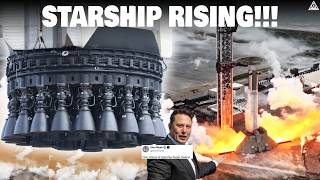

Musk's Booster 20 Static Fire: 33 Engines, 24 Seconds!
60sThe raw power and record-breaking duration of the static fire, with Elon Musk's praise, is visually and conceptually explosive, perfect for hooking viewers.
▶ Play Clip"Delivers on the promise of covering both events, but the title overhypes with 'something no rocket ever done' when it's a static fire."
This video covers two major events in the space industry: SpaceX's successful static fire of Super Heavy Booster 20, the longest ever for a version 3 booster, and China's first-ever recovery of a rocket booster using a cable net capture system. The video also previews the upcoming Starship Flight 13, which will attempt an in-space engine relight, a critical step for future missions.
SpaceX's Super Heavy Booster 20 completed its biggest test before Starship Flight 13, with all 33 Raptor 3 engines firing for about 24 seconds, producing over 9,200 metric tons of thrust. Elon Musk praised the flawless execution.
The static fire took place at Starbase, Texas, on July 10th. The engines produced massive flames and smoke, shaking the ground. Aerial footage showed the scale of the test.
Booster 20's static fire lasted about 24 seconds, compared to Booster 19's 14 seconds. The extra 10 seconds increased heat, vibration, and stress on components, making it the longest static fire for a version 3 Super Heavy.
SpaceX reused at least four Raptor engines (57, 73, 87, 91) from Booster 19's initial test set on Booster 20, demonstrating hardware reuse during development, not just after flight.
There was speculation that Booster 20 might not need to roll back to Mega Bay after the static fire due to its completeness, but a road closure notice indicated it would return for final inspections.
FAA NOTAMs include reentry and splashdown warnings for Flight 13, with July 15th as the likely launch date. Next steps include stacking Ship 40 on Booster 20.
China's Long March 10B launched on July 10th, and its first stage was recovered using a cable net capture system on the vessel Ling Heng Jia. This was the first successful recovery of a heavy booster for this rocket family on its first flight.
The cable net recovery concept was originally developed by Professor Dokier Semenov's company, with public materials available years before China's demonstration. This raises questions about independent development vs. inspiration.
SpaceX has recovered boosters over a hundred times, making landings routine. The gap between a single successful catch and weekly landings is vast, requiring years of failures and fixes.
Flight 13 will attempt an in-space engine relight of a single Raptor 3 during the coast phase. This is critical for future missions, enabling deorbit burns and landing burns.
In space, propellant sloshes, making it hard to know if the intake is pulling liquid or gas. An ullage burn is needed to settle propellant before the main engine lights.
SpaceX's Booster 20 static fire and China's cable net recovery mark significant milestones in reusable rocketry. Flight 13's in-space relight will be a crucial test for future deep space missions.
How long did Booster 20's static fire last?
About 24 seconds.
02:33
What is the thrust produced by Booster 20's 33 Raptor 3 engines?
Over 9,200 metric tons of thrust.
01:49
Which four Raptor engines were reused from Booster 19 on Booster 20?
Raptor 57, 73, 87, and 91.
04:08
What is the purpose of an ullage burn?
To create a brief acceleration that settles propellant at the tank bottom before the main engine lights.
11:27
What is the target launch date for Starship Flight 13?
July 15th.
06:53
What recovery system did China use for its Long March 10B booster?
A cable net capture system on the vessel Ling Heng Jia.
07:50
Why is in-space engine relight challenging?
Because propellant sloshes in microgravity, making it uncertain if the intake pulls liquid or gas.
11:11
Longest Static Fire for V3 Super Heavy
Demonstrates the booster's maturity and readiness for flight.
02:33Engine Reuse During Development
Shows SpaceX's philosophy of reusing hardware even before flight.
04:08China's First Cable Net Recovery
A historic first for China's reusable rocket program.
07:50In-Space Relight as Critical Milestone
Essential for future missions to the Moon and Mars.
10:02[00:09] SpaceX's Super Heavy Booster 20 has just completed its biggest test before Starship flight 13. It was such a massive success that even Elon Musk had to praise the flawless execution. And here's the crazy part. Just hours
[00:23] earlier, China successfully recovered one of its rocket boosters over the ocean for the very first time using a never-before-seen cable net capture system. So, which one deserves your attention the most? Let's dive in.
[00:37] the day the entire Starship community had been waiting for a very long time has arrived. At around 9:00 a.m. Texas time on July 10th, all eyes at Starbase were on Booster 20. The countdown began. 3 2 1 boom!
[00:53] All 33 Raptor 3 engines erupted into life at the same instant. In a split second, twin rivers of orange fire blasted through both sides of the flame trench, while thousands of tons of supercooled liquid oxygen and methane
[01:06] turned into enormous white clouds that completely swallowed the base of the ground, you could barely even see the launch tower one anymore, just fire, smoke, and a deafening roar so powerful that people at Starbase said they could
[01:22] actually feel the ground shaking beneath their feet. But my favorite view came later when SpaceX released the aerial footage. From above, you finally get a real sense of just how insane this test actually was. It was so impressive that
[01:35] even Elon Musk posted, "Anyone can visit the Starship factory and launch site in Texas, as it is right next to the public highway. It is incredibly inspiring to see." Although, don't take that too literally. During launch operations, the
[01:49] won't be wandering around anywhere near the site. Booster 20 stood perfectly still on the launch mount, While underneath it, all 33 Raptor engines roared to life, producing over 9,200 metric tons of thrust, roughly
[02:05] equivalent to the full lift-off power of a fully fueled Super Heavy. To put that into perspective, that's enough force to hurl a 70-m tall multi-thousand ton vehicle straight into the sky if Mechazilla's massive clamps weren't
[02:19] holding it firmly in place. And here's the really crazy part. SpaceX didn't just fire those engines for a few seconds. They held all 33 Raptors at full power for roughly 24 seconds. That might not sound long until you compare
[02:33] it to Booster 19, the first version 3 Super Heavy, which only managed about 14 seconds in its full 33-engine static fire. Those extra 10 seconds mean dramatically more heat, dramatically more vibration, and dramatically more
[02:47] stress on every single component, from the Raptor 3 engines and propellant plumbing, all the way down to the launch mount itself. This wasn't just the longest static fire ever performed by a version 3 Super Heavy. It was the
[03:00] strongest evidence yet that SpaceX has turned Booster 20 into a far more mature, battle-tested vehicle, one that's ready to finish what Booster 19 started, a clean, controlled splashdown in the Gulf. Speaking of Booster 19,
[03:15] you'll probably remember just how cautious SpaceX was with the very first version 3 Super Heavy. Instead of rolling it out with all 33 Raptor 3 engines, they started with just 10. Those engines weren't there to qualify
[03:28] the booster for flight. They were there to qualify everything else, the propellant system, the plumbing, the structure, and even the brand new launch pad itself. Then came the static fire, and a few of those engines didn't
[03:41] perform exactly the way SpaceX wanted. So, what did they do? Believe it or not, they pulled every single one of those 10 engines off the booster. Yep, all of them. Then they installed an entirely different set of 33
[03:54] flight-ready Raptors, performed a full duration static fire, and eventually launched Booster 19 on flight 12. Now, here's the part I absolutely love. SpaceX didn't throw those original engines away, not even close. At least
[04:08] engines away, not even close. At least four of them, Raptor 57, 73, 87, and 91, have now found a new home on Booster 20. To me, that's SpaceX in its purest form. They're not just trying to reuse rockets after launch. They're already reusing
[04:23] hardware during development, long before the rocket has ever left the ground. But, wait. The story gets even more interesting. Even before Booster 20 lit up the pad, Starship fans were already debating one question. Could this become
[04:37] the first Super Heavy that doesn't have to roll back to Mega Bay after its static fire? Sounds like an odd question, but there was actually a pretty good reason behind it. A lot of people noticed that Booster 20 looked
[04:49] far more complete than Booster 19 ever did at this stage. The chines along the vehicle had already been fully closed out. The temporary wiring bundles that were clearly visible on Booster 19 were almost completely gone. Then Ryan
[05:03] Hansen, one of the community's sharpest Starship trackers, spotted something even more interesting. The main wiring harness near the base of the booster now appears to disconnect underneath the chines, potentially allowing technicians
[05:16] to remove it right there on the launch pad. And suddenly everyone started thinking, wait a second, if Booster 20 is already this complete, maybe SpaceX doesn't need to send it back to Mega Bay at all. Honestly, I thought the same
[05:29] thing. If Booster 20 could stay at pad two after its static fire, SpaceX would eliminate an entire rollout and an entire rollback. That might not sound like much, but when you're moving a stainless steel giant that's nearly 70 m
[05:43] tall, cutting out just two transportation operations could save days of preparation, less work, less time, more launches. That's exactly the future SpaceX is trying to build, but this time it looks like the community
[05:57] may have gotten a little ahead of itself. Not long after the static fire wrapped up, Starbase posted a brand new road closure notice. The description was incredibly simple. Pad to production. Scheduled to begin during the early
[06:11] hours of July 11th. And if you've followed Starbase for any length of time, you already know what that usually means. Booster 20 is most likely heading back to Mega Bay 1 for its final inspections before returning to the pad
[06:24] for flight 13. And honestly, that isn't bad news at all. After putting all 33 Raptor 3 engines through the longest static fire ever performed by a version 3 Super Heavy, bringing the booster back for one final health check is exactly
[06:39] what you'd expect. Once those final inspections are complete, the next big milestone will be stacking Ship 40 on top of Booster 20, followed by the final launch preparations. And based on the latest FAA NOTAMs, which now include
[06:53] atmospheric reentry and splashdown warnings for Starship flight 13's upper stage, July 15th is looking more and more like the target launch date. So, are you ready for flight 13? If you are, let me know by dropping go 13 down in
[07:08] miss everything that's about to happen over the next few days, be sure to hit that subscribe button. Trust me, the most exciting part of this story is only just beginning. But before we dive into flight 13 and the major milestones
[07:23] SpaceX is about to attempt, let's head over to China first. Because what happened there could have a real impact on the future competition in reusable rockets. On July 10th, just a few hours before SpaceX lit up Booster 20 for its
[07:37] record-breaking static fire, China successfully launched its brand new Long March 10B from the Wenchang Space Launch Site on Hainan Island. The upper stage placed its payload into the planned orbit, but that wasn't what everyone was
[07:50] watching. About 6 minutes after stage separation, the first stage booster flipped around, performed a controlled descent, and dropped straight into a giant cable net stretched across the deck of the recovery vessel Ling Heng
[08:02] deck of the recovery vessel Ling Heng Jia waiting out at sea. No landing legs, no catch tower, just a pair of hooks mounted to the booster, a network of tension steel cables, and a descent precise enough for both to meet at
[08:14] exactly the right moment. It's the first time in history a rocket booster has been recovered using a cable net capture system. And remarkably, it's also the first successful recovery of a heavy booster for this rocket family on its
[08:26] very first flight. Pretty impressive, right? Well, yes. know. This isn't actually a concept that originated with China's space program, nor is it as unique as SpaceX's
[08:39] Mechazilla catch system. A few months ago, Professor Dokier Semenov reached out to our channel by email explaining that this cable-based recovery concept was originally developed by his company. Along with his
[08:52] message, he shared a collection of 3D renderings and concept videos showing an almost identical idea, materials that had been publicly available online years before China's recent demonstration. So, that naturally raises an interesting
[09:06] question. Did Chinese engineers independently arrive at the same solution, or were those publicly available concepts part of the inspiration? But if the similarities are more than just coincidence, the speed at
[09:19] which this concept went from old renderings to a real-world demonstration would be nothing short of astonishing. Yeah, China caught one booster once. But SpaceX has done it over a hundred times, and at this point a Falcon 9
[09:34] landing barely makes the news anymore. It's just Tuesday. The gap between we caught it and we do this every week at scale isn't something you can close by borrowing someone else's concept. That kind of reliability only comes from
[09:47] years of failures, fixes, and doing it again. You can copy an idea. You can't copy the reps. Now, speaking of rockets doing things for the first time, let's talk about what SpaceX is about to attempt with flight 13.
[10:02] Because one of the most important moments in this mission sounds almost They're going to light a single engine in space, let it burn for a few seconds, then shut it off. That's it. It sounds like turning on your gas stove and
[10:16] flicking it back off. But, this is exactly what SpaceX couldn't do on flight 12 back in May. And if they pull it off on flight 13, that single Raptor 3 igniting in the silence of deep space could be one of the most important
[10:29] moments in SpaceX's entire history. On the road to the moon and eventually Mars. Ship 40 will fly suborbital, meaning it won't reach orbit. It climbs high, builds speed, re-enters, and splashes down in the Indian Ocean. The
[10:44] whole trip takes about an hour. But, during a specific window called the coast phase, where the ship is just drifting through space with no engines firing, like a ball at the peak of its arc, SpaceX is going to try firing up a
[10:57] single sea level Raptor 3, hold the burn for a few seconds, then cut it clean. This is called an in-space engine relight. And to understand why it's so hard, you need to understand one key thing about operating in space. On the
[11:11] ground, gravity keeps your propellant settled. Liquid methane and LOX sink to the bottom of the tank, and the intake always has fluid to pull from. In space, freely. What engineers call propellant slosh.
[11:27] You have no idea if your intake is pulling liquid or or bubble. The fix is an ullage burn, firing small thrusters to create a brief acceleration, pushing liquids toward the tank bottom before the main engine lights. Simple in
[11:40] concept, brutally complex in microgravity. And flight 13 needs to get it right for the first time with Raptor 3. Because once they can light a Raptor in space on demand, everything else unlocks. The deorbit burn, reentry, the
[11:54] landing burn back at the tower. Every single step of a real operational mission starts from that that one capability. Flight 13 is where Raptor 3 for today. Thanks for sticking around.
[12:08] If you want to see more on flight 13 or China's net catch system, make sure to subscribe because that video is coming very soon.



⚡ Saved you 0h 12m reading this? Transcribe any YouTube video for free — no signup needed.