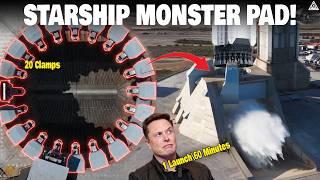

Starship Launch Every 60 Minutes?
44sThe bold claim of launching Starship every 60 minutes challenges current turnaround records and sparks curiosity about how it's possible.
▶ Play Clip"Delivers solid engineering detail on the pad's systems, but the title's '20 Clamps' is never mentioned and the 'sci-fi tech' framing oversells."
This video explores the engineering behind SpaceX's Starbase launch pad, designed to support rapid Starship reusability with a goal of 60-minute turnaround. It explains the concept of 'stage zero' and the critical systems—chopsticks, launch mount, quick disconnects, and water deluge—that must work flawlessly and be rapidly repairable.
SpaceX aims to launch Starship every 60 minutes, a stark contrast to Falcon 9's best turnaround of ~45 hours at SLC-40. This requires rethinking the entire launch pad process.
The critical path is the longest sequence of dependent events. The launch rate is limited by the slowest component, not the fastest. SpaceX calls its ground infrastructure 'stage zero' because it's the first stage of the launch process.
The chopsticks stack and catch the booster, the launch mount holds the vehicle, quick disconnect arms feed propellant and data, and the water deluge system absorbs acoustic energy. Moving complexity to the ground saves weight on the booster.
A link in the chopsticks drive chain jammed after a static fire test. The team replaced it in 30-36 hours by pulling hardware from Cape Canaveral. This highlights the need for rapid repairability, not indestructibility.
The hold-down arms secure thousands of tons of propellant and rocket, then release simultaneously. SpaceX didn't have a test article heavy enough to simulate a fully fueled Starship, so every launch tests the pad. Release timing is critical to avoid asymmetric loads.
QDs handle LOX, methane, vent lines, purge systems, power, and data. They must work under cryogenic temperatures and ice formation. A tiny jiggle in the QD arm triggered sensitive hydraulic sensors, aborting a launch. SpaceX welded a hard stop bumper to eliminate the movement rather than widening software limits.
The flame diverter redirects supersonic exhaust. SpaceX uses ~650,000 gallons of water, nearly an Olympic pool, delivered in about a minute. Instead of a giant pump, they use methalox gas generators (nicknamed 'baby Raptors') to pressurize tanks, turning them into giant spray cans. Main water lines are 48-60 inches in diameter.
SpaceX's Starbase pad is a revolutionary piece of engineering that treats the launch pad as part of the vehicle. Its design prioritizes rapid identification and replacement of failed components over sheer durability, enabling the ambitious goal of rapid reusability.
What is the critical path in the context of launch turnaround?
The longest set of sequential events that are gated by each other and must be completed for a task to happen. The launch rate is limited by the slowest component.
01:22
Why does SpaceX call its ground infrastructure 'stage zero'?
Because it is literally the first stage of the launch process, handling integration, catching, and all pad operations.
02:04
What was the best Falcon 9 turnaround time at SLC-40?
Around 45 hours.
00:30
How did SpaceX fix the drive chain failure?
They pulled replacement hardware from Cape Canaveral, brought in three cranes, removed the damaged chain, and installed a new one, taking 30-36 hours.
04:07
What is the purpose of the water deluge system?
To absorb acoustic energy and protect the pad and rocket from the exhaust of 33 Raptor engines.
02:45
How does SpaceX pressurize the water deluge system?
Using small methalox gas generators that produce high-pressure gas to pressurize storage tanks, turning them into giant pressurized spray cans.
11:11
What happened when the QD arm jiggled during a launch attempt?
The hydraulic sensors detected motion outside tight bounds and aborted the countdown. SpaceX later welded a hard stop bumper to eliminate the movement.
07:08
Critical Path Concept
Explains why launch rate is limited by the slowest component, a fundamental principle in systems engineering.
01:22Stage Zero Definition
Reframes the launch pad as an integral part of the rocket, a novel perspective in aerospace.
02:04Rapid Repair in Action
Demonstrates SpaceX's philosophy of designing for quick replacement rather than indestructibility.
04:07Automation Abort
Shows how sensitive sensors can catch tiny anomalies that might indicate larger problems, and the clever fix of eliminating the cause.
07:08Baby Raptors Water System
Reveals an innovative use of gas generators to pressurize water tanks, avoiding the need for a giant pump.
11:11[00:02] indefinitely. >> That might be the craziest claim you've ever heard from a SpaceX engineer. A Falcon 9 pad still needs nearly two full days to turn around. So, how the hell is SpaceX planning to launch a Starship
[00:16] every 60 minutes? In this episode, we're diving deep into the insane engineering behind Starbase's launch pad, and why it was built to do something no rocket complex has ever achieved before. Let's get into it. After a Starship launch,
[00:30] that pad gets absolutely hammered. Extreme heat, shock waves, and the raw power of 33 screaming Raptor engines. Even with Falcon 9, which already holds the world record for the fastest turnaround, the best they've achieved at
[00:44] turnaround, the best they've achieved at SLC-40 is still around 45 hours. The process is the same. Engineers have to inspect every inch for damage, roll in a new vehicle, reconnect all the ground systems, load thousands of tons of
[00:57] systems, load thousands of tons of propellant, run full checks, and only then can they launch again. So, if SpaceX is truly serious about cutting that down to just 1 hour for Starship, they didn't just improve the process,
[01:10] they completely rethought it from the ground up. And that's exactly why Starbase's launch pad could end up being just as revolutionary as Starship itself. So, how did SpaceX design a launch pad capable of something like
[01:22] this? To answer that, we first need to understand one key idea. >> And what the critical path is is the longest set of sequential events that are gated by each other that must be completed in order for a task to happen.
[01:37] >> What does that actually mean? It means every step we just talked about has to happen in a specific order, one after another. If even one part of that chain takes longer than expected, the entire turnaround takes longer with it. A
[01:50] just a few hours after landing, but if the launch pad needs 2 weeks to recover, inspect, and reset, none of that matters. The launch rate is never determined by the fastest part of the system. It's always limited by the
[02:04] slowest one. And that's exactly why SpaceX refers to its entire ground SpaceX refers to its entire ground infrastructure as stage zero. >> I mean, the integration mechanism is the pad. The catch mechanism is the pad. All
[02:17] the pad operates. And so, the reason we call it stage zero is is literally it is the first stage of the launch process. >> And this is how stage zero works. The chopsticks stack Starship on top of Super Heavy and later catch the booster
[02:31] when it returns. The launch mount holds everything in place during countdown. Quick disconnect arms feed propellant, gases, electrical power, and data into the vehicle right up until lift off. And the water deluge system floods the pad
[02:45] with hundreds of thousands of liters of water in seconds, absorbing the acoustic energy from 33 Raptor engines firing simultaneously, protecting both the rocket and the pad itself. SpaceX deliberately moved part of the rocket's
[02:59] complexity onto the ground. Super Heavy doesn't have to carry enormous landing legs anymore. Every kilogram of hardware removed from the booster is another kilogram that doesn't have to be lifted into space and hauled all the way back
[03:12] on every single flight. It's a brilliant solution, but that brilliance comes at a price. The launch pad is no longer just a slab of reinforced concrete. It has become part of the launch vehicle itself. Those two massive arms ride on a
[03:26] carriage that travels up and down the full height of the tower. And that carriage doesn't move on hydraulics or electric motors alone. It's driven by a chain, one of the largest drive chains ever built, running the entire length of
[03:39] the tower. And it means that every single component of stage zero, not just launch day. >> And when I say roller, it's literally bicycle chain. It's built almost exactly like a bike chain except for it's 380 lb
[03:52] >> After one static fire test, a link in the chopsticks drive chain jammed and eventually failed. Starship could have been perfectly healthy. The engines could have been loaded, but if the carriage couldn't move, SpaceX couldn't
[04:07] continue its integration operations. The team immediately called Cape Canaveral, pulled replacement hardware that had been set aside for future launch towers, rushed it to Starbase, brought in three cranes, removed the damaged chain, and
[04:21] installed a new one. From discovering the problem to having the system fully operational again, took only about 30 to 36 hours. That's incredibly fast. But if your goal is a 60-minute turnaround, even that isn't fast enough. A rapidly
[04:36] reusable launch pad doesn't have to be indestructible. In fact, no machine that repeatedly endures the violence of a Starship launch ever could be. Instead, it has to let engineers quickly identify what failed, reach it, replace it, and
[04:50] get the entire system back online as fast as possible. Once Starship has been stacked, the launch mount takes over. It's the hold-down arms, not the chopsticks, that secure the entire vehicle before launch. It sounds like a
[05:04] simple job. In reality, it's one of the most demanding tasks on the pad. These arms must hold thousands of tons completely motionless, then release all of that force almost simultaneously at precisely the right moment.
[05:17] >> These things were holding like 5,000 [music] tons of propellant plus the rocket weight. And it's like, "Okay, well, why didn't you guys simulate much." >> That's right. SpaceX simply didn't have
[05:30] any test article heavy enough to fully replicate a fully fueled Starship. So, every launch also became a test of the launch pad itself. The hold-down arms don't just have to be incredibly strong. They also have to let go perfectly.
[05:44] Release too early, before the engines have fully stabilized, and you've got a problem. Release even one arm a fraction of a second later than the others and the booster could experience dangerous asymmetric loads. Holding up thousands
[05:57] of tons is difficult. Letting go of thousands of tons at exactly the right moment is even harder. Next, stage zero has to transform itself into the biggest fueling station you've ever seen. The ship quick disconnect or ship QD
[06:13] connects to the upper stage. The booster quick disconnects or BQDs service super heavy through the launch mount. But calling them fuel lines is a bit like calling a smartphone a pocket calculator. Technically true, but it
[06:26] leaves out almost everything that makes them remarkable. These QDs have to handle liquid oxygen, liquid methane, vent lines, drain lines, purge systems, electrical power, and high-speed data connections. They have to keep working
[06:41] while metal contracts under cryogenic temperatures, ice forms around the mechanisms, and pressure changes race through dozens of lines. Then, after disconnect from the vehicle in the final seconds before lift off.
[06:55] As SpaceX puts it, >> Mechanical systems really come alive in >> And here's what actually happened during one launch attempt. >> So, as we retracted that pin, the arm wanted to shove closer into the tower.
[07:08] jiggle back and forth very slightly. That jiggle set off some really tight, sensitive bounds that we had on the hydraulic system out there and you needed to work or else or else rocket doesn't fly, so.
[07:21] >> The QD arm is pressed tightly against Starship using preload, making sure the connection stays perfectly secure. Just before launch, a locking pin is pulled, allowing the arm to swing away. But the moment that pin came out, the force
[07:34] stored inside the mechanism caused the tip of the QD arm to shake ever so slightly. To the human eye, it looked like nothing more than a tiny twitch. The hydraulic sensors saw something very different. They detected motion outside
[07:47] stopped the countdown. This is automation at its best. A smart the green light. It's one that knows when a tiny movement could be warning you about a much bigger problem. >> When we see an unexpected response, how
[08:02] explain that such that we're not unknowingly walking into an actual >> SpaceX never wanted to look at an unexpected signal and simply say, "It's probably fine." They wanted to understand exactly why it
[08:16] happened because sometimes a tiny anomaly is only the visible symptom of a much larger issue. Their solution was just as clever. Instead of simply widening the software limits so the system wouldn't abort next time, they
[08:29] welded a hard stop bumper onto the QD arm, physically limiting its movement when the locking pin was removed. They didn't silence the sensors. They eliminated the reason the sensors had something to complain about. The ship QD
[08:41] also has another critical job. It has to get out of the way fast enough. >> As we unpin that arm so that the QD can swing away and not blow itself up as the >> If it disconnects too early, it can't finish supplying the vehicle. If it
[08:55] disconnects too late, the rising Starship or the violent airflow surrounding it could destroy the entire mechanism. The chopsticks also have to be safely retracted before lift-off. The rocket isn't responsible for avoiding
[09:08] the launch tower. The launch tower has to clear the rocket's path. Then all 33 Raptor engines prepare to ignite. And at that moment, stage zero faces something disaster.
[09:22] this energy that is just absolutely trying to obliterate our pad. We want to give it a thing to obliterate to keep from obliterating the things give it is water. >> Instead of trying to resist that
[09:35] incredible force directly, SpaceX deliberately gives the exhaust something water. >> It's like imagine you had the world's of shooting bullets, it was shooting pickup trucks, and it's just firing 11
[09:47] bottom of the rocket. It's like >> That's why the flame diverter isn't just dealing with fire. It's controlling a supersonic exhaust stream carrying enormous heat, pressure, and momentum. >> A flame diverter is like a super simple
[10:00] concept that is like not at all complicated in operation, and it's just absolutely murderous in the details. >> The basic idea is simple. Take the exhaust blasting straight down and redirect it out both sides. But, making
[10:13] that work over and over again without destroying the pad is where every tiny engineering detail becomes absolutely brutal. The flame diverter has to survive extreme thermal shock, violent vibrations, intense acoustic loads,
[10:28] constant erosion, and repeated heating and cooling cycles. The water has to be distributed evenly enough that no dry spots ever form. The welds have to stay protected. Steam and hot gases can't be allowed to find their way into bunkers,
[10:41] pipelines, or structural gaps. Because if even one small area loses its water coverage, it can quickly turn into a hot spot. And when all 33 Raptor engines are firing at once, a small hot spot can become a very expensive repair bill.
[10:56] we're sitting somewhere in the neighborhood of about 650,000 gallons >> That's nearly enough water to fill an Olympic-sized swimming pool in about a minute. But, how do you move that much water almost instantly? The answer isn't
[11:11] simply building the world's biggest water pump. Independent analyses of the hardware at Starbase suggest that SpaceX uses small methalox gas generators to produce high-pressure gas on demand. That gas then pressurizes massive
[11:25] storage tanks, forcing the water out at an incredible rate. In other words, instead of relying on one enormous pump to spin up from zero, SpaceX essentially turns the entire water tank into a giant pressurized spray can. Among fans, those
[11:40] pressure generators have even earned the nickname baby Raptors. The entire system is divided into multiple circuits serving the flame diverter, the apex region, and the water-cooled launch deck. Some of the main water lines are
[11:53] believed to measure 48 to 60 inches in diameter. Those enormous pipes aren't just for show. Think about putting your thumb over a garden hose. Now scale that up to hundreds of thousands of gallons per minute. If the pipes are too small,
[12:07] turbulence and pressure loss become an engineering nightmare fast.


⚡ Saved you 0h 12m reading this? Transcribe any YouTube video for free — no signup needed.